.svg)

What to Look for in an Addiction Recovery Coach Near Me

Key Takeaways
- Treat the first conversation as a vetting interview—ask who trained the coach, who supervises them, what their scope allows, and how they handle crises at 2 a.m.
- A recovery coach is a nonclinical peer who helps with structure, accountability, and resource navigation; they do not diagnose, prescribe, or provide therapy 2.
- No federal license exists for recovery coaches, so verify the exact credential, issuing body, and ID number with your state's authority before signing 4.
- Evidence most strongly supports coaching for treatment engagement and retention, not guaranteed abstinence—be skeptical of anyone promising specific recovery outcomes 7.
- Ask about supervision frequency, training length, and fidelity review; weekly supervision and multi-day training separate program-based coaches from unmonitored freelancers 10.
- A coach's stance on buprenorphine, methadone, and naltrexone is the fastest compatibility test—anyone who discourages medication is a safety risk 12.
- Decide which tasks need physical presence—rides, meeting accompaniment, home visits—versus phone or video check-ins before letting geography narrow your options.
- Get fees, scope, confidentiality terms, and crisis protocol in writing; refusal on any of these, or vague credentials, should end the conversation 1.
The vetting conversation nobody tells you to have
You just left treatment, or someone you love did, and now a search for an addiction recovery coach near you returns a wall of smiling faces and inspirational slogans. Each profile sounds confident. Few of them tell you what you actually need to know: who trained this person, who supervises them, what they are allowed to do, and what happens at 2 a.m. when things get hard.
The fact that you are asking those questions already matters. Hiring a coach in the first weeks after discharge is a real decision with real stakes, and the person worth hiring is not the one with the most moving story. It is the one whose credential, scope, supervision, and coordination with your clinical team hold up when you ask directly.
This guide walks you through that conversation. You will learn how to tell a recovery coach apart from a sponsor, a case manager, or a therapist, how to verify a credential in your state when there is no single federal license 4, which documents to request before you sign anything, and what the research actually supports a coach doing 7. Take your time. You are allowed to interview more than one.
What a recovery coach actually is (and what they are not)
The nonclinical role, defined
A recovery coach is a peer. That word matters. SAMHSA defines peer-support workers as people who have moved through their own recovery and now help others doing the same, offering advocacy, resource sharing, skill-building, mentoring, and goal-setting 3. The relationship is person-centered and voluntary, which means you set the goals and the coach helps you move toward them. The coach does not impose a plan on you 2.
Here is what that looks like in practice. A coach can sit with you while you make the call to your outpatient program. They can help you build a weekly structure, show up at a meeting with you, coordinate a ride, prep you for a hard conversation with your employer, and connect you with housing or transportation resources. They can hold you accountable to the plan you built together.
What they cannot do: diagnose a condition, prescribe or adjust medication, provide psychotherapy, or offer medical advice 2. If someone with a coach title is doing any of that, something is wrong. The role is powerful precisely because it is bounded.
Coach vs. sponsor vs. case manager vs. therapist
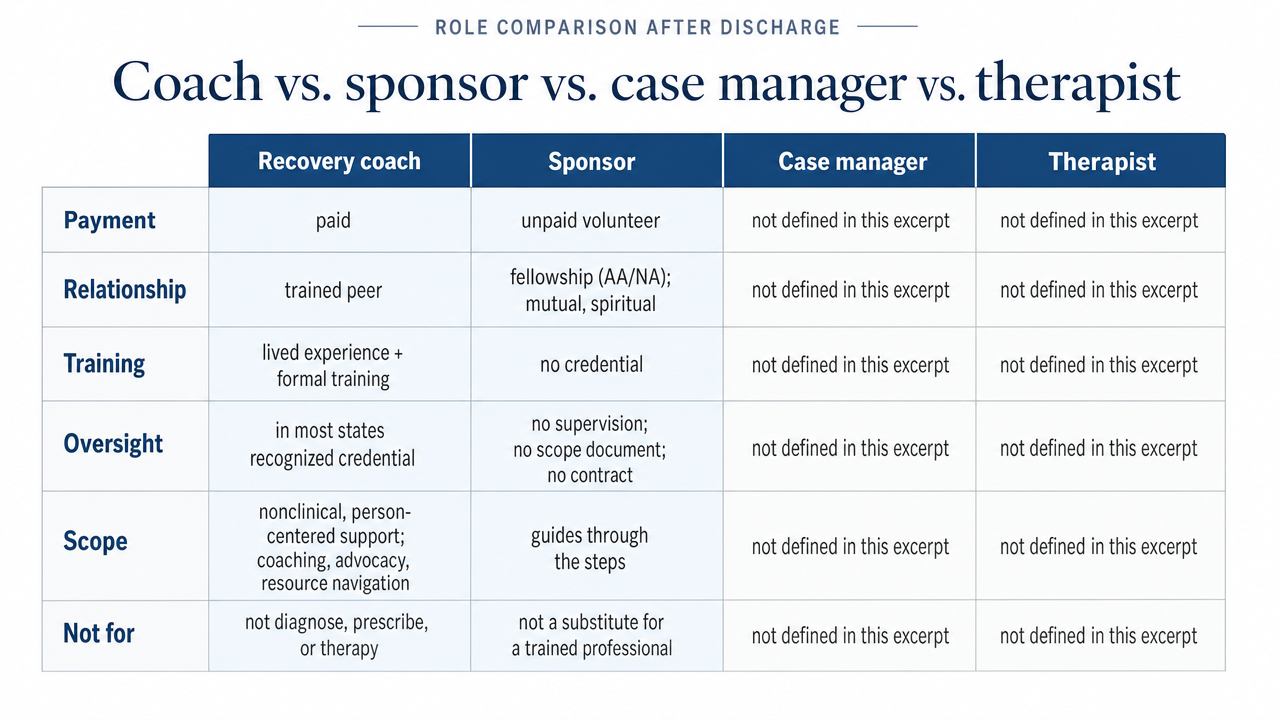
Four roles get mixed up constantly in the first weeks after discharge, and the differences matter when you are deciding who to hire, who to call, and who to lean on. Sorting them out now will save you confusion later.
A recovery coach is a paid, trained peer who provides nonclinical, person-centered support. Their work rests on lived experience plus formal training, and in most states a recognized credential 2. Scope is limited to coaching, advocacy, and resource navigation. A coach does not diagnose, prescribe, or provide therapy.
A 12-step sponsor is an unpaid volunteer within a fellowship like AA or NA. The relationship is mutual and spiritual rather than professional. There is no credential, no supervision, no scope-of-practice document, and no contract. A sponsor guides you through the steps; they are not a substitute for a trained support worker or a clinician.
A case manager coordinates services. They handle insurance questions, connect you to housing, schedule appointments across your care team, and keep paperwork moving. Case managers often hold a social-work or behavioral-health credential and operate within an agency's clinical structure. They may or may not have lived experience.
A licensed therapist diagnoses mental-health and substance-use conditions, provides psychotherapy, and in some roles manages medication. Licensure is state-regulated and verifiable through a state board. This is the clinical seat at your table.
Most people in post-treatment transition end up with more than one of these in their life. A coach is not a replacement for a therapist, a sponsor is not a replacement for a coach, and a case manager is not a replacement for either. Knowing which role you are hiring protects everyone, including the coach you choose.
Credentials: what to ask for and who verifies them
Why there is no single federal license
You might expect a national license for recovery coaches, the way nurses or therapists have one. There isn't. CMS confirmed in its 2024 guidance that no single federal training or certification standard exists for peer-support providers; each state sets its own minimum criteria, training hours, supervision rules, and continuing education 4. That is why two coaches in two states can hold very different credentials and both call themselves certified.
SAMHSA has tried to pull this together with its National Model Standards for Peer Support Certification, which lay out expectations for lived experience, training, ethics, supervision, continuing education, and boundaries 1. States are encouraged to align, but they are not required to. The practical result for you: the title "certified recovery coach" means whatever your state says it means, and sometimes it means a weekend workshop with no supervision attached.
That is not a reason to panic. It is a reason to ask who issued the credential, how many training hours it required, and which authority verifies it. A credible coach will answer those questions without flinching.
How to verify a credential in your state
Start by asking the coach for the exact name of the credential, the issuing body, and a credential or registration number. Then confirm it yourself. Most states route peer certifications through a state behavioral-health agency, a certification board, or a Medicaid-approved training entity. If the coach cannot name who verifies them, that is the answer.
Two examples show how different states look up close. Massachusetts defines a peer recovery coach, for Medicaid purposes, as someone with lived experience, at least two years of sustained recovery, and either a recognized credential or active pursuit of one 5. New Hampshire's 2026 Medicaid amendment requires specific recovery-coach training and ethics training for covered peer services 6. Neither state's rules automatically apply where you live, but they show the kind of specificity a legitimate credential sits inside.
Two more honest notes. First, Medicaid-based rules govern what is reimbursable through that program; a private-pay coach is not necessarily held to the same floor 6. Second, if you are hiring someone who will work with you across state lines or remotely, ask which state's credential governs the work and whether their training transfers. Reciprocity is uneven 4.
If the credential checks out and the issuing body confirms the number is active and in good standing, you have cleared the first gate. One down. Keep going.
Five documents to request before you sign
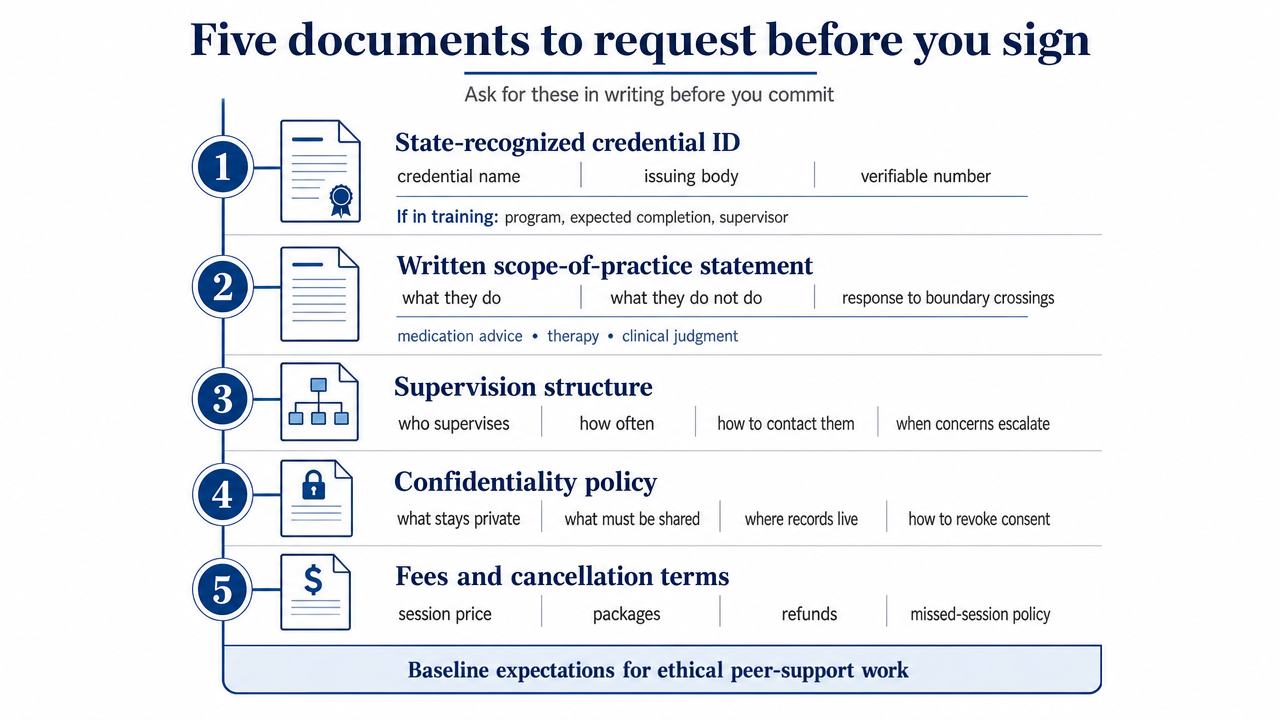
Before you commit to anyone, ask for five things in writing. A coach who runs a serious practice will have these ready; one who improvises will not. SAMHSA's National Model Standards treat all five as baseline expectations for ethical peer-support work 1.
- A state-recognized credential ID. The exact credential name, the issuing body, and a number you can verify. If the coach is still in training, ask for the training program, the expected completion date, and who is supervising their practice in the meantime.
- A written scope-of-practice statement. One page is enough. What the coach does, what they do not do, and how they will respond if you ask them to cross a line (medication advice, therapy, clinical judgment). SAMHSA's standards treat clear role definition as foundational 1.
- A supervision structure. Who supervises this coach, how often they meet, and whether that supervisor is a clinician or a senior peer. Weekly supervision is a reasonable floor.
- An ethics and boundaries policy. Confidentiality terms, mandated-reporting duties, and explicit rules on dual relationships—money, favors, social contact, business ties 1.
- A crisis-escalation protocol. Exactly what the coach does if you relapse, disappear for a day, or signal self-harm. Who gets called, in what order, and how your clinical team is looped in.
If a coach hesitates on any of these, you have your answer. Move on without guilt.
What the evidence actually supports
Before you hire anyone, you deserve a clear answer to a basic question: what does recovery coaching actually do? The honest answer is more useful than the marketing one.
The strongest signal comes from a 2026 systematic review of 28 quantitative studies covering 12,601 participants. It found that peer recovery support and recovery coaching most consistently improve treatment engagement and retention—people are more likely to start treatment, stay in it, and keep showing up 7. Those are real, measurable gains, especially in the first few months after discharge when drop-off is highest.
What the same review did not find was conclusive proof that coaching, by itself, drives better substance-use outcomes like sustained abstinence or reduced use. The evidence there is promising but preliminary 7. An earlier systematic review reached a similar conclusion and flagged a hard methodological problem: studies define "peer worker" and "recovery coach" so differently that it is tough to tell what is doing the work—the coach, the broader treatment the client is already in, or the other recovery supports layered on top 8.
One pilot randomized trial of hospitalized patients with opioid use disorder did not show improved medication-treatment retention from a recovery-coach intervention compared with usual care 11. That null finding does not mean coaching fails everyone; it means a specific model, in a specific setting, with a specific population, did not move that specific outcome. It is a useful corrective to anyone selling you guaranteed results.
Availability is uneven, too. SAMHSA's 2024 facility survey found that 76.2% of U.S. substance-use treatment facilities offered assistance obtaining social services, 70.5% offered mentoring or peer support, and only 31.3% offered recovery coaching specifically 14. That is why your local search returns such a mixed bag—some coaches are embedded in facilities, many are independent, and the label itself varies.
Take this in without discouragement. A coach can realistically help you stay engaged with the treatment that is already working for you, keep appointments, build structure, and reach people who can intervene when things get wobbly. That is a lot. Just do not hire someone who promises more than the evidence supports.
Insight Beyond Treatment
At Next Level Wellness & Behavioral Health, we believe meaningful change starts with perspective, not just protocols.
That philosophy is directly led by Amanda Marino, whose voice in behavioral health extends beyond clinical settings into leadership, culture, and personal growth.
Through keynote speaking and live events, Amanda explores the deeper themes that show up in recovery, family systems, and life transitions: authenticity, resilience, accountability, and the courage to change. Her work invites audiences to move past labels and into honest conversations that create lasting impact.
Supervision, training, and fidelity: the questions that separate programs from freelancers
A credential tells you someone passed a baseline. It does not tell you whether anyone is still watching their work. That is where supervision comes in, and it is the single clearest line between a coach embedded in a program and a solo operator improvising week to week.
Ask directly: who supervises you, how often do you meet, and what do you bring to those meetings? Implementation research on peer-delivered behavioral interventions found that regular supervision—often weekly, led by a clinician or an experienced senior peer—is used to work through hard cases and keep practice consistent with the model the coach was trained in 10. If a coach cannot answer that question in one breath, they are working without a net, and so are you.
Training length matters, too, though not in the way marketing pages suggest. A review of peer-support competencies and implementation found that most trainings run several days rather than a single afternoon, and most studied programs built in structured individual or group supervision after training ended 9. A two-hour online course and a printable certificate are not the same thing as a multi-day curriculum with ongoing oversight.
Fidelity is the quieter word to listen for. It means someone checks whether the coach is actually practicing the way they were trained, not drifting into advice-giving, rescue behavior, or clinical territory. Self-rated fidelity tends to run higher than independent ratings, which is why external quality monitoring matters 10. You can ask: does anyone outside your own head review your work?
If the answer is a program with weekly supervision, documented training hours, and some form of quality review, you are looking at infrastructure. If the answer is "I've been doing this a long time," you are looking at a freelancer. Both can be competent. Only one has a second set of eyes on your case.
Medication treatment: the single biggest compatibility question
If you or your loved one is on buprenorphine, methadone, or naltrexone for opioid use disorder, this is the question that sorts coaches faster than any credential check: how does the coach feel about medication-assisted treatment, and what will they do to support it?
Ask it directly. Listen for the answer. CDC guidance is explicit that detoxification alone, without medication for opioid use disorder, is not recommended because it raises the risk of resumed use, overdose, and overdose death 12. SAMHSA's TIP 63 treats methadone, buprenorphine, and naltrexone as core, evidence-based treatments paired with psychosocial support—not as crutches to be weaned off on someone's personal timeline 13. A coach who hints that medication is a lesser form of recovery, or who nudges toward tapering outside a prescriber's plan, is a safety problem. Walk away.
What you want to hear instead is operational. The coach helps you make and keep prescriber appointments. They know what a missed dose means and whether it warrants a same-day call to your clinician. They understand that discharge from inpatient care requires a working outpatient medication plan, and they will help you hold that plan together 13. If naloxone is in the house, they know where it is.
One honest note: a coach is nonclinical 2. They do not adjust doses, interpret labs, or override your prescriber. Their job is to protect the treatment that is already working. That is more than enough.
What proximity buys you (and what it doesn't)
The word "near me" in your search is doing real work, but it is not doing all the work. Some parts of recovery coaching genuinely need a human in the room with you. Others do not, and pretending they do narrows your options for no good reason.
In-person proximity earns its keep when the task is physical. Riding with you to your first outpatient appointment. Sitting next to you at a meeting where you don't know anyone yet. Showing up at the house on a Saturday morning when the week ahead feels shapeless. Walking through a job interview location before you have to be there for real. Being reachable within a short drive if things get rough. If any of those are on your list, hire someone who can actually get to you, and ask how far they travel, what their response window looks like, and whether weekends and evenings cost more.
Other work travels fine over a phone or video call. Weekly check-ins, planning the next seven days, prepping for a hard conversation with a family member, reviewing what tripped you up last week, coordinating with your clinical team. A coach two states away who answers the phone at 9 p.m. may serve you better for those tasks than a local coach with a packed schedule.
Most people end up with a mix. Decide which tasks need a body in the room before you narrow the map.
What you are paying for
Pricing for recovery coaches ranges widely, and no honest article will quote you a national rate. What you can control is clarity about the unit of work. Ask every coach to break their fee down the same way, so you can compare apples to apples.
Most arrangements fall into four buckets. Scheduled check-ins, usually 45 to 60 minutes by phone or video, are the lightest touch and the cheapest. In-person sessions, including meeting accompaniment, appointment rides, or home visits, cost more because travel time is on the clock. Intensive in-home support, where a coach is with you for a full day or overnight through a high-risk stretch, is priced by the day or shift. On-call availability between sessions, including nights and weekends, is sometimes bundled and sometimes billed as a retainer.
Ask what is included, what triggers an extra charge, how cancellations work, and whether the coach bills for coordination calls with your clinical team. Get the answer in writing. A clear fee structure is itself a signal that someone runs a real practice 1.
Red flags that should end the conversation
Some answers are not warning signs. They are stop signs. If you hear any of these on a first call, thank the coach for their time and keep looking. You are not being picky.
A coach who dismisses or discourages medication for opioid use disorder—buprenorphine, methadone, or naltrexone—is a safety risk, full stop. CDC guidance is clear that medication is the standard of care 12. A coach who cannot name their supervisor, or who says they do not have one, is working without oversight that implementation research treats as basic 10. A coach who refuses to put scope, fees, confidentiality, and crisis protocol in writing is asking you to trust a handshake during the hardest months of your life 1.
Other stop signs: promises of guaranteed sobriety or specific outcomes the evidence does not support 7, pressure to drop your therapist or sponsor, requests for loans or business favors, vague credentials with no verifiable issuing body 4, and sliding into clinical territory—diagnosing, interpreting symptoms, suggesting medication changes 2. Trust what you heard. Make the next call.
A short script for the first call
You do not need to interview like a pro. You need to hear specific answers to specific questions. Keep this list next to you on the first call and take notes.
- "What credential do you hold, who issued it, and what is the number I can verify?" 4- "Who supervises your work, and how often do you meet with them?" 10- "How do you feel about medication for opioid use disorder, and how would you support my prescriber's plan?" 12- "Can you send me your scope of practice, fees, confidentiality policy, and crisis protocol in writing?" 1- "What happens if I relapse or stop answering your calls for a day?"- "How do you coordinate with my therapist and outpatient program?"
Listen for direct, unhurried answers. Hesitation is information. The right coach will sound relieved you asked.
Frequently Asked Questions
What is the difference between a recovery coach and a sponsor?
A recovery coach is a paid, trained peer with a credential, defined scope, and supervision 1. A 12-step sponsor is an unpaid volunteer inside a fellowship like AA or NA, with no formal training, contract, or oversight. Sponsors guide you through the steps as a mutual spiritual relationship. Coaches help you build structure, coordinate care, and keep appointments. You can have both; they do different jobs.
Do recovery coaches need to be licensed or certified?
There is no single federal license. CMS confirmed in 2024 that each state sets its own training, certification, supervision, and continuing-education rules for peer-support providers 4. SAMHSA publishes National Model Standards that many states draw from, covering ethics, boundaries, and supervision 1. Ask for the credential name, the issuing body, and a verifiable number, then confirm it with that authority yourself.
Can a recovery coach work with someone on medication for opioid use disorder?
Yes, and a good one actively supports it. CDC guidance treats buprenorphine, methadone, and naltrexone as standard care 12, and SAMHSA's TIP 63 pairs medication with psychosocial support rather than treating them as opposites 13. A coach should help you keep prescriber appointments and protect the plan. A coach who discourages medication is a safety risk. Walk away.
Does a recovery coach have to be local to be helpful?
It depends on the task. In-person proximity matters for appointment rides, meeting accompaniment, home visits, and showing up during a hard stretch. Weekly check-ins, planning calls, and care-team coordination work fine by phone or video. Many people hire a local coach for physical presence and keep remote support for everything else. Decide which tasks need a body in the room first.
What outcomes can a recovery coach actually deliver?
The strongest evidence, from a 2026 systematic review of 28 studies and 12,601 participants, is for improved treatment engagement and retention—starting treatment, staying in it, keeping appointments 7. Effects on substance-use outcomes like sustained abstinence are promising but not conclusive 8. One pilot RCT in hospitalized patients with opioid use disorder showed no retention gain 11. Be wary of guaranteed-sobriety promises.
What are the biggest red flags when hiring a recovery coach?
Dismissing medication for opioid use disorder 12. No named supervisor or supervision schedule 10. Refusal to put scope, fees, confidentiality, and crisis protocol in writing 1. Vague credentials with no verifiable issuing body 4. Guarantees of sobriety the evidence does not support 7. Pressure to drop your therapist or sponsor, requests for loans, or drifting into diagnosis and medication advice 2.
References
- National Model Standards for Peer Support Certification. https://library.samhsa.gov/sites/default/files/pep23-10-01-001.pdf
- Core Competencies for Peer Workers: Behavioral Health. https://www.samhsa.gov/substance-use/recovery/peer-support-workers/core-competencies
- Peer Support Workers for Those in Recovery. https://www.samhsa.gov/substance-use/recovery/peer-support-workers
- Frequently Asked Questions on Medicaid and CHIP Coverage of Peer Support Services. https://www.medicaid.gov/federal-policy-guidance/downloads/faq06052024.pdf
- Massachusetts State Plan Amendment (SPA)#: 23-0015. https://www.medicaid.gov/sites/default/files/2023-09/MA-23-0015.pdf
- New Hampshire State Plan Amendment (SPA) - 25-0030. https://www.medicaid.gov/medicaid/spa/downloads/NH-25-0030.pdf
- Peer Recovery Support Services and Recovery Coaching for Substance Use Disorder: A Systematic Review. https://pubmed.ncbi.nlm.nih.gov/41551498/
- A Systematic Review of Peer Recovery Support Services for Substance Use Disorder. https://pubmed.ncbi.nlm.nih.gov/31263434/
- The Competencies and Implementation of Peer Support .... https://pmc.ncbi.nlm.nih.gov/articles/PMC13152074/
- Implementation Factors Influencing Peer-Delivered Behavioral .... https://pmc.ncbi.nlm.nih.gov/articles/PMC13104263/
- A peer recovery coach intervention for hospitalized patients with opioid use disorder: A pilot randomized controlled trial. https://pmc.ncbi.nlm.nih.gov/articles/PMC10544697/
- Opioid Use Disorder: Treating | Overdose Prevention | CDC. https://www.cdc.gov/overdose-prevention/hcp/clinical-care/opioid-use-disorder-treating.html
- TIP 63: Medications for Opioid Use Disorder. https://www.samhsa.gov/sites/default/files/pep21-02-01-002.pdf
- Data on Substance Use and Mental Health Treatment Facilities, United States, 2024. https://www.samhsa.gov/data/sites/default/files/reports/rpt56696/2024-nsumhss-annual-report.pdf
A Voice Shaping the Conversation
The topics explored here—change, self-awareness, recovery, and growth—are the same themes Amanda Marino brings to audiences nationwide through speaking engagements and live events.
Known for her appearances on A&E’s Intervention and Digital Addiction, Amanda speaks to organizations, communities, and leadership teams about navigating adversity, embracing vulnerability, and building lives rooted in purpose. Her message resonates far beyond treatment, offering insight that applies to families, professionals, and anyone standing at a crossroads.


Heal on your terms—any time, anywhere.