.svg)

The Amanda Marino Approach to Family Recovery

Key Takeaways
- Family-based interventions are a legitimate clinical target, not a support role — coaching the people around an adult child consistently reduces substance use and improves family functioning 1.
- CRAFT roughly doubles treatment entry for refusing loved ones, reaching 77–86% in comprehensive formats, because the family member's communication skills are trainable variables 5.
- The televised confrontation is not the method — real family work is a continuum of assessment, coached conversations, invitational engagement when warranted, placement, and aftercare 10.
- Before calling anyone, document the specific week that happened, engage one other household member since outcomes improve with multiple involved 4, and use SAMHSA's 24-hour helpline if needed 14.
When the Standard Playbook Has Already Failed
If you're reading this at 2 a.m., you're not alone. You've probably already done the things you were told to do. The outpatient program that ended too soon. The 30-day facility three states away. The ultimatum you delivered at Thanksgiving that you're still not sure was the right call. The family therapist who saw your adult child twice and then couldn't get them back on the calendar.
None of that was wasted. But it may not have been enough, and it may not have been aimed at the right target.
Here is the piece that most families are never told: the research on what actually moves an adult child toward treatment doesn't center on the individual. It centers on the people around them. A 2026 systematic review of randomized trials found that family-based interventions consistently reduce substance use and improve family functioning for both adolescents and adults 1. That is not a soft claim. That is a two-decade evidence base saying the family unit is a legitimate clinical target, not a waiting room.
The Amanda Marino approach, visible to millions through A&E's Intervention and Digital Addiction, is a working translation of that evidence into concierge practice. What follows is not a biography. It's a look at the methodology behind the work, and what it means when the standard playbook has already run its course in your household.
The Family as the Client, Not the Collateral
Here is the reframe that changes almost everything: in the approach modeled by Amanda Marino's clinical work, you are not the support system. You are the client.
That distinction sounds small until you sit with it. In the standard model, your adult child is the patient. You are the worried parent in the intake paperwork, the emergency contact, the person who drives them to the appointment and hopes for updates. Your own exhaustion, your marriage strain, your other children who have been quietly rationing their own needs for years — none of that has a clinician assigned to it. You are collateral to someone else's care plan.
The evidence base has been quietly rejecting that arrangement for years. Family-based treatment, as reviewed across the literature, works on family skills directly — communication, coping, problem-solving, and the relationships that surround the person struggling 3. TIP 39, SAMHSA's clinical guidance for the field, is explicit that involving family members improves engagement, retention, and outcomes, and that the work centers on communication patterns and relationships rather than on managing the person in crisis from a distance 10.
When you become the client, the questions change. Not "how do we get them to agree to treatment?" but "what is your household actually able to sustain, and where are you being asked to carry weight that belongs to a clinician?" Not "what should we say to them?" but "what does a coached conversation look like when you're the one who has to have it Sunday afternoon?"
That is what concierge family recovery work is built around. The person you love matters. So do you.
What the Research Actually Says About Coaching Parents
Why Family Coaching Roughly Doubles Treatment Entry
You have probably been told, more than once, that your adult child has to want it. That until they hit bottom, there is nothing you can do. That your job is to protect yourself, step back, and wait.
The research says something different, and it says it clearly.
A systematic review of Community Reinforcement and Family Training — CRAFT, the most studied family-coaching model in substance use care — found that CRAFT was twice as effective as control and comparison groups at getting treatment-refusing loved ones to actually enter treatment 5. The people delivering that outcome were not clinicians reaching the person directly. They were concerned significant others — parents, partners, sometimes siblings — who were coached in specific communication and behavioral skills and then went home and used them.
The scope matters, and it is worth stating plainly. These were adults who had already refused help. The measured behavior was the family member's, not the loved one's. The outcome was whether the person eventually walked into treatment. When CRAFT was delivered in a comprehensive, multi-modality format — combining individual coaching, group work, and structured practice — treatment entry rates reached 77% and 86% in the studies reviewed 5. That is not a small effect. That is the difference between a family stuck in the same loop for another year and a household that finds a door.
What that means for you is narrower and more useful than the headline number. It means that the skill of the person doing the asking — you — is a variable that can be trained. It means the 11 p.m. phone call has a better and a worse version, and the better version is teachable. It means the standard advice to detach and wait is not the only evidence-based option on the table. There is a coached path, and it has been studied for decades.
None of this promises certainty. Coached families still face hard weeks. But the ceiling is meaningfully higher when the family is trained rather than left to improvise.

The Modalities Behind the Method: Systemic, CRAFT, and Brief Family Work
CRAFT is not the whole picture. It is one of several evidence-based family models a good concierge practice will draw from, depending on what your household is actually carrying.
Systemic family therapy sits at the top of the evidence hierarchy. A 2022 review of couple and family therapies for substance use classified systemic family therapy as a well-established standalone treatment, with behavioral family and couple therapies rated as probably efficacious on their own and well-established as part of a multi-component plan 7. In plain terms, that is the highest level of research support the field awards. It is not experimental. It is the baseline against which other approaches are measured.
Systemic-motivational therapy, one of the specific approaches described in the TIP 39 companion counseling chapter, works by assessing the relationship between substance use and family life and helping the family operate as a team building strategies for change, rather than as isolated actors reacting to the person in crisis 2. Psychoeducation and network therapy sit alongside it in the same chapter, each with distinct goals — teaching the family what they are actually dealing with, and organizing the wider circle of people who can support recovery 2.
Then there is brief family therapy, which matters when time is short and stakes are high. The TIP 26 brief family therapy chapter reviews time-limited models — Behavioral Marriage Therapy, Multidimensional Family Therapy, and others — and describes what happens when the whole family is engaged: changes come faster, they hold better, and the person in care gains a built-in support system that outlasts any single treatment episode 8.
A concierge practice does not pick one model and force every family through it. The methodology visible in Amanda Marino's clinical work draws on the modality that fits the situation in front of it — CRAFT when your adult child is refusing help, systemic work when the household patterns themselves are part of what is keeping the cycle alive, brief structured therapy when a moment of openness has to be met quickly. That is what evidence-based, personalized family recovery actually looks like when it is practiced well.
Insight Beyond Treatment
At Next Level Wellness & Behavioral Health, we believe meaningful change starts with perspective, not just protocols.
That philosophy is directly led by Amanda Marino, whose voice in behavioral health extends beyond clinical settings into leadership, culture, and personal growth.
Through keynote speaking and live events, Amanda explores the deeper themes that show up in recovery, family systems, and life transitions: authenticity, resilience, accountability, and the courage to change. Her work invites audiences to move past labels and into honest conversations that create lasting impact.
The TV Intervention vs. What Actually Happens in a Living Room
You have seen the scene. The camera pans across a semicircle of relatives on folding chairs. Someone reads a letter through tears. The person at the center of it all walks in expecting brunch. A car idles outside. By the end of the hour, a bag is packed and a plane ticket is printed.
That is television. It is edited for a 43-minute arc and a commercial break. It is not the working method behind it, and it is not what happens in your living room when a concierge family recovery practice is doing its job well.
The clinical picture looks different in almost every dimension. SAMHSA's Advisory summarizing TIP 39 is direct on this point: involving family members in substance use treatment improves engagement, retention, and outcomes, and the actual work focuses on communication patterns and relationships rather than a single confrontational moment 10. Systemic family therapy, the frame that underlies much of this practice, is classified as a well-established treatment in its own right — not a dramatic prelude to someone else's care 7.
Set the two side by side and the differences become concrete:
- The TV version stages a confrontation; the clinical version coaches a conversation, sometimes over weeks.
- The TV version is a single event; the clinical version is a continuum that begins before any invitation is made and extends well past treatment placement into aftercare.
- The TV version puts the individual at the center and the family in a supporting arc; the clinical version treats the family as the primary unit of change, with the person you love as one member of that system.
None of this means an in-person invitational meeting is off the table when the situation calls for one. It means the meeting is not the intervention. The intervention is the months of family work that make the meeting possible — or make it unnecessary.
The Week-to-Week Texture of Concierge Family Work
The First Call and What It Actually Covers
The first call is not an intake form read aloud.
You will probably do most of the talking, and a good clinician will let you. What sounds like venting is actually the assessment. In forty-five minutes, someone trained in family systems can hear which patterns are load-bearing in your household, which ones are cosmetic, and where the actual leverage is. That is not intuition. That is what the field calls assessing the relationship between substance use and family life — the opening move in systemic-motivational work as described in TIP 39's counseling chapter 2.
Expect the questions to land in specific places:
- What did the last treatment episode look like, and how did it end.
- Who in the family is still speaking to your adult child, and who has gone quiet.
- What is your spouse's read on the situation, and does it match yours.
- Is there a sibling absorbing more than they should.
- What have you already tried that felt close to working, even if it didn't hold.
- What are you afraid will happen if you push, and what are you afraid will happen if you don't.
Nothing about that call is about extracting a decision from you. It is about building the map. By the end, you should have a clearer picture of where your household actually is — and what the next two weeks could reasonably look like if you decided to keep going.
Coached Conversations and the Night Before an Invitation
The work between calls is where family recovery actually happens.
A coached conversation is not a script. It is a rehearsal of a specific moment — the drive home from the appointment, the Sunday phone call, the text you have been drafting and deleting for three days. You bring the moment to your clinician. They walk you through what your adult child is likely to hear, where the conversation tends to derail, and what a small, honest shift in your language could open up. Then you go home and try it. Then you come back and report what happened, and the two of you adjust.
That is the mechanism behind what the family involvement literature calls skills-based work — communication, coping, and problem-solving practiced by the family member and refined over time 3. It is not glamorous. It is closer to physical therapy than to a breakthrough scene.
The night before an invitational meeting, if the situation warrants one, looks quieter than television has taught you to expect. There is a walk-through of who will be in the room and who will not. There is a plan for what happens if your adult child says yes, and a separate plan for what happens if they say no or leave. There is a treatment placement already secured, so the answer to "where would I even go" is not hypothetical. And there is a conversation about you — how you are sleeping, what you will do afterward, who is checking on you Monday morning.
The meeting is the visible part. The preparation is the intervention.
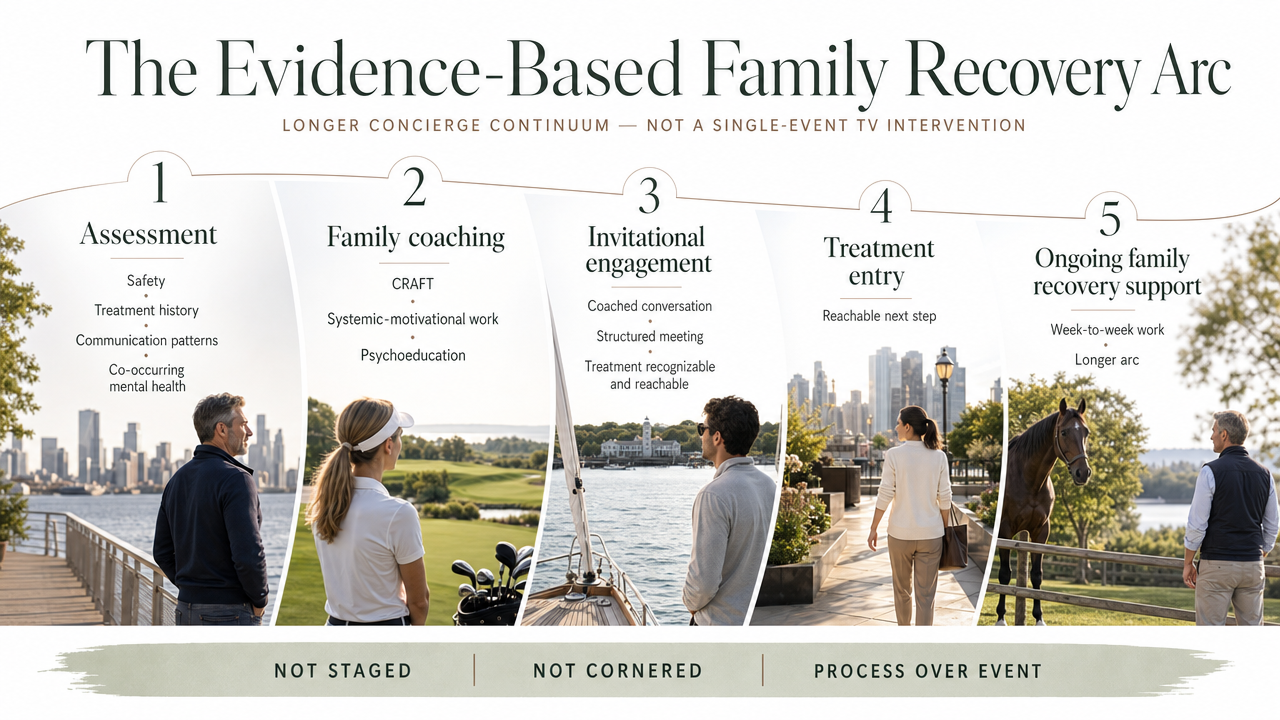
The Evidence-Based Family Recovery Arc
Zoom out, and the week-to-week work sits inside a longer arc that a concierge practice runs with intention. Each stage has a job, and each stage has research behind it.
- It begins with assessment — the mapping described above, done seriously, with attention to safety, current treatment history, family communication patterns, and any co-occurring mental health picture.
- It moves into family coaching, drawing on CRAFT when your adult child is refusing help, systemic-motivational work when household patterns are part of what keeps the cycle in place, and psychoeducation when the family needs a shared vocabulary before anything else can move 2.
- From there, coaching may build toward an invitational engagement — a coached conversation, sometimes a structured meeting, aimed at making treatment recognizable and reachable rather than staged and cornered.
- When your adult child says yes, the work shifts to treatment placement: matching level of care, program culture, and clinical fit rather than settling for whichever bed is open Tuesday.
- Placement is not the endpoint. The last and longest stage is aftercare and family continuity — the months and sometimes years when the household is learning to hold recovery without holding it too tightly.
Family involvement across this full arc is what the scoping literature associates with better treatment entry, higher completion rates, and stronger outcomes for the person in care and for the family itself 4.
The arc is not linear for every household. Some families move through it in a season. Others cycle. What matters is that there is an arc at all — that the work has a shape, and that you are not being asked to hold it alone.
Concerns Parents Rarely Say Out Loud
Discretion, Reputation, and Adult Children in Another Time Zone
You have questions you have not written down anywhere. Whether the neighbors will find out. Whether your adult child's employer will find out. Whether the flight has to happen at night. Whether a clinician can meet your daughter in a hotel suite in another city instead of a clinic waiting room with fluorescent lights.
These are not vanity concerns. They are protective ones. And they are legitimate reasons families delay reaching out — sometimes for years.
Concierge family recovery work is built around the premise that discretion is a clinical variable, not a luxury. NDAs, private travel logistics, off-hours sessions, and coordination through a single point of contact are standard, not exceptional. When your adult child lives in another state or another time zone, the practice travels or coordinates locally on the ground, so the family is not stitching together strangers by phone at midnight. TIP 39's guidance is clear that the substance of family work is communication patterns and relationships 10— none of which require your household to be visible to anyone outside it.
What that gives you is the room to make a decision without also managing exposure.
Dual Diagnoses, Digital Dependencies, and What Family Support Can Move
The other question you have not said out loud: whether family work still matters when the picture is more complicated than substance use alone.
It does. A study of family support and outcomes among people experiencing both mental health and substance use challenges found that direct family support — practical and emotional — was associated with reductions in substance use in that dual-diagnosis population 9. That does not mean family coaching replaces psychiatric care or medication management. It means the household around a person carrying two conditions is not a bystander to either one.
Digital dependencies belong in this conversation too. The adult child who has withdrawn into gaming, compulsive scrolling, or a screen life that has replaced most of their offline one is not outside the scope of family recovery work. The methodology shown in Amanda Marino's Digital Addiction work applies the same skills-based frame the family involvement literature describes — communication, coping, problem-solving, and the relationships surrounding the person 3— to behaviors that clinical care has been slower to name.
Complexity does not disqualify your family from this work. It is often the reason to start it.
What You Can Do Tonight, Before You Call Anyone
You do not have to make a decision by morning. But there are three things you can do before the sun comes up that will make every conversation after this one easier.
- Write down what actually happened this week. Not the story you tell your sister, and not the version you tell yourself in the car. The specific week. Who called, what was said, what you did in response, how you slept afterward. Clinicians can work with a page of that. They cannot work with "it's been bad for years."
- Pick one person in your household to read this with, if you can. Not to convince them of anything. Just so the next call is not one of you carrying the whole weight alone. The scoping literature on family-focused work is consistent that outcomes improve when more than one family member is engaged in the process 4, and that starts at your kitchen table, not in an office.
- Then, if you need something in your hand tonight, SAMHSA's National Helpline is free, confidential, and open 24 hours 14. It will not replace a concierge practice, but it can give you a person to talk to at 3 a.m. and a starting point for referrals 13.
When you are ready for the private, coordinated version of this work — the kind that meets you at your kitchen table and travels to your adult child's zip code — Next Level Wellness & Behavioral Health is one number to keep on the list.
You are already doing the hardest part. You are still looking.
Frequently Asked Questions
Who is Amanda Marino and why is her work referenced in family recovery?
Amanda Marino is a certified interventionist known publicly through A&E's Intervention and Digital Addiction. Her methodology is referenced because it translates the family-based treatment evidence base — reviewed most recently in a 2026 systematic review showing consistent reductions in substance use and improvements in family functioning 1— into a concierge practice that coaches parents and partners as the primary unit of change.
How is the Amanda Marino approach different from a traditional TV-style intervention?
The televised version compresses months of work into a single confrontational scene. The clinical version is a continuum — assessment, family coaching, an invitational engagement only when warranted, treatment placement, and aftercare. SAMHSA's TIP 39 Advisory is clear that the substance of family work is communication patterns and relationships over time, not a staged event 10. The meeting, when it happens, is the visible tip of the preparation.
What if my adult child refuses treatment or lives in another state?
Refusal is exactly the scenario CRAFT was built to address. The model coaches concerned significant others — often parents — in specific communication and behavioral skills that measurably increase the likelihood a treatment-refusing loved one eventually enters care 5. Distance is a logistics question, not a clinical barrier. Concierge practices travel or coordinate on the ground so the family is not managing a stranger by phone across time zones.
Does family coaching work when there is a dual diagnosis or digital dependency involved?
Yes. Research on people experiencing both mental health and substance use challenges found that direct family support was associated with reductions in substance use in that population 9. Family coaching does not replace psychiatric care or medication management — it works alongside them. The same skills-based frame, communication, coping, and problem-solving 3, applies to digital dependencies like compulsive gaming or screen use that clinical care has been slower to name.
How discreet is concierge family recovery work for high-profile families?
Discretion is treated as a clinical variable. NDAs, private travel, off-hours sessions, and single-point-of-contact coordination are standard practice rather than exceptions. The clinical work — communication patterns, coached conversations, family skills — does not require your household to be visible to anyone outside it 10. That structure gives families room to make thoughtful decisions without also managing exposure to employers, neighbors, or the wider community.
What should we do tonight if we're not ready to hire anyone yet?
Write down what actually happened this week — the specific week, not the running story. Read this with one other person in your household if you can; outcomes improve when more than one family member is engaged 4. If you need a person to talk to before morning, SAMHSA's National Helpline is free, confidential, and open 24 hours a day 14, with additional coping resources and treatment locators available 13.
References
- A Systematic Review on Randomized Controlled Trials of Family-Based Interventions for Substance Use Disorders. https://pmc.ncbi.nlm.nih.gov/articles/PMC13068785/
- Chapter 3—Family Counseling Approaches (TIP 39 Companion Chapter). https://www.ncbi.nlm.nih.gov/books/NBK571088/
- Family Involvement in Treatment and Recovery for Substance Use Disorders. https://pmc.ncbi.nlm.nih.gov/articles/PMC8380649/
- Family-focused practices in addictions: A scoping review. https://pmc.ncbi.nlm.nih.gov/articles/PMC5781095/
- Community reinforcement and family training and rates of treatment entry: A systematic review. https://pubmed.ncbi.nlm.nih.gov/31770469/
- Community Reinforcement and Family Training: A Pilot Study. https://pmc.ncbi.nlm.nih.gov/articles/PMC3331969/
- Couple and family therapy for substance use disorders. https://pubmed.ncbi.nlm.nih.gov/34435387/
- Chapter 8—Brief Family Therapy (TIP 26: Substance Abuse Treatment for Persons with Co-Occurring Disorders). https://www.ncbi.nlm.nih.gov/books/NBK64953/
- Family support and substance use outcomes for persons with mental illness and substance use disorders. https://pubmed.ncbi.nlm.nih.gov/11215552/
- The Importance of Family Therapy in Substance Use Disorder Treatment (Advisory 39). https://library.samhsa.gov/product/advisory-importance-family-therapy-substance-use-disorder-based-tip-39/pep20-02-02-016
- Family Therapy Can Help for People in Recovery from Mental Illness or Addiction. https://library.samhsa.gov/product/family-therapy-can-help-people-recovery-mental-illness-or-addiction/sma15-4784
- What Is Substance Abuse Treatment? A Booklet for Families. https://library.samhsa.gov/product/what-substance-abuse-treatment-booklet-families/sma14-4126
- Helping Families Cope with Mental Health and Substance Use. https://www.samhsa.gov/mental-health/children-and-families/coping-resources
- SAMHSA’s National Helpline. https://www.samhsa.gov/find-help/helplines/national-helpline
A Voice Shaping the Conversation
The topics explored here—change, self-awareness, recovery, and growth—are the same themes Amanda Marino brings to audiences nationwide through speaking engagements and live events.
Known for her appearances on A&E’s Intervention and Digital Addiction, Amanda speaks to organizations, communities, and leadership teams about navigating adversity, embracing vulnerability, and building lives rooted in purpose. Her message resonates far beyond treatment, offering insight that applies to families, professionals, and anyone standing at a crossroads.


Heal on your terms—any time, anywhere.