.svg)

Digital Addiction Recovery in Northern Virginia, VA

Key Takeaways
- Northern Virginia families in McLean, Great Falls, Vienna, and Langley face a specific pattern where dual careers, nannies, and unsupervised evening hours let compulsive device use build quietly at home.
- Heavy screen use and clinical compulsion are different problems; sleep disruption, withdrawal irritability, deception, and functional decline sustained over weeks signal the need for behavioral health support, not stricter app timers.
- Concierge in-home recovery uses wellness companions and case management to coordinate with existing therapists, schools, and household staff without generating records that surface in background checks or FCPS files.
- Before acting, compare privacy exposure, whether the intervention targets compulsive patterns versus total hours 16, calendar flexibility, and how well the provider integrates with the therapist and school team already in place.
When the iPad Stopped Being a Babysitter and Started Being the Problem
You handed them the iPad because you had a 7 a.m. call with London. You handed it back at bedtime because the nanny needed a break, because dinner was late, because the Silver Line was delayed and you were still in Tysons at 6:45. That is not the failure. Every parent in your zip code has done a version of the same thing.
The failure signal is different. It is the locked bedroom door in McLean. The 2 a.m. Discord voice chat you can hear through the wall in Great Falls. The son who used to captain the Vienna travel soccer team and now lies about where his phone is. The daughter at TJ whose grades slipped a full letter last quarter and who cries when you ask her to close the laptop. That is when the device stopped being a tool and became something closer to a dependency.
The local data confirms you are not imagining a pattern. In the 2024 Fairfax County Youth Survey, 40.1% of students in grades 8, 10, and 12 reported spending three or more hours per school day on non-academic device use, and 33.9% of sixth graders reported the same 10, 11. That is one in three eleven-year-olds and two in five high schoolers, measured in the same county where your child sits in homeroom.
Heavy use is common. Compulsive use is different, and it is what this page is about. What follows is how to tell them apart, what discreet recovery looks like inside a home like yours, and how a concierge team works with your family without ever appearing on a school counselor's log or a group therapy sign-in sheet.
Heavy Use vs. Compulsive Use: Where the Clinical Line Actually Sits
The Signals That Change the Conversation
Heavy use looks like a kid who spends three hours on Fortnite after school, gets annoyed when you call them to dinner, and then closes the laptop. Compulsive use looks like a kid who cannot close the laptop. That distinction is the one most parents miss, and it is the one that changes what kind of help your family actually needs.
You are watching for a cluster of behaviors, not any single incident. Sleep disruption is usually first. The device migrates into the bedroom, then under the pillow, then into the bathroom at 3 a.m. Withdrawal irritability follows: not normal teenage moodiness, but a spike in anger, tearfulness, or panic when the Wi-Fi drops or the phone is taken for a car ride. Deception is the third signal, and it is often what finally lands parents on a page like this one. A second Instagram account you did not know about. A gaming rig hidden in a closet. A story about being at a friend's house in Vienna that turns out to be six hours in a Discord server.
Functional decline is the fourth marker and the hardest to argue with. Grades slip. The travel team gets quit. The kid who used to run cross country stops leaving the room. Friendships shrink to online-only. Meals get skipped or eaten one-handed at the desk.
None of these signals alone means addiction. Together, sustained over weeks, they mean something different is happening. The 2024 ABCD study, which followed 9,538 U.S. adolescents over one and two years, found that higher total screen time prospectively predicted higher depression and conduct symptom scores, even after controlling for other factors 1. That is not a snapshot correlation. That is a signal that tracks kids forward through time, in the same age range as yours.
What the Numbers Say About Your Child's Risk
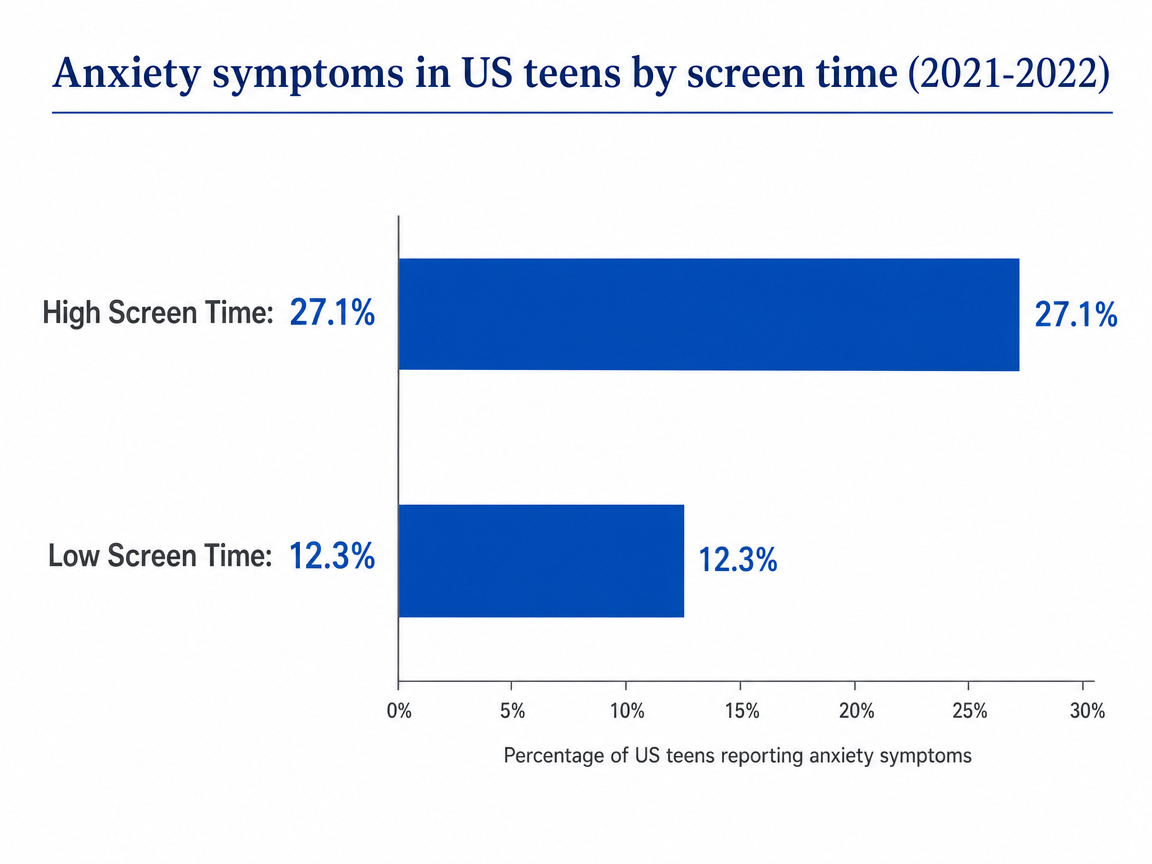
You are a data-literate reader, so here is the data plainly. In a national analysis of U.S. teens from 2021 to 2022, adolescents with high daily non-schoolwork screen time reported depression symptoms at 25.9%, compared with 9.5% among teens without high screen time. Anxiety symptoms showed the same pattern: 27.1% versus 12.3% 4. The risk of a depression or anxiety picture roughly doubles or triples as screen time climbs into the high band.
The academic performance question worries most parents in your zip code more than the mood question, at least at first. That signal is real too. A study of 17,076 U.S. adolescents found that those with excessive screen-time behaviors had 1.28 times higher odds of reporting serious cognitive difficulties, meaning trouble concentrating or remembering, after adjusting for covariates 5. A 28% bump in the odds of cognitive struggle is not catastrophic, but it is the difference between a kid who used to be able to sit with an AP Chemistry problem set and one who cannot. If your child is at TJ, or on a trajectory toward it, that margin matters.
Two things to hold at the same time. First, these are population-level associations. They do not tell you what will happen to your specific child. Second, when your child is already showing the behavioral cluster from the previous section, they are no longer a statistical average. They are the kid inside the elevated-risk band, and the numbers describe the terrain they are standing on.
That is why the conversation shifts from screen time as a habit to screen time as a clinical variable worth acting on.
The Honest Scientific Debate You Deserve to Hear
You will find researchers who push back on the framing above, and you should know their argument before you make a decision for your family. A 2020 review of the digital-age adolescent literature concluded that most large, preregistered studies find only small associations between total device use and mental health, and that focusing on hours alone misses what actually matters: content, context, and the child in front of you 7. A separate analysis of time-use diary data from Ireland, the U.S., and the U.K., covering 17,247 adolescents, found little evidence for substantial negative associations between digital screen engagement and well-being 8.
Both findings are real. Both are worth respecting. What they mean in practice is that a blanket panic about screen hours is not warranted for a typical teenager who happens to be online a lot.
That is not your situation. You are here because your child is showing the behavioral cluster, not because they logged 210 minutes on TikTok last Tuesday. The academic debate is about population averages. Your question is clinical: is this specific pattern in this specific kid a compulsion that needs treatment? That is a different question, and the honest answer often is yes.
The Northern Virginia Household Pattern Nobody Names
Dual Careers, Discreet Nannies, and the 10 p.m. Slack Ping
Here is the household most local providers do not know how to talk to. One parent is a partner at a firm on K Street or a principal at a consultancy in Tysons. The other holds a clearance, runs a P&L for a defense prime, or sits on the Hill. You are both good at your jobs. You are both on Slack at 10 p.m. The nanny is excellent and has been with you for years. She has also, quietly, been the person managing after-school hours since your daughter was in third grade.
The device did not sneak into your home. You installed it, on purpose, because it worked. The iPad kept a six-year-old calm during a deposition prep call. The Switch made the flight to a client site tolerable. The gaming PC in the basement in Great Falls was a thoughtful birthday gift that also, honestly, bought you a quiet Saturday morning. None of that was a mistake. It was a rational allocation of a scarce resource, which was your attention.
What changed is that the child adapted to the arrangement faster than the arrangement adapted to the child. Compulsive patterns build in the exact hours when no adult is fully present. Strong social support has been shown to buffer the mental health impact of heavy screen use in adolescents, which is another way of saying that the presence of an engaged adult is protective in a way an app timer is not 6. Your home has the resources. It has not yet had the structure.
Why the Usual Local Options Feel Wrong
You have already tried some version of the standard path, or you have looked at it and closed the tab. The FCPS counselor was kind and overworked. The referral list pointed to a group IOP in Fairfax that meets three afternoons a week in a strip mall off Route 7. Your teen would have to be signed in at a front desk, sit in a room with kids from three high schools, and be picked up at a predictable time by a predictable car. For a family whose name appears on a bar association roster, a lobbying disclosure, or a Senate committee page, that geometry is a problem.
The private options are not much better. A wilderness program in Utah pulls a kid out of TJ mid-semester and creates a gap that has to be explained. A residential digital detox retreat asks you to hand your child to strangers in another state for six weeks. Both approaches also miss the point. The compulsion did not form on a mountainside. It formed in your basement, on your Wi-Fi, in the exact rhythms of your household. Removing the child from that context can produce a clean 30 days and a relapse in week five.
What you actually need is help that comes to the house, works around your calendar, and leaves no paper trail at the school.
Insight Beyond Treatment
At Next Level Wellness & Behavioral Health, we believe meaningful change starts with perspective, not just protocols.
That philosophy is directly led by Amanda Marino, whose voice in behavioral health extends beyond clinical settings into leadership, culture, and personal growth.
Through keynote speaking and live events, Amanda explores the deeper themes that show up in recovery, family systems, and life transitions: authenticity, resilience, accountability, and the courage to change. Her work invites audiences to move past labels and into honest conversations that create lasting impact.
What Concierge Recovery Actually Looks Like at Home
In-Home Wellness Companions Instead of App Blockers
You have already tried the Bark subscription, the Screen Time passcode, the router that promises to shut off Wi-Fi at 10 p.m. Your teen defeated all three inside a weekend. This is not a failure of the software. It is a mismatch between the intervention and the problem. Compulsion is a relational and physiological pattern. A password is a speed bump.
What works better in a home like yours is a person. A mental wellness companion comes to the house on a schedule your family sets, sits with your child during the highest-risk windows, and provides the structured human presence that has been eroded by two demanding careers. In the evidence base, strong social support has been shown to buffer the mental health impact of heavy screen use in adolescents, which is the closest thing the research has to a protective factor you can actually deploy 6. An app timer does not sit at the kitchen table. A companion does.
The work looks less clinical than you might expect. A companion might drive your daughter to a Saturday morning yoga class in Vienna, then stay for coffee, then help her plan a study block that does not involve her phone in the same room. With your son, it might mean a co-played hour of Rocket League followed by a walk in Great Falls Park and a conversation about why he lied about the Discord server on Tuesday. The device is not confiscated. It is displaced by something a compulsive user has been going without: reliable, unhurried adult attention that is not also checking Outlook.
That is the intervention. It is quiet, it is in-home, and it does not require your child to sit in a strip mall waiting room off Route 7.
Treating the Compulsion, Not Policing the Minutes
Here is the finding that should reorient how you think about progress. A 2025 systematic review and meta-analysis of structured interventions for youth aged 6 to 19 found that these programs reduced problematic digital use at an effect size of d = 1.47 immediately after intervention, and d = 1.13 at follow-up. Total screen hours barely moved, at roughly d = 0.15 16. In plain terms, the interventions were nearly ten times more effective at treating the compulsion than at cutting the clock.
Read that again, because it changes the scoreboard. If you measure recovery in daily hours, you will feel like nothing is working. Your teen may still spend three hours on the PlayStation on a Sunday in February. But if you measure recovery in the behaviors that define compulsion, meaning the deception, the sleep disruption, the withdrawal irritability, the abandoned soccer team, you will see movement much sooner. A kid who games for three hours and then closes the console and eats dinner with the family is a different kid from one who games for three hours and then rages when asked to stop.
That is why concierge work targets pattern, not volume. The companion is not there to count minutes. They are there to interrupt the loop: the trigger, the reach for the device, the shame spiral, the deception, the isolation. Every time that loop is broken by a real human presence, the compulsion loses some of its grip. Screen hours will drift down as a byproduct. They are not the goal.
This reframing also protects your child's dignity. You are not fighting them over a number. You are helping them build a different relationship with a tool they will use for the rest of their life.
Coordinating With Your Existing Therapist, School, and Household Staff
You probably already have a therapist in McLean or Arlington who your child sees on Wednesdays. You may have an FCPS counselor who has been kind but limited. You have a nanny who has been with the family for six years and knows more about your teen's daily rhythms than either parent does. None of these people need to be replaced. They need to be coordinated.
Case management is the connective tissue. One person on the concierge team holds the whole picture: what the therapist is working on, what the school knows and does not know, what the companion observed during Tuesday's shift, what medication the pediatrician adjusted, what the household staff should reinforce and what they should stay out of. Weekly check-ins with you, brief written updates, one phone number to call at 11 p.m. when your son locks himself in the bathroom with his phone.
The school piece matters most for privacy. Nothing about this arrangement has to touch your child's academic record. The case manager can communicate with a teacher about an assignment extension without disclosing why. Your nanny can be briefed on the parts of the plan she needs to execute without becoming a clinician. Your therapist gets a partner, not a competitor.
You keep the team you built. It just starts working together.
What Recovery Looks Like in the First 90 Days
The first two weeks are the ugliest part, and you deserve to know that before you start. When a companion begins showing up and the loop starts getting interrupted, your child will likely test the arrangement. Expect a fight over the phone at 9 p.m. on day three. Expect a slammed door in the Great Falls kitchen on day six. Expect your teen to be charming with the companion on Saturday and furious with you on Sunday. This is not a setback. It is the compulsion pushing back against the first real friction it has felt in months.
Weeks three through six are where you start seeing the small wins that matter. Your daughter eats dinner at the table without her phone twice in one week. Your son admits, unprompted, that he was up until 2 a.m. on Discord and asks the companion to hold his phone overnight on Thursdays. He goes on a Saturday walk in Great Falls Park without being asked. The Bark alerts drop from twelve a day to three. None of this is a cure. All of it is movement, and it is the kind of movement the research predicts: problematic patterns shift meaningfully faster than total hours do 16.
By weeks seven through twelve, the picture stabilizes into something you can actually work with. Sleep is closer to normal. The deception has thinned out because there is less to hide. Grades usually stop sliding first and start climbing second. Your teen has a person in their life, outside the family, who knows them and holds them accountable without carrying the emotional weight of being their parent. That relationship is doing the work that the app blockers could not.
At the 90-day mark, you and the case manager sit down and decide what the next quarter looks like. Some families taper companion hours from four days a week to two. Some hold steady because a school transition or a summer schedule is coming. A few need to add support because a co-occurring issue, usually anxiety or ADHD, has surfaced now that the device is no longer masking it. Recovery is not linear, and no one is going to hand you a discharge certificate. What you get instead is a household that runs on human presence again, and a child who is learning how to live with a device instead of inside one.
How to Start Without Disrupting a Public-Facing Career
The first call is the part most parents delay for months, usually because they are imagining a scene that is not going to happen. There is no intake packet emailed to a shared family account. No insurance form that routes through your firm's benefits portal. No car with a logo on it parked in your Langley driveway at 4 p.m. on a Tuesday. The first conversation is a phone call with a clinician, on your schedule, and it stays there until you decide otherwise.
What you share in that call is your version of the picture: the behavioral cluster you have been watching, what you have already tried, what your child's therapist is working on, what your household actually looks like on a Wednesday night. What you get back is a plan built around your calendar and your privacy, not a slot in someone else's program. Amanda Marino, who was featured on A&E's Digital Addiction, has spent years reading the specific pattern you are describing, and pattern recognition is what shortens the runway between recognition and action.
You do not have to have the hard conversation with your teen before you call. Most parents in your position do it the other way around: build the team first, then bring the child in with structure already waiting. That is the version that protects your family and gives your child a real chance to get their life back.
Frequently Asked Questions
How do I know if my child has crossed from heavy screen use into digital addiction?
Look for a cluster, not a single incident: sleep disruption, withdrawal irritability when the device is taken, deception about use, and functional decline at school or in activities they used to love. When three or more of those show up together over several weeks, you are past heavy use. A 2023 systematic review found social media and smartphone use are consistently linked with reduced wellbeing in adolescents, particularly when patterns become compulsive 2.
How is concierge digital addiction recovery different from a standard outpatient program in Northern Virginia?
A standard IOP asks your teen to sit in a group room three afternoons a week on someone else's schedule. Concierge recovery comes to your home, works around your calendar, and coordinates privately with your existing therapist and school. There is no group roster, no strip-mall waiting room, and no predictable pickup pattern outside a Fairfax office. The intervention is relational and in-context, not programmatic.
Will working with an in-home wellness companion compromise our family's privacy or my security clearance?
No. The engagement is private, out-of-pocket, and does not route through insurance, employer benefits portals, or your child's academic record. Companions arrive discreetly, without branded vehicles or identifying paperwork. Nothing about the arrangement generates a filing that would surface in a background investigation or a reinvestigation. Communication with the household is direct and documented only in the concierge team's internal case file, not in any public-facing system.
Can you coordinate with our existing therapist and my child's school?
Yes, and that coordination is usually the point. A case manager holds the full picture and syncs weekly with your therapist in McLean or Arlington, your pediatrician, and, when you authorize it, your child's teacher or FCPS counselor. School contact can be limited to logistics, like an assignment extension, without disclosing clinical details. Your existing team stays in place. The concierge role connects them so nothing falls between the cracks.
What if my teen refuses to give up their phone or gaming setup?
Most do refuse at first. The plan does not depend on confiscation. Companions build a relationship before they change any rules, then displace device time with structured presence, activity, and conversation. The device becomes less central because something else is finally there. A 2025 meta-analysis found structured interventions reduced problematic use far more effectively than they reduced total hours, which is exactly the pattern parents see at home 16.
How quickly can we start, and what does the first week actually look like?
The first clinical call usually happens within a day or two of your inquiry, on your schedule. From there, a plan and companion assignment can be in place inside a week. The first week itself is quiet: intake conversations with you, a low-pressure introduction between your teen and the companion, and observation before any structure changes. Nothing dramatic happens on day one. The point is to build footing your child will not immediately reject.
References
- Screen time and mental health: a prospective analysis of the Adolescent Brain Cognitive Development study. https://pmc.ncbi.nlm.nih.gov/articles/PMC11457456/
- The associations between screen time and mental health in adolescents: a systematic review. https://pubmed.ncbi.nlm.nih.gov/37081557/
- Daily Screen Time Among Teenagers: United States, July 2021–December 2023. https://www.ncbi.nlm.nih.gov/books/NBK610606/
- Associations Between Screen Time Use and Health Outcomes Among Teenagers in the United States, 2021–2022. https://pmc.ncbi.nlm.nih.gov/articles/PMC12249308/
- Excessive screen time behaviors and cognitive difficulties among US adolescents. https://pubmed.ncbi.nlm.nih.gov/35932571/
- The role of social support in mitigating the effects of increased screen time on adolescent mental health. https://pubmed.ncbi.nlm.nih.gov/41661911/
- Adolescent Mental Health in the Digital Age: Facts, Fears and Future Directions. https://pmc.ncbi.nlm.nih.gov/articles/PMC8221420/
- Screens, Teens, and Psychological Well-Being: Evidence from Three Time-Use-Diary Studies. https://pubmed.ncbi.nlm.nih.gov/30939250/
- Associations between screen time and lower psychological well-being among children and adolescents: Evidence from a population-based study. https://pmc.ncbi.nlm.nih.gov/articles/PMC6214874/
- Fairfax County Youth Survey: 2024 Report, Grades 8–12. https://www.fairfaxcounty.gov/data/sites/data/files/Assets/documents/youth%20survey/survey%20reports/2024_Fairfax_8_12th_FINAL.pdf
- Fairfax County 6th Grade Youth Survey: 2024 Report. https://www.fairfaxcounty.gov/data/sites/data/files/Assets/documents/youth%20survey/survey%20reports/2024_Fairfax_6th_Draft_FINAL.pdf
- 2023–2024 Fairfax County Youth Survey Presentation. https://www.fairfaxcounty.gov/data/sites/data/files/Assets/Documents/youth%20survey/survey%20reports/2023%20Youth%20Survey%20Presentation%20Final.pdf
- Time Use Fact Sheet: Fairfax County Youth Survey 2023–2024. https://www.fairfaxcounty.gov/data/sites/data/files/Assets/documents/youth%20survey/fact%20sheets/Time%20Use%20Fact%20Sheet%201.22.25.pdf
- Youth Survey | Fairfax County Data Analytics. https://www.fairfaxcounty.gov/data/youth-survey
- Getting Ahead: The Economic and Social Health of Northern Virginia. https://societyhealth.vcu.edu/media/society-health/pdf/NVHF-Issue-Brief-FINAL.pdf
- The effectiveness of school-based interventions to reduce problematic digital technology use and screen time among individuals aged 6–19 years old: A systematic review and meta-analysis. https://pmc.ncbi.nlm.nih.gov/articles/PMC12231446/
- Digital Media Use and Screen Time Exposure Among Youths: A Global Review of Health Consequences. https://pmc.ncbi.nlm.nih.gov/articles/PMC12364383/
- Impact of Digital Addiction on Youth Health: A Systematic Review and Meta-Analysis. https://pmc.ncbi.nlm.nih.gov/articles/PMC12486297/
A Voice Shaping the Conversation
The topics explored here—change, self-awareness, recovery, and growth—are the same themes Amanda Marino brings to audiences nationwide through speaking engagements and live events.
Known for her appearances on A&E’s Intervention and Digital Addiction, Amanda speaks to organizations, communities, and leadership teams about navigating adversity, embracing vulnerability, and building lives rooted in purpose. Her message resonates far beyond treatment, offering insight that applies to families, professionals, and anyone standing at a crossroads.


Heal on your terms—any time, anywhere.