.svg)

Executive Recovery Programs in Philadelphia, PA

Key Takeaways
- Philadelphia's concentration of finance, legal, medical, and academic professionals creates demand for recovery support that travels to Rittenhouse, Society Hill, Center City, University City, and the Main Line rather than requiring relocation.
- A concierge recovery associate handles coordination, accompaniment, and structure, while assessment, medication, and therapy stay with Pennsylvania-licensed SUD providers operating under Act 70 and ASAM Criteria 7.
- Privacy protections differ by role: treatment records fall under Act 33 and 42 CFR Part 2, while associate work is governed by a private contract, and no provider can contract around court orders or mandated reporting 10, 11.
- Before hiring, compare who holds which records and under what law, how the associate coordinates with your existing clinicians, and how the first 72 hours address medical stabilization, scheduling, and continuing-care planning 15, 17.
When the Call Can't Wait Until Monday
If you're reading this at 11 p.m. on a Tuesday, after a board dinner or between late emails, you're already doing something. That matters. The hardest part of this is often the first search.
Maybe it's your husband. Maybe it's the managing partner you've covered for twice this quarter. Maybe it's you, and you've closed the browser tab three times before letting this one load. Whoever brought you here, the question underneath is usually the same: is there a way to get real help without putting a thirty-day hole in a calendar that cannot absorb one?
In Philadelphia, there is a version of recovery support that moves to you. A concierge recovery associate meets a client in a Rittenhouse apartment, a Society Hill brownstone, a Main Line home, or a quiet office after hours. The associate works alongside a Pennsylvania-licensed clinical team that handles assessment, medication, and treatment 7. You stay in your city. You keep the people you trust. You get a steadier structure around the next 72 hours and the weeks that follow.
This piece walks through what that actually looks like, where the honest limits are, and how privacy really works under Pennsylvania and federal law. No scripts. No promises anyone shouldn't make.
Why a No-Relocation Model Fits Philadelphia
The Professionals Quietly Asking for Help
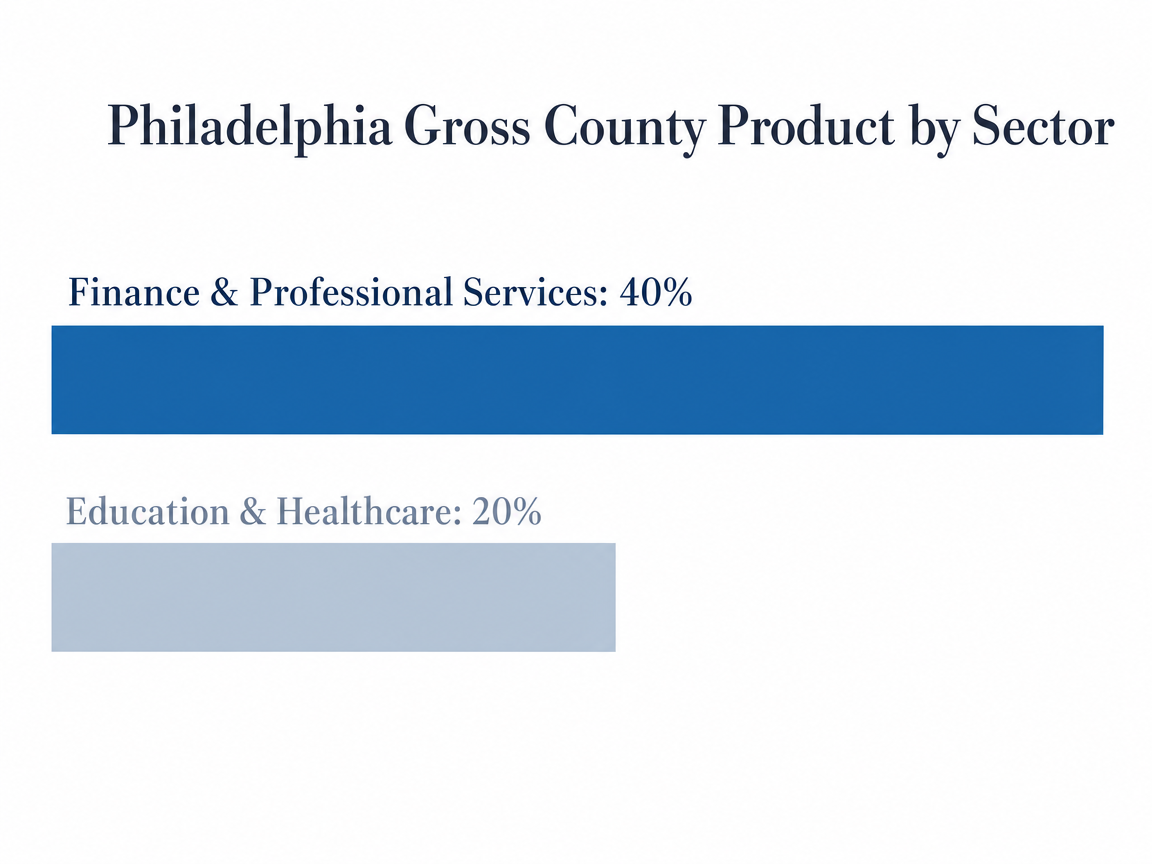
Philadelphia runs on people whose calendars don't bend. The city's economic composition makes that plain: finance accounts for roughly 21% of gross county product, professional services for about 19%, and education and healthcare together for approximately 20%, with education and healthcare representing nearly one-third of all employment 3. That is not an abstract pie chart. That is a managing partner at a Market Street firm, a cardiologist at Penn, a general counsel in a Rittenhouse tower, a dean on Walnut, a biotech founder whose investor update is due Thursday.
When you sit inside one of those roles, the usual recovery playbook feels impossible. Thirty to ninety days away. A new area code. A gap in your calendar that colleagues will notice before they ask. For a hospital system leader on call, or a partner in the middle of a deal cycle, that gap isn't just inconvenient. It is a signal you cannot afford to send.
That is why a traveling associate model fits here. You stay in your home. You keep your clinicians, your cardiologist, your therapist, your children's school pickup. The associate shows up where you already are: Rittenhouse, Society Hill, Center City, University City, the Main Line, a quiet corner office after everyone else has gone home.
None of this is a workaround for serious clinical care. It is a way to make serious care survivable alongside the life you have built. The first honest step is admitting that your life doesn't pause just because you need help. The next is finding support that doesn't ask it to.
A Citywide Risk, Not a Neighborhood Problem
There is a story the headlines sometimes tell about Philadelphia overdoses, and there is the story the data actually tells. They are not the same, and if you are the person on the other end of this screen, you deserve the real one.
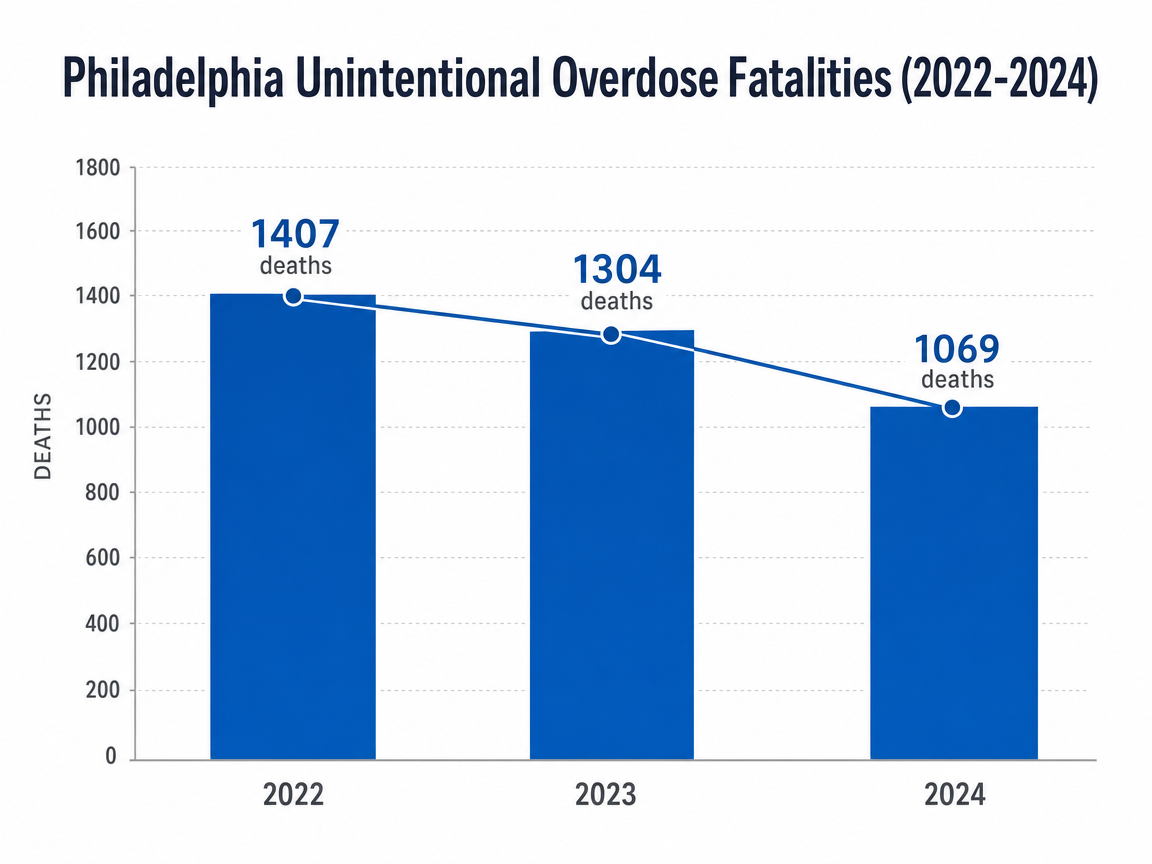
Philadelphia recorded 1,069 unintentional overdose fatalities in 2024, down from 1,304 in 2023 and 1,407 in 2022 5. That is a meaningful decline. It is also not a finish line. Opioids were detected in 77% of 2024 deaths, stimulants in 70%, and both opioids and stimulants together in 50% 5. Deaths involving stimulants alone rose 8.6% year over year 5. The crisis is changing shape, not leaving.
The geography matters too. In 2024, 59% of Philadelphia ZIP codes recorded at least ten overdose deaths 6. That is most of the city. Not one corridor. Not one demographic. The burden is unevenly distributed and has fallen hardest on specific communities, with 42% of 2024 deaths among non-Hispanic Black residents and 15% among Hispanic residents 6. Nothing about those numbers lets an affluent address off the hook.
This is why staying close to a local clinical team matters, and why having someone who can be in the room, drive to an appointment, or sit through a hard evening is not a luxury layer. It is the quiet, practical response to a risk pattern that doesn't respect ZIP codes.
What a Concierge Recovery Associate Actually Does
A Day in Rittenhouse, Society Hill, or the Main Line
Picture a Wednesday. The associate arrives at your building before the coffee shop opens, and the doorman thinks it's a cousin or a family friend. That's the point. No scrubs, no clipboard, no badge.
What happens next depends on where you are in your week. Some mornings it looks like a long walk through Rittenhouse Square and a conversation about why last night was harder than Monday. Other mornings it is a quiet ride to a 9:00 appointment with your psychiatrist in University City, waiting in the car with a book, then lunch at your kitchen table so you don't eat alone. On a Society Hill evening, it might be sitting in the living room during a difficult call with your sister, then helping you draft the text to your sponsor you've been avoiding.
On the Main Line, where distance and privacy stack up differently, the associate might stay through dinner, take the car keys when you ask them to, and be there when the kids come home from practice so the house still feels normal.
The work is coordination, structure, and presence. Confirming a buprenorphine refill is picked up. Making sure the family therapist and the outpatient program are talking to each other. Reinforcing the care plan your clinicians wrote, not inventing one 13. Small wins, done on purpose. Keeping one appointment. Telling one person. Going to bed sober on a Thursday.
Scope of Practice: Associate, Clinician, Housing
Here is where honesty matters more than marketing. A concierge recovery associate is not a clinician, and the service is not a replacement for licensed treatment or a licensed residential program. Blurring those lines does damage, especially for a client whose career depends on knowing exactly who is doing what.
Three distinct roles sit side by side in a well-run Philadelphia engagement, and each has its own rules.
- Concierge recovery associate.
- This role falls within what SAMHSA describes as recovery-support services: social support, coordination, linkage to providers, and reinforcement of a care plan written by clinicians 13. The associate drives you to appointments, sits with you through hard hours, helps the family communicate, keeps the week structured, and acts as the connective tissue between your clinical team and your daily life. The associate does not diagnose, prescribe, taper medication, or deliver therapy.
- Pennsylvania-licensed SUD treatment provider.
- Assessment, levels of care, medication management, counseling, and formal treatment belong here. Under Act 70, Pennsylvania SUD treatment providers must align service delivery with the ASAM Criteria, and entities providing SUD treatment services in Pennsylvania must be licensed by DDAP 7. That is your psychiatrist, your outpatient program, your intensive outpatient team, your medication prescriber. The associate works around their plan, not in place of it.
- Licensed recovery housing.
- This is a separate category again. Recovery or sober-living housing that receives referrals from state agencies or state-funded facilities, or that receives public funding, must be licensed by DDAP, and licensed halfway houses are expected to support recovery, daily living, community integration, and access to transportation 12. A mobile associate working with you in your own Rittenhouse apartment or Villanova home is not a halfway house, does not function as one, and should never be sold as one.
Keep those three columns straight and the rest of the conversation gets easier. You can hire the associate without surrendering your clinicians, and you can keep your home without being told to pack a bag for a sober-living bed you don't need.
Privacy, Honestly: What Pennsylvania and Federal Law Actually Protect
Privacy is where this conversation deserves the most honesty, because it is where most marketing becomes least truthful. No one can promise you absolute secrecy. What can be described, clearly, is what the law actually protects, who it binds, and where the real seams are.
Start with the record itself. In 2022, Pennsylvania passed Act 33, which aligned the state's substance use disorder confidentiality requirements with federal law 10. Those protections apply to records prepared or obtained by SUD treatment providers and medical providers 10. The federal layer underneath, 42 CFR Part 2, is stricter than general health-privacy rules. It governs what a treatment provider can share, with whom, and under what written authorization. The DDAP guide spells out the operational version: information systems may not disclose identifiable client-oriented data, and any disclosure has to fit a legal exception or a signed authorization 11.
Here is the part that matters for a concierge model. Those confidentiality rules attach to treatment records held by licensed providers. A recovery associate traveling to your Rittenhouse apartment is not a treatment provider in that regulatory sense. The associate operates under a private contract with you, with written confidentiality terms you can read before you sign. That is a different kind of promise than Part 2 coverage, and anyone selling you on this work owes you the distinction out loud.
What that looks like in practice: your psychiatrist's chart notes, your outpatient program's assessments, your medication records — those sit inside the Part 2 and Act 33 framework and cannot move without your written authorization 10, 11. The associate's work alongside them is governed by the contract you sign, the professional standards of their role, and the care taken at the front door, in the elevator, in the car, and in any conversation with your family or your office.
Ask three questions before you hire anyone.
- Who holds the records, and under what law?
- What exactly am I authorizing in writing, and can I revoke it?
- What are the known exceptions — court orders, medical emergencies, mandated reporting — that no provider can contract away?
If the answers are clear and specific, you are talking to someone serious. If the answers are a brochure, keep looking.
Insight Beyond Treatment
At Next Level Wellness & Behavioral Health, we believe meaningful change starts with perspective, not just protocols.
That philosophy is directly led by Amanda Marino, whose voice in behavioral health extends beyond clinical settings into leadership, culture, and personal growth.
Through keynote speaking and live events, Amanda explores the deeper themes that show up in recovery, family systems, and life transitions: authenticity, resilience, accountability, and the courage to change. Her work invites audiences to move past labels and into honest conversations that create lasting impact.
Fitting the Work Around a Local Care Team
Why Local Navigation Has Value Here
Philadelphia has excellent clinicians. It also has access friction that even sophisticated patients underestimate until they are trying to make a Tuesday appointment on a Friday afternoon.
A 2025 secret-shopper study from the University of Pennsylvania's Leonard Davis Institute found a median wait of three business days for a buprenorphine appointment across Philadelphia clinics, and most clinics did not provide complete information about when a prescription would actually be written or what the client would need to do to stay in medication treatment 18. Three days sounds short on paper. If you have been up since 4 a.m. with someone who is sick, it is not short.
That is where a traveling associate earns their keep. Not by diagnosing, not by prescribing, but by making the calls that keep slipping down your to-do list.
- Confirming which intake form the practice needs by 8 a.m. tomorrow.
- Riding with you to the appointment so the car isn't the obstacle.
- Writing down what the prescriber said after you walked out of the office with half of it already gone from your head.
- Looping your family therapist in so no one is working from a different version of the plan.
This is the connective tissue work SAMHSA describes when it defines recovery-support services: coordination among allied providers, social support, and linkage to care that complements clinical treatment rather than replacing it 13. In a city where appointment logistics and information gaps are measurable, that connective tissue is not a luxury. It is often the difference between a plan that exists and a plan that actually happens.
Detox, Medication, and Continuing Care
Three things get confused in family conversations about recovery, and the confusion costs people time they do not have. Detox is not treatment. Medication is often the treatment. Continuing care is where most of the actual work lives.
Detoxification matters when it is clinically indicated, and it has to be medically supervised when the substance and the body require it. But detox alone is not sufficient treatment for substance dependence; federal clinical guidance has been clear on this for years and describes it as one part of a continuum of care 15. If someone in your life has been through a hospital detox twice and relapsed within weeks, that is not a character failure. That is what happens when the stabilization step is treated as the whole answer.
For opioid use disorder specifically, NIDA states that medication is generally the first-line treatment, usually combined with behavioral therapy or counseling, and that treatment should be tailored to each patient's drug-use patterns and related medical, mental-health, and social problems 16. A concierge associate does not prescribe or manage that medication. A Pennsylvania-licensed prescriber does. What the associate can do is help the medication actually get taken, the follow-up actually get kept, and the family actually understand why both matter.
Then there is the long middle. NIAAA recommends planning for ongoing support after the initial treatment plan ends and preparing in advance for what to do if a relapse occurs 17. For an executive going back to a trading floor, a hospital rotation, a courtroom, or a 60-hour week, that plan is not a nice-to-have. It is the structure that keeps a good week from quietly becoming a bad one. The associate helps you build it, write it down, and use it when Thursday night gets hard.
The Physician and Healthcare-Leader Question
If you are a physician, a hospital system executive, a department chair, or a nurse leader in Philadelphia, this section is for you. The reasons you have not called anyone yet are specific, and they deserve a specific answer.
The AMA has reported that more than 40% of physicians do not seek help for burnout or depression because of concerns about disclosure, professional reputation, and licensing consequences 19. That figure is about burnout and depression broadly, not substance use alone, and it is national rather than Philadelphia-specific. But the mechanism is the same one keeping a Penn attending, a CHOP fellow, or a Jefferson vice president from making the first call. The 2023 physician burnout rate sat at 48.2%, and while more than 30 state medical or health licensing boards and over 500 hospitals have revised intrusive application language, the reforms are uneven and the fear is rational 20.
That is not career protection. It is breathing room. For a clinician who has been running on 48.2% fumes, breathing room is where the first real decision gets made.
What the First 72 Hours Can Look Like
The first three days set the tone for everything after. They do not have to be perfect. They have to be real.
Hour one. A phone call, usually from a spouse, a chief of staff, or the person themselves at a kitchen island with the lights still on. Someone listens. No forms yet. The goal of the conversation is to understand what is actually happening tonight, what is already in place, and what cannot wait until morning.
The first 24 hours. If medical stabilization is needed, you are routed to a Pennsylvania-licensed clinician who can assess that, because detox is a medical event and not something an associate handles 15. If the situation is urgent but not medical, an associate can be in your home the same day. Written confidentiality terms are reviewed before anything else begins, and you decide what the associate may discuss with your family, your clinician, or anyone else 11.
Day two. The schedule gets built. Appointments confirmed. Medications accounted for. If a buprenorphine intake is part of the plan, someone makes the call and clarifies what the practice actually needs 18. Your existing clinicians stay yours.
Day three. A written continuing-care outline, built with your team, including what to do if a bad night comes 17. Not a cure. A structure. The quiet start of the long middle, where recovery actually happens.
Frequently Asked Questions
Is a concierge recovery associate the same as a therapist or clinician?
No. An associate provides recovery-support work: accompaniment, structure, coordination with your providers, and reinforcement of a care plan written by clinicians 13. Assessment, diagnosis, therapy, and medication management belong to Pennsylvania-licensed SUD treatment providers operating under Act 70 and the ASAM Criteria 7. The two roles work alongside each other. Anyone selling you one as the other is blurring a line that matters.
Can I stay in Philadelphia and keep working while receiving support?
Yes, and that is the premise of the model. The associate travels to your home or office in Center City, Rittenhouse, Society Hill, University City, or the Main Line, and the schedule gets built around your calendar instead of the other way around. Your Pennsylvania-licensed clinical team handles treatment 7. NIDA emphasizes that recovery works best when it accounts for work, family, and medical realities 16.
How is my privacy actually protected under Pennsylvania and federal law?
Act 33 of 2022 aligned Pennsylvania's SUD confidentiality rules with federal law, including 42 CFR Part 2 10. Those protections attach to records held by SUD treatment and medical providers, and disclosures require a signed authorization or a specific legal exception 11. A concierge associate operates under a private contract with written confidentiality terms. Court orders, medical emergencies, and mandated reporting sit outside any contract. Ask who holds what, and under which law.
Will this work alongside my current doctor or treatment program?
That is the point. You keep your psychiatrist, your outpatient program, your prescriber, your therapist. The associate helps the pieces talk to each other, confirms appointments, and reinforces the plan your clinicians wrote 13. In a city where a Penn LDI study found appointment logistics and treatment information often incomplete, that coordination work has measurable local value 18. Nothing moves without your written authorization.
I'm a physician or healthcare leader. Can you really keep this away from my licensing board?
No one honest will promise that. Mandated reporting, court orders, and medical emergencies cannot be contracted away 11. What the model offers is different: care in your home instead of a waiting room with your residents in it, coordination with a Pennsylvania-licensed clinician you choose, and a structure that doesn't generate the paper trail an intake at your own health system would. The AMA has documented that disclosure fears keep more than 40% of physicians from seeking help 19.
What happens in the first 72 hours after we reach out?
A phone call first. Someone listens before any forms. If medical stabilization is needed, you are routed to a Pennsylvania-licensed clinician, because detox is a medical event 15. If not, an associate can be in your home the same day. Day two builds the schedule and confirms medications. Day three produces a written continuing-care outline with your team, including a plan for a bad night 17.
References
- City of Philadelphia, Pennsylvania. https://www.phila.gov/media/20250519125628/annual-comp-financial-report-FY-2024.pdf
- City of Philadelphia Workforce Development Annual Report. https://www.phila.gov/media/20250909084427/Workforce-Development-Annual-Report-FY24.pdf
- Philadelphia's $570.5 Million City Service Agreement Revenue And .... https://www.phila.gov/media/20250908141556/bond-ratings-general-bonds-sp-2025-09-04.pdf
- Philadelphia Life Sciences Impact Report. https://www.phila.gov/media/20240909103127/Philadelphia-Life-Sciences-Impact-Report-Department-of-Commerce.pdf
- Unintentional Drug Overdose Fatalities in Philadelphia, 2024. https://www.phila.gov/media/20260512093123/health-chart-v1-e1-overdose-fatalities.pdf
- Unintentional drug overdose fatalities in Philadelphia in 2024 | Board of Health. https://www.phila.gov/2026-05-11-unintentional-drug-overdose-fatalities-in-philadelphia-in-2024/
- Operationalizing ASAM's 3rd Edition in Pennsylvania. https://www.pa.gov/content/dam/copapwp-pagov/en/ddap/documents/professionals/documents/asam-page/asam-update/operationalizing-asam-3rd-edition-in-pennsylvania-a-guide-for-providers.pdf
- OMHSAS-25-05 Behavioral Health Clinic Services Provided Outside of the Clinic. https://www.pa.gov/content/dam/copapwp-pagov/en/dhs/documents/docs/publications/documents/forms-and-pubs-omhsas/omhsas-25-05-behavioral-health-clinic-services-provided-outside-of-the-clinic.pdf
- Telemedicine FAQs. https://www.pa.gov/agencies/dos/resources/professional-licensing-resources/telemedicine-faqs
- Confidentiality | Department of Drug and Alcohol Programs. https://www.pa.gov/agencies/ddap/for-professionals/confidentiality
- DDAP Confidentiality Federal State Regulations Guide. https://www.pa.gov/content/dam/copapwp-pagov/en/ddap/documents/documents/agency-publications/confidentiality_federal_state_regulations_guide.pdf
- Housing | Department of Drug and Alcohol Programs. https://www.pa.gov/agencies/ddap/treatment-and-support/housing
- Federal Guidelines for Opioid Treatment Programs. https://library.samhsa.gov/sites/default/files/federal-guidelines-opioid-treatment-pep24-02-011.pdf
- Financing Peer Recovery Support: Opportunities to Enhance the Substance Use Disorder Peer Workforce. https://www.samhsa.gov/sites/default/files/financing-peer-recovery-report-pep23-06-07-003.pdf
- Quick Guide For Clinicians Based on TIP 45 Detoxification and Substance Abuse Treatment. https://nida.nih.gov/sites/default/files/samhsa_detoxification_and_substance_abuse_treatment.pdf
- Treatment and Recovery - National Institute on Drug Abuse. https://nida.nih.gov/publications/drugs-brains-behavior-science-addiction/treatment-recovery
- Step 3—CHOOSE quality care. https://alcoholtreatment.niaaa.nih.gov/how-to-find-alcohol-treatment/step-3-choose-quality-care
- Study Reveals Uneven Access to Buprenorphine Treatment. https://ldi.upenn.edu/our-work/research-updates/research-brief-philadelphia-study-reveals-uneven-access-to-buprenorphine-for-opioid-use-disorder/
- Battling physician burnout one inappropriate form at a time. https://www.ama-assn.org/practice-management/physician-health/battling-physician-burnout-one-inappropriate-form-time
- When will physicians feel safe seeking mental health care?. https://www.ama-assn.org/practice-management/physician-health/when-will-physicians-feel-safe-seeking-mental-health-care
A Voice Shaping the Conversation
The topics explored here—change, self-awareness, recovery, and growth—are the same themes Amanda Marino brings to audiences nationwide through speaking engagements and live events.
Known for her appearances on A&E’s Intervention and Digital Addiction, Amanda speaks to organizations, communities, and leadership teams about navigating adversity, embracing vulnerability, and building lives rooted in purpose. Her message resonates far beyond treatment, offering insight that applies to families, professionals, and anyone standing at a crossroads.


Heal on your terms—any time, anywhere.