

Supporting a Loved One: Family Intervention for Schizophrenia

Supporting a Loved One: Family Intervention for Schizophrenia
Key Takeaways
- Family intervention for schizophrenia is a structured, multi-session psychosocial program—not a staged confrontation—built around professional facilitation, peer support, communication skills, coping strategies, and problem-solving 9.
- Named models with trained facilitators consistently outperform loose family counseling, and simpler formats like family psychoeducation often match more elaborate packages on relapse outcomes 2.
- Evidence points to meaningful but not guaranteed benefits: short-term relapse reduction has moderate-to-very-low certainty 1, while caregiver-related outcomes show encouraging gains 3.
- When clinic-based programs aren't available, families can start without their loved one, build a written relapse plan, protect caregiver well-being, and bring structured support into the home.
What families actually mean by 'intervention' here
When your loved one is diagnosed with schizophrenia or early psychosis, the word intervention probably conjures the scene you've watched on television: folding chairs in a hotel conference room, a surprise confrontation, a letter read aloud. That is the addiction-intervention format. It is not what clinicians mean when they talk about family intervention for schizophrenia.
In this context, family intervention is a structured psychosocial program your whole household takes part in, usually alongside your loved one's psychiatric care. You learn what psychosis is and isn't, practice calmer ways of talking during hard moments, build a shared plan for early warning signs, and get real support for the toll this takes on you. The National Institute of Mental Health describes this kind of family education and skills work as a core component of coordinated specialty care for early psychosis, delivered by a team that shares decisions with the person experiencing symptoms and the people who love them 7, 8.
There is no ambush. There is no script that forces a choice in a single evening. There are sessions, often over weeks or months, where a trained facilitator helps your family trade confusion and fear for a working playbook. That shift, from one dramatic conversation to an ongoing one, is the whole point.
The clinical model: five components that make it work
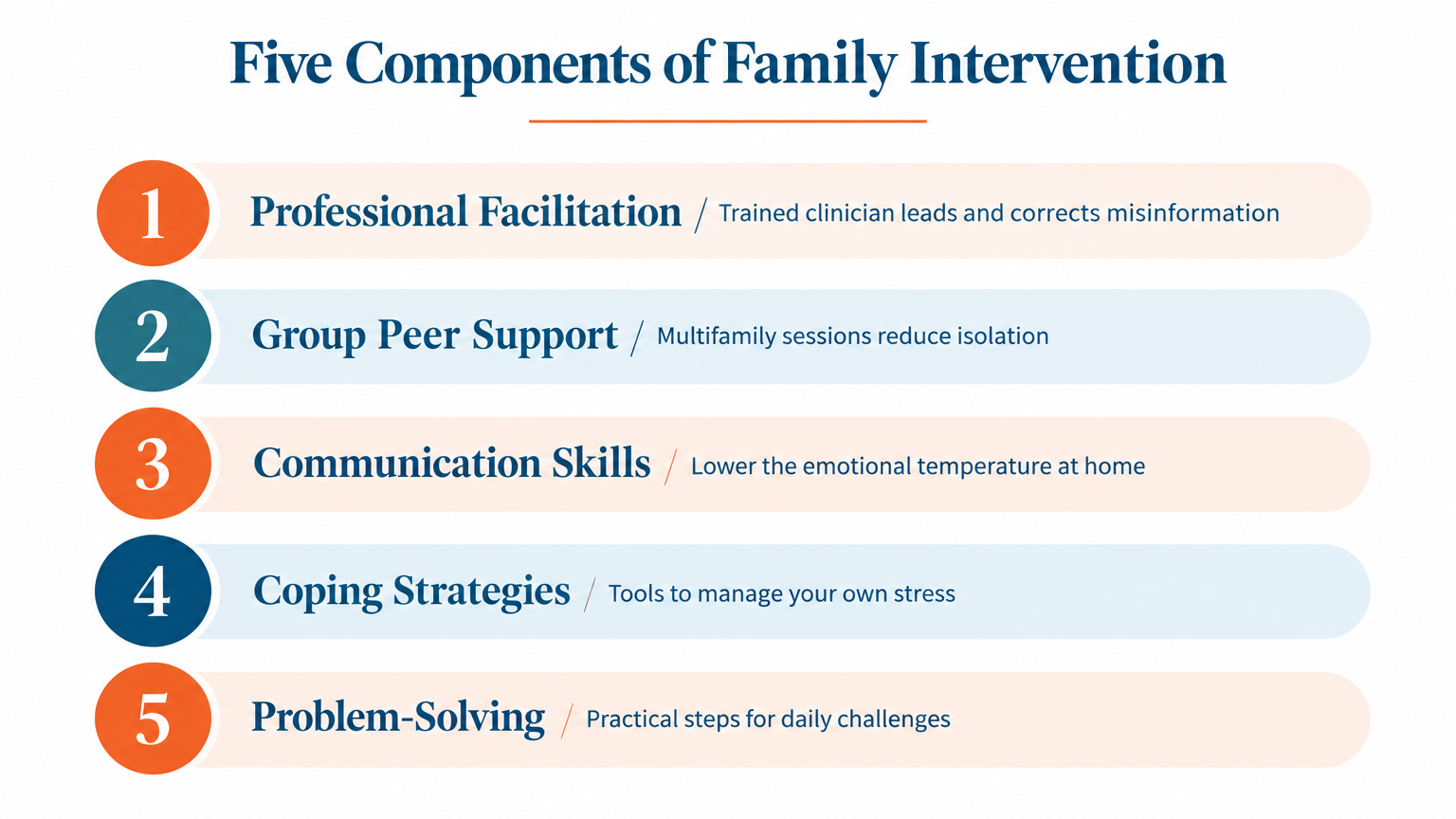
Structured family intervention isn't one technique. It's a bundle of five working parts that researchers have repeatedly identified as the pieces families actually find useful. A mixed-method systematic review of psychoeducational programs for family members of people with schizophrenia pinned down the components relatives value most: skilled professional facilitation, group peer support, communication skills, coping strategies, and practical problem-solving 9. Think of them less as a checklist and more as a loop you keep returning to as circumstances shift.
Professional facilitation. A trained clinician or specialist leads the sessions. Not a well-meaning friend, not a self-help book. The facilitator keeps conversations from spiraling, corrects misinformation about psychosis in real time, and gives your family a steady presence to lean on when a session gets hard 9.
Group peer support. Many programs are multifamily, meaning you sit alongside other households going through something similar. You stop feeling like the only parent whose adult child stopped answering texts, or the only spouse rehearsing what to say before dinner. That shared room matters 9.
Communication skills. You practice how to speak when your loved one is suspicious, withdrawn, or flat. You learn to lower the emotional temperature in the room, a skill set structured family programs consistently emphasize.
Coping strategies. You get tools for your own stress, sleep, and emotional reserves. This isn't a side feature; it's a core component 9. The National Institute of Mental Health frames family education as something that strengthens caregivers' coping as much as it supports the person with the diagnosis 6.
Problem-solving. Each session typically ends with a concrete problem your family brings in—medication routines, boundary-setting, a sibling who won't visit—and a worked plan to try before the next meeting 9.
These five don't run in a straight line. You cycle through them as new episodes, new medications, or new life stages pull different parts forward.
Which model of family intervention actually works
Not every family intervention program is built the same, and the differences matter. The largest comparative analysis to date, a 2022 network meta-analysis of 90 randomized controlled trials involving more than 10,000 participants, lined up multiple models against treatment as usual and tracked relapse at the 12-month mark. Nearly every structured family-involving model outperformed usual care, but the spread between them was wide. Odds ratios ranged from 0.18 for family psychoeducation delivered alone to 0.63 for community-based interventions that involved family members, with other models falling in between 2.
Read that spread carefully. A lower odds ratio means a bigger apparent reduction in the odds of relapse compared with treatment as usual. The surprising finding is that family psychoeducation on its own, the simplest of the models, produced the strongest signal in this analysis. Bigger and more elaborate packages did not automatically win 2. That cuts against the instinct to assume more sessions, more modalities, and longer programs are always better.
A few general categories worth knowing, as grouped in the network meta-analysis:
- Family psychoeducation delivered alone. Structured family-focused education about schizophrenia, delivered without additional complex components.
- Family psychoeducation combined with other components. Education packaged alongside additional elements such as skills training or broader psychosocial support.
- Multifamily group formats. Interventions delivered to several families together rather than one family at a time.
- Community-based interventions involving family members. Family work embedded within broader community mental health approaches 2.
Format matters too. The Schiz'Aides trial tested a brief multifamily program of just six sessions over roughly 1.5 months, showing that a shorter structured format can be feasible in routine care 4. That matters for busy families who cannot commit to a year of weekly sessions.
The practical takeaway: ask any program what model it's based on, how long it runs, whether it's single-family or multifamily, and what the sessions actually cover. If the answer is vague, keep looking. The research is clear that structured, named models with trained facilitators outperform loose family counseling, and the simpler, well-delivered ones often hold their own against more complex packages 2.
What the evidence does and doesn't yet prove
You deserve a straight answer about what this research actually supports, not a brochure version. Here is where the evidence sits right now, and where it still has holes.
The 2024 Cochrane review found a possible short-term reduction in relapse for people whose families participated in a structured intervention, with a risk ratio of 0.66 (95% CI 0.49–0.89). That estimate came from just four randomized trials with 229 participants, and the authors rated the certainty of the evidence as moderate to very low. They explicitly called for larger, better-designed trials before treating the benefit as settled 1. A separate 2024 meta-analysis of 21 studies covering 1,639 caregivers found statistically significant improvements across caregiver-related outcomes—encouraging, with the caveat that most of the included studies carried unclear or high risk of bias 3.
Then there are the trials that pump the brakes. A randomized study of brief family psychoeducation delivered by psychiatric visiting nurses did not produce a significant reduction in caregiver burden 5. The FIRST telehealth trial, which tested up to 16 live web-based sessions for caregivers, found no difference between telehealth psychoeducation and usual care across 12 months on treatment failure, caregiver burden, or physical and mental health functioning. Both groups improved 11.
Why so few families are offered this
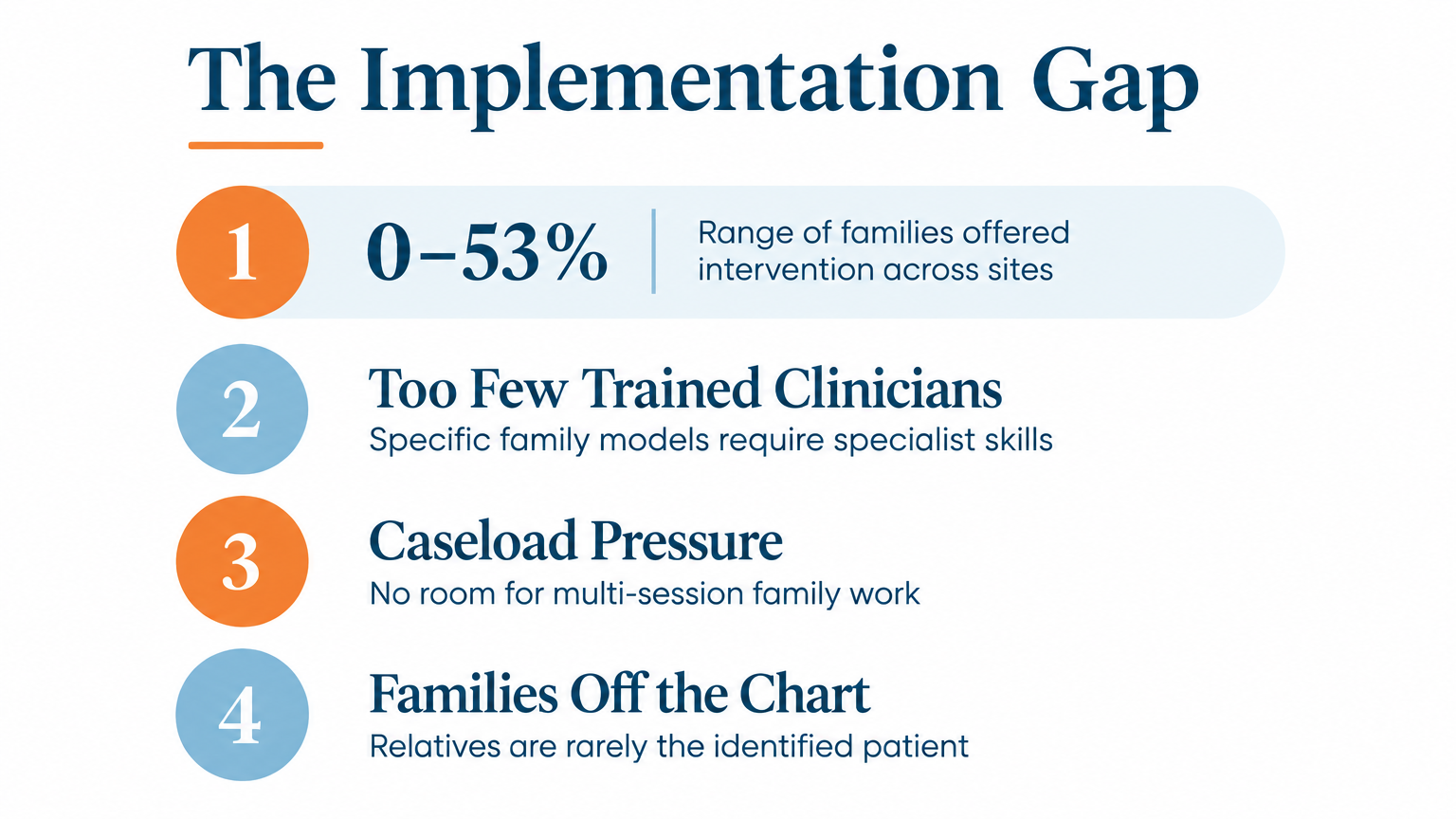
Here is the quiet frustration behind this whole topic: the research supports family intervention, major guidelines recommend it, and most families never get offered it. A systematic review of how recommended psychological interventions for schizophrenia actually show up in routine services found that implementation rates for family intervention ranged from 0% to 53% across sites studied 10. Even in the best-performing settings, roughly half of eligible families walked out of the clinical system without the structured support the guidelines point to. In the worst, nobody did.
The reasons are not mysterious, and none of them are your fault. The same review identified organizational, staff, and service-user barriers: not enough clinicians trained in a specific family-intervention model, caseloads that don't leave room for multi-session family work, time pressures, and the simple fact that family members are often not the ones holding the chart 10. A psychiatrist can prescribe medication in a 20-minute visit. A trained facilitator running weekly family sessions over months is a very different staffing commitment.
So you may hear the phrase family intervention mentioned at discharge, handed a pamphlet, and then find no one available to actually deliver it. That gap is why so many families end up assembling their own support, piece by piece, instead of being handed a program.
A first 90 days roadmap after diagnosis
Weeks 1–2: stabilize the room, not the diagnosis
The first two weeks are not for solving schizophrenia. They are for lowering the temperature in the house so your loved one can sleep, eat, and keep taking whatever medication the psychiatrist has prescribed. That's it. If you try to do more, you'll burn out before the real work starts.
Pick one person in the family to be the point of contact with the psychiatric team. Everyone else routes questions through them. This keeps your loved one from fielding five anxious phone calls a day and keeps the clinical story consistent. Write down medication names, doses, and the next appointment on a single sheet of paper somewhere visible.
Soften the sensory environment. Lower voices, fewer visitors, predictable meals, regular bedtimes. The National Institute of Mental Health frames respectful, steady support as part of what families can offer during this stretch while a clinical plan takes shape 6. Save the big conversations about school, work, and the future for later. Right now, calm is the intervention.
Weeks 3–6: learn the language and build the team
Once the household is steadier, you can start learning. This is where structured family intervention actually enters the picture. Ask the psychiatrist or care coordinator directly: is a family psychoeducation program available through this clinic, and if not, who in the area runs one? If your loved one is in a coordinated specialty care program for early psychosis, family education and skills work are supposed to be built into the model 7, 8.
Start learning the vocabulary your clinical team uses. Positive symptoms, negative symptoms, expressed emotion, prodrome. You don't need to become a clinician, but when you understand the words, you stop feeling like a visitor in your own family's story.
Build the roster now, before you need it in a crisis. Psychiatrist, therapist, case manager, pharmacist, primary care doctor, and whichever family members will share night and weekend calls. Put names, numbers, and after-hours protocols in one shared document. A team you assembled on a quiet Tuesday is worth ten you scramble to find at 2 a.m.
Weeks 7–12: write the relapse plan together
By the third month, you have enough information to write something most families never get around to: a relapse prevention plan, drafted with your loved one, not about them. Relapse planning is one of the active ingredients that structured family programs consistently include, and families report it as one of the most useful parts 9.
Sit down together, ideally with the therapist or case manager in the room, and answer four questions in plain writing:
- Early warning signs. What showed up before the last episode? Sleep changes, withdrawing from friends, suspiciousness, a specific worry that keeps repeating. Your loved one often knows these better than you do.
- What helps. Specific people, places, routines, or coping tools that have worked before.
- What hurts. Triggers to reduce when signs show up: alcohol, certain conversations, overloaded schedules, specific stressors.
- Who to call, in what order. Psychiatrist first, then therapist, then a trusted family member. Include 988 Suicide & Crisis Lifeline and 911 for safety emergencies.
Keep the document to one or two pages. Review it every few months. A written plan drafted in a calm week is far easier to follow when things get loud.
What to say during a psychotic episode (and what to skip)
When your loved one is in the middle of an episode—hearing voices, convinced of something that isn't happening, or so frightened they can't track your words—your job isn't to argue them back to shared reality. It's to keep them, and you, safe enough to get through the next hour.
Speak slowly. Use short sentences. Lower your voice rather than raising it, even if theirs is climbing. Say their name. Stand or sit where they can see you, not behind them, and give them more physical space than feels natural. If you can, move to a quieter room with fewer people and less noise.
What to say sounds smaller than you'd expect. I'm here. You're safe. I believe this is scary for you. You don't have to agree that the voices are real to acknowledge that the fear is. Validating the emotion is not the same as confirming the content.
Skip the debate. Arguing a delusion rarely softens it and often sharpens the sense that no one is on their side. Skip ultimatums, raised voices, and crowds of relatives trying to help at once. If there is any threat of harm to your loved one or anyone else, call 988 for the Suicide & Crisis Lifeline, or 911 if the situation is immediately dangerous.
When your loved one refuses treatment
This is the hardest version of the problem, and it's more common than clinicians often acknowledge. Your loved one may not believe they are sick, may distrust the medication, or may simply be exhausted by appointments. Refusal is not stubbornness aimed at you. It's often part of the illness itself, or a reasonable reaction to a system that has moved too fast.
Here is the quieter truth: family intervention doesn't require your loved one's participation to help. The structured programs are designed for you. You can start psychoeducation, practice calmer communication, and build a relapse plan on your own, and research on these components points to encouraging effects across caregiver-related outcomes even when the person with the diagnosis is not in the room 3, 9. A calmer, better-informed household often becomes the thing that eventually makes treatment feel safer to re-enter.
Keep the door open rather than forcing it. Stay connected on neutral ground—shared meals, a walk, a show you both like. Ask what they think would help, and listen without correcting. If there is any threat of harm to themselves or others, call 988 for the Suicide & Crisis Lifeline, or 911 for immediate danger.
Caring for the caregiver
You cannot run a steady household on an empty tank. The research on family intervention is clear that caregiver outcomes matter in their own right, not just as a lever for your loved one's recovery. The 2024 meta-analysis of 21 studies covering 1,639 caregivers found statistically significant improvements across caregiver-related outcomes when caregivers had access to structured psychoeducation 3. Translated: when you get real support, you tend to feel steadier, and the room often gets calmer.
So treat your own care as part of the clinical plan, not a luxury you'll get to later. Protect your sleep like it's a prescription. Keep one or two friendships that have nothing to do with the diagnosis. Find a therapist of your own, or a caregiver support group where you don't have to explain what psychosis is before you can talk about your week. The National Institute of Mental Health frames caregiver coping as a central aim of family education, not a side effect 6.
Guilt will try to tell you that rest is abandonment. It isn't. A caregiver who sleeps, eats, and has somewhere to put their own fear is the caregiver your loved one actually needs next month.
When private, in-home support fills the gap
If the structured family programs the guidelines recommend aren't available where you live, or the waitlist stretches past the point your family can hold, private concierge support exists to fill that gap. This is the practical reality behind the implementation numbers: a psychiatrist can hand you a referral, but there may be no one trained in a specific family-intervention model within an hour of your home, and no multifamily group accepting new participants until spring.
Private in-home support can bring the active ingredients to your kitchen table rather than asking you to find them in a clinic. A trained specialist can run psychoeducation sessions with your family, coach communication during real conversations with your loved one, help you draft and rehearse the relapse plan, and sit with you through the hard weeks between psychiatry appointments 9. For families who need discretion, flexible hours, or support that travels with them, this model answers a question the public system often cannot.
It is not a replacement for your loved one's psychiatric care. It is the scaffolding around it, built to your household's actual schedule.
Starting a confidential conversation
You didn't sign up for this role, and you shouldn't have to figure it out alone at midnight. If structured family support hasn't been handed to you, or the version offered doesn't fit your household's privacy, schedule, or geography, a confidential conversation with a concierge behavioral health team can help you map what's actually available to your family.
Next Level Wellness & Behavioral Health, founded by Amanda Marino, works with families and the professionals who refer them—psychiatrists, attorneys, wealth managers—to build discreet, in-home support around existing psychiatric care. Call Next Level when you're ready to talk through options, no commitment required. Creating Lasting Change starts with one quiet conversation.
Frequently Asked Questions
Is family intervention for schizophrenia the same as a staged confrontation?
No. The televised addiction-intervention format is a single staged confrontation. Family intervention for schizophrenia is a structured psychosocial program delivered over multiple sessions, where a trained facilitator teaches your family about psychosis, communication, and relapse planning alongside your loved one's psychiatric care 7, 8.
How long does a structured family intervention program usually last?
It varies by model. Many evidence-based programs run several months of regular sessions. Shorter formats exist too—the Schiz'Aides trial tested a brief multifamily program of six sessions over roughly 1.5 months and showed shorter structured formats can be feasible in routine care 4. Ask any program upfront how many sessions it includes.
Does family intervention actually reduce relapse?
The research points that direction, with caveats. The 2024 Cochrane review found a possible short-term relapse reduction with a risk ratio of 0.66 (95% CI 0.49–0.89), drawn from four trials and 229 participants, with certainty rated moderate to very low 1. It's one of the better-supported psychosocial options, but the authors called for larger trials before treating the benefit as settled.
What should we do if our loved one refuses to participate?
Start without them. Structured family programs are designed to help you, and the components—psychoeducation, communication skills, relapse planning—can benefit caregivers across caregiver-related outcomes even when the person with the diagnosis isn't in the room 3, 9. A calmer, better-informed household often becomes what makes treatment feel safer to re-enter later. Keep the door open; don't force it.
When should we call 988 or 911 instead of trying to handle it at home?
Call 988, the Suicide & Crisis Lifeline, when your loved one is talking about suicide, self-harm, or is in acute psychiatric distress you can't de-escalate. Call 911 when there is immediate danger—a weapon, a threat of violence toward themselves or someone else, or a medical emergency. You don't need to be certain. Err on the side of calling.
Can family intervention happen privately at home instead of in a clinic?
Yes. The active ingredients—trained facilitation, psychoeducation, communication coaching, problem-solving, relapse planning—can be delivered in your home by a qualified specialist 9. Private in-home support often fills the gap left by routine services, where implementation of recommended family intervention has been reported anywhere from 0% to 53% of eligible families 10. It works alongside, not in place of, psychiatric care.
References
- Family-based interventions versus standard care for people with schizophrenia. https://pubmed.ncbi.nlm.nih.gov/39364773/
- Family interventions for relapse prevention in schizophrenia: a systematic review and network meta-analysis. https://pubmed.ncbi.nlm.nih.gov/35093198/
- Effects of Psychoeducation on Caregivers of Individuals Experiencing Schizophrenia: A Systematic Review and Meta-Analysis. https://www.ncbi.nlm.nih.gov/pubmed/39252184
- Family psychoeducation to improve outcome in caregivers and patients with schizophrenia: a randomized clinical trial. https://pmc.ncbi.nlm.nih.gov/articles/PMC10326382/
- Effects of brief family psychoeducation on family caregiver burden of persons with schizophrenia: a randomized controlled trial. https://pmc.ncbi.nlm.nih.gov/articles/PMC11177502/
- Schizophrenia. https://www.nimh.nih.gov/health/publications/schizophrenia
- Understanding Psychosis. https://www.nimh.nih.gov/health/publications/understanding-psychosis
- Recovery After an Initial Schizophrenia Episode (RAISE). https://www.nimh.nih.gov/research/research-funded-by-nimh/research-initiatives/recovery-after-an-initial-schizophrenia-episode-raise
- Psychoeducational interventions for family members of people with schizophrenia: a mixed-method systematic review. https://pubmed.ncbi.nlm.nih.gov/24434103/
- A systematic review of the implementation of recommended psychological interventions for schizophrenia: Rates, barriers, and improvement strategies. https://pubmed.ncbi.nlm.nih.gov/26537838/
- Telehealth-Based Psychoeducation for Caregivers: The Family Intervention in Recent-Onset Schizophrenia Treatment (FIRST) Study. https://pmc.ncbi.nlm.nih.gov/articles/PMC9055490/
- Culturally adapted family intervention for people with schizophrenia. https://pmc.ncbi.nlm.nih.gov/articles/PMC10061709/
Insight Beyond Treatment
At Next Level Wellness & Behavioral Health, we believe meaningful change starts with perspective, not just protocols.
That philosophy is directly led by Amanda Marino, whose voice in behavioral health extends beyond clinical settings into leadership, culture, and personal growth.
Through keynote speaking and live events, Amanda explores the deeper themes that show up in recovery, family systems, and life transitions: authenticity, resilience, accountability, and the courage to change. Her work invites audiences to move past labels and into honest conversations that create lasting impact.
A Voice Shaping the Conversation
The topics explored here—change, self-awareness, recovery, and growth—are the same themes Amanda Marino brings to audiences nationwide through speaking engagements and live events.
Known for her appearances on A&E’s Intervention and Digital Addiction, Amanda speaks to organizations, communities, and leadership teams about navigating adversity, embracing vulnerability, and building lives rooted in purpose. Her message resonates far beyond treatment, offering insight that applies to families, professionals, and anyone standing at a crossroads.


Heal on your terms—any time, anywhere.