

How Much Does an Interventionist Cost? Fees Explained

Key Takeaways
- Industry estimates place standard interventions in the $2,500 to $3,500 range, while complex engagements commonly start near $7,500, with travel, clinical complexity, family size, discretion needs, and follow-up length driving the final number.
- A complete engagement typically covers scoped work across assessment and family prep, the facilitated meeting, treatment placement coordination, transport or safe escort, and a defined post-intervention follow-up window.
- Interventionist fees are almost always private pay; 2024 federal parity rules govern covered benefits but do not create insurance coverage for private intervention services 8.
- Judge any proposal by whether scope matches your situation, whether the provider can describe clinical collaboration and privacy posture under HIPAA or 42 CFR Part 2 9in operational terms, and how long follow-up stays open.
The Price Range Families Actually See
If you are reading this at 11 p.m. after a hard day, here is the number you came for: industry estimates place most professionally facilitated interventions in the United States somewhere between $2,500 and $3,500 for a standard case, with more complex engagements commonly starting around $7,500 and climbing from there. Those are indicative industry estimates, not a government fee schedule, and the spread between them is where the real conversation lives.
What moves a quote from the lower band to the higher one is rarely mysterious. Travel distance, how many family members are involved, whether your loved one has co-occurring mental health concerns, the level of discretion you need, and how much coordination the interventionist does after the meeting ends all pull the number in a specific direction. A quiet case down the street with a cooperative family looks very different from an international engagement involving dual diagnosis, legal considerations, and a private flight.
So the useful question is not whether $3,000 or $12,000 is the "right" price. It is what each number actually buys you, and whether the scope matches the situation sitting in your living room.
What You Are Actually Paying For
A professional interventionist's fee is not a flat charge for one afternoon in your living room. It is a scoped engagement that typically covers five distinct pieces of work:
- a pre-intervention assessment and family preparation
- the facilitated meeting itself
- treatment placement coordination
- transport or safe escort to the receiving program
- a defined window of post-intervention follow-up with the family and the receiving clinical team
When you read a proposal, the number at the bottom is the sum of those parts. A quote that looks cheaper on the surface may stop at the meeting and hand the rest back to you. A higher quote may fold placement, transport, and two weeks of follow-up into the same figure. The job of the next few sections is to show you what sits inside each line so you can read any proposal honestly.
Inside a Scope-of-Engagement Quote
Pre-Intervention Assessment and Family Preparation
Before anyone sits in a room with your loved one, a competent interventionist spends real time with you. That usually means intake calls with each participating family member, a history of substance use and any co-occurring mental health concerns, a map of who has leverage and who will escalate the situation, and a rehearsal of what each person will say and bring. This is the part most families underestimate when they look at a quote.
Family preparation is also where the clinical model gets chosen. A well-trained interventionist will know when to borrow from approaches like multidimensional family therapy, behavioral couples and family therapy, brief strategic family therapy, functional family therapy, or solution-focused brief therapy, all of which have federal evidence support for substance use disorder care 2. The preparation hours sit inside the fee; cheaper quotes often shorten them.
The Intervention Day Itself
The meeting is the shortest part of the engagement, and often the most misunderstood. A professional interventionist arrives early, confirms the room setup, reviews letters with family members one more time, and then facilitates a structured conversation designed to move your loved one toward accepting help that day.
What you are paying for in that window is composure under pressure. The interventionist manages tone when voices rise, redirects when a family member drifts into old grievances, and holds a clear path toward the agreed-upon treatment option. If the meeting goes sideways, they already have a contingency script ready. The hours look small on paper. The judgment behind them is why the day commands a fee at all.
Treatment Placement Coordination
Saying yes in the living room is only useful if there is a bed, a program, and an admissions team ready for your loved one the same day. Treatment placement coordination is the quiet logistical work that turns a verbal agreement into a confirmed admission, and it is often where thinner quotes fall apart.
A thorough interventionist pre-vets programs against your loved one's clinical picture, insurance posture, and personal preferences before the meeting ever happens. That means knowing which programs handle dual diagnosis well, which can start medically supervised withdrawal management on arrival, and which align with the behavioral therapies NIDA describes as part of evidence-based treatment and recovery 6. Placement coordination also includes direct handoff conversations with the receiving clinical team so nothing gets lost in translation between your home and theirs.
Transport and Safe Escort
The hours between "I'll go" and arrival at the program are the most fragile in the entire engagement. Transport and safe escort cover that window. For a local admission, this may mean a trained companion driving your loved one directly to intake. For an out-of-state or international placement, it can mean a same-day commercial flight with an escort, or a chartered flight when privacy, timing, or clinical stability demand it.
Travel distance is the single biggest line-item driver here. A sixty-minute drive and a transcontinental flight with an overnight layover are not the same expense, and quotes should itemize them clearly so you know what you are approving.
Post-Intervention Follow-Up
The intervention does not end when your loved one walks through the admission doors. A defined follow-up window is where a scoped engagement either proves its worth or quietly disappears. Expect check-ins with the receiving clinical team during the first days of care, ongoing contact with the family members who were in the room, and guidance on what to do if your loved one leaves the program against clinical advice.
Follow-up is also where family-focused work continues as its own line of support. Peer-reviewed research describes three broad categories a family-based service can serve: promoting treatment entry, involving family members and the person with the substance problem in treatment, and supporting family members in their own right 5. A proposal that stops at the front door of the program is only paying for the first of those three. Ask how long the follow-up window runs and what it includes before you sign.
A Scope-and-Fee Table You Can Read Any Proposal Against
Here is a template you can hold up against any proposal that lands in your inbox. It will not tell you the exact dollar figure a given provider will quote, because no public dataset sets interventionist pricing. What it will do is let you see whether a quote is covering the full scope of work or quietly stopping halfway through.
ComponentWhat It CoversWhat Moves the PriceAssessment & Family PrepIntake calls, history, roles, rehearsal of letters and responsesNumber of family members, co-occurring mental health concerns, prep hoursIntervention DayOn-site facilitation, structured conversation, contingency planningTravel distance, overnight stays, length of meetingTreatment PlacementPre-vetting programs, admissions coordination, clinical handoffDual diagnosis, specialty care needs, same-day bed availabilityTransport & EscortDriver or escort from home to programLocal drive vs. commercial flight vs. private charterFollow-Up WindowCheck-ins with program and family, guidance if your loved one leaves careLength of window, international time zones, family coaching included
Based on indicative industry estimates, a standard case covering most of these components typically falls near the $2,500 to $3,500 band discussed earlier, while a complex engagement starting around $7,500 usually adds international coordination, extended follow-up, or significant discretion requirements. If a quote feels low, find the component that is missing.
What Pushes a Quote From Standard to Complex
Five variables do most of the heavy lifting when a proposal moves from the $2,500 to $3,500 band into complex territory. Learning to spot them in a conversation with any interventionist will tell you quickly whether a quote is reasonable or whether something is missing.
- Travel distance and logistics. An interventionist flying across the country, staying overnight, and escorting your loved one to a program three time zones away is not pricing the same engagement as one driving across the county. International work adds passports, customs, and clinical handoffs across borders.
- Clinical complexity. A co-occurring mental health condition changes the preparation, the room, and the receiving program. Dual diagnosis cases need interventionists who understand the behavioral therapies NIDA describes as part of evidence-based care and can place accordingly 6.
- Family size and dynamics. Six participants with unresolved history require more prep hours than two aligned parents.
- Discretion requirements. Public-facing clients, custody considerations, or professional licensing concerns raise the privacy bar.
- Length of follow-up. A two-week window costs less than a ninety-day one. Ask which you are buying.
The Evidence Behind Family Involvement — and What It Does Not Price
Here is where honesty matters more than marketing. Family involvement in substance use disorder care has real peer-reviewed support, but no study prices a private interventionist. If someone sells you a fee by waving research in your direction, read the research yourself before you nod.
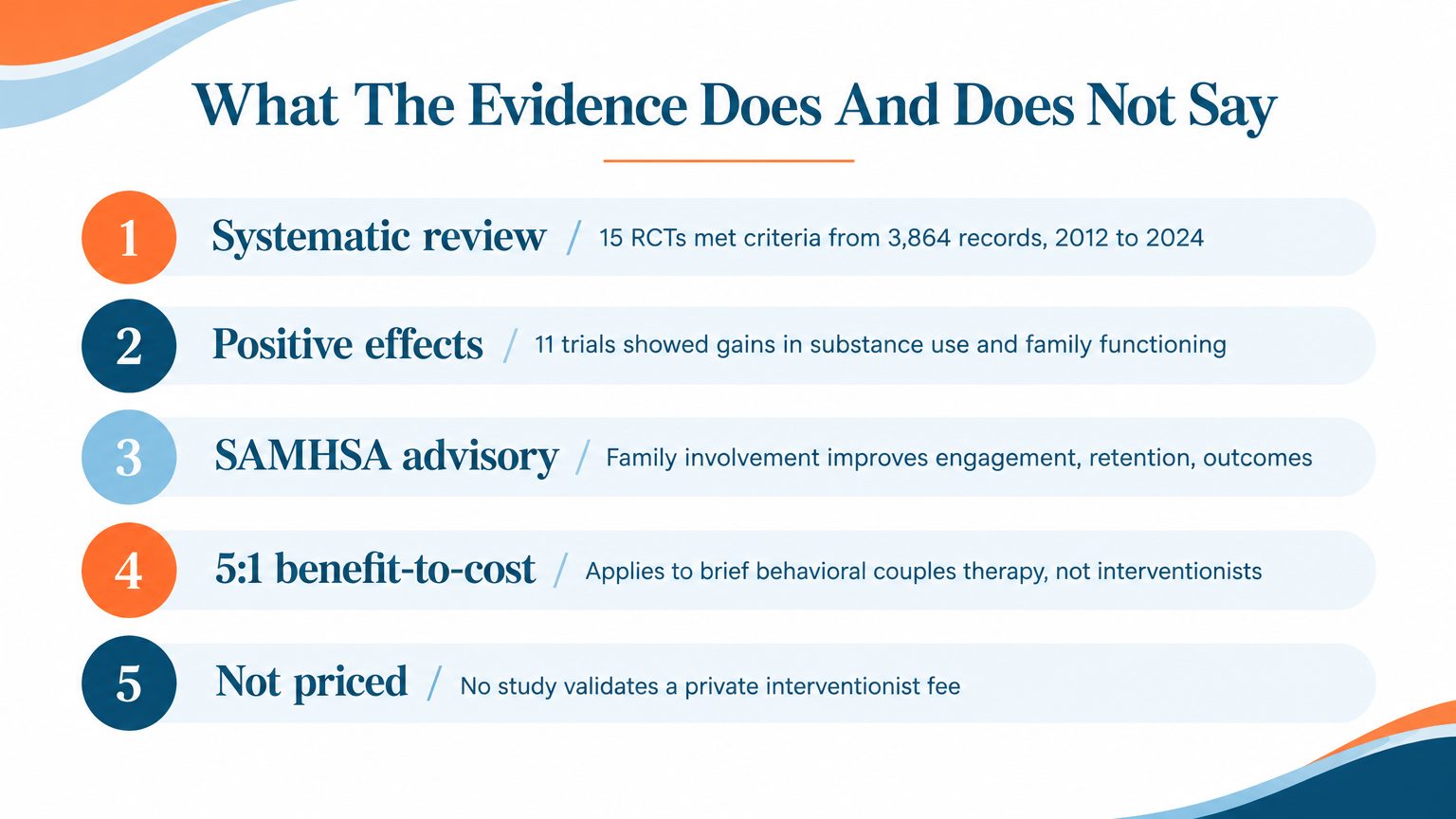
The strongest recent summary comes from a systematic review of randomized controlled trials published between 2012 and 2024. Of 3,864 records identified, 15 trials met inclusion criteria, and 11 reported significant positive effects from family-based interventions on substance use and family functioning 3. That is meaningful signal, and the same authors call for more high-quality trials — a reminder that "family involvement helps" and "this specific provider at this specific fee delivers outcomes" are two different claims.
SAMHSA's broader advisory echoes the first claim: family participation can improve client engagement, retention, and outcomes in SUD care 1. A SAMHSA treatment-protocol exhibit also reports a more than 5:1 benefit-to-cost ratio for brief behavioral couples therapy in one cited study 7. Hold that number in context. It describes a specific couples-therapy model studied in a specific population. It is not a return-on-investment calculation for a private interventionist's fee, and no credible provider should present it that way.
What the evidence does justify is paying for family work that is scoped, clinically informed, and connected to follow-on treatment. What it does not justify is any promise about the day after.
How Age, Setting, and Clinical Complexity Change the Scope
The person you are worried about shapes the fee as much as the logistics do. A 19-year-old living at home with a parent as the primary leverage holder is a very different engagement from a 55-year-old executive with custody considerations and a prescribing psychiatrist already in the picture. The scope changes, so the hours change, so the price changes.
For younger clients, developmental stage and family role matter in specific ways. A 2024 systematic review of 41 studies on family intervention models for young adults reported reductions in behavioral problems and improvements in family functioning when family members were brought into the work 4. Translated into scope: more preparation with parents, more careful handling of siblings, and often a receiving program with age-appropriate programming.
Setting also drives the quote. A home-based meeting with a cooperative family is one thing. A hotel-room facilitation for a client flying in from overseas, or a workplace-adjacent engagement that must preserve a professional reputation, adds hours before the first conversation and after the last handoff. Clinical complexity — co-occurring eating disorder presentations, active psychiatric symptoms, or a history of leaving programs early — asks the interventionist to coordinate with more clinicians and plan for more contingencies. Ask any provider which of these variables apply to your case and how each one shows up in their fee.
Insurance, Private Pay, and Reimbursement Realities
Here is the straight answer: professional interventionist fees are almost always private pay, and your insurance plan is the only authority on what, if anything, might come back to you in reimbursement. Federal parity rules strengthened in 2024 apply to covered mental health and substance use benefits under group health plans, with most provisions beginning with the first plan year on or after January 1, 2025, and certain requirements applying beginning in 2026 8. Those rules address how plans administer benefits they already cover; they do not create a new benefit for private interventionist services.
What this means in practice is simple. The intervention itself is typically out of pocket. The treatment program your loved one enters afterward may be partially or fully covered depending on your plan, the level of care, and in-network status. A thorough interventionist should coordinate with your plan on the placement side and give you a clean invoice you can submit for any possible out-of-network reimbursement on the intervention side. Call your plan before you sign; do not rely on any interventionist to predict what your insurer will do.
Privacy and Discretion: The Questions Behind the Price
Discretion is not an aesthetic. It is a specific set of practices you can ask about, and the answers tell you whether the quote in front of you reflects a serious operation or a casual one. The 2024 final rule modifying 42 CFR Part 2 aligned certain substance use disorder record protections with HIPAA and clarified how records received under consent may be redisclosed 9. That matters because the moment you share your loved one's name with an interventionist, information starts moving.
Ask four concrete questions before you sign:
- What information is collected during the assessment, and where is it stored?
- Who at the receiving program will receive it, and under what consent?
- Is the interventionist operating under HIPAA, 42 CFR Part 2, both, or neither?
- What happens to notes and recordings after the engagement closes?
A provider who answers crisply has thought this through. A provider who waves the questions away is quoting on a different standard than the one your family needs.
Questions to Ask Before You Sign a Proposal
Before you wire a retainer, run the proposal through a short list of pointed questions. The answers will tell you more about the engagement than any price tag.
- What exactly is included in this fee, line by line? You want assessment hours, intervention day, placement coordination, transport, and follow-up itemized or clearly bundled.
- Who personally delivers each piece? Ask whether the person you are speaking with is the one in the room, or whether the work hands off to someone else.
- Which clinical approaches do you draw from, and how do you collaborate with the receiving program? A credible answer references family-based models with federal evidence support 2and a direct handoff to clinicians 6.
- How long is the follow-up window, and what does it include? Two weeks and ninety days are not the same product.
- What happens if my loved one says no, or leaves the program early? You want a plan, not a shrug.
- What is your privacy posture? A specific answer about consent, storage, and record handling tells you how seriously discretion is taken.
If You Are a Referring Professional
A note for the attorneys, psychiatrists, therapists, dietitians, wealth managers, and trust officers reading this on behalf of a client: your client is going to ask what this costs, and a defensible answer sounds different from the one a family member needs. Give the range honestly as indicative, then move the conversation to scope and clinical collaboration.
What strengthens a referral is specificity. Ask the interventionist how they coordinate with prescribing clinicians, how they document consent under HIPAA or 42 CFR Part 2 9, and how placement decisions align with evidence-based behavioral treatment 6. A provider who answers those questions in operational terms is the one you can put in front of a client without hedging.
Deciding Whether the Fee Fits Your Family's Situation
The fee fits when the scope matches what is actually happening in your home, and when the people delivering it can hold the weight of the day. That is a more useful test than any dollar threshold. A $3,000 engagement is expensive if it stops at the meeting and leaves you to find a bed on your own. A $12,000 engagement is reasonable if it includes a dual-diagnosis placement, a cross-country escort, and a ninety-day follow-up window with the receiving clinical team.
Walk the proposal against three honest questions:
- Does the scope cover every component your situation actually needs, or are you quietly being handed the hardest pieces?
- Can the interventionist describe clinical collaboration and privacy posture in operational terms, not slogans?
- Will the follow-up window stay open long enough to matter if your loved one wavers in the first weeks?
When those three answers land cleanly, the number on the invoice tends to make sense.
A Confidential Next Conversation
If you have read this far, you are probably weighing a specific decision for a specific person you love. The number on the invoice matters, and so does what sits behind it: who shows up, how they prepare, where they place your loved one, and how long they stay close after the room clears.
Next Level Wellness & Behavioral Health is a concierge behavioral health firm based in Boca Raton, Florida, serving families nationally and internationally. Founder Amanda Marino built Next Level around the idea that support should fit the family in front of it, before, during, after, or in place of treatment — Creating Lasting Change on terms that make sense for your home. If you are a family member or a referring professional, a confidential call is the next useful step.
Frequently Asked Questions
How much does an interventionist typically cost?
Most standard cases in the United States fall between $2,500 and $3,500, while more complex engagements commonly start around $7,500 and climb from there. Those are indicative industry figures, not a government fee schedule. The exact number depends on scope: how much preparation your family needs, travel logistics, clinical complexity, and the length of the follow-up window you are buying.
What is usually included in an interventionist's fee?
A full-scope fee generally covers five pieces of work: pre-intervention assessment and family preparation, facilitation of the meeting itself, treatment placement coordination, transport or safe escort to the receiving program, and a defined window of post-intervention follow-up with your family and the receiving clinical team. Ask any provider to itemize these line by line before you sign. A lower quote often means one or more components are missing.
Does insurance cover the cost of an interventionist?
Professional interventionist fees are almost always private pay. Federal parity rules strengthened in 2024 govern how plans administer covered mental health and substance use benefits, but they do not create a new benefit for private intervention services 8. Treatment your loved one enters afterward may be partially covered depending on your plan. Call your insurer directly rather than relying on an interventionist to predict reimbursement.
Why do some interventions cost significantly more than others?
Five variables do most of the work. Travel distance, including international logistics, raises the number quickly. Clinical complexity such as co-occurring mental health conditions requires more preparation and specialized placement. Larger families with unresolved history need more prep hours. Discretion requirements for public-facing clients add privacy infrastructure. And a ninety-day follow-up window simply costs more than a two-week one. Ask which variables apply to your case.
Are travel, transport, and treatment placement billed separately?
It depends on the provider. Some fold travel, transport, and placement coordination into one bundled retainer. Others quote a base fee for the meeting and bill transport, flights, lodging, and extended placement work separately. Neither approach is wrong, but you need to know which one you are reading. Ask for a written breakdown so you can compare proposals honestly instead of judging by the headline number.
How do I know if an interventionist is worth the fee?
Judge the engagement by scope and operational specifics, not price alone. A credible provider references family-based clinical approaches with federal evidence support 2, coordinates directly with the receiving program's behavioral treatment team 6, and gives crisp answers about privacy posture under HIPAA or 42 CFR Part 2 9. If they can describe clinical collaboration, follow-up length, and contingency planning in operational terms, the fee tends to make sense.
References
- THE IMPORTANCE OF FAMILY THERAPY Advisory 39. https://library.samhsa.gov/sites/default/files/pep20-02-02-016.pdf
- Executive Summary. https://www.ncbi.nlm.nih.gov/books/NBK571078/?report=classic
- Efficacy of Family-based Interventions in Addressing Substance Use Disorders: A Systematic Review on Randomized Controlled Trials. https://pubmed.ncbi.nlm.nih.gov/41970367/
- Family Intervention Models for Young Adults with Substance Abuse: A Systematic Review. https://pubmed.ncbi.nlm.nih.gov/39564277/
- Family interventions in the treatment of alcohol and drug problems. https://pubmed.ncbi.nlm.nih.gov/16234133/
- Treatment and Recovery. https://nida.nih.gov/publications/science-addiction/treatment-recovery
- Substance Use Disorder Treatment and Family Therapy - NCBI - NIH. https://www.ncbi.nlm.nih.gov/books/NBK571084/box/ch1.b4/
- Departments of Labor, Health and Human Services, Treasury Issue Final Rules Strengthening Access to Mental Health and Substance Use Disorder Care. https://www.cms.gov/newsroom/press-releases/departments-labor-health-and-human-services-treasury-issue-final-rules-strengthening-access-mental
- Fact Sheet 42 CFR Part 2 Final Rule. https://www.hhs.gov/hipaa/for-professionals/regulatory-initiatives/fact-sheet-42-cfr-part-2-final-rule/index.html
Insight Beyond Treatment
At Next Level Wellness & Behavioral Health, we believe meaningful change starts with perspective, not just protocols.
That philosophy is directly led by Amanda Marino, whose voice in behavioral health extends beyond clinical settings into leadership, culture, and personal growth.
Through keynote speaking and live events, Amanda explores the deeper themes that show up in recovery, family systems, and life transitions: authenticity, resilience, accountability, and the courage to change. Her work invites audiences to move past labels and into honest conversations that create lasting impact.
A Voice Shaping the Conversation
The topics explored here—change, self-awareness, recovery, and growth—are the same themes Amanda Marino brings to audiences nationwide through speaking engagements and live events.
Known for her appearances on A&E’s Intervention and Digital Addiction, Amanda speaks to organizations, communities, and leadership teams about navigating adversity, embracing vulnerability, and building lives rooted in purpose. Her message resonates far beyond treatment, offering insight that applies to families, professionals, and anyone standing at a crossroads.



Heal on your terms—any time, anywhere.