

How to Have Someone Committed for Mental Illness: Steps

Key Takeaways
- Involuntary commitment is a court-run legal process, not a family decision, and generally requires evidence of mental illness plus near-term risk of serious harm or inability to meet basic needs 1.
- A diagnosis alone is not enough; the Supreme Court held that a state cannot confine a nondangerous person who can survive safely with willing family or friends 2.
- Match the number to the moment: 911 for immediate danger, 988 for suicidal thoughts, mobile crisis or an ER for escalating psychosis, and a county petition when risk is real but not acute 3, 5.
- Before calling anyone, document the last three incidents with dates, direct quotes, and witnesses, since every state process rewards specific recent facts over labels or diagnoses 10, 12.
- State standards vary widely in who can file, how many clinical certificates are required, the evidentiary burden, and how fast a hearing happens, so start with your county probate or mental health court 1.
- The petition path follows a predictable rhythm: find the right court or screening agency, file with specific observations, allow clinicians to evaluate, and prepare to testify at a hearing 10, 11.
- Less-restrictive alternatives, including voluntary admission, outpatient commitment where available, and a professionally facilitated family conversation, often work better and are something courts expect petitioners to have considered 1, 8.
- Discharge is the most fragile moment; leave with written medications, a first follow-up appointment, and a crisis plan naming 988 and 911 by situation to prevent repeat hospitalizations 3.
What "Having Someone Committed" Actually Means
If you are reading this at an odd hour, worried about someone you love, take a breath. The phrase "having someone committed" sounds like a decision you can make, the way you might call a plumber or sign a form. It is not. Involuntary commitment is a legal process run by courts and clinicians, not by families, and understanding that distinction is the first thing that will steady you tonight.
At its core, civil commitment is a state-law intervention that can lead to short-term inpatient hospitalization or, in some places, supervised outpatient treatment 1. A judge or judicial authority, acting on evaluations by qualified clinicians, decides whether the legal standard is met. Your role is to raise the alarm, document what you have seen, and get your loved one in front of the right professionals. It is a meaningful role, but it is not a unilateral one.
Two things usually have to be true before any court will act. First, there must be evidence of a mental illness as the state defines it. Second, that illness must be causing a near-term risk of serious harm, or in some states an inability to meet basic health and safety needs, and voluntary or less-restrictive options must be insufficient 1. Refusing therapy, making poor choices, or frightening the family does not, by itself, clear that bar.
Knowing what commitment is, and what it is not, lets you spend your energy on the steps that actually move things forward.
The Legal Floor: Why Mental Illness Alone Is Not Enough
Here is the piece most families do not learn until they are already on the phone with a hospital: a diagnosis, by itself, is not a legal reason to hold anyone. In O'Connor v. Donaldson, the Supreme Court was blunt about it, ruling that a state cannot confine a nondangerous person who is capable of surviving safely in freedom alone or with willing family or friends 2. That single sentence sets the floor every state builds on, and it is why your worry, however justified, is not the same thing as a legal threshold.
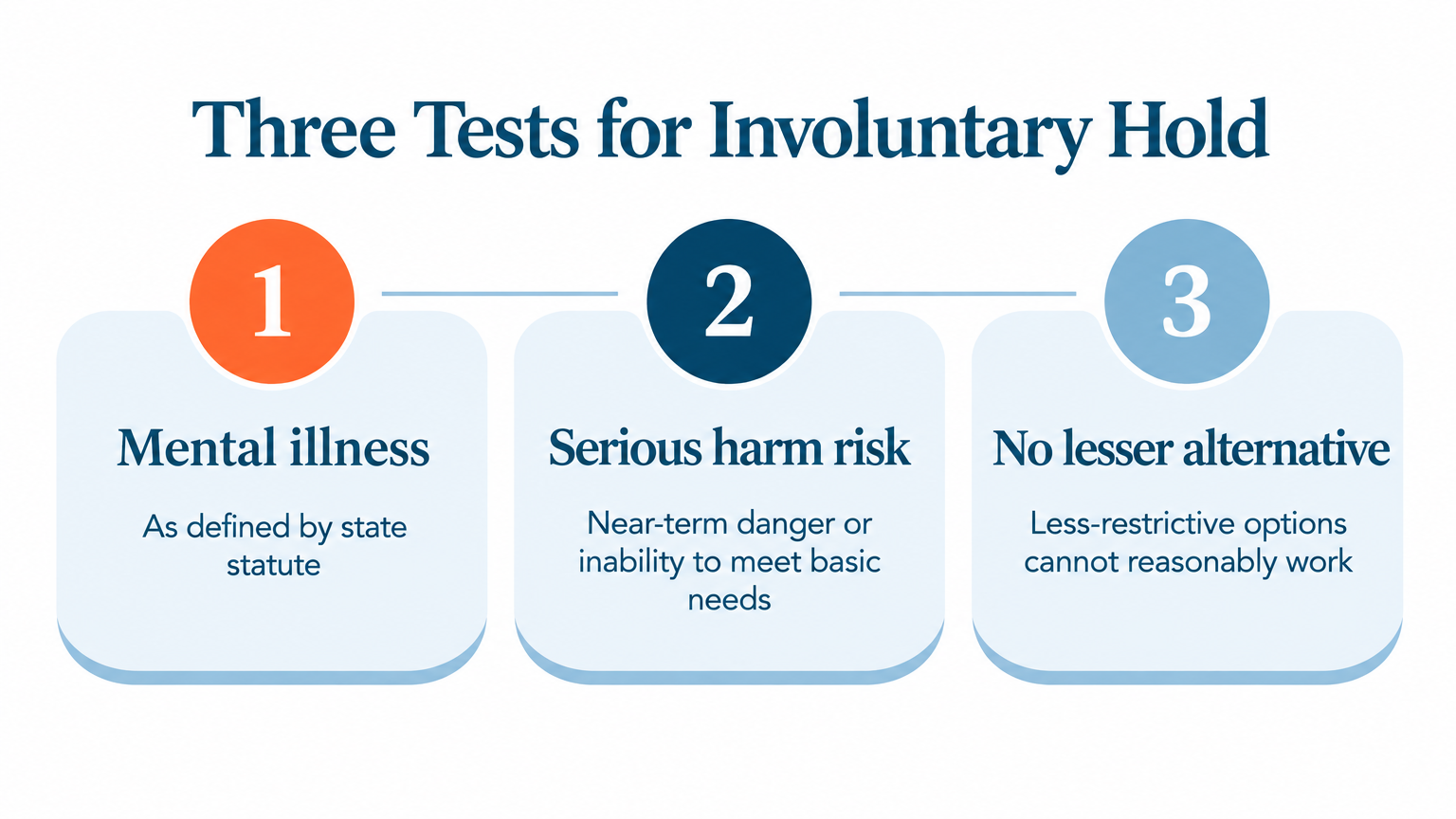
Most state frameworks ask three questions before anyone is held against their will:
- Is there a mental illness as that state defines it?
- Is that illness creating a near-term likelihood of serious harm, or in some states an inability to meet basic health and safety needs?
- Is there no less-restrictive alternative that could reasonably work instead 1?
All three usually have to line up. Massachusetts, for instance, demands proof beyond a reasonable doubt on each prong, which is the same burden used in criminal trials 8.
It helps to notice what is not on that list. Refusing medication is not on it. Quitting therapy is not on it. Drinking too much on a Tuesday, saying cruel things to you, or spending money you cannot afford to lose, none of these clear the bar on their own, no matter how frightening they feel from across the kitchen table.
That gap between what alarms you and what the law recognizes is painful. It is also the reason the next few sections matter so much. When the legal door is narrow, the quality of your observations, the number you call, and the alternatives you line up become the levers you actually control.
Emergency vs. Non-Emergency: Which Number to Call Tonight
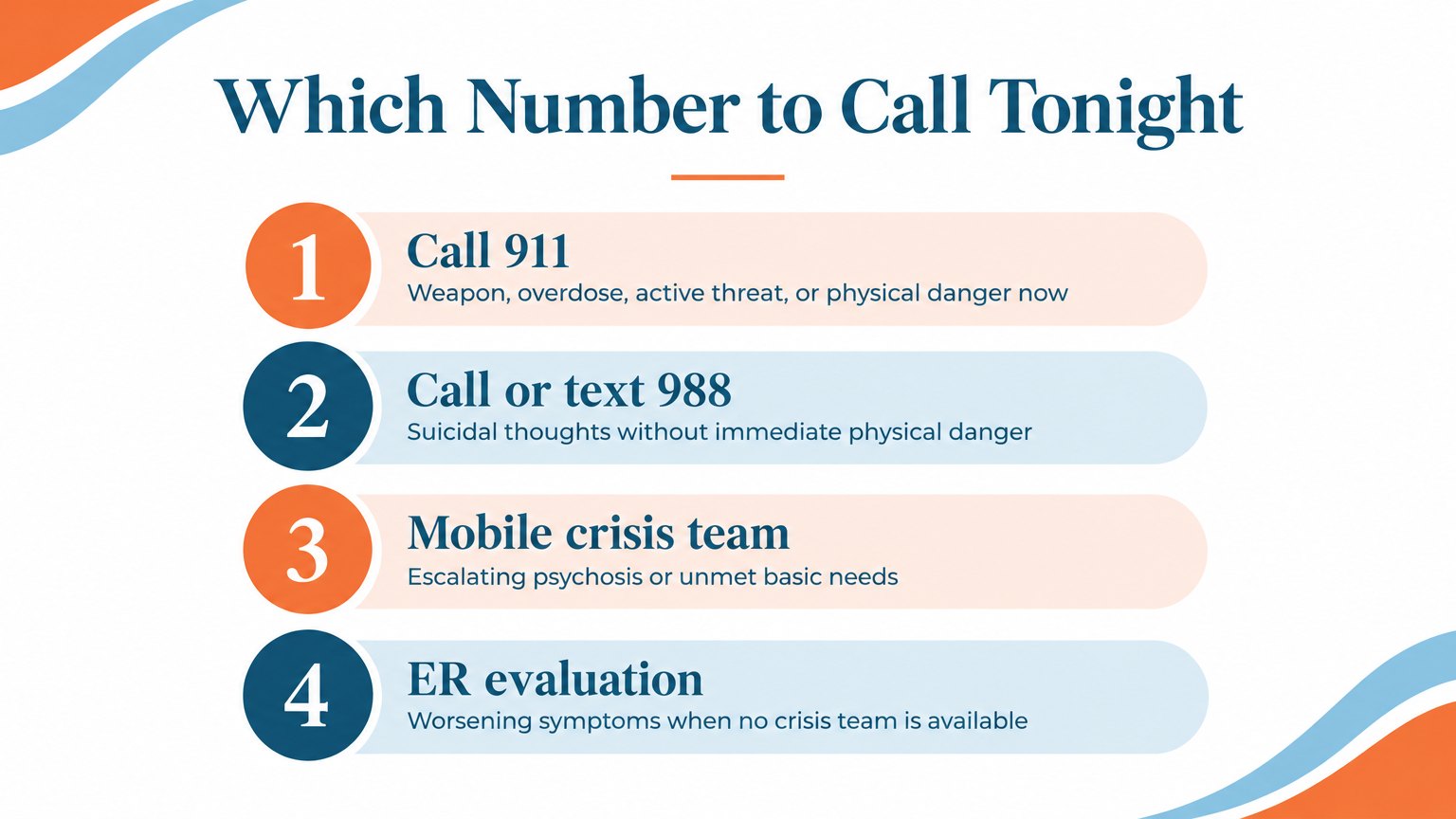
If you are not sure which number to dial, start here. The right call depends on what is happening in the next hour, not on what has been building for months. Immediate physical danger, a stated plan to die, escalating psychosis, and a slow worrying slide are four very different situations, and they route to four different places.
Call 911 when the situation is life-threatening right now. If your loved one is holding a weapon, has already harmed themselves, has overdosed, is unconscious, or is actively threatening to hurt someone, this is a 911 call 3. When you dial, ask specifically for a crisis-trained officer or a mobile crisis team if your area has one, and say the words "mental health emergency" early in the call so the dispatcher routes appropriately.
Call or text 988 for suicidal thoughts or urges to self-harm. The 988 Suicide and Crisis Lifeline is the right number when your loved one is talking about ending their life, hinting at it, or struggling with urges to hurt themselves but is not in immediate physical danger 3. You can call on their behalf. If they have said they are going to kill themselves, do not leave them alone, do not promise to keep it secret, and remove access to firearms and medications if you can do so safely 4.
Use mobile crisis or an ER evaluation for escalating psychosis or an inability to meet basic needs. If your loved one is hearing voices, acting on frightening beliefs, not sleeping for days, or no longer eating, drinking, or caring for themselves, the behavior can shift quickly and unpredictably 5. Many counties dispatch a mobile crisis team that comes to the home; if that is not available, a hospital emergency department can perform a psychiatric evaluation and start an emergency hold when the clinical criteria are met.
Use the non-emergency petition path when the risk is real but not immediate. If your loved one is deteriorating and refusing help but is not in acute danger tonight, the right next step is usually a county civil-commitment petition, a screening agency referral, or a professional evaluation 1. That path is slower and more deliberate, and it gives you time to document what you have seen before anyone knocks on the door.
What to Document Before You Call Anyone
Before you dial anyone, give yourself fifteen minutes with a notebook. The specific facts you can describe, in order and with dates, are what move a screening agency, a crisis clinician, or a judge. Vague worry does not. Every state process you might eventually enter rewards concrete, recent, witnessed behavior over diagnoses or labels 10, 12.
Write down the last three incidents that scared you. For each one, note the date, the time, where it happened, who else saw or heard it, and what your loved one actually said or did. Direct quotes matter more than paraphrase. "I'm done, I have the pills in my drawer" lands differently in an evaluation than "she was talking dark again." Arizona's application process, for example, explicitly asks for recent examples of dangerous behavior, not general concerns 10.
Then capture the context clinicians will ask about:
- current medications and whether any were recently started, stopped, or missed;
- prior psychiatric hospitalizations or diagnoses;
- substance use in the last 72 hours;
- access to firearms, large quantities of medication, or vehicles; and
- whether your loved one is eating, sleeping, and bathing.
If psychosis is part of the picture, note what beliefs they are acting on and how those beliefs have changed in the past week 5.
Michigan's process is a useful standard to borrow from even if you live elsewhere: it requires a petition plus two clinical certificates supported by witness observations and identifying information 12. You are, in effect, drafting the witness-observation half of that record now, before anyone is in a hospital gown and before memory starts to blur.
Keep this document on your phone and email a copy to yourself. You will refer to it more times than you expect.
How State Processes Actually Differ
You might assume civil commitment works roughly the same way everywhere, the way traffic tickets or small-claims court feel broadly familiar across state lines. It does not. The person who can file, the proof a court demands, the number of clinicians who must sign off, and how quickly a hearing happens are set by each state's legislature, and the differences are large enough to change what you do next. A quick tour of six states shows how much ground the phrase "involuntary commitment" actually covers 1.
A Side-by-Side Look at Six State Standards
In Florida, the Baker Act requires that a person meet the statutory definition of mental illness and satisfy specific involuntary-examination criteria, with any court order laying out the facts behind the findings 6. A judge cannot simply agree that your loved one "seems unwell." The order has to point to the behavior that triggered it, which is why your documentation matters long before anyone sees a courtroom.
Massachusetts uses one of the strictest evidentiary bars in the country. A petitioner must prove, beyond a reasonable doubt, that the person is mentally ill, that failing to retain them would create a likelihood of serious harm, and that no less-restrictive alternative is available 8, 9. That is the same standard a prosecutor carries in a felony trial, applied to a hospital bed instead of a jail cell.
Oregon takes a different route. Two people with firsthand knowledge of the behavior may file a civil-commitment petition together, which can be a relief when one family member has been carrying the weight alone. A county investigation follows, and a judge may order commitment only on clear and convincing evidence of a mental disorder plus danger to self, danger to others, or an inability to provide for basic personal needs 7.
Arizona front-loads the clinical screening. An adult who recently witnessed concerning behavior may apply for involuntary evaluation, and a designated screening agency reviews the facts before a court is asked to order an evaluation. Physicians then conduct the evaluation, and a separate hearing determines whether treatment is ordered. The application has to spell out specific, recent examples of dangerous behavior, not general worry 10.
Michigan builds the clinical layer into the filing itself. A petition or application for involuntary hospitalization must be accompanied by two clinical certificates, with witness observations and identifying information attached 12. In practical terms, your loved one typically needs to be seen by two qualified clinicians before the court takes up the request.
Minnesota focuses on the clock. Once a petition is filed, a commitment hearing must generally occur within 14 days, and the respondent can demand an earlier hearing within five business days, with only limited extensions allowed 11. That timeline shapes how quickly you need to gather records, line up witnesses, and prepare for what will feel like a very fast two weeks.
Six states, six genuinely different experiences. Your home state almost certainly borrows pieces from several of these models, which is why calling your county probate or mental health court, or an attorney who handles these filings, is usually your most useful early step.
What Petitioners, Certificates, and Hearings Have in Common
Underneath the state-by-state variation, three threads run through almost every process, and recognizing them helps you prepare no matter where you live.
First, someone has to file something. Call it a petition, an application, or a request for emergency examination, the paperwork asks for specific recent facts, your relationship to the person, and often the names of other witnesses 10, 12. The notebook you started earlier becomes the raw material for this filing.
Second, clinicians, not family members, decide whether the medical criteria are met. Depending on the state, that may be one emergency-room physician, two signing clinicians, or a court-appointed evaluator 12. Your job is to get your loved one in front of them with enough information for a real assessment, not to argue the diagnosis yourself.
Third, due process applies. Every state offers prompt notice of rights, access to counsel, and a timely opportunity to challenge continued confinement before a judge 1. Your loved one will have a lawyer. They can attend the hearing, testify, and present evidence of their own. That is a feature of the system, not a flaw in it, and it is one of the reasons the process can feel slower than the crisis seems to demand.
The Petition Path: Filing, Evaluation, and Court Review
When the situation is serious but not an emergency tonight, the petition path is usually where you land. It is slower than a 911 call and faster than hoping things improve on their own, and it has a predictable rhythm once you know what to expect.
Step one is finding the right courthouse or screening agency. In most places, that is the county probate court, mental health court, or a designated screening agency that reviews petitions before anything reaches a judge 10. Call during business hours and ask what forms you need, who may sign them, and whether a lawyer is required. In Oregon, two people with firsthand knowledge of the behavior can file together, which can take some of the pressure off a single family member 7. In Michigan, your petition will need to be accompanied by two clinical certificates, so part of your early planning is figuring out how your loved one will be seen by two qualified clinicians 12.
Step two is the filing itself. The notebook you built earlier becomes the backbone here: dates, direct quotes, witnesses, and recent examples of behavior that put your loved one or someone else at risk 10. Vague language weakens a petition. "He has not slept in four days and told me on Monday that the neighbors are poisoning the water" is the kind of specific, dated observation screeners and judges can act on.
Step three is evaluation. After a petition is accepted, a court may order a clinical evaluation, or a screening agency may arrange one. Physicians or other qualified clinicians, not family members, decide whether the medical criteria are met 10. Your job at this stage is to make records, medications, and witness contact information easy to find.
Step four is the hearing. Timelines vary, but Minnesota is a useful benchmark: a commitment hearing must generally occur within 14 days of filing, with an option to demand an earlier hearing within five business days 11. Your loved one will have counsel, the right to attend, testify, and present their own evidence, and the petitioner will need to meet the state's evidentiary standard, whether that is clear and convincing evidence or, in Massachusetts, proof beyond a reasonable doubt 9. Expect to be asked to testify about what you saw and when.
Walk into each step knowing it is one piece of a longer sequence, not a verdict on your loved one or on you.
Less-Restrictive Alternatives Worth Considering First
Voluntary admission is the most overlooked path. Many people who seem to refuse help will agree to a hospital stay if the conversation happens with the right person, at the right moment, and without an ultimatum attached. A trusted physician, a long-time therapist, or a family member who has not been part of recent arguments can sometimes make the ask that lands. Voluntary admissions preserve more of your loved one's autonomy, create fewer records, and often lead to better engagement afterward.
Outpatient commitment or assisted outpatient treatment exists in many states as a court-supervised alternative to hospitalization, allowing someone to live at home while complying with treatment conditions 1. For a loved one who has been hospitalized before and keeps falling out of care, this can be the structure that finally holds.
A professionally facilitated family conversation, often called an intervention, is another option when the risk is real but not immediate. A trained interventionist helps the family present concerns in a coordinated, non-confrontational way, with a treatment plan already arranged. It is a different kind of pressure than a court order, and for many families it is the step that avoids ever needing one.
What Happens After Discharge: Preventing the Revolving Door
Discharge is not the finish line. It is the moment the real work shifts from the hospital back to your home, and it is where many families get caught off guard. A short inpatient stay can stabilize a crisis, but it rarely resolves the underlying illness, and the days right after release are often the most fragile. Walking in with a plan matters more than the plan being perfect.
Before your loved one leaves the unit, ask the treatment team for specifics in writing: the discharge diagnosis, every medication and dose, the first follow-up appointment with a prescriber, a therapist referral, and a crisis plan that names 988 and 911 by situation 3. If outpatient commitment is available in your state as a court-supervised alternative, ask whether it fits here; for someone who has cycled through hospitalizations before, that structure can be what finally holds 1. Keep your original notebook open. The same specific, dated observations that helped a screener will help the outpatient prescriber see the fuller picture.
Then plan for the first two weeks. Who is driving to the follow-up appointment, who is holding the medications if that was agreed on, who is checking in each evening, and what happens on a weekend when the clinic is closed. If symptoms escalate again, you already know the decision tree: 988 for suicidal thoughts, 911 for immediate danger, mobile crisis or an ER for psychosis or an inability to care for basic needs 3, 5. A professionally coordinated transition, whether through a case manager, a recovery associate, or a trusted clinician, often prevents the second hospitalization that would have followed the first.
A Note for Referring Professionals
A quick scope shift here: this section is for the attorneys, psychiatrists, concierge physicians, therapists, trust officers, and wealth managers who get the call before the family knows which number to dial. You already know the legal floor is dangerousness plus mental illness plus the absence of a less-restrictive alternative 1, 2. What your client usually needs from you in the first hour is triage, not case law.
Three practical anchors tend to help:
- Keep the emergency decision tree visible for staff who may take the first call, with 988 and 911 routed by situation 3.
- Prompt families to begin dated, witness-level documentation immediately, since every state petition rewards specific recent facts over labels 10, 12.
- And when the risk is real but not acute, point toward voluntary admission, outpatient commitment where available, or a professionally coordinated family conversation before the courthouse door.
Starting a Conversation About Support
If you have read this far, you already know the answer to the question you came in with. You cannot simply have someone committed because they are mentally ill or refusing help. What you can do is observe carefully, call the right number for the moment you are in, document what you see, and surround your loved one with people who know how to carry the next hard conversation.
That is often where a concierge behavioral health firm becomes useful. Next Level Wellness & Behavioral Health, founded by Amanda Marino and based in Boca Raton with national and international reach, works with families before, during, after, or in place of treatment. We help you prepare documentation, coordinate a professionally facilitated family conversation, line up voluntary admission or outpatient options, and stay close through discharge so the first hospitalization does not become the first of many. Our work is private pay, and we can help with insurance reimbursement submissions when relevant.
When you are ready, reach out for a confidential conversation. Bringing in steady, experienced support is part of Creating Lasting Change for the person you love, and for you.
Frequently Asked Questions
Can I have someone committed just because they refuse treatment?
No. Refusing treatment, by itself, is not a legal basis for involuntary commitment anywhere in the United States. The Supreme Court made clear that a state cannot confine a nondangerous person who can survive safely with willing family or friends 2. You generally need evidence of a mental illness causing a near-term risk of serious harm or an inability to meet basic needs 1.
How long does an involuntary psychiatric hold usually last?
Initial emergency holds are short, typically a few days, while clinicians evaluate whether the legal criteria are met. If the hospital seeks continued treatment, a court hearing follows. Minnesota, for example, requires a commitment hearing within 14 days of filing, with an option to demand one within five business days 11. Exact timelines vary by state, so ask the admitting facility for the specific clock that applies.
What happens if the hospital releases my loved one before I think they are safe?
Discharge decisions belong to the treating clinicians, and they are bound by the same dangerousness and least-restrictive-alternative principles that govern admission 1, 2. Before release, ask for a written safety plan, the first follow-up appointment, and medication details. If symptoms escalate again at home, use the same decision tree: 988 for suicidal thoughts, 911 for immediate danger, and mobile crisis or an ER for psychosis or basic-needs concerns 3, 5.
Will an involuntary commitment go on my loved one's permanent record?
Civil commitment is a legal and medical record, not a criminal one, and it is protected by health privacy laws. That said, it can surface in specific contexts, such as firearm eligibility checks, certain professional licensing questions, or security clearances, depending on state law 1. If this is a serious concern, talk with an attorney in your state before filing, and weigh whether voluntary admission might accomplish the same clinical goal.
Can I file a petition if my loved one lives in a different state than I do?
Petitions are filed in the state and county where your loved one is physically located, not where you live. Some states, like Oregon, require two people with firsthand knowledge of the behavior to sign together 7. Others, like Michigan, require a petition plus two clinical certificates 12. Call the county probate or mental health court where your loved one actually is, and ask what filers and documents they require.
What if my loved one is struggling but not suicidal or violent?
This is the hardest middle ground, and it is where most families actually live. If there is no immediate danger, commitment is unlikely to be available, and pushing for it can damage trust without changing anything. Focus on the less-restrictive paths: a voluntary admission conversation led by a trusted clinician, outpatient treatment where offered as a court-supervised option 1, or a professionally facilitated family conversation that presents concerns and a prepared plan together.
References
- Civil Commitment and the Mental Health Care Continuum. https://www.samhsa.gov/sites/default/files/civil-commitment-mental-health-care-continuum.pdf
- J. B. O’CONNOR, Petitioner, v. Kenneth DONALDSON. https://www.law.cornell.edu/supremecourt/text/422/563
- My Mental Health: Do I Need Help?. https://www.nimh.nih.gov/health/publications/my-mental-health-do-i-need-help
- Frequently Asked Questions About Suicide. https://www.nimh.nih.gov/health/publications/suicide-faq
- Understanding Psychosis. https://www.nimh.nih.gov/health/publications/understanding-psychosis
- Baker Act Benchguide. https://flcourts-media.flcourts.gov/content/download/215973/file/Baker-Act-Benchguide.pdf
- Oregon Health Authority: Civil Commitment. https://www.oregon.gov/oha/BH/Adults/Pages/Civil-Commitment.aspx
- Standards of Judicial Practice: Civil Commitment and Authorization of Medical Treatment for Mental Illness: Standard 2. https://www.mass.gov/info-details/standards-of-judicial-practice-civil-commitment-and-authorization-of-medical-treatment-for-mental-illness-standard-2
- Section 1117. Civil commitment hearings for mental illness. https://www.mass.gov/guide-to-evidence/section-1117-civil-commitment-hearings-for-mental-illness
- Steps in the AZ Involuntary Treatment Process. https://www.sc.pima.gov/media/bsnixsxm/mhjsccbrochure.pdf
- Civil Commitment Process Fact Sheet. https://mn.gov/omhdd/assets/Civil-Commitment-MI-D-Fact-Sheet_tcm23-619853.pdf
- Voluntary and Involuntary Admissions. https://www.michigan.gov/-/media/Project/Websites/mdhhs/Folder2/Folder56/Folder1/Folder156/Tab_25_Voluntary_and_Involuntary_Admissions.pdf?rev=756fce57dcea4629ba7af8ea7cbe0a5c
Insight Beyond Treatment
At Next Level Wellness & Behavioral Health, we believe meaningful change starts with perspective, not just protocols.
That philosophy is directly led by Amanda Marino, whose voice in behavioral health extends beyond clinical settings into leadership, culture, and personal growth.
Through keynote speaking and live events, Amanda explores the deeper themes that show up in recovery, family systems, and life transitions: authenticity, resilience, accountability, and the courage to change. Her work invites audiences to move past labels and into honest conversations that create lasting impact.
A Voice Shaping the Conversation
The topics explored here—change, self-awareness, recovery, and growth—are the same themes Amanda Marino brings to audiences nationwide through speaking engagements and live events.
Known for her appearances on A&E’s Intervention and Digital Addiction, Amanda speaks to organizations, communities, and leadership teams about navigating adversity, embracing vulnerability, and building lives rooted in purpose. Her message resonates far beyond treatment, offering insight that applies to families, professionals, and anyone standing at a crossroads.


Heal on your terms—any time, anywhere.