

How to Find Intensive Case Management Services That Fit

Key Takeaways
- A serious intensive case manager runs a structured process with assessment, individualized planning, active coordination, monitoring, advocacy, and defined crisis protocols, so one person holds the whole picture across fragmented care.
- This article organizes intensive case management around seven working components rather than contact frequency; ask any service to walk through each one on an anonymized case before you commit.
- The role sits between a single clinician and a full team, acting as connective tissue that lighter options like therapists, discharge planners, or recovery associates alone cannot provide.
- Evidence shows intensive case management can reduce hospitalization, improve retention, and support social functioning 5, but it coordinates care rather than resolving the underlying condition itself.
- Network depth matters more than one coordinator's calendar, especially when roughly 40% of the U.S. population lives in a mental-health professional shortage area 15.
- A first call should test assessment structure, caseload numbers, credentials, verified network relationships, response windows, and a written crisis protocol with specific escalation steps.
- Privacy deserves written documentation: business associate agreements, specific releases of information, family communication plans, and clear rules about where notes are kept and who sees them 11.
- Trust patterns over pitches. Fit shows up as specific numbers, named clinicians, and willingness to put boundaries in writing; vague answers and outcome promises are reasons to walk away.
What a Serious Coordinator Actually Does for Your Family
A serious intensive case manager runs a structured process, not a referral list. You get a thorough assessment, a written individualized plan, active coordination with clinicians and other supports, ongoing monitoring, advocacy on your behalf, and attention to transitions across providers and settings 1, 3. The person on the phone is accountable for whether the plan actually happens.
That matters because behavioral health care is fragmented in ways families only discover mid-emergency. A psychiatrist in one system, a therapist in another, a dietitian who does not know either of them, a discharge planner whose job ended at the hospital exit. Someone has to hold the whole picture.
A good coordinator does three things your family cannot easily do alone. They translate between clinicians and keep the plan consistent across settings. They watch for drift, missed appointments, medication gaps, warning signs, before those drift into a crisis. And when something urgent happens, they already know who to call, what the plan says, and how to loop you in 2.
The sections ahead give you a concrete way to evaluate whether a service actually does this work.
Intensive Case Management, Defined by Structure Not Frequency
The Seven Components That Separate Coordination From a Contact List
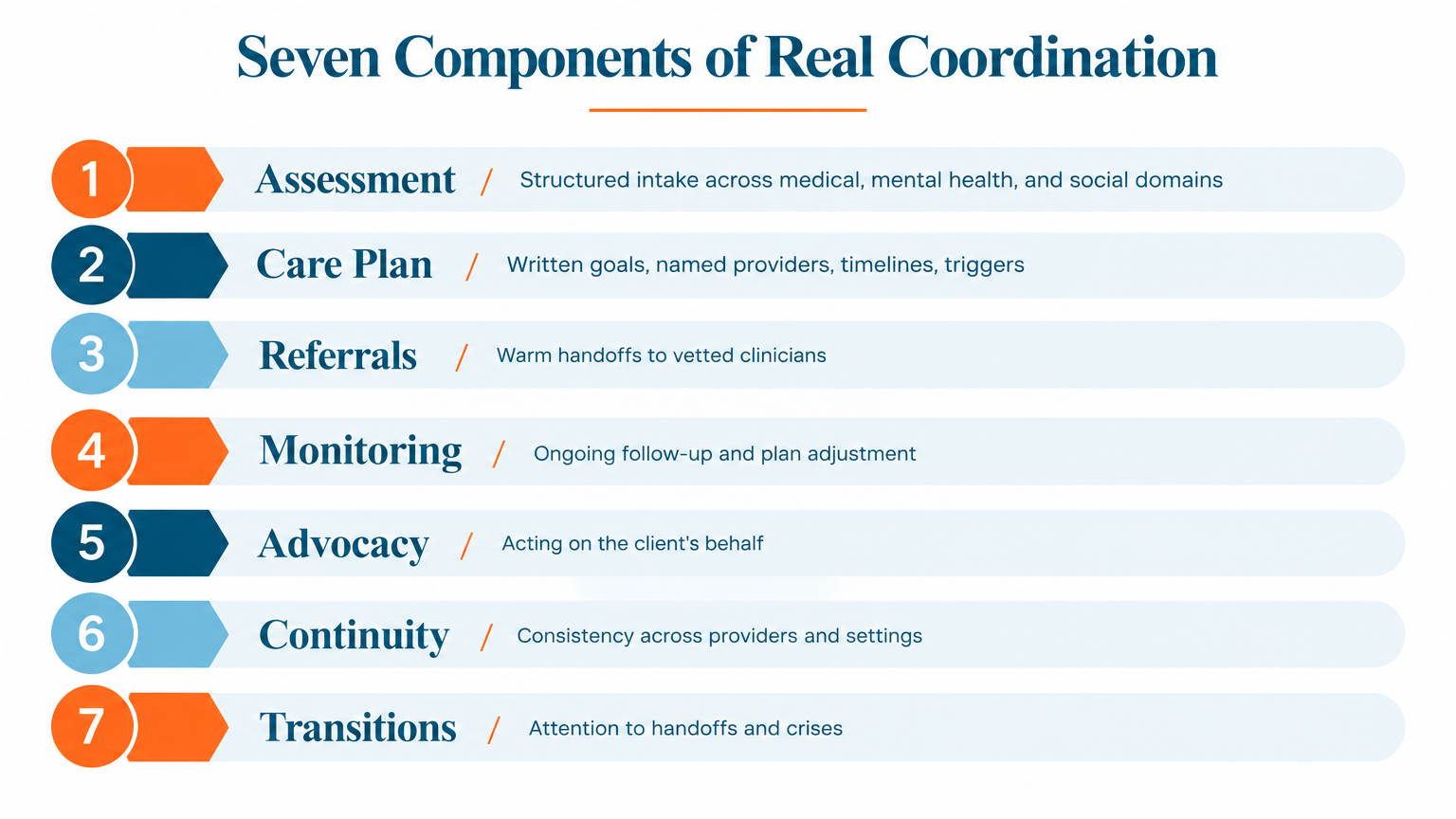
Intensive case management can be understood as a defined process with seven working parts. If a service cannot show you how it handles each one, you are looking at a contact list with a monthly invoice, not coordinated care.
Federal Medicaid guidance names four components as the structural core of targeted case management: a comprehensive assessment, a written individualized care plan, referrals and linkage to services, and ongoing monitoring and follow-up 3. Drawing on SAMHSA's TIP 27 and its Advisory, which describe coordination across treatment, medical, social, vocational, legal, and family domains and emphasize advocacy, continuity, and follow-up, we organize this article around three additional components: advocacy on the client's behalf, continuity across providers and settings, and attention to transitions and crises 1, 2.
Here is what each component should look like in practice when you ask about it:
- Assessment. A structured intake that covers medical history, mental health, substance use, medications, family dynamics, legal or financial pressures, and functional status, not a 20-minute phone call.
- Individualized care plan. A written document with specific goals, named providers, timelines, and the signs that would trigger a change in plan.
- Referrals and linkage. Warm handoffs to specific clinicians the coordinator has worked with, with scheduling and intake friction handled on your behalf.
- Monitoring. Regular check-ins with you, your loved one, and the treating clinicians, with a cadence written into the plan.
- Advocacy. Someone who speaks up in treatment team meetings, pushes back on discharge timing that does not fit, and translates clinical decisions into plain language.
- Continuity. One file, one point of accountability, as your loved one moves between a residential program, outpatient care, home, or travel.
- Transitions and crisis protocol. A clear procedure for what happens at 2 a.m., at an airport, or on the day of hospital discharge 1.
Treat these seven as a checklist. In a first call, ask the coordinator to walk through all seven on a real anonymized case.
How Intensive Models Differ From Lighter Coordination
The difference between intensive case management and lighter coordination is not how often someone replies to your texts. It is the depth of the work and the caseload behind it.
Lighter coordination tends to mean a referral list, a few scheduling calls, and periodic check-ins. A peer-reviewed review of mental health quality interventions describes genuinely intensive models as proactive rather than reactive, with individualized service planning, active linkage, monitoring, advocacy, and high-contact support, in some models reaching up to twelve hours a day, seven days a week, with coordinator caseloads of roughly fifteen to twenty people 10. Those numbers come from specific research models and are not a universal standard, but they tell you what intensity actually looks like on the inside.
Three structural tells separate the two in a vetting conversation. First, outreach direction: does the coordinator initiate contact with clinicians and family on a schedule, or wait for you to flag a problem? Second, caseload: how many active clients does one coordinator carry, and what is the response window? Third, documentation: is there a living care plan that gets updated, or a static intake form that was never opened again?
Ask these three directly. The answers tell you whether you are buying coordination or a well-dressed address book.
Where Intensive Case Management Fits Among Nearby Options
Intensive case management sits between a single clinician and a full team, pulling the pieces together without replacing any of them. It is not therapy, not crisis response, not a hospital discharge planner, and not a sober companion alone. It is the connective tissue that makes those services add up to a coherent plan.
Families usually arrive at this question after trying one of the lighter options and finding a gap. A therapist can be excellent inside the fifty-minute hour and still have no view of what happens at the pharmacy, the airport, or the family dinner. A discharge planner's job typically ends when your loved one walks out of the building, which is often the exact moment a plan starts to wobble. A recovery associate, often called a sober companion, provides steady in-person presence but is not responsible for coordinating the psychiatrist, the dietitian, and the outpatient program.
Here is how the nearby options compare in plain terms:
- Single therapist or psychiatrist. Deep expertise in one modality. No responsibility for coordinating other clinicians, monitoring between sessions, or managing transitions.
- Treatment-center discharge planner. Builds an aftercare list at the end of a program. Rarely follows the plan into the home, workplace, or next level of care 2.
- Recovery or wellness associate alone. Direct, in-person support day to day. Not accountable for the clinical plan, insurance submissions, or communication across providers.
- Medicaid targeted case management. Delivers the four federally defined components (assessment, care plan, referrals, monitoring) within program rules that vary by state and by eligibility 3, 4.
- Private intensive case management. Combines structured coordination with a vetted clinical network, flexible contact intensity, and continuity across home, travel, and treatment settings 1, 9.
If one person needs to hold the whole picture, intensive case management is the role designed for that job. If your loved one already has a cohesive team and only needs one more clinical hour per week, a different option may serve you better.
What the Evidence Actually Supports (and Does Not)
Intensive case management has real evidence behind it, with honest limits. For people with severe mental illness, a Cochrane systematic review of 40 randomized trials and 7,524 participants found that intensive case management can reduce hospitalization, increase retention in care, and improve social functioning compared with standard care. Effects on mental state and quality of life were less clear 5. The U.S. Office of Disease Prevention and Health Promotion summarizes the same body of work and cautions that differences across health and social-support systems make universal conclusions hard to draw 6.
For substance use populations, the picture is more modest. A federal evidence review found small to moderate benefits for case-management models, including greater use of community services, reduced inpatient use, longer treatment retention, improved quality of life, and high client satisfaction. Effects on substance use itself and on broader psychosocial functioning were less consistent, and no single model was broadly superior 7.
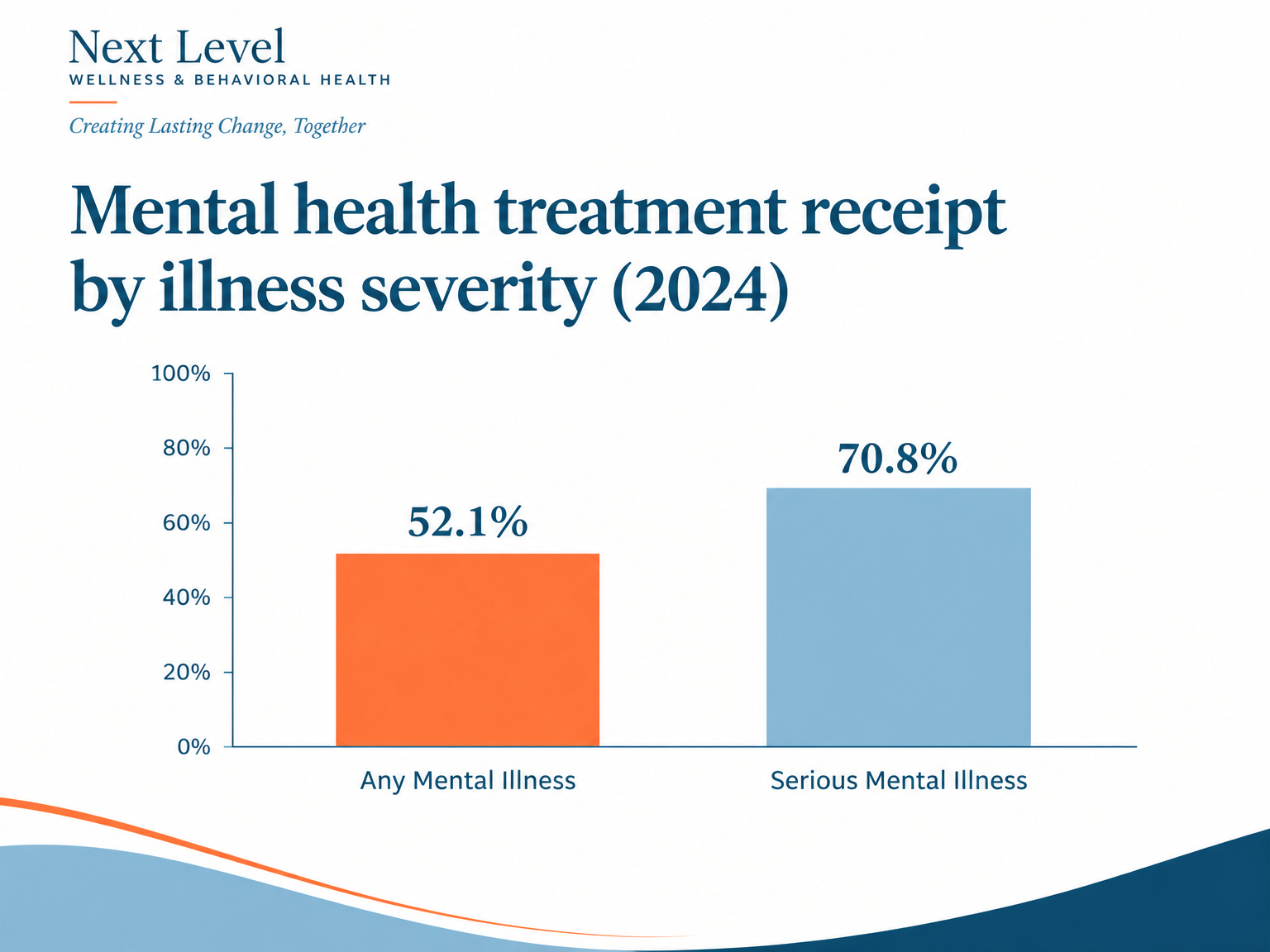
Zoom out to the access gap and the reason coordination matters becomes concrete. In 2024, 52.1% of adults with any mental illness received mental-health treatment, compared with 70.8% of adults with serious mental illness 14. More than a quarter of adults with serious mental illness still went without care, and nearly half of adults with any mental illness did.
What this means for you: expect intensive case management to help with the structural problems, keeping care connected, catching gaps, and holding transitions. Do not expect it, on its own, to resolve the underlying condition. That is the clinicians' work, which the coordinator is paid to orchestrate.
Why Network Depth Matters More Than a Single Coordinator
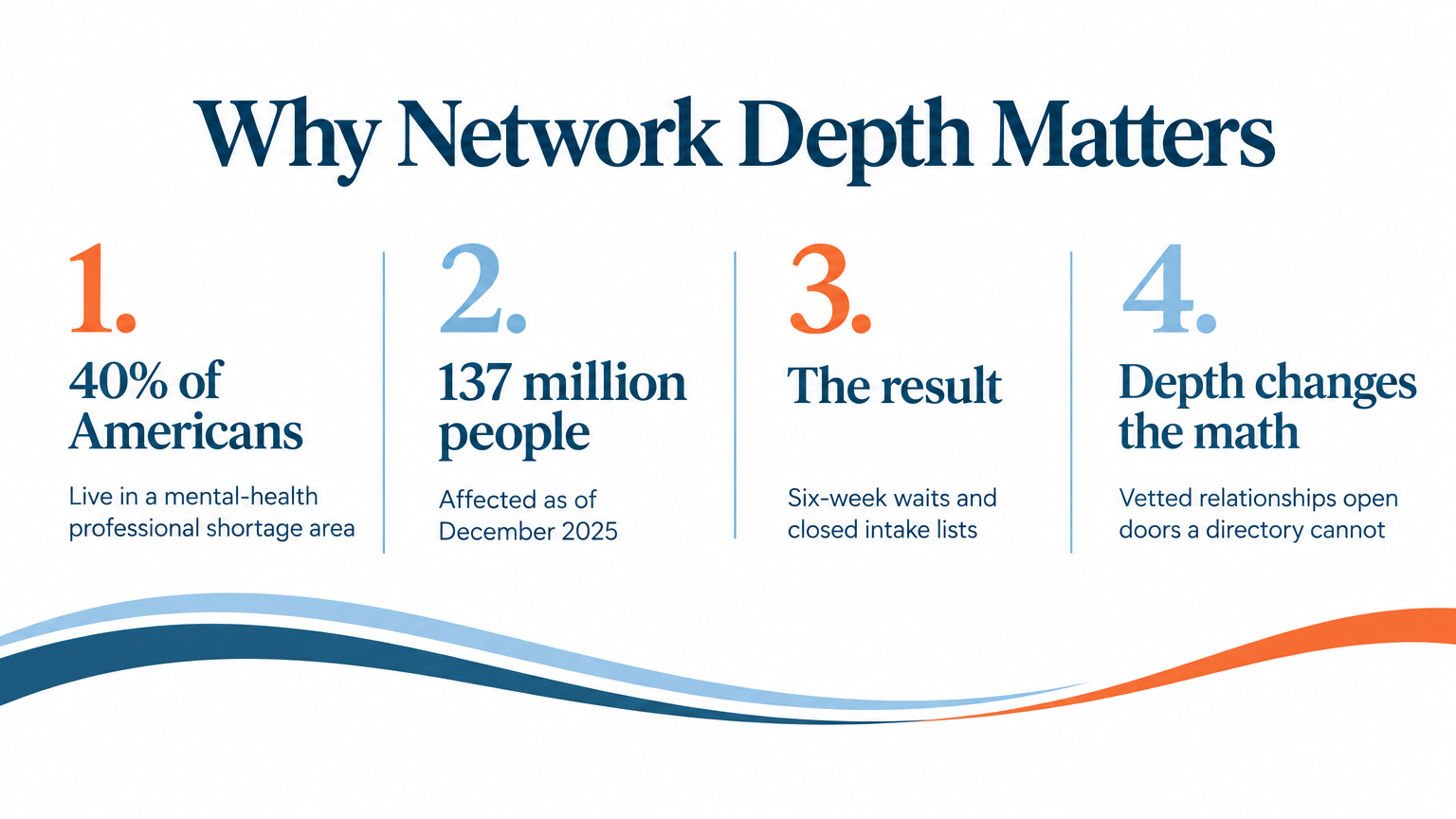
The real value of an intensive coordinator is not one person's calendar. It is who answers when that person calls. A coordinator without a vetted network is a kind voice reading from a public directory.
HRSA reports that approximately 40% of the U.S. population—about 137 million people—lived in a federally designated mental-health professional shortage area as of December 2, 2025 15. That shortage is not just about rural counties. It shows up as six-week waits for a first psychiatry appointment, a dietitian who stops answering email mid-plan, and an outpatient program with no open slots the week your loved one is discharged. A coordinator working from the same crowded directory you can already find will produce the same crowded result.
Depth is what changes the math. Ask who the coordinator already works with, by discipline and by region. For a complex picture, that list should include psychiatrists comfortable with co-occurring conditions, therapists trained in the specific modality your loved one needs, registered nurses, addiction medicine physicians, dietitians experienced with eating disorders, and recovery or wellness associates who can hold the day-to-day at home or during travel 15. Ask how recently each relationship was used and how quickly a first appointment typically happens.
Then ask what happens when a referral does not fit. A deep network has second and third options and a coordinator willing to pivot. A thin one has a single name and a shrug.
The First-Call Question Set You Can Use Tomorrow
Assessment, Care Plan, and Caseload
Open the first call by testing the structure. If a service cannot describe its assessment, its care-plan format, and its caseload in concrete terms, keep looking.
Here is the set to work through on that call:
- "Walk me through your intake assessment. What domains do you cover, how long does it take, and who conducts it?" You are listening for medical history, mental health, substance use, medications, family dynamics, legal and financial pressures, and functional status 1, 3.
- "Can you show me a sample individualized care plan with the client details removed?" A real plan names providers, timelines, specific goals, and the signals that would trigger a change in course 2.
- "How often is the plan updated, and who signs off on changes?" You want a living document with a named owner, not a one-time intake form.
- "How many active clients does one coordinator carry right now?" Some intensive models in the research operate around fifteen to twenty clients per coordinator 10. Private concierge caseloads often run lower by design. Ask for the actual number, not a range.
- "Who covers your caseload when you are on vacation or sick?" Continuity should not depend on one person's calendar.
If the answers are specific, you are talking to a real coordinator. If they are abstract, you are talking to a salesperson.
Credentials, Network, and Scope of Practice
The second block of questions tests who stands behind the coordinator. Titles vary widely in this field, and a case manager or recovery associate is not necessarily a licensed clinician 16.
- "What are your credentials, and what is your scope of practice?" Credentials vary and may include coaching, intervention, nursing, or clinical licenses. A good coordinator will tell you plainly what they do and do not do, and when they hand off to a clinician.
- "Which licensed professionals are in your working network?" You should hear specific disciplines: psychiatrists comfortable with co-occurring conditions, LMFTs, LMHCs, MSWs, psychologists, registered nurses, addiction medicine physicians, dietitians with eating-disorder experience 15.
- "How recently have you worked with each of those providers, and how fast is a first appointment?" A warm referral used last month is different from a name copied from a directory.
- "How do you verify the clinicians you introduce?" For any licensed professional, you can confirm the license through the relevant state board 16.
- "What happens if the first referral is not the right fit?" A deep network has second and third options and a coordinator willing to pivot without starting over.
You are not asking for a resume. You are asking whether the network behind the voice on the phone is real.
Response Windows, After-Hours, and Crisis Protocol
The third block tests what happens when things get hard. A coordinator who is only reachable Monday through Friday is a different service than one who answers at 11 p.m. on a Saturday.
- "What is your typical response time during business hours, and what is your after-hours response window?" Ask for a number, not a reassurance.
- "Who answers after hours, and are they familiar with my loved one's plan?" A rotating answering service is not the same as a coordinator who already knows the file.
- "Walk me through what happens if my loved one is in acute distress at 2 a.m., or if something happens during travel." You should hear a defined escalation path that includes 988 and 911 when appropriate, mobile crisis response where available, and a plan for communicating with you and the treating clinicians 12.
- "How do you handle hospital transitions and discharge day?" This is where many plans break. Ask who shows up, who coordinates with the hospital team, and how post-discharge follow-up is tracked 13.
- "What is your role versus a crisis provider's role?" An honest answer draws a clear line. A case manager coordinates. A crisis team responds.
Write the answers down. Compare them across two or three services. The gaps will tell you where to go next.
Privacy, HIPAA, and the Conversations You Should Have in Writing
Privacy is not a feature to assume. It is a document to read. For families used to signing airtight NDAs in other parts of life, the behavioral-health version deserves the same scrutiny before the first appointment is booked.
Start with the ground rules. HIPAA generally permits treating providers to share protected health information with other treating providers for treatment, case management, and care coordination, which is how a coordinator can realistically do the job 11. That permission has limits. State laws, professional ethics rules, and federal substance-use confidentiality protections can require additional written consent before specific information moves between people 11. A coordinator who waves this away is not a coordinator you want.
Ask for the paperwork in writing before you commit:
- Business associate and service agreement. What is the coordinator's legal relationship to you, to the clinicians, and to any associates who come into the home or travel with your loved one?
- Release of information forms. Who is named, what information is shared, with whom, for what purpose, and how long does each release last?
- Family communication plan. What do you receive, what does your loved one keep private, and how are those lines reviewed as circumstances change?
- Documentation and storage. Where are notes kept, who can see them, and what happens to the file when services end?
Put the answers in a folder. If something changes later, you will know what you actually agreed to.
Signals of a Fit, and Signals to Walk Away
By the end of two or three vetting calls, patterns show up. Trust the patterns, not the pitch.
Signals of a fit: the coordinator asks more questions than you do on the first call. They describe their intake, caseload, and crisis protocol with numbers. They name specific clinicians and when they last worked with each. They answer privacy questions by offering to send paperwork, not by reassuring you. They are comfortable saying what they do not do and when they would refer out. They treat your loved one as a person with a specific life, not a diagnosis to be managed.
Signals to walk away: vague answers about caseload or response time. A single coordinator with no backup. A network described in adjectives rather than names. Pressure to commit before you have paperwork in hand. Promises about outcomes, including any version of "we can get your loved one to stop." Dismissive answers about 988, mobile crisis, or hospital transitions 12. A reluctance to put the care plan, releases, and family communication boundaries in writing.
If two services clear the bar, pick the one whose coordinator you would want on the phone at 2 a.m.
Starting the Conversation
You do not have to decide today. You just have to make the next call clearer than the last one.
Pick two or three services. Work through the seven structural components, the first-call question set, and the privacy paperwork. Keep notes side by side. The right coordinator will sound relieved that you are asking hard questions, not defensive.
When you are ready for a confidential conversation, Next Level Wellness & Behavioral Health, founded by Amanda Marino and based in Boca Raton with clients supported nationally and internationally, is one option worth including on your list. Our work sits before, during, after, or in place of treatment, with the quiet consistency that creating lasting change actually requires.
If anyone is in immediate danger, call 988 or 911 first. Then make the next call.
Frequently Asked Questions
What is the difference between intensive case management and a regular case manager?
A regular case manager typically focuses on referrals and periodic check-ins. Intensive case management adds proactive outreach, individualized service planning, active linkage, regular monitoring, advocacy, and higher contact frequency, with coordinator caseloads often kept lower so the work can actually happen 10. The structure is the same; the depth, pace, and accountability are different.
Who is a good candidate for intensive case management services?
It fits people whose care involves multiple clinicians, moving parts, or transitions that keep slipping. Research supports intensive case management for people with severe mental illness who are high users of inpatient care or hard to engage 9. In practice, families often use it after a hospitalization, between levels of care, during travel, or when a complex substance use, eating disorder, or co-occurring picture needs one accountable coordinator.
How is intensive case management different from hiring a therapist or a sober companion?
A therapist provides clinical treatment inside sessions. A recovery associate, often called a sober companion, provides steady day-to-day presence. Neither is responsible for coordinating the full plan across providers, settings, and transitions. Intensive case management is the role that holds the whole picture, running assessment, individualized planning, referrals, monitoring, advocacy, and crisis protocol across everyone involved 1, 3.
Does insurance cover intensive case management, or is it private pay?
It depends on the model. Medicaid programs cover targeted case management with defined components, though eligibility and rules vary by state 3, 4. Private concierge coordination is typically private pay and operates outside insurance panels. Some providers can help you submit documentation for out-of-network reimbursement. Ask any service directly how billing works and what you receive in writing before you commit.
How do you protect privacy and share information across a care team?
HIPAA generally allows treating providers to share information for treatment, case management, and care coordination, which is what lets a coordinator do the work 11. State laws, professional ethics rules, and federal substance-use confidentiality protections can require additional written consent for specific disclosures 11. A serious coordinator asks you to sign specific releases naming who receives what information, for what purpose, and for how long.
What happens if a crisis occurs after hours or during travel?
A case manager is not a crisis provider. A good one has a written escalation plan that includes 988 and 911 when appropriate, mobile crisis response where available, a defined after-hours contact, and immediate communication with you and the treating clinicians 12. Ask for the specific response window, who answers at night, and how hospital transitions and discharge-day follow-up are handled.
References
- TIP 27: Comprehensive Case Management for Substance Abuse Treatment. https://library.samhsa.gov/sites/default/files/sma15-4215.pdf
- Comprehensive Case Management for Substance Use Disorder Treatment: An Advisory. https://library.samhsa.gov/sites/default/files/PEP20-02-02-013.pdf
- Making Connections: Strengthening Care Coordination in Medicaid and CHIP. https://www.medicaid.gov/medicaid/benefits/downloads/epsdt-care-coordination-strategy-guide.pdf
- State Medicaid & CHIP Toolkit for Children's Behavioral Health. https://www.medicaid.gov/federal-policy-guidance/downloads/state-medicaid-chip-bh-epsdt.pdf
- Intensive case management for severe mental illness. https://pubmed.ncbi.nlm.nih.gov/28067944/
- Intensive Case Management for Severe Mental Illness. https://odphp.health.gov/healthypeople/tools-action/browse-evidence-based-resources/intensive-case-management-severe-mental-illness
- Effectiveness of different models of case management for substance-abusing populations. https://www.ncbi.nlm.nih.gov/books/NBK73754/
- The effectiveness of case management interventions for the homeless, including substance use, health, and housing outcomes: A systematic review and meta-analysis. https://pubmed.ncbi.nlm.nih.gov/32271769/
- EPA guidance on the quality of mental health services: A systematic meta-review and update of recommendations focusing on care coordination. https://pmc.ncbi.nlm.nih.gov/articles/PMC7443789/
- A comprehensive review of prioritised interventions to improve the quality of mental health care. https://pmc.ncbi.nlm.nih.gov/articles/PMC8356292/
- Mental Health. https://www.hhs.gov/hipaa/for-professionals/faq/mental-health/index.html
- National Behavioral Health Crisis Care Guidance. https://www.samhsa.gov/mental-health/national-behavioral-health-crisis-care
- The Universal Foundation. https://www.cms.gov/medicare/quality/cms-national-quality-strategy/universal-foundation
- Key Substance Use and Mental Health Indicators in the United States: Results from the 2024 National Survey on Drug Use and Health. https://www.samhsa.gov/data/sites/default/files/reports/rpt56287/2024-nsduh-annual-national-report.pdf
- State of the Behavioral Health Workforce, 2025. https://bhw.hrsa.gov/sites/default/files/bureau-health-workforce/data-research/Behavioral-Health-Workforce-Brief-2025.pdf
- License Certification. https://flhealthsource.gov/license-certification/
Insight Beyond Treatment
At Next Level Wellness & Behavioral Health, we believe meaningful change starts with perspective, not just protocols.
That philosophy is directly led by Amanda Marino, whose voice in behavioral health extends beyond clinical settings into leadership, culture, and personal growth.
Through keynote speaking and live events, Amanda explores the deeper themes that show up in recovery, family systems, and life transitions: authenticity, resilience, accountability, and the courage to change. Her work invites audiences to move past labels and into honest conversations that create lasting impact.
A Voice Shaping the Conversation
The topics explored here—change, self-awareness, recovery, and growth—are the same themes Amanda Marino brings to audiences nationwide through speaking engagements and live events.
Known for her appearances on A&E’s Intervention and Digital Addiction, Amanda speaks to organizations, communities, and leadership teams about navigating adversity, embracing vulnerability, and building lives rooted in purpose. Her message resonates far beyond treatment, offering insight that applies to families, professionals, and anyone standing at a crossroads.



Heal on your terms—any time, anywhere.