

Interventionalist vs Interventionist: What's the Difference?

Key Takeaways
- Interventionist refers to the behavioral-health professional who helps families plan and facilitate a structured conversation; interventionalist, with the extra -al-, is a hospital physician performing image-guided procedures 1, 2.
- A qualified interventionist works in three layers: assessment of safety and family dynamics, preparation and rehearsal of each family member, and facilitation with a vetted treatment placement waiting 3.
- Families will hear three named approaches: Johnson uses rehearsed statements in one meeting, while CRAFT and ARISE are additional family-engagement strategies named in the adolescent-engagement literature 9.
- Because the title is not uniformly regulated, ask about any intervention-related certifications and the issuing board, clinical collaborators, safety screening, and what happens in the weeks after the meeting 3, 6.
- Many families should try a prepared home conversation first using SAMHSA's guidance; consider a facilitated intervention when direct talks keep failing or the clinical picture is layered 4, 5.
The spelling question, answered in one screen
If you are searching this at 11 p.m. because a treatment program just handed you the word and you want to be sure you heard it right: you want interventionist. That is the professional who helps your family plan and facilitate a structured conversation with a loved one about substance use, a mental health crisis, or an eating disorder.
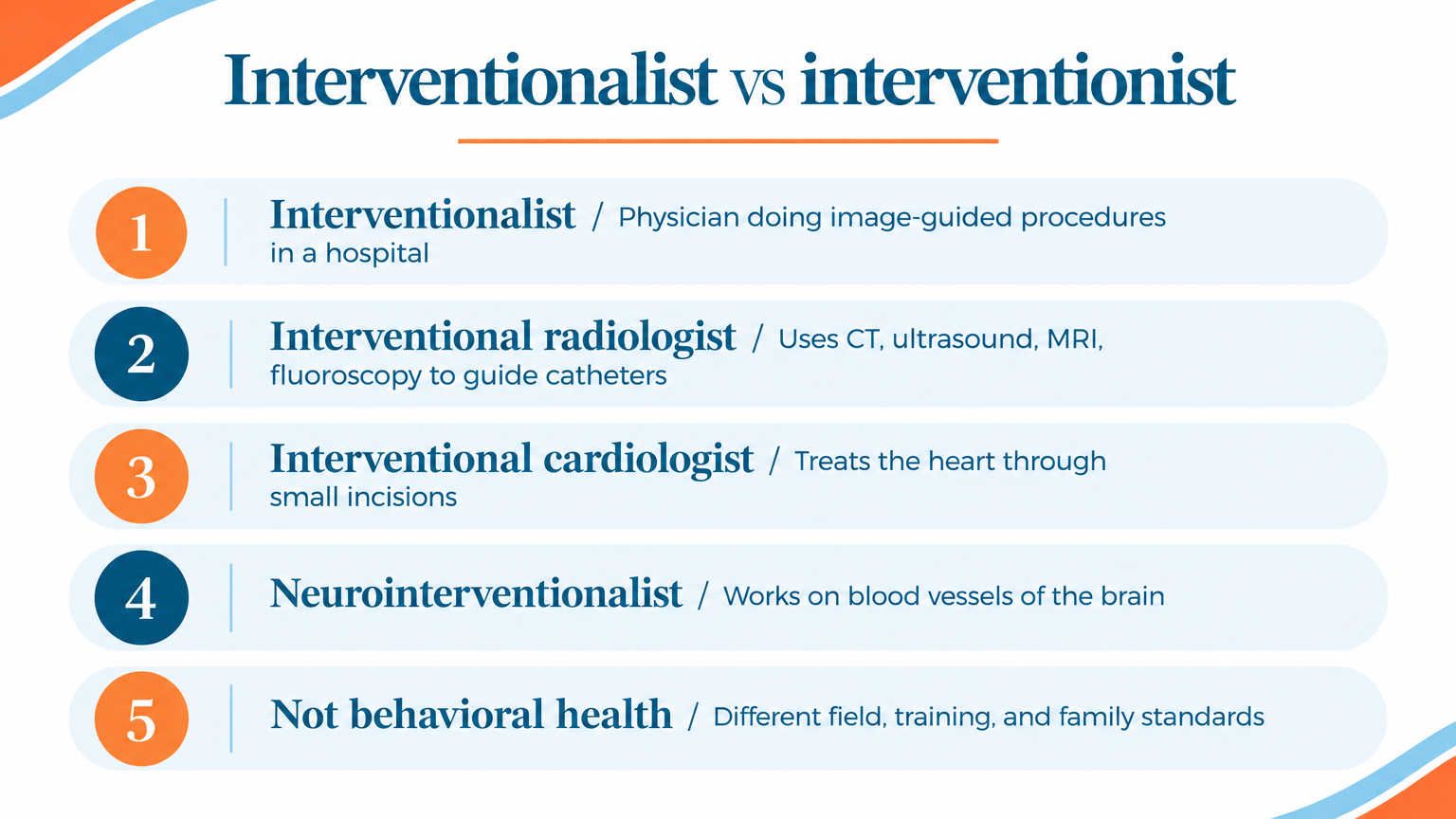
An interventionalist, with the extra -al-, is a physician who performs minimally invasive, image-guided procedures in a hospital, such as an interventional radiologist or interventional cardiologist 1, 2. Different setting, different training, different phone call.
The spelling is the easy part. The harder question, and the one worth your attention tonight, is how to tell a qualified interventionist from someone using the title loosely, and whether a formal family meeting is even the right next step for your situation. The rest of this guide walks you through both.
Interventionalist: the physician in the hospital
An interventionalist is a physician who performs minimally invasive, image-guided procedures instead of open surgery. You will find them in hospitals and specialized procedure suites, not in your living room. The two words you have probably seen together are interventional radiologist and interventional cardiologist, and both are examples of what the medical world means by the longer spelling.
Interventional radiologists use imaging such as CT, ultrasound, MRI, and fluoroscopy to guide catheters, wires, and other instruments through small incisions 1. That is how they treat problems like blocked arteries, tumors, and bleeding without a traditional operation. Interventional cardiology and endovascular interventional neuroradiology work on the same principle in the heart and the blood vessels of the brain, and together these three fields make up the main branches of interventional medicine 2.
If you are reading this because your loved one is struggling with substance use, an eating disorder, or a mental health crisis, this is almost certainly not the person a treatment program meant when they said the word out loud. Behavioral health is a different world with different training and different standards for family involvement, including assessment, safety screening, and confidentiality decisions that have nothing to do with a hospital procedure 3.
Interventionist: the person who helps your family have the conversation
An interventionist is a behavioral-health professional who helps your family plan, rehearse, and facilitate a structured conversation with someone you love, usually about substance use, a mental health crisis, or an eating disorder. The goal is not to corner your loved one. The goal is to turn a scattered, exhausted family into a prepared one, and to connect your person with care they will actually accept.
In practice, that work has three layers. First, assessment: a good interventionist asks who is in the family, what has already been tried, whether there is any history of violence or acute medical risk, and whether family involvement is even safe and useful right now 3. Second, preparation: coaching each family member on what to say, what not to say, and how to stay regulated when the conversation gets hard. Third, facilitation: running the meeting itself, keeping it on track, and handing your loved one off to a specific next step, often same-day admission to a program the interventionist has already vetted.
Unlike an interventionalist, this person is not a physician performing a procedure. They are closer to a specialized coach and coordinator who works alongside licensed clinicians, admissions teams, and sometimes a family therapist. When it is safe and appropriate, family involvement is associated with better engagement, retention, and outcomes in substance use disorder treatment, which is why this role exists at all; SAMHSA also advises screening for current abuse or other circumstances in which family-based intervention may be inadvisable 3. Family and friends can also play a meaningful part in motivating someone to enter care even when that person is not yet fully willing 6.
Why the distinction matters when you are seeking help
Calling the wrong kind of professional in a crisis wastes something you do not have much of: time, composure, and the narrow window when your loved one might say yes to help. The spelling confusion is not an English lesson. It is a routing problem.
If you dial a hospital's interventional radiology department asking for help with your son's drinking, a kind scheduler will redirect you, and you will lose an afternoon you spent working up the nerve. If you hire someone marketing themselves as an interventionist without asking what they actually do before, during, and after the meeting, you may end up with a single dramatic conversation and no treatment plan on the other side of it.
The distinction also matters because the behavioral-health title is not uniformly regulated. Two people can both call themselves an interventionist and offer very different levels of assessment, safety screening, and clinical coordination 3. That is why the next sections focus less on vocabulary and more on how to tell them apart before you hand over your family's hardest week.
Three family-engagement models you will actually hear named
When you start calling around, three names come up again and again: Johnson, CRAFT, and ARISE. They are not brands. They are different ideas about how a family can help someone move toward care, and they differ in tone, pacing, and how much your loved one participates. A good interventionist will tell you which one shapes their work, and why.
The Johnson model: prepared statements, rehearsed meeting
The Johnson approach is the one most families picture, even if they do not know the name. The Johnson Intervention involves multiple family meetings to prepare and rehearse how concerned family members will communicate their concern, love, impact statements, and boundaries 9.
The meeting itself is rehearsed, including the order people speak, how to respond to common objections, and what happens if your loved one says yes or no. Treatment placement is arranged in advance, so there is a concrete next step waiting rather than a vague promise to look into options later.
Done well, it is firm without being cruel. Done poorly, it tips into the reality-TV ambush families fear. The quality of the facilitator, and the care taken during preparation, is most of the difference.
CRAFT: a family-engagement strategy named in the literature
CRAFT, short for Community Reinforcement and Family Training, is one of the family-engagement strategies named alongside Johnson and ARISE in the University of Miami adolescent-engagement resource 9. In contrast to a single decisive meeting, CRAFT is generally described as working with family members over time rather than organizing one planned confrontation.
Your loved one does not have to agree to anything up front for CRAFT-style work to begin. That matters when the person you are worried about is not open to a formal conversation yet, or when a direct meeting would raise safety concerns 3.
It is quieter than the Johnson model, and it asks family members to examine their own patterns. For families who want to help without issuing an ultimatum, it is often a better fit than one dramatic sit-down.
ARISE: another named family-engagement strategy
ARISE is the third family-engagement approach named in the same adolescent-engagement literature 9. Families often describe it as a more gradual, less confrontational alternative to the Johnson model, with family members able to begin planning before the loved one is fully on board.
Many families appreciate an approach that does not rely on a surprise living room or a hidden rental car in the driveway. A planned, step-by-step structure gives everyone a sense that this is a plan, not a single high-stakes event.
One honest caveat covers all three models. Much of the formal evidence base, including a 2024 systematic review of 41 studies that found family interventions were associated with reductions in substance use, behavioral problems, and improvements in family functioning, was conducted primarily in young people 8. The Johnson, CRAFT, and ARISE descriptions in the University of Miami adolescent-engagement literature share that scope 9. The models are used with adults too, including in high-net-worth family systems, but the strongest research sits with younger populations. A skilled interventionist adapts the approach to the actual family in front of them rather than applying a protocol verbatim.
How to vet an interventionist before you hire one
Because the title is not uniformly regulated, two people can both call themselves interventionists and offer very different work. The questions below are the ones a seasoned referral partner would ask on your behalf. Ask them yourself, in the first phone call, before anyone travels or signs anything.
Credentials and clinical collaboration
Start with letters after the name. Ask about any intervention-related certifications on the bio, which board issued the credential, when it was last renewed, and what continuing education it requires. A clear answer takes thirty seconds. A vague one tells you something.
Credentials alone are not enough. Ask who the interventionist collaborates with when a case gets complicated. A good answer names actual clinicians: licensed therapists (LMFT, LMHC, LCSW), psychologists, addiction medicine physicians, dietitians for eating-disorder cases, and nurses for medical risk. Family involvement is most useful when it is coordinated with qualified behavioral-health and treatment professionals rather than handled by one person alone 3. If the only name on the team is the person on the phone, keep calling.
Safety screening, confidentiality, and when family involvement is not the right first step
Ask directly: what do you screen for before you agree to run a meeting? A careful interventionist will walk you through an assessment that covers acute medical risk, withdrawal concerns, history of violence or abuse in the family system, suicidality, and whether any current circumstances make family-based intervention inadvisable or counterproductive 3. If none of that comes up in the intake call, that is a problem.
Confidentiality is the next question. Who hears what, and when. Ask how they handle releases of information, how they communicate with the treatment program they are placing your loved one into, and what they will and will not share with extended family who want to be looped in. For high-net-worth families, add a practical layer: how do they handle household staff, travel logistics, and documentation that could surface later.
Sometimes the honest answer is that a formal meeting is not the right first step. If there is active violence, acute psychiatric crisis, or overdose risk, call 988 or 911 first. A good interventionist will tell you that themselves and help you think about what to do next, rather than booking a flight.
Treatment placement and what happens after the meeting ends
A facilitated meeting without a landing spot is a conversation, not a plan. Before you hire anyone, ask how they handle treatment placement. You want to hear specifics: which programs they have personally vetted, how they match a program to your loved one's clinical picture rather than a referral relationship, and what happens if the first option is not available on the day you need it.
Then ask about the days and weeks after. Who travels with your loved one to the program. Who stays in contact with the family while admission paperwork is finalized. Who is on the phone at week three when motivation dips. Family and social support can influence whether treatment engagement holds, and willingness is not required at entry 6. The interventionists worth hiring treat the meeting as the beginning of a case, not the end of one, and can describe follow-through concretely before you write a check.
What a facilitated family meeting actually looks like
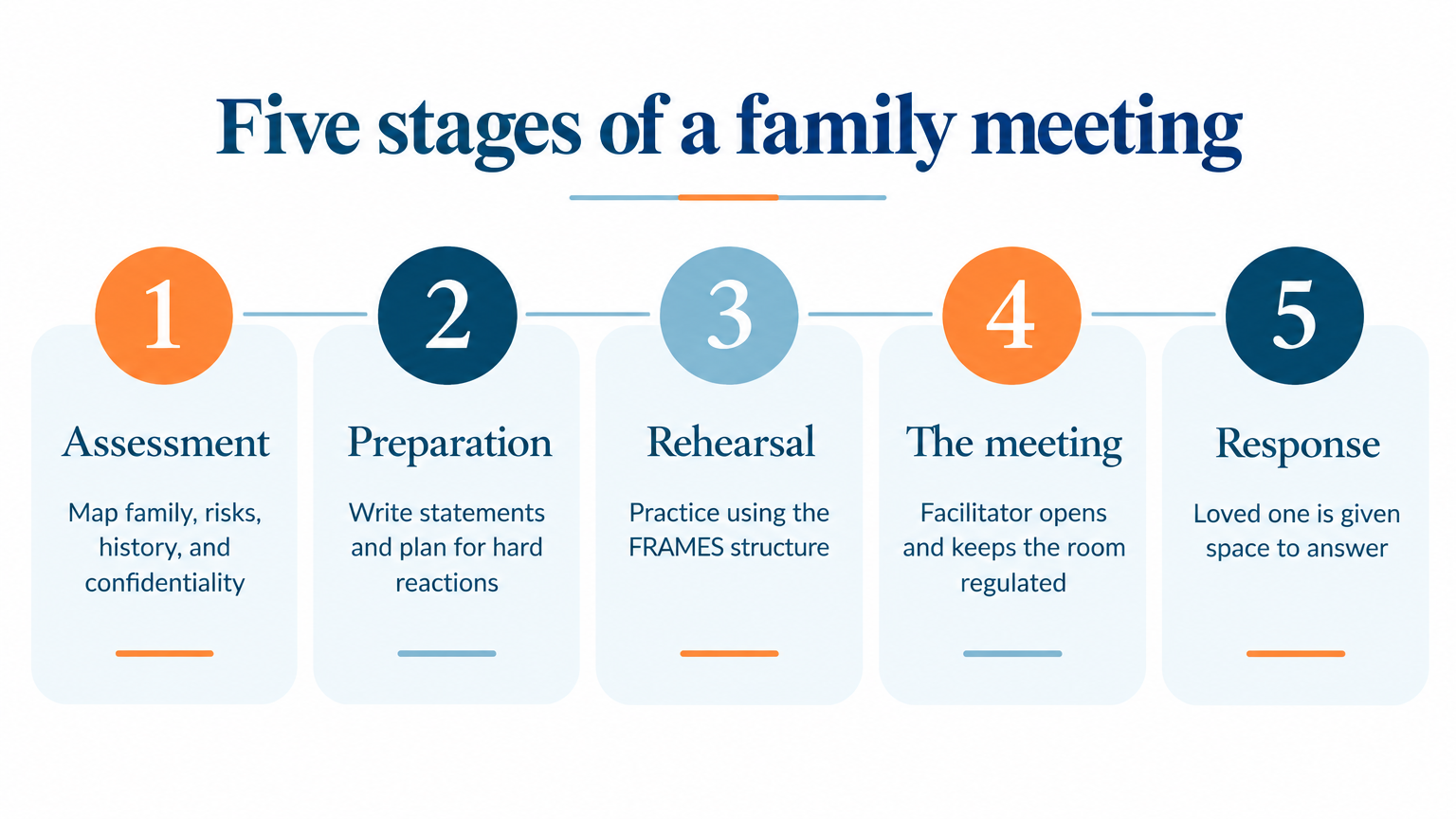
By the time you reach the meeting itself, most of the work is already done. A good interventionist shapes the day around five stages, each with its own purpose, and each anchored in the kind of structure SAMHSA recommends for family-based methods and brief, disciplined conversations about change 3, 7.
- 1. Assessment. Before anyone agrees to a date, the interventionist gathers a picture of your family: who is involved, what has already been tried, any history of violence, acute medical risk, withdrawal concerns, or circumstances where family-based intervention might be unsafe or counterproductive 3. This is also where confidentiality is sorted out, including who hears what and which releases need to be signed.
- 2. Preparation and rehearsal. Family members meet with the interventionist, usually more than once, to write statements, practice what they will say, and work through what to do if your loved one gets angry, cries, or walks out. Disciplined conversations about change tend to follow the FRAMES structure, which includes feedback, responsibility, advice, a menu of options, empathy, and support for self-efficacy 7. Rehearsal is where that structure gets built into real sentences in your actual voice.
- 3. The meeting itself. The interventionist opens, keeps the room regulated, and makes sure each person speaks in the order and tone the group prepared. Your loved one is given space to respond. The goal is not to overpower them. It is to let a careful, honest conversation happen under the only conditions where it has a real chance of landing.
- 4. Treatment placement. If your loved one agrees, there is a specific next step waiting, often same-day admission to a program the interventionist has personally vetted and matched to the clinical picture, not a generic referral. Travel, intake paperwork, and clinical handoff are coordinated so no one is left googling options at a kitchen table.
- 5. Follow-through. The case does not close when the front door of the program closes. The interventionist stays in contact with the family and the clinical team through the first weeks, when motivation often dips and small adjustments matter most 3.
Before you call anyone: the smaller conversation most families should try first
Not every situation needs a hotel conference room, a flight, and five relatives flown in from three time zones. Sometimes the right first move is a quieter one: a direct, prepared conversation at the kitchen table, without a professional in the room yet.
SAMHSA's guidance for families is almost disarmingly plain. Pick an appropriate time and place. Express your concern directly. Acknowledge your loved one's feelings. Listen without judgment. Offer to help find care, and stay patient when the first answer is no 4, 5. That is not a watered-down intervention. It is often the conversation that opens the door to one.
A few things make a home conversation more likely to land. Pick a sober, unhurried moment, not the end of a bad night. Lead with what you have seen, in specific terms, rather than labels. Name one concrete step you are prepared to help with, whether that is a call to a therapist, a consult with a family coach, or research into programs. And accept that your loved one may not agree to anything the first time. Family and social support can play a meaningful role in motivating someone to enter care, and treatment need not begin with complete personal willingness 6.
If the conversation surfaces active overdose risk, self-harm, or an immediate safety concern, call 988 or 911. Otherwise, a brief, structured talk at home, sometimes paired with a family coaching call or a family-therapy consult, is a reasonable first chapter. If it does not move things, you will have better information when you call an interventionist, and your loved one will have heard the concern from you first.
When a facilitated intervention is the right next step
A home conversation is the right starting place for many families. For others, it is not enough, and waiting to find out can cost you weeks you do not have.
Consider a facilitated intervention when you have already tried direct conversations and watched them end the same way, when the pattern of use or symptoms is escalating, or when the people who love your person can no longer stay in the same room without the exchange collapsing into blame. Also consider it when the clinical picture is layered: substance use alongside a mental health diagnosis, an eating disorder with medical risk, or a relapse after a prior treatment episode. Those situations benefit from someone who can hold structure in the room, coordinate with licensed clinicians, and arrive with a treatment placement already matched to the picture 3.
Reaching out does not commit you to a meeting. A good first call is an assessment. Your person may not be ready today, and family and social support can influence whether they get there 6. Starting that conversation now gives you a plan either way.
For referring professionals: what a crisp handoff looks like
A quick scope note: this section is for the attorneys, psychiatrists, therapists, dietitians, and family-office advisors who get the first call when a client's household starts to fray. The handoff you make in that call shapes everything that follows.
A clean referral to an interventionist includes four things. One, a one-paragraph clinical picture: what you have observed, how long, any known medical or psychiatric risk, and whether family-based involvement has been assessed as safe to pursue 3. Two, the family's actual decision-makers and any confidentiality constraints you already know about. Three, what has already been tried, including prior treatment episodes, so the interventionist does not re-run a conversation that failed last year. Four, your read on urgency, including whether you believe the window is days or weeks.
Ask the interventionist the same questions you would want a client to ask: certifications, clinical collaborators, placement process, and follow-through through the first weeks when engagement often wavers 6. A crisp handoff ends with a named next step, not a warm introduction left hanging in an inbox.
Starting a quieter conversation with Next Level Wellness & Behavioral Health
If you have read this far, you are already doing the hard part: thinking carefully before you act. A first call does not commit you to a hotel conference room, a flight, or a meeting on a calendar. It is a conversation about what your family is actually facing and what a reasonable next step looks like, whether that is a facilitated meeting, a brief coaching call, case management alongside a program your loved one is already in, or quieter support at home.
Next Level Wellness & Behavioral Health is a concierge behavioral health firm based in Boca Raton, Florida, serving families nationally and internationally. Founded by Amanda Marino, our approach is relationship-based rather than program-based, which means support can be shaped to run before, during, after, or in place of treatment. That is the premise behind Creating Lasting Change: a careful plan, built with you, that holds up after the first difficult week.
Frequently Asked Questions
Is it interventionalist or interventionist for addiction?
For addiction, mental health, or eating disorder situations, the word you want is interventionist. An interventionalist, with the extra -al-, is a physician who performs image-guided procedures in a hospital, such as an interventional radiologist 1. Different setting, different training, different phone call.
What does an interventionist actually do?
An interventionist helps your family plan, rehearse, and facilitate a structured conversation with a loved one about substance use, a mental health crisis, or an eating disorder. The work has three layers: assessment of who is involved and whether family involvement is safe and appropriate, preparation and coaching for each family member, and running the meeting itself with a specific treatment placement waiting on the other side 3.
How do I know if an interventionist is qualified?
Ask about any intervention-related certifications and the issuing board, when the credential was last renewed, and what continuing education it requires. Ask who they collaborate with clinically, including licensed therapists, addiction medicine physicians, and nurses. Ask what they screen for before agreeing to a meeting, including medical risk, violence, and acute psychiatric concerns 3. A careful answer takes a few minutes. A vague one tells you to keep calling.
What if my loved one refuses to go to treatment after the meeting?
A refusal is not a failure. Family and social support can play a meaningful role in motivating someone to enter care, and willingness is not required at entry 6. A good interventionist stays involved after a no, coaches the family on how to respond in the days that follow, and keeps a treatment placement ready for when the window opens again.
Do we need a formal intervention, or can we start with a conversation at home?
Many families should try a prepared home conversation first. SAMHSA's guidance is plain: pick an appropriate time, express concern directly, acknowledge feelings, listen without judgment, and offer to help find care 4, 5. Consider a facilitated intervention when direct conversations keep ending the same way, when the pattern is escalating, or when the clinical picture is layered with mental health or medical risk.
Can an interventionist help with mental health or eating disorder situations, not just substance use?
Yes. Experienced interventionists work across substance use, mental health crises, and eating disorders, often in situations where more than one is present at once. The structure is similar, but the clinical collaborators change: a dietitian and physician for eating disorder cases, a psychiatrist for acute mental health concerns 3. If overdose or self-harm risk is active, call 988 or 911 first.
References
- Imaging and radiology: MedlinePlus Medical Encyclopedia. https://medlineplus.gov/ency/article/007451.htm
- Interventional radiology, cardiology, and neuroradiology. https://pmc.ncbi.nlm.nih.gov/articles/PMC2745361/
- The Importance of Family Therapy in Substance Use Disorder Treatment. https://library.samhsa.gov/sites/default/files/pep20-02-02-016.pdf
- Starting the Conversation Guide. https://www.samhsa.gov/sites/default/files/starting-the-conversation-guide.pdf
- Helping a Loved One Dealing with Mental and/or Substance Use Disorders. https://www.samhsa.gov/sites/default/files/samhsa_families_family_support_guide_final508.pdf
- Principles of Drug Addiction Treatment: A Research-Based Guide. https://nida.nih.gov/sites/default/files/podat-3rdEd-508.pdf
- Quick Guide for Clinicians Based on TIP 34: Brief Interventions and Brief Therapies in Substance Abuse. https://library.samhsa.gov/sites/default/files/sma15-4136.pdf
- Family Intervention Models for Young Adults with Substance Abuse: A Systematic Review. https://pmc.ncbi.nlm.nih.gov/articles/PMC11572604/
- Engaging Family Members Into Adolescent Drug Treatment. https://sites.education.miami.edu/ciffta/wp-content/uploads/sites/9/2014/10/Engaging_Families_Adolescent_Drug_Tx_FinalWEB.pdf
Insight Beyond Treatment
At Next Level Wellness & Behavioral Health, we believe meaningful change starts with perspective, not just protocols.
That philosophy is directly led by Amanda Marino, whose voice in behavioral health extends beyond clinical settings into leadership, culture, and personal growth.
Through keynote speaking and live events, Amanda explores the deeper themes that show up in recovery, family systems, and life transitions: authenticity, resilience, accountability, and the courage to change. Her work invites audiences to move past labels and into honest conversations that create lasting impact.
A Voice Shaping the Conversation
The topics explored here—change, self-awareness, recovery, and growth—are the same themes Amanda Marino brings to audiences nationwide through speaking engagements and live events.
Known for her appearances on A&E’s Intervention and Digital Addiction, Amanda speaks to organizations, communities, and leadership teams about navigating adversity, embracing vulnerability, and building lives rooted in purpose. Her message resonates far beyond treatment, offering insight that applies to families, professionals, and anyone standing at a crossroads.



Heal on your terms—any time, anywhere.