

Choosing Interventionist and Case Management Services

Key Takeaways
- Families often describe a gap between the intervention and ongoing coordination; pairing an interventionist with a case manager keeps the day of the conversation and the months after under one continuous plan.
- An interventionist structures the family conversation and admission handoff, while a case manager coordinates providers, monitors follow-through, and adjusts the plan as needs change 2.
- A combined team functions differently across four moments: before treatment, during treatment, after discharge, and when a loved one declines or delays a program.
- Vet providers by asking who assesses, who communicates with the treatment program, how the plan is documented, and how co-occurring concerns are handled mid-engagement.
- Modern family participation is prepared and consent-aware, not an ambush; structured involvement supports engagement and retention rather than pressure 4.
- HIPAA permits coordination among providers and allows family communication when the person agrees or is incapacitated, so releases and a single family contact should be clarified upfront 10, 11.
- With 40% of Americans in a mental-health shortage area as of December 2, 2025, capable case management now spans states, telehealth schedules, and travel logistics 14.
- A nonclinical team is not an emergency service; for imminent risk, call 988 and 911, and expect the team to explain crisis protocols before a crisis occurs 13.
The Handoff Problem Most Families Discover Too Late
You hire an interventionist because the morning feels impossible. Your husband is in the next room. Your daughter is on a flight home. Your adult son's employer has started asking questions you cannot answer. Someone needs to structure the conversation, and someone needs to get your loved one to a program by nightfall.
Then the plane lands at the treatment center, and the interventionist's work ends.
Families often describe a gap at this point. The person agrees to care, enters a program, and no one is tracking medications, communicating with the clinical team, holding family boundaries, or planning the return home. The space between the intervention and sustained coordination is quiet, and it can widen fast.
Case management is the role designed to close that gap. SAMHSA describes it as individualized coordination that links a person to services, monitors follow-through, and adjusts the plan as needs change 1. When you look for an interventionist, what you actually need is a team whose intervention plan is already a case management plan, so the day of the conversation and the months that follow belong to the same continuous support.
Two Roles, One Continuous Plan
What an Interventionist Actually Does
An interventionist is the person who structures the conversation your family cannot have alone. Their work starts well before the day you picture in your head. They interview you and other close family members, gather clinical and social history, assess risk, help you decide who should be in the room, and prepare each participant on what to say, what not to say, and what they are prepared to do if the answer is no.
Modern, evidence-informed interventions are not ambush meetings. SAMHSA's guidance on family involvement in substance use disorder treatment treats family participation as a support for engagement and retention, not a pressure tactic, and that framing informs how intervention preparation is approached 4. A capable interventionist spends more time coaching your family than performing on the day itself.
Their deliverable is a handoff. If your loved one agrees to care, the interventionist arranges transport, confirms the receiving program, and makes sure someone is physically present through admission. Their scope typically ends there, which is exactly why the next role matters so much. The person who opens the door is not usually the person who stays with you for the months that follow.
What a Case Manager Actually Does
A case manager is the person who keeps the plan honest after the first week. AHRQ describes case management as a collaborative process of assessment, planning, facilitation, and advocacy on behalf of the client 8. SAMHSA's clinical guidance for intensive outpatient settings puts the same work in operational terms: develop an individualized plan, coordinate referrals, monitor follow-through and outcomes, and advocate with treatment and community providers 6.
In practice, this looks less dramatic than an intervention and more like steady maintenance. The case manager talks to the clinical team at the treatment program, tracks medication changes, flags scheduling conflicts, loops in a psychiatrist or dietitian when a new concern surfaces, and keeps a written record so no one is working from memory. When something shifts, your father's discharge date, your daughter's living arrangements, your son's return to work, the plan gets reassessed rather than quietly abandoned 9.
SAMHSA's TIP 27 frames this as coordination across multiple agencies, with adjustments as needs change 2. That phrase, as needs change, is the entire reason the role exists. Treatment is a moving target. The case manager is the person watching it move.
Where the Two Roles Overlap, and Where They Should Not
The roles share a foundation. Both begin with assessment. Both require careful listening to your family's history, the clinical picture, and the practical constraints: who lives where, who travels, who pays, who talks to whom. When an interventionist and a case manager are part of the same team, that assessment is written once and carried forward, so your loved one is not asked the same intake questions three times in four days.
Where they should not overlap is in authority. The interventionist leads the day of the structured conversation. The case manager leads the weeks and months after. Blending those too tightly can leave your family unsure of who to call when a medication is missed on a Tuesday afternoon or when the treatment program wants a new release signed by Friday.
A combined team solves the handoff problem without erasing the distinction. AHRQ's evidence review on care coordination is honest about the limits here: coordination strategies improve selected outcomes, but no single model is universally superior 7. What that means for you is practical. You are not looking for a brand name or a proprietary method. You are looking for a team that can tell you, in plain language, who holds which responsibility at each stage, and how those two people stay in the same conversation.
Four Scenarios Where a Combined Team Functions Differently
Before Treatment: Planning the Conversation and the Day After
In the weeks before a structured conversation, a combined team is doing two things at once. The interventionist is preparing your family, rehearsing what each person will say, and mapping possible responses. The case manager is already building the plan for what happens if your loved one says yes: which program, which bed, which flight, which prescriber, which release-of-information forms waiting to be signed in the admissions office.
SAMHSA's family guidance favors expressing concern, patience, and a judgment-free tone over pressure tactics 5. That tone is only possible when the logistics are handled elsewhere. If you are the one calling programs between dinner and bedtime, you cannot also be the calm, prepared voice in the room on the day of the conversation.
Ask the team to walk you through both tracks before you sign anything. The intervention plan and the day-after plan should already read as a single document.
During Treatment: Keeping Providers, Family, and the Plan in Sync
Once your loved one is admitted, the interventionist's active role tapers and the case manager's begins in earnest. This is the stretch where families most often feel locked out. The clinical team is bound by confidentiality, the program has its own rhythm, and your questions start piling up without a clear person to send them to.
A case manager becomes that person. SAMHSA's intensive outpatient guidance describes the ongoing work plainly: coordinate referrals, monitor follow-through and outcomes, advocate with the treatment team 6. In practice, that means a weekly call with the program's clinical lead, a running record of medication adjustments, a scheduled family update that respects the client's consent, and a flag raised when something stops matching the plan.
The point is not more communication. It is organized communication, with one person holding the thread so you are not reconstructing the picture from fragments every Sunday night.
After Treatment: Transitions, Reassessment, and the Return Home
Discharge is not an ending. It is the moment the plan has to change again. AHRQ's framework for case management specifically names periodic reassessment of needs across medical, social, educational, and other supports as a core function 9. A capable case manager treats the step down from a residential program, the move to an outpatient schedule, or the return to a family home as a trigger for a formal reassessment, not a status update.
What does that look like in your week? A new living arrangement might require different household boundaries. A step-down to outpatient care may introduce a psychiatrist, a dietitian, or a recovery associate (sometimes called a sober companion) into the picture. School, work, or custody conversations may surface. SAMHSA's TIP 27 describes case management as adjusting the plan as needs change 2. Ask how often reassessment happens and what triggers an unscheduled one.
In Place of Treatment: Supporting Someone Who Will Not Enter a Program
Sometimes your loved one says no. Sometimes they say later. Sometimes residential care is not the right level for the picture in front of you, and sometimes a high-performing individual quietly arranging support for themselves wants help without entering a program at all. A combined team should have a plan for this scenario, not treat it as a failure.
Case management can continue even when formal treatment is paused or declined. SAMHSA's advisory on case management describes it as individualized coordination that links a person to a range of services, including supports outside formal treatment settings 1. NSDUH's 2025 release reflects how wide that range has become, with national estimates now covering peer support, recovery coaches, withdrawal management, and overdose-reversal medication alongside formal treatment 15. Coordination across those options is often what makes a non-program path workable in the first place.
The Vetting Conversation: Questions That Separate Process From Promises
You will know within one phone call whether a provider has a process or a pitch. The difference shows up in how they answer specific operational questions, not in how warmly they speak about recovery. AHRQ's care coordination framework names assessment, planning, communication, facilitation, and advocacy as the measurable domains of this work 8. Ask the team to describe each one in their own practice.
Keep these questions close when you make the first calls:
- Who conducts the initial assessment, and when is it reassessed? AHRQ specifies periodic reassessment after transitions or changes in risk as a core function, not a courtesy 9. A direct answer names the person, the format, and the triggers.
- Who communicates with the treatment program, and how often? SAMHSA's intensive outpatient guidance lists coordination of referrals, monitoring of follow-through, and advocacy with providers as the standard scope 6. Ask for a cadence, not an intention.
- How do you document the plan, and who sees it? A written individualized plan should exist, and someone on the team should own it between calls 2.
- What is your process when a co-occurring concern surfaces mid-engagement? SAMHSA's co-occurring guidance expects referral and coordination between behavioral-health professionals rather than a single-provider workaround 3.
- What releases of information do you use, with whom, and when do they expire? This is a process question, not a legal one.
A capable team welcomes these questions and answers them in specifics. Vague reassurance is the signal to keep calling.
Family Participation Without Ambush or Coercion
The scene from older television shows, where relatives surprise a loved one in a living room with letters and ultimatums, is not the current standard. SAMHSA's advisory on family involvement in substance use disorder treatment treats family participation as a support for engagement, retention, and outcomes, which is a different goal than catching someone off guard, and that guidance informs how a prepared conversation is structured 4. The work happens before the conversation, not during it.
A capable team spends real time with you first. They ask who in your family is grounded enough to be in the room, who should write a letter but stay home, and who should have no speaking role at all. They help each person decide what they are prepared to offer and what they are not. SAMHSA's family guide favors expressing concern, patience, and a judgment-free tone over pressure or shame 5, and that tone is a skill that gets rehearsed.
Consent-aware does not mean passive. Your father may still hear hard things from his sister. The difference is that the hard things are chosen in advance, delivered with care, and paired with a concrete offer of support rather than an ultimatum your family cannot sustain by Wednesday.
Privacy, HIPAA, and the Practical Rules of Who Talks to Whom
Privacy is not a disclaimer at the bottom of a contract. It is an operational question your provider should answer in plain language before anyone signs anything. Who can call your mother? Who can tell your husband's employer anything at all? What happens if your daughter is admitted to a program while sedated and your family needs an update that night?
Start with the baseline. HHS makes clear that HIPAA permits providers to share protected health information with other health providers for treatment, case management, and care coordination, which is why a combined team can legitimately talk to the receiving program, the prescribing psychiatrist, and the outpatient dietitian without a new form for every call 10. Case management and care coordination are specifically identified as health-care operations under HIPAA, with the minimum-necessary standard applied to each disclosure 12.
Family communication follows a different track. When your loved one has capacity and agrees or does not object, providers may share relevant information with involved family members. When they are incapacitated, providers may use professional judgment about what is in the person's best interests 11. Your team should walk you through both situations before the first appointment, not after the first missed update.
Ask the specific questions. Which releases of information are signed, with whom, and when do they expire? Who on the team is the single point of contact for your family? What is shared, what is paraphrased, and what is held back under the minimum-necessary standard? A provider who can answer these without hedging is one who has handled the question many times before.
Why Coordination Now Spans Multiple Providers and Geographies
You may picture a case manager as someone local, a single person who knows the clinicians in your zip code. That picture is out of date. HRSA's 2025 workforce brief reports that 40% of the U.S. population, or 137 million people, lived in a mental-health professional shortage area as of December 2, 2025, with gaps across addiction counselors, psychologists, psychiatrists, and social workers 14. The right prescriber for your son may practice in another state. The eating disorder dietitian your daughter needs may only take telehealth appointments on Thursdays. The outpatient program with a bed next week may be two time zones away.
Cross-geography coordination is not a luxury layered on top of good case management. It is the baseline. A capable team should already work this way, with experience holding a plan together across state licensure rules, telehealth schedules, and travel logistics. Ask how they handle a provider in one state, a family in another, and a client who moves between the two. If the answer is specific, you have found a team built for the actual landscape.

Crisis Protocols: What a Nonclinical Team Should and Should Not Do
Ask the team directly how they handle crisis situations. SAMHSA's 2025 crisis-care guidelines are clear that confidentiality holds except in limited circumstances such as imminent risk or legal requirements 13. A capable provider explains those exceptions before a crisis, not during one, and documents who they will call, in what order, and what information they will share under the minimum-necessary standard. If the answer is vague, you have found the edge of their process.
The Five-Stage Arc of a Combined Engagement
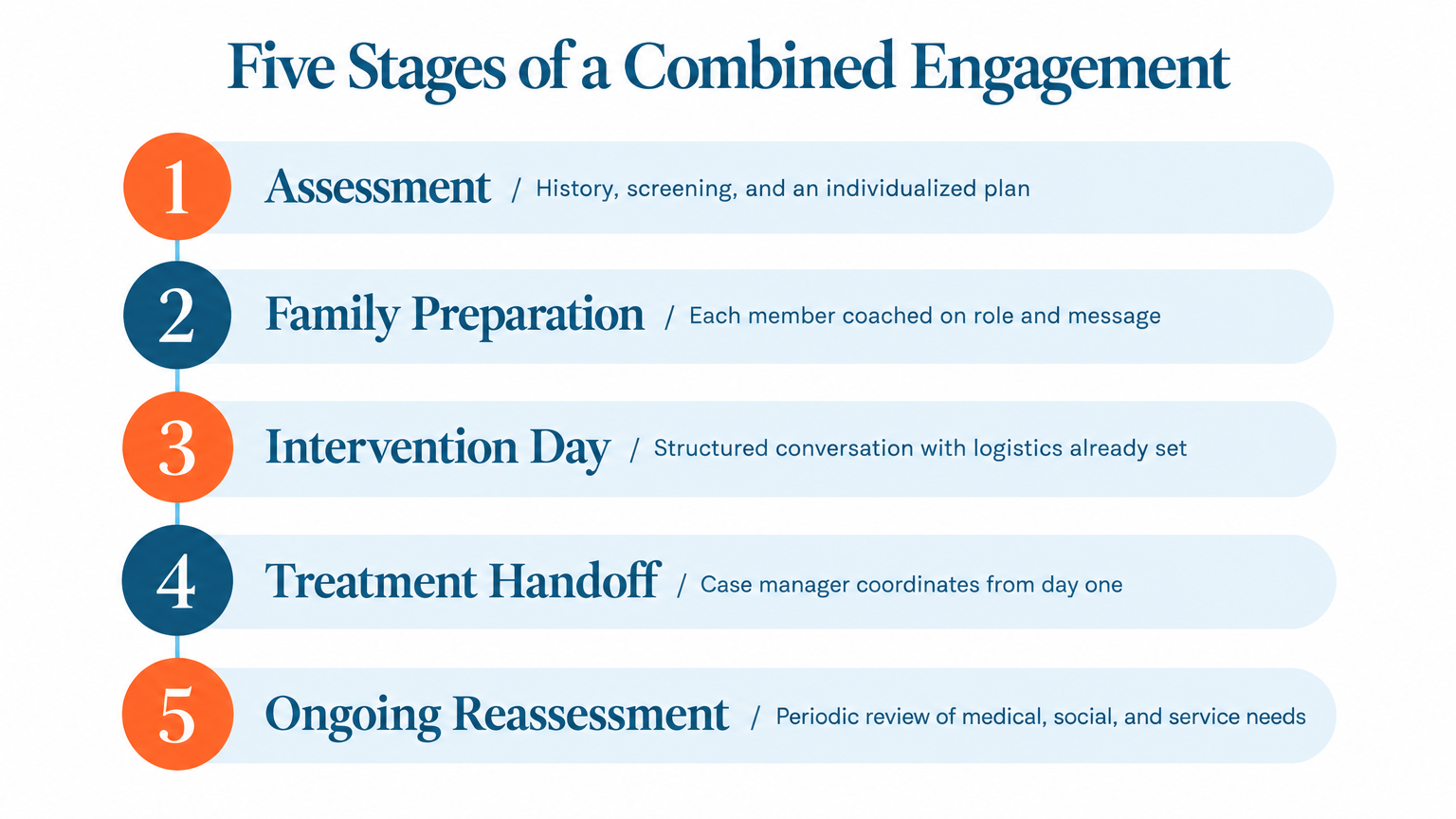
When a combined team is working the way it should, the whole engagement moves through five recognizable stages. You should be able to ask any provider to walk you through all five, in order, before you sign anything.
- Assessment comes first. The team gathers clinical and social history, screens for co-occurring concerns, and writes an individualized plan rather than a template 2.
- Family Preparation follows, with each participant coached on what to say, what to offer, and what to withhold, grounded in SAMHSA's guidance on family involvement in substance use disorder treatment 4.
- Intervention Day is the structured conversation itself, with transport and admission logistics already in motion so your family can stay present rather than scrambling.
- Treatment Handoff is where many families describe engagements losing continuity, and where a combined team should instead tighten. The case manager begins coordinating referrals, monitoring follow-through, and advocating with the clinical team from the first day of admission 6.
- Ongoing Case Management and Reassessment is the long tail. AHRQ names periodic reassessment of medical, social, educational, and other service needs as a defining function, not an optional one 9.
Ask the team to name what triggers an unscheduled reassessment. The answer tells you whether stage five is a practice or a promise.
Starting the Conversation
You do not have to have the plan figured out before you make the first call. The right team will help you build it. What you need going in is a sense of what to listen for: a provider who answers specific questions in specific terms, who can describe both the day of the structured conversation and the months that follow in the same breath, and who treats your family's privacy as an operational practice rather than a line in a contract.
At Next Level Wellness & Behavioral Health, founder Amanda Marino leads a team that supports people before, during, after, or in place of treatment, with discretion from Boca Raton and across the country and internationally. When you are ready for a confidential conversation about combined interventionist and case management support, we are here to listen first and help you plan from there. Creating Lasting Change begins with a single, quiet call.
Frequently Asked Questions
What is the difference between an interventionist and a case manager?
An interventionist structures the family-centered conversation that opens the door to care and manages the handoff to a program. A case manager picks up from there, running assessment, individualized planning, referral, monitoring, and advocacy across providers as needs change 8. One role is about the moment of decision. The other is about the months that follow.
Should we hire one combined team or two separate providers?
A combined team closes the handoff gap, because the intervention plan and the case management plan are written together rather than stitched after the fact. Separate providers can work when they communicate well, but you take on the coordination risk. Ask any provider to walk you through both the day of the conversation and the following six months in one continuous plan.
How does HIPAA affect what the team can share with our family?
HIPAA permits providers to share information for treatment, case management, and care coordination, and to communicate relevant information with involved family members when the person agrees or does not object 10. When your loved one is incapacitated, providers may use professional judgment about what is in their best interests 11. Ask who the family point of contact is and which releases are signed.
What questions should we ask before signing with a provider?
Ask who conducts the initial assessment and what triggers reassessment 9. Ask who speaks with the treatment program and how often. Ask how the individualized plan is documented and who owns it between calls 2. Ask how co-occurring concerns are handled mid-engagement 3. Clear, specific answers suggest a real process. Warm generalities suggest you should keep calling.
Can case management work if our loved one refuses treatment?
Yes. Case management is individualized coordination that links a person to services, which can include supports outside formal treatment such as peer support, recovery coaches, withdrawal management, and prescribers 1, 15. A capable team keeps assessing, keeps the family prepared, and keeps the door open for a different answer later. Declining a program is a decision point, not an endpoint.
Do these services work across different states or countries?
They have to. HRSA reports that 40% of the U.S. population lived in a mental-health professional shortage area as of December 2, 2025, which means the right prescriber, program, or specialist is often in another state 14. Ask how the team coordinates across licensure rules, telehealth schedules, and travel logistics before you sign.
References
- COMPREHENSIVE CASE MANAGEMENT FOR SUBSTANCE USE DISORDERS: A REVIEW OF THE EVIDENCE. https://library.samhsa.gov/sites/default/files/PEP20-02-02-013.pdf
- TIP 27: Comprehensive Case Management for Substance Abuse Treatment. https://library.samhsa.gov/sites/default/files/sma15-4215.pdf
- Substance Use Disorder Treatment for People with Co-Occurring Disorders. https://library.samhsa.gov/sites/default/files/pep20-06-04-006.pdf
- THE IMPORTANCE OF FAMILY THERAPY IN SUBSTANCE USE DISORDER TREATMENT. https://library.samhsa.gov/sites/default/files/pep20-02-02-016.pdf
- Helping a Loved One Dealing with Mental and/or Substance Use Disorders. https://www.samhsa.gov/sites/default/files/samhsa_families_family_support_guide_final508.pdf
- CLINICAL ISSUES IN INTENSIVE OUTPATIENT TREATMENT FOR SUBSTANCE USE DISORDERS. https://library.samhsa.gov/sites/default/files/pep20-02-01-021.pdf
- Review of Systematic Reviews of Care Coordination Interventions. https://www.ncbi.nlm.nih.gov/sites/books/NBK44016/
- Chapter 3. Care Coordination Measurement Framework. https://www.ahrq.gov/ncepcr/care/coordination/atlas/chapter3.html
- Care Coordination Measures Atlas Update. https://www.ahrq.gov/ncepcr/care/coordination/atlas/chapter3tab3.html
- Mental Health - HHS.gov. https://www.hhs.gov/hipaa/for-professionals/faq/mental-health/index.html
- HIPAA Privacy Rule and Sharing Information Related to Mental Health. https://www.hhs.gov/sites/default/files/ocr/privacy/hipaa/understanding/special/mhguidancepdf.pdf
- HIPAA and Health Plans – Uses and Disclosures for Care Coordination and Continuity of Care. https://www.hhs.gov/hipaa/for-professionals/faq/uses-and-disclosures-for-care-coordination-and-continuity-of-care/index.html
- 2025 National Guidelines for a Behavioral Health Coordinated System of Crisis Care. https://library.samhsa.gov/sites/default/files/national-guidelines-crisis-care-pep24-01-037.pdf
- State of the Behavioral Health Workforce, 2025. https://bhw.hrsa.gov/sites/default/files/bureau-health-workforce/data-research/Behavioral-Health-Workforce-Brief-2025.pdf
- 2025 National Survey on Drug Use and Health (NSDUH) Key Substance Use and Mental Health Indicators. https://www.samhsa.gov/data/data-we-collect/nsduh-national-survey-drug-use-and-health/national-releases/2025
- 214 - NIDA FY 2025 narrative. https://nida.nih.gov/sites/default/files/nida_fy25_cj-web.pdf
- Joint CMCS and SAMHSA Informational Bulletin. https://www.medicaid.gov/federal-policy-guidance/downloads/cib-01-26-2015.pdf
- Methods - Interventions for Substance Use Disorders in Adolescents: A Systematic Review. https://www.ncbi.nlm.nih.gov/books/NBK557286/
Insight Beyond Treatment
At Next Level Wellness & Behavioral Health, we believe meaningful change starts with perspective, not just protocols.
That philosophy is directly led by Amanda Marino, whose voice in behavioral health extends beyond clinical settings into leadership, culture, and personal growth.
Through keynote speaking and live events, Amanda explores the deeper themes that show up in recovery, family systems, and life transitions: authenticity, resilience, accountability, and the courage to change. Her work invites audiences to move past labels and into honest conversations that create lasting impact.
A Voice Shaping the Conversation
The topics explored here—change, self-awareness, recovery, and growth—are the same themes Amanda Marino brings to audiences nationwide through speaking engagements and live events.
Known for her appearances on A&E’s Intervention and Digital Addiction, Amanda speaks to organizations, communities, and leadership teams about navigating adversity, embracing vulnerability, and building lives rooted in purpose. Her message resonates far beyond treatment, offering insight that applies to families, professionals, and anyone standing at a crossroads.



Heal on your terms—any time, anywhere.