.svg)

Discreet Family Interventions in Boca Raton, FL

Key Takeaways
- A modern family intervention in Boca Raton is a structured, prepared conversation with a clinical on-ramp, not the ambush-style confrontation dramatized on television.3,4
- Privacy planning in a tightly connected community means thinking through who books travel, where pre-meetings happen, which family members are told when, and whether placement should be outside Palm Beach County.
- Compare facilitators on the full five-stage arc—preparation, facilitation, transport and placement, family coaching, and aftercare—rather than the meeting day alone, since long-term outcomes hinge on the back half.
- Weigh local coordination against national hotlines: a facilitator working inside Palm Beach County's behavioral health infrastructure can match your child to clinically appropriate beds instead of paid-lead placements.10,16
What a Real Intervention Looks Like (It's Not the A&E Version)
You have probably pictured it already. A dim living room. A circle of chairs. Someone with a clipboard reading letters aloud while your son or daughter sits stunned, then storms out, then breaks down. That is the television version, and it has done real damage to families who might otherwise have asked for help years earlier.
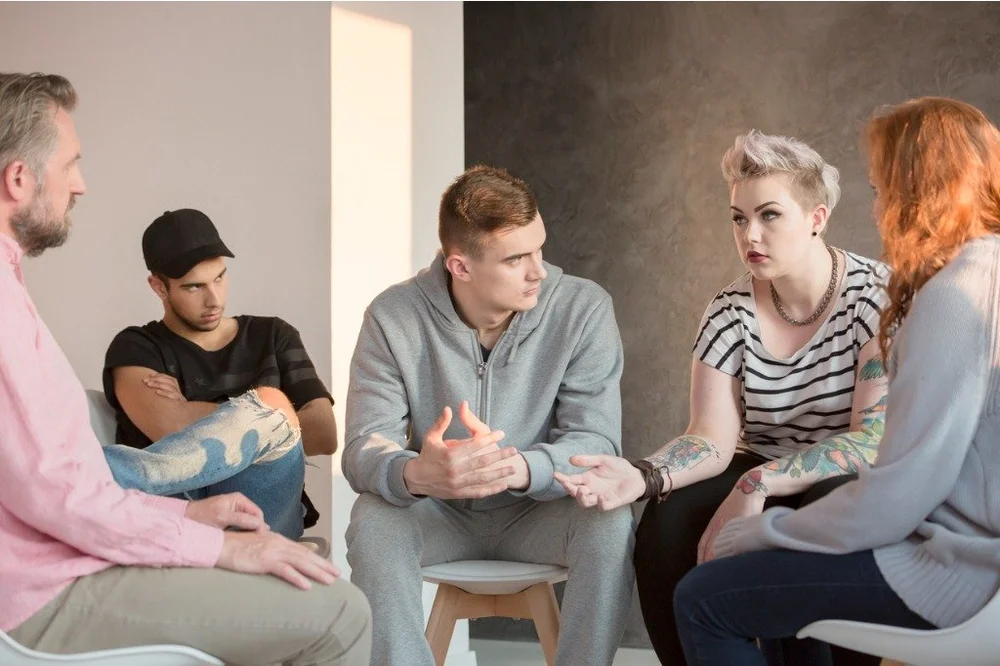
A contemporary family intervention looks almost nothing like that. It looks more like a well-prepared conversation with a clinical on-ramp attached. There is a facilitator in the room, yes. There are people who love your adult child, yes. But the emotional choreography has already happened in the two weeks before anyone sits down, and the focus is not on cornering your child. The focus is on giving your family a shared language and giving your child a real, immediate option for care.
The research supports that shift. CDC identifies parenting skills and family relationship programs as one of six evidence-based strategies for preventing or delaying substance use, alongside school and community approaches. Family-based therapy models like multidimensional family therapy and functional family therapy are among the most effective psychosocial treatments in this space. None of those models rely on ambush. All of them rely on structure.3,1,4
You are not staging a scene. You are opening a door your child can actually walk through, with a bed reserved, a bag packed, transportation waiting, and a family that has been coached on what to say when the moment gets hard. If your adult child says no in the first ten minutes, the room does not collapse. There is a plan for that too.
What you saw on television was the crisis. What you actually want is the beginning of a coordinated pathway. That is what the rest of this guide walks through.
The Boca Raton Privacy Problem
Here is the part no national addiction guide will name for you: Boca Raton is a small town wearing a big city's clothes.
The population has roughly doubled in a generation, growing from 49,447 residents in 1980 to 97,422 in 2020. On paper, that looks like anonymity. In practice, it is the opposite. The people who matter most to your family's reputation—your golf foursome, the board of your foundation, your practice partners, the other parents from Saint Andrew's or Pine Crest, the neighbors on your block in Royal Palm Yacht & Country Club or St. Andrews or Woodfield—still all know each other. They see each other at the same handful of restaurants on East Palmetto Park. Their spouses sit on the same nonprofit committees. Their kids grew up in the same group chats.11
You already know this. It is why you have not called anyone. It is why the search history on your phone is more honest than any conversation you have had this month.
A discreet interventions Boca Raton FL is not just about closing the blinds. It is about a whole set of decisions most families do not think to make until they are already exposed:
- Who books the flight, and under whose name.
- Whether the pre-intervention family meetings happen at your house, at a private office, or by secure video so no unfamiliar car sits in your driveway for two hours.
- Which family members get a heads-up, and which get told after your child is safely in care.
- Whether the treatment center is inside Palm Beach County at all, because sometimes the safest placement is a bed in another state where nobody recognizes the last name.
Facilitators who work in this community plan for those questions before you have to ask them. They also plan for the ones you cannot anticipate—the country club employee who might recognize your car at a certain address, the concerned aunt who will absolutely post something on Facebook if she is invited too early, the housekeeper who deserves a truthful but limited explanation for the change in routine.
None of this is vanity. You are protecting your child's future ability to walk back into their own life—their job, their friendships, their standing—without the recovery becoming the first thing people whisper about. That is a legitimate clinical concern, not a shallow one. And it is one of the reasons a coordinated, local team matters more here than the branded national hotline you saw at 3 a.m.
The Family Intervention Arc: Five Stages, Not One Day
The most useful reframe you can make right now is this: the intervention is not the event. It is one stage in a five-part arc that starts before your child ever hears about the meeting and continues long after they walk into treatment:
- Preparation
- Facilitation
- Transport and placement
- Family coaching
- Aftercare
Understanding the arc changes how you spend the next two weeks. Instead of rehearsing a single dramatic moment, you and your facilitator are building a runway. Each stage has its own work, its own risks, and its own definition of success. The stages below are the front half of that arc—the part that gets your adult child from the living room to a clinical setting. The back half, family coaching and aftercare, comes later in this guide because the truth is that most of the real recovery work happens after the plane lands.
This staged design is not improvisation. It mirrors how evidence-based family treatment models are structured in clinical settings: sustained engagement, skill building, and coordinated linkage to care rather than a one-off confrontation. CDC treatment guidance also describes recovery as a continuum that may include medication, various therapy modalities, and telehealth options—not a single admission decision. Your job is not to win an argument in one afternoon. Your job is to keep the runway lit.2,3,4
Preparation: The Two Weeks Before the Room
Preparation is where the intervention is actually won or lost. In the two weeks before anyone sits down, your facilitator meets with each family member individually—sometimes in person, sometimes by secure video if a car in the driveway is a risk. You map who belongs in the room. You identify who does not, however much they love your child. You draft what each person will say and, more importantly, what each person will not say when the temperature rises.
You also line up the clinical piece in parallel. A bed is reserved. A bag is quietly packed. Flights or transport are booked under discreet arrangements. The CDC coping research shows that some of the most instinctive family responses are counterproductive, which is exactly why this stage is guided rather than improvised. By the time the meeting starts, there are almost no surprises left for you.7
Facilitation Day: What Actually Happens
The morning of, you will feel sick. That is normal. The facilitator arrives early, walks the room, and reviews the sequence one last time. When your child arrives, there is no ambush. There is a calm invitation to sit down and hear what the people around them have prepared.
Family members read or speak, one at a time, in the order rehearsed. The facilitator holds the pacing, cuts off spirals, and redirects when someone drifts into old grievances. The ask is specific: accept the treatment option that is already reserved and waiting today. If your child says yes, transport is ready within the hour. If they say no, the facilitator has already coached you on the boundaries you agreed to hold—and the door stays open for the next conversation, often within days.
Transport, Placement, and the First 72 Hours
Once your child says yes, speed matters. A trained transport professional—not you, not a sibling—accompanies them to the facility, whether that is a program in South Florida or a bed out of state where the last name means nothing. You are not the driver on this leg. You are the parent who gets to breathe.
The first 72 hours are quiet on your end by design. Intake happens. Medical stabilization begins, which may include medication to help with cravings or withdrawal alongside the therapy work that follows. You will get limited updates, not a live feed. Resist the urge to fill the silence with calls. This window belongs to your child and their clinical team. Your part of the work is about to start in a different form.2
Why Family-Centered Care Outperforms the Solo Approach
For a long time, the standard advice sounded like this: get your child into treatment, and then wait. Wait for the phone call. Wait for the return. Wait to see if this time takes. You were positioned as the audience for someone else's recovery. That framing has quietly fallen apart in the research over the last decade.
A review of family interventions across mental, emotional, and behavioral health outcomes found that 96% of studies demonstrated effectiveness—meaning the family-based approach itself produced measurable improvements across a wide range of conditions. Read that carefully. The figure describes the share of studies showing effectiveness across a body of family intervention research, not a per-family success rate and not a guarantee for your child. What it tells you is that the model itself, done well, tends to work. That is a very different claim than any single program can honestly make.6
The clinical literature backs the same direction. Family-based approaches are consistently identified as among the most effective psychosocial treatments in this space, with structured models like multidimensional family therapy and functional family therapy leading the evidence base. Even the smaller-effect studies show a persistent benefit when families are included as active participants rather than concerned bystanders. CDC guidance on adverse childhood experiences reinforces the point from a different angle, recommending that adults be linked to family-centered treatment approaches that include both substance use treatment and parenting interventions.3,4,5,8
Here is what that means for your household. The solo model asks your adult child to change while everyone around them stays the same. Family-centered care asks the whole system to move—slightly, thoughtfully, and with coaching. You are not being blamed. You are being included, because inclusion is what the evidence supports.
That is also why the intervention day is designed to launch a longer family process rather than end one. When you sit down in that room, you are not closing a chapter on years of worry. You are opening the first structured session of work you and your child will do side by side, in parallel tracks, for months. The bag by the door is real. So is the seat you will be asked to keep showing up in.
Insight Beyond Treatment
At Next Level Wellness & Behavioral Health, we believe meaningful change starts with perspective, not just protocols.
That philosophy is directly led by Amanda Marino, whose voice in behavioral health extends beyond clinical settings into leadership, culture, and personal growth.
Through keynote speaking and live events, Amanda explores the deeper themes that show up in recovery, family systems, and life transitions: authenticity, resilience, accountability, and the courage to change. Her work invites audiences to move past labels and into honest conversations that create lasting impact.
Language for the Room: What to Say, What to Retire
What comes out of your mouth in the first ninety seconds of that meeting matters more than any speech you rehearse for the middle. Your adult child is scanning for two things: are you here to shame me, or are you here to help me. Everything you say points to one answer or the other, whether you intend it to or not.
The good news is that the phrasing is learnable. So is the phrasing that quietly wrecks the room. Below is a starting vocabulary—not a script, because a script will sound like one—drawn from what facilitators coach families through in the preparation weeks.
Phrases That Open a Door
Lead with what you have seen, not what you have concluded. "I've noticed you haven't been sleeping" lands differently than "You have a problem." Name your own feeling before you name their behavior: "I'm scared, and I love you, and I want to say this out loud."
Offer something specific, not a lecture. "There's a bed reserved for you today. A bag is packed. I'll go with you as far as the door." Concrete beats abstract every time.
Close your turn with an invitation, not a verdict. "Will you let us help you say yes to this today?" You are asking a question your child can answer, not delivering a sentence they have to accept.
Well-Meaning Responses That Backfire
Here is the counterintuitive finding that changes how facilitators coach families. A CDC-hosted study of family members living with a loved one's substance use disorder found that withdrawal coping—stepping back from arguments, refusing to fund the behavior, pulling out of the daily emotional tug-of-war—was rated the most helpful strategy, while several frequently used engaged strategies were rated unhelpful by the very families using them. In other words, the responses that feel most loving in the moment are often the ones that keep the pattern alive.7
Retire the guilt trip. "Do you know what you're doing to your mother?" turns the room into a courtroom, and your child has been rehearsing that defense for years. Retire the résumé. Listing every school, opportunity, and dollar spent on your child sounds like a bill being presented. Retire the ultimatum delivered in anger; hold boundaries in your calmest voice, or hold them later.
Retire "we've tried everything." You have not. You are trying this. Say that instead.
When Your Adult Child Has Already Been Through Treatment
If your son or daughter has already been to treatment—maybe once, maybe three times, maybe at programs whose names you can no longer say without flinching—you are reading this section for a specific reason. You are wondering whether another intervention is even honest. Whether you are the parent who keeps rearranging deck chairs. Whether your child will roll their eyes before you finish the first sentence.
Let that go for a minute. Recurrence is not proof that your child cannot recover, and it is not proof that you failed. It is data. Each prior admission tells the next clinical team something useful: what medications were tried, which therapy modalities landed, where the aftercare fell apart, which relationships were still standing at the six-month mark. That history is an asset in the preparation phase, not a mark against your family.
What often needs to change the second or third time is not the intensity of the confrontation. It is the design of what comes after intake. CDC treatment guidance frames recovery as a combination of medication where appropriate, various forms of therapy, and options that include office-based and telehealth care—which matters because an adult child who resisted residential care the last time may accept a differently structured plan this time. Family-centered treatment linkage is also part of the current standard for adults with complex histories, particularly those carrying adverse childhood experiences into adulthood.2,8
So when you sit down to prepare this round, the question is not "how do we make them go." The question is what specifically was missing from the last exit plan, and what your family is willing to do differently on your side of the equation. A returned phone call from your child this week is still a win. A willingness to meet the facilitator once is still a win. You are not starting over. You are starting from where you actually are.
The Local Layer: Palm Beach County Infrastructure Behind the Scenes
You do not see it from your street, but there is a real public system running underneath the private one your family is about to use. Knowing it exists changes how you think about your options.
Palm Beach County operates an Office of Behavioral Health and Substance Use Disorders that serves as the county-level coordination point for access and referral. Alongside it, the county's Youth Services division runs a Residential Treatment and Family Counseling program offering free, trauma-informed mental health services and educational programs to youth and families, with services available in English, Spanish, French, and Creole. Florida's Department of Health frames the broader model as integrated behavioral health care, where medical providers, behavioral health providers, and community organizations coordinate rather than operate in parallel silos.9,10,12
The urgency layer is also more data-informed than it used to be. In January 2025, the Florida Department of Health in Palm Beach County launched an overdose surveillance dashboard that aggregates emergency department data across every hospital in the county, letting local partners identify hotspots and track trends in near real time. Statewide, the overdose response emphasizes education, naloxone distribution, and navigator models that link people to care. Access to community behavioral health facilities in Florida is not evenly distributed by neighborhood, though, which is one honest reason concierge-style coordination exists in a market like this one—to fill the gaps a public map alone will not solve.13,16
Here is what the local layer means for you, practically. Your facilitator is not working in a vacuum. Bed availability, medical detox capacity, dual-diagnosis programs equipped for co-occurring conditions, and aftercare options across the county are known quantities to someone doing this work locally every week. When your child says yes on a Tuesday morning, the right call goes to the right admissions line, not a national 800 number that routes you to whichever facility paid for the lead. That distinction is not marketing. It is the difference between your child being placed somewhere clinically appropriate and your child being placed somewhere convenient.
After the Placement: The Family Work That Actually Holds
The plane lands. Your child is in intake. The house is quiet in a way it has not been in months, and you do not know what to do with your hands. This is the moment most families stop reading guides like this one, because the emergency is technically over. Do not stop here. What happens in the next ninety days on your side of the equation is what decides whether the placement holds or becomes another entry on the list.
Family coaching is not a soft add-on. It is the second half of the intervention. You will meet with a clinician or coach on a regular cadence to work on the specific patterns that kept the old dynamic alive—how you responded to late-night calls, which financial supports quietly funded the behavior, how a sibling learned to translate for everyone else. CDC guidance points adults with complex histories toward family-centered treatment approaches that include parenting interventions alongside substance use care, and the family-based clinical literature is clear that the model works because the whole system learns new moves, not just the person in treatment.1,4
Expect setbacks in this window. A missed family call. A hard week around a holiday. Your child asking to come home early. These are not failures. They are the data your clinical team uses to adjust the aftercare plan, which under current treatment standards may include medication support, ongoing therapy, and telehealth options once residential care ends.2
Celebrate the small returns honestly. A completed family session. A boundary you held without apologizing for it. A conversation with your child that ended without either of you hanging up first. Those are the wins that compound. You are not waiting for a finish line. You are learning to keep the runway lit for as long as it takes.
For support that meets you right where you are—anytime, anywhere—connect with us today.
Frequently Asked Questions
How is a professional family intervention different from the version shown on television?
The televised version compresses weeks of work into one dramatic scene. A real intervention front-loads two weeks of family preparation, individual coaching, and clinical placement setup, then holds a calm, structured meeting with a facilitator guiding pacing and language. It mirrors evidence-based family therapy models rather than ambush framing, and the goal is opening a door with a bed already reserved—not cornering your child.3,4
How do you keep an intervention private in a small community like Boca Raton?
Privacy planning starts before the first family meeting. Pre-intervention sessions can happen by secure video or at a private office instead of your home. Travel and admissions are booked discreetly, and placement may be inside or outside Palm Beach County depending on who might recognize a name. Extended family and household staff are told on a need-to-know timeline, after your child is safely in care rather than before.
What happens if my adult child refuses treatment on the day of the intervention?
A refusal is planned for, not improvised through. Your facilitator will have coached the family on specific boundaries to hold calmly—financial, logistical, relational—and on what to say as your child leaves the room. The door stays open. Many adult children who say no in the first meeting agree within days or weeks, especially when the family holds new patterns steadily and the treatment option remains available and specific.
Does a family intervention still make sense if my child has already been through treatment before?
Yes, and prior admissions actually help the design. Each round tells the clinical team what medications, therapy modalities, and aftercare structures did or did not hold. What usually needs to change is the exit plan and the family patterns around it, not the intensity of the meeting itself. Family-centered treatment linkage is especially important for adults carrying complex histories into this round.2,8
Who should be in the room, and who should stay out of it?
Include people your child trusts and who can hold their own emotions under pressure—usually parents, a sibling or two, sometimes a close friend or mentor. Leave out anyone who cannot resist old grievances, anyone your child is currently in acute conflict with, and well-meaning extended family who will process the meeting on group chats afterward. Your facilitator will map this with each family member individually before anyone is invited.
What does the family do in the weeks after placement?
The family enters coaching on a regular cadence to work on the patterns that kept the old dynamic running. Expect setbacks—a missed family call, a hard holiday week, a request to come home early—and treat them as data, not failures. CDC coping research shows that withdrawal-style responses often help more than instinctive engaged ones. Small wins compound: a held boundary, a completed session, a conversation that ends well.7
References
- Evidence-Based Strategies to Prevent Youth Substance Use - CDC. https://www.cdc.gov/overdose-prevention/php/interventions/youth-substance-use-prevention.html
- Treatment of Substance Use Disorders | Overdose Prevention - CDC. https://www.cdc.gov/overdose-prevention/treatment/index.html
- Family-based Treatments for Adolescent Substance Use. https://pmc.ncbi.nlm.nih.gov/articles/PMC6986353/
- Adolescent Substance Use Disorder Treatment. https://pmc.ncbi.nlm.nih.gov/articles/PMC7241222/
- Interventions for Adolescent Substance Abuse: An Overview of Systematic Reviews. https://pmc.ncbi.nlm.nih.gov/articles/PMC5026681/
- Family Interventions to improve mental, emotional, and behavioral health. https://pmc.ncbi.nlm.nih.gov/articles/PMC9957186/
- Coping with a loved one's substance use disorder or gambling disorder. https://stacks.cdc.gov/view/cdc/94883/cdc_94883_DS1.pdf
- Adverse Childhood Experiences (ACEs) | VitalSigns - CDC. https://www.cdc.gov/vitalsigns/aces/index.html
- Behavioral Health - Florida Department of Health. https://www.floridahealth.gov/individual-family-health/child-infant-youth/behavioral-health/
- Office of Behavioral Health and Substance Use Disorders Home. https://discover.pbc.gov/communityservices/BHSUCOD/Pages/Office%20of%20Behavioral%20Health%20and%20Substance%20Use%20Disorders.aspx
- Palm Beach County Census Population 1980-2020. https://discover.pbc.gov/pzb/planning/PDF/Projects/Population/1980_2020_PBC_POP.pdf
- Youth Services Residential & Family Counseling - Palm Beach County. https://discover.pbc.gov/youthservices/pages/counseling.aspx
- Drug Overdose Surveillance & Epidemiology. https://www.floridahealth.gov/statistics-data/overdose-reporting/
- DOH-Palm Beach Launches Overdose Surveillance Dashboard. https://palmbeach.floridahealth.gov/2025/01/22/doh-palm-beach-launches-overdose-surveillance-dashboard/
- Data About the Overdose Epidemic - Palm Beach County. https://palmbeach.floridahealth.gov/programs-and-services/wellness-programs/od2a/data-about-the-overdose-epidemic/
- Sociodemographic Correlates of Affordable Community Behavioral Health Treatment Facilities in Florida. https://pmc.ncbi.nlm.nih.gov/articles/PMC9812544/
A Voice Shaping the Conversation
The topics explored here—change, self-awareness, recovery, and growth—are the same themes Amanda Marino brings to audiences nationwide through speaking engagements and live events.
Known for her appearances on A&E’s Intervention and Digital Addiction, Amanda speaks to organizations, communities, and leadership teams about navigating adversity, embracing vulnerability, and building lives rooted in purpose. Her message resonates far beyond treatment, offering insight that applies to families, professionals, and anyone standing at a crossroads.


Heal on your terms—any time, anywhere.