.svg)

Family Crisis Interventions in Boca Raton, FL

Key Takeaways
- Boca Raton family interventions work best as structured, clinically guided conversations with pre-arranged treatment placement, not surprise confrontations modeled on televised ambushes 2.
- CRAFT and ARISE roughly double or triple treatment engagement compared to self-help alone, but real-world rates are closer to 29% at three months than the 65% often marketed 11, 3.
- Palm Beach County families should know the difference between the Baker Act for psychiatric emergencies and the Marchman Act for substance-related crises, and keep 988, 911, and 211 Palm Beach accessible 19, 15.
- Before choosing a program, compare co-occurring mental health capacity, insurance parity coverage, secured admission timing, and aftercare planning rather than accepting the first available bed 10, 17.
When Pleading Stops Working: A Calmer Framework for Boca Raton Families
You've already tried the long talks at the kitchen table. The ultimatums. The quiet bargaining at 2 a.m. when the house finally went still. If you're reading this, something has shifted, and you can feel it. The person you love is in trouble, and the usual words aren't reaching them anymore.
That doesn't mean you've failed. It means the situation has outgrown what any one family member can do alone.
A family intervention in Boca Raton is not the ambush you've seen on television. The strongest outcomes come from a structured, clinically guided conversation paired with pre-arranged treatment placement and a clear safety plan — not from surprise, shame, or threats. SAMHSA's own family guidance is direct about this: there is no single formula, but informed family involvement can meaningfully affect whether a loved one engages with care 2.
Over the next sections, you'll find a calmer framework built around three things. First, what evidence-based family approaches like CRAFT and ARISE actually look like in a living room, with honest numbers rather than guarantees. Second, a 24–72 hour sequence you can act on — assessment, planning, placement, meeting, transport, aftercare. Third, how to use Palm Beach County's crisis infrastructure safely, including the distinction between the Baker Act and the Marchman Act when a situation escalates 19.
You are not starting from zero. You are starting from exhaustion, which is different, and it deserves a plan.
What a Professionally Facilitated Intervention Actually Looks Like
Not a Televised Ambush: The Shift Away From Surprise Confrontation
Picture what you've seen on cable: a loved one walks into a room, finds everyone sitting in a half-circle, and gets handed letters. The camera lingers on tears. Someone issues an ultimatum. The credits roll before anyone sees what happens three weeks later.
That image has done real damage to real families. It makes the whole idea of an intervention feel like a betrayal you have to steel yourself to inflict. And it crowds out the quieter, more effective approach that most clinicians actually use now.
A professionally facilitated intervention in Boca Raton looks more like a prepared conversation than a staged confrontation. There is still a plan. There are still boundaries. But the posture is different. The goal is to lower defenses, not raise them, and to walk your loved one toward a treatment slot that is already waiting rather than toward a decision they feel cornered into making.
SAMHSA's family guidance is clear that there is no single formula and that support, not coercion, is what reliably connects people to care 2. That reframing matters for you tonight. You are not plotting an ambush. You are preparing a conversation that respects the person you love enough to be honest with them.
CRAFT, ARISE, and SAMHSA-Aligned Family Meetings
Three evidence-informed approaches show up most often in a professionally facilitated family meeting. Knowing their shape helps you ask better questions when you call a facilitator.
- CRAFT (Community Reinforcement and Family Training)
- Coaches you, the concerned family member, in specific communication skills, positive reinforcement, and safety planning. The goal is to shift the daily dynamics at home so that treatment becomes the more attractive option. CRAFT is nonconfrontational and often works without your loved one even knowing it has started.
- ARISE
- A staged, relational sequence that mobilizes a wider network — siblings, close friends, sometimes a trusted colleague — through a series of increasingly direct meetings. In one clinical study of 110 consecutive initial contacts, ARISE reported an 83% engagement rate with a median of seven days to treatment entry, though it was not a modern randomized trial and should be read as a historical signal rather than a guarantee 18.
- SAMHSA-aligned family meetings
- Emphasize consent, confidentiality releases, and coordinated referral, drawing on the structured family-therapy framework SAMHSA publishes for clinicians 1.
What they share is more important than what separates them: careful preparation, pre-arranged treatment placement, and continuing support for the family after the meeting ends.
That last piece is not decorative. A randomized trial of families of treatment-refusing drug users measured treatment entry at 58.6% for CRAFT alone, 76.7% for CRAFT paired with structured aftercare, and 29.0% for Al-Anon/Nar-Anon facilitation 4. The study is older and its sample modest, so read the numbers as direction rather than a forecast for your family. But the direction is consistent: when the family meeting is built with a next-day, next-week, and next-month plan attached, more people walk through the door of treatment.
That is why the sequence outlined in the sections ahead treats aftercare as part of the meeting itself, not an afterthought.
What the Evidence Actually Shows (and Where It Stops)
Efficacy Trials vs. Real-World Engagement
You deserve honest numbers, not marketing ones.
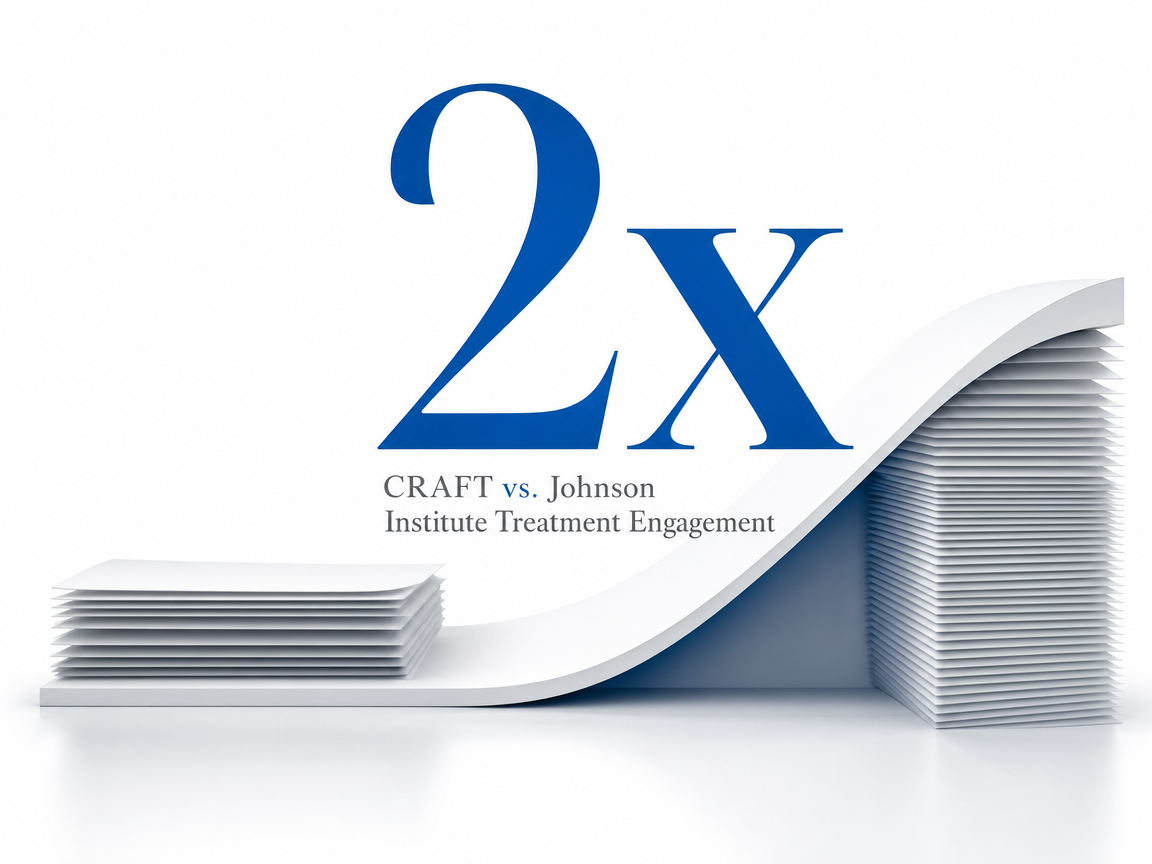
Specialist clinics running CRAFT with highly trained staff tend to publish the strongest results. A meta-analysis of four randomized trials involving 264 concerned significant others found CRAFT engaged about three times as many reluctant loved ones in treatment as Al-Anon or Nar-Anon facilitation, and roughly twice as many as the classic Johnson Institute confrontation 3. That is the number you'll see repeated across treatment websites. It's real. It's also drawn from tightly controlled research settings with experienced clinicians and motivated families who volunteered for a study.
When CRAFT moves into ordinary treatment systems, the gap narrows. A pragmatic cluster-randomized trial of families of problem drinkers measured treatment engagement at three months in 29% of concerned significant others who received group or individual CRAFT, compared with 15% in those given self-administered written materials 11. The difference between formats was not statistically significant in that trial, and both numbers are well below what efficacy studies suggest.
Honest Limits: Treatment Entry Is Not Sustained Recovery
Here is the harder truth, and it's one you probably already sense.
Nearly every CRAFT and ARISE study measures the same primary outcome: did the person enter treatment? That is a meaningful first step. It is not the same as sustained recovery. An evidence review of family-involved interventions found that CRAFT reliably promotes treatment initiation, but evidence was limited on whether that initial engagement is sustained or whether it reduces the person's symptoms over time 20.
What this means for you is practical. Walking your loved one through the doors of a treatment program on day three is a real win. Keep it. But plan beyond it. The randomized trials that paired CRAFT with structured aftercare reported higher engagement than CRAFT alone, and the direction is consistent: continuing support changes the arc 4.
Family-centered approaches do more than move one person into one program. Reviews of family-centered care report improvements in treatment engagement and retention, reductions in substance use, and gains in family resilience that outlast any single admission 16. That last piece matters for you specifically. The exhaustion you're carrying tonight is part of what the plan has to address, not just the crisis you're trying to resolve.
Insight Beyond Treatment
At Next Level Wellness & Behavioral Health, we believe meaningful change starts with perspective, not just protocols.
That philosophy is directly led by Amanda Marino, whose voice in behavioral health extends beyond clinical settings into leadership, culture, and personal growth.
Through keynote speaking and live events, Amanda explores the deeper themes that show up in recovery, family systems, and life transitions: authenticity, resilience, accountability, and the courage to change. Her work invites audiences to move past labels and into honest conversations that create lasting impact.
A 24–72 Hour Sequence You Can Act On
Hour 0–12: Private Assessment and Risk Screening
Start quieter than you think you need to.
The first phone call isn't to your loved one. It's to a facilitator or clinician who can take a careful history from you: what substances or symptoms, how long, recent changes, any overdoses, any weapons in the house, any psychiatric history, any medications. This is the assessment SAMHSA's family therapy advisory treats as foundational — a clear picture before any meeting is planned, with explicit attention to safety and confidentiality 1.
Expect pointed questions in the first hour:
- Has your loved one lost consciousness recently?
- Threatened self-harm?
- Driven impaired?
- Mixed opioids with benzodiazepines or alcohol?
These aren't accusations. They decide whether the next step is a planned meeting on day three or a call to 988, which in Palm Beach County is answered by 211 Palm Beach and the Treasure Coast 15.
During this window, you'll also list the people who belong in the room — and the ones who don't. A sibling who still enables. An in-law whose anger will derail the conversation. A trusted friend who the person actually listens to. Nothing is scheduled yet. You are gathering information so the next 48 hours have a shape.
Hour 12–48: Planning the Meeting and Securing Placement
This is the stretch where most families start to feel something shift from dread to purpose.
Two things happen in parallel. The facilitator runs a private planning session — often two to three hours, sometimes split across a day — with the family members who will be present. You rehearse what each person will say, in what order, and what you will not say. You decide on specific, enforceable boundaries that each person can actually hold, which is harder than it sounds and matters more than any single sentence delivered in the meeting itself.
At the same time, treatment placement is being secured. Not researched. Secured. A specific program, a specific bed or outpatient slot, a specific admission time, insurance verified in advance where possible 10. The reason this matters is practical. A randomized trial of families engaging treatment-refusing drug users found treatment entry rose from 58.6% with CRAFT alone to 76.7% when CRAFT was paired with structured aftercare planning 4. The sample was modest and the study is older, but the direction is consistent across the literature: the family meeting that has a next step already waiting outperforms the one that ends with "we'll figure out where tomorrow."
By hour 48, you should have a confirmed admission, a transport plan, and a packed bag quietly ready.
Hour 48–72: The Facilitated Meeting, Transport, and Family Aftercare
The meeting itself is usually shorter than families expect. Sixty to ninety minutes is common.
Chairs in a loose semicircle. The facilitator opens, sets ground rules, and names the purpose plainly: everyone in this room cares about you, and we have a plan we'd like you to say yes to today. People speak in the order you rehearsed. Short statements. Specific examples. No piled-on grievances. The facilitator keeps the temperature low and redirects when someone drifts into blame.
If your loved one agrees — and most do when the room is prepared and placement is already arranged — the next move is transport, not celebration. A sober companion or safe transport professional accompanies them directly to the admission, often within the hour. The window between saying yes and arriving at treatment is where plans most often collapse, and closing that gap is part of the design.
If your loved one says no, the meeting is still not a failure. SAMHSA's family guidance is explicit that family support continues to matter even when the identified person declines treatment 2. Boundaries previously rehearsed go into effect. The facilitator stays engaged for follow-up conversations over the following days.
Then there's you. Family aftercare — individual sessions, a family coach, a support group — is not optional in this sequence. Reviews of family-centered care consistently show improvements in family resilience alongside treatment engagement 16. You've been running on adrenaline for weeks. The 72-hour mark is where that catches up with you, and the plan has to include your recovery too.
Safety Planning: Baker Act, Marchman Act, and When to Escalate in Palm Beach County
Most family meetings never need any of this. Plan for it anyway.
Safety planning is the quiet layer underneath everything else in the sequence. It's what lets the facilitator keep the temperature low in the room, because the harder paths are already mapped if the night turns.
Start with what's not an emergency. When a loved one is in distress but not in immediate danger, 988 is the first number. In Palm Beach County, those calls are answered by 211 Palm Beach and the Treasure Coast, which coordinates a countywide mobile response team that operates 24/7 and aims to arrive within 60 minutes when violence is not a factor 15. That window matters. It means a trained clinician can come to your home instead of your loved one leaving in the back of a cruiser.
When the picture is more serious — threats of self-harm, a psychiatric break, active overdose risk, weapons in the house — the pathway changes. Florida's two statutory tools are distinct, and the difference is worth knowing before you need either one.
- The Baker Act
- Allows short-term involuntary psychiatric evaluation, treatment, and stabilization for someone experiencing a mental-health emergency who meets statutory criteria.
- The Marchman Act
- Addresses individuals severely impaired because of substance abuse, and it's the pathway families use when the crisis is substance-related rather than primarily psychiatric 19.
Neither is a routine extension of a family intervention. Both are legal emergency mechanisms with specific thresholds and professional or judicial processes. A facilitator can help you understand which, if either, applies to your situation, and whether a petition is realistic given what you've documented. If medical instability is present — unresponsive, blue lips, mixed opioids with benzodiazepines, a seizure — skip the decision tree and call 911.
Write the numbers down tonight. 988. 911. The facilitator's direct line. The planned admission's intake phone. Tape them inside a cabinet door where you can find them without searching. You probably won't need the harder ones. But you'll breathe easier in the meeting knowing they're there.
Co-Occurring Mental Health: Why Screening Comes Before Program Selection
Pick the program before you understand what's actually driving the crisis, and you may end up in the wrong building.
The pattern underneath substance use is often not just substance use. CDC surveillance data from 2024 found that 37% of people who died from overdose had evidence of a mental-health diagnosis, and 20% were in treatment for mental-health or substance-use disorders at the time of death 17. Those are population figures, not a forecast for your loved one. But they tell you something important about the terrain. Depression, trauma, anxiety, bipolar disorder, ADHD, undiagnosed autism — any of these can be sitting underneath what looks on the surface like a drinking problem or a pill problem.
This matters tonight because programs are not interchangeable. A detox-focused facility that doesn't carry psychiatric prescribing on staff is a different environment than a dual-diagnosis program with a psychiatrist on the unit. Walking into the wrong one can mean a destabilizing week and a loved one who signs themselves out on day five.
Ask the facilitator you call to screen for co-occurring conditions during the initial assessment, not after admission. The question to raise before placement is specific: does this program treat both, with the same team, at the same time?
Coordinating Treatment Placement and the Insurance Reality
Placement coordination is where good intentions meet the switchboard.
By the time the facilitated meeting happens, three things should already be settled: which program your loved one is admitting to, who holds the admission slot, and how the first thirty days are being paid for. Not estimated. Settled. The alternative is a yes in the living room that evaporates in a parking lot while someone is on hold with a utilization reviewer.
The payment conversation is less mysterious than it looks. The Mental Health Parity and Addiction Equity Act requires covered mental-health and substance-use benefits to be provided at the same level as medical and surgical benefits, which gives you real leverage when you call the number on the back of the insurance card 10. Ask four questions in that call:
- What is the deductible status for this plan year?
- What is the copay or coinsurance for inpatient and outpatient behavioral health?
- How many days are authorized at each level of care?
- Which in-network providers in South Florida are accepting admissions this week?
Parity does not mean every program is covered, and it does not mean a concierge facilitator or sober companion is a reimbursable benefit 10. Those are often out of pocket. Know that going in, and know what the clinical program itself will cost before the meeting, not after.
If coverage is thin or absent, SAMHSA's FindTreatment resource points families toward sliding-scale fees, Medicaid pathways, and payment assistance programs that exist precisely for this moment 10. The exhaustion you're feeling is not a reason to accept the first bed offered. It is a reason to let a facilitator or case manager make the calls on your behalf while you hold the family together.
Local Infrastructure: What Palm Beach County Can and Cannot Do
Here's what the county actually has, and what it doesn't.
Palm Beach County has invested seriously in behavioral-health capacity. The Community Services Department reported $55.3 million in client services and more than 48,669 residents served through direct and contracted programs in fiscal year 2024, with a Behavioral Health and Substance Use Disorder Master Plan adopted by the Board of County Commissioners in October 2024 21. Recovery Community Center programming engaged 3,978 individuals, and 81% of measured clients showed gains in recovery capital 21. That infrastructure is real, and it's part of why continuing-care options exist for your loved one after a first admission.
What the county does not provide is a private facilitator who will sit in your living room on 48 hours' notice, coordinate a confidential placement with your insurer, and ride with your loved one to admission. Public systems are built for population-level access, not concierge discretion. The county's own report shows some targets, including rapid-rehousing placements, were not fully met 21 — a reminder that capacity is uneven even where it exists.
Use both layers. County resources for crisis response, surveillance-informed outreach, and long-term recovery support. Private facilitation for the specific, time-compressed, discreet work of getting one person into one program this week.
A Note on Working With a Professional Facilitator
A good facilitator does three things you cannot easily do yourself at 11 p.m. on a Tuesday:
- They take a clinical history without the weight of twenty years of family history coloring every answer.
- They coordinate placement, insurance verification, and transport in parallel while you focus on the people in your house.
- And they stay in the room when the conversation gets hard, holding a structure that keeps blame out and keeps the plan intact 1.
Ask about credentials — CIP, LMHC, LMFT, MSW — and about what happens if your loved one says no. A facilitator who only has a plan for yes is not ready for your family. If private concierge support fits your situation, Next Level Wellness & Behavioral Health is one Boca Raton option. There are others. The best one is the one who answers the phone tonight.
Frequently Asked Questions
What is the difference between the Baker Act and the Marchman Act in Florida?
The Baker Act is Florida's short-term involuntary psychiatric evaluation and stabilization law, used when someone is in a mental-health emergency and meets statutory criteria. The Marchman Act addresses individuals severely impaired because of substance abuse and is the pathway families use when the crisis is substance-related rather than primarily psychiatric 19. Both are legal emergency mechanisms, not routine extensions of a family meeting.
Does a family intervention have to be a surprise confrontation?
No. The televised ambush is one older model, and it's not what most clinicians recommend now. SAMHSA's family guidance emphasizes support, consent, and connection rather than coercion, and notes there is no single formula that fits every family 2. A professionally facilitated meeting is usually a prepared conversation your loved one knows is happening, built around a treatment slot that's already waiting.
What should we do tonight if our loved one is in immediate crisis in Palm Beach County?
If there's medical instability — unresponsive, blue lips, seizure, suspected overdose — call 911. For a behavioral-health crisis without immediate medical danger, call 988. In Palm Beach County, those calls are answered by 211 Palm Beach and the Treasure Coast, which coordinates a 24/7 mobile response team that aims to arrive within 60 minutes when violence is not a factor 15.
Will insurance cover treatment after an intervention?
Often yes for the clinical treatment itself, less reliably for private facilitation or companion services. The Mental Health Parity and Addiction Equity Act requires covered mental-health and substance-use benefits at the same level as medical and surgical benefits 10. Call the number on the insurance card before the meeting and ask about deductible, copay, authorized days, and in-network providers accepting admissions this week.
What if our loved one has a mental health condition alongside substance use?
Co-occurring conditions are common and change which program fits. CDC surveillance from 2024 found 37% of people who died from overdose had evidence of a mental-health diagnosis 17. Ask the facilitator to screen for depression, trauma, anxiety, bipolar, ADHD, or autism during the initial assessment, and confirm the admitting program treats both conditions with the same team at the same time.
What happens if our loved one refuses treatment after the meeting?
A no is not a failure, and the plan accounts for it. The rehearsed boundaries go into effect, and the facilitator stays engaged for follow-up conversations in the days that follow. SAMHSA is explicit that family support continues to matter even when the identified person declines treatment, and that families themselves benefit from counseling or support groups during this stretch 2.
References
- The Importance of Family Therapy in Substance Use Disorder Treatment. https://library.samhsa.gov/sites/default/files/pep20-02-02-016.pdf
- Helping Families Cope with Mental Health and Substance Use. https://www.samhsa.gov/mental-health/children-and-families/coping-resources
- an effective option to engage treatment-resistant substance-abusing individuals in treatment: a meta-analysis of the Community Reinforcement and Family Training approach. https://pubmed.ncbi.nlm.nih.gov/20626372/
- A randomized trial of two methods for engaging treatment-refusing drug users through concerned significant others. https://pubmed.ncbi.nlm.nih.gov/12362968/
- Is treatment entry training sufficient?. https://pubmed.ncbi.nlm.nih.gov/28836796/
- Are CDC's Priorities Restoring Public Trust and Improving the Health of the Nation?. https://www.cdc.gov/washington/testimony/2024/t20240723.htm
- Overdose Data - Florida Department of Health in Palm Beach County. https://palmbeach.floridahealth.gov/programs-and-services/wellness-programs/od2a/data-about-the-overdose-epidemic/
- Provisional Drug Overdose Death Counts. https://www.cdc.gov/nchs/nvss/vsrr/drug-overdose-data.htm
- Substance Use Disorder - Florida Department of Health. https://www.floridahealth.gov/diseases-and-conditions/disease/substance-use-disorder/
- What To Expect. https://findtreatment.gov/what-to-expect/payment
- Primary Outcome from a cluster-randomized trial of three formats for delivering Community Reinforcement and Family Training (CRAFT) to the significant others of problem drinkers. https://pubmed.ncbi.nlm.nih.gov/35538465/
- Community Reinforcement and Family Training (CRAFT) goes digital: Randomized pilot trial for families of individuals with opioid use problems. https://pubmed.ncbi.nlm.nih.gov/41538229/
- Family Involvement in Treatment and Recovery for Substance Use Disorders. https://pmc.ncbi.nlm.nih.gov/articles/PMC8380649/
- Efficacy of Family-based Interventions in Addressing Substance Use Disorders: A Systematic Review on Randomized Controlled Trials. https://pubmed.ncbi.nlm.nih.gov/41970367/
- Sequential Intercept Model Mapping Report: Palm Beach County, Florida. https://discover.pbc.gov/publicsafety/criminaljustice/PDF/2024/Palm-Beach-Co-FL-SIM-Report-FINAL.pdf
- Family-centred interventions for people with substance use disorders. https://pmc.ncbi.nlm.nih.gov/articles/PMC11367307/
- Substance Use & Mental Health. https://www.cdc.gov/mental-health/about-data/substance-use-mental-health.html
- Outcomes with the ARISE approach to engaging reluctant drug- and alcohol-dependent individuals in treatment. https://pubmed.ncbi.nlm.nih.gov/15624546/
- Statewide Drug Policy Advisory Council (DPAC) Public Book. https://www.floridahealth.gov/wp-content/uploads/2025/08/DPACPublicBookDecember102024.pdf
- RESULTS. https://www.ncbi.nlm.nih.gov/books/NBK117208/
- Palm Beach County Community Services Department Annual Report 2024. https://discover.pbc.gov/communityservices/PDF/CSD%20Annual%20Report%202024.pdf
A Voice Shaping the Conversation
The topics explored here—change, self-awareness, recovery, and growth—are the same themes Amanda Marino brings to audiences nationwide through speaking engagements and live events.
Known for her appearances on A&E’s Intervention and Digital Addiction, Amanda speaks to organizations, communities, and leadership teams about navigating adversity, embracing vulnerability, and building lives rooted in purpose. Her message resonates far beyond treatment, offering insight that applies to families, professionals, and anyone standing at a crossroads.


Heal on your terms—any time, anywhere.