

Medical Case Management: 5 Steps to Find the Right Fit

Key Takeaways
- Define the scope you actually need before comparing firms, so you don't overpay for wraparound services when a tight discharge handoff is the real gap.
- Verify who is assigned to the case, their credentials, and how written consent is handled under HIPAA and 42 CFR Part 2 9.
- Test coordination depth by asking about response windows, how disagreements between clinicians get resolved, and what records moved during the last discharge 5, 6.
- Pressure-test crisis and transition handling by asking about after-hours availability, when the firm escalates to 988 or 911, and how it closes loops after an event 8.
- Confirm what gets measured and reported — appointment attendance, medication adherence, goal progress — and look for a firm willing to describe limits honestly 11, 12.
What You're Actually Hiring When You Hire a Case Manager
When you start calling around about medical case management, you'll hear a lot of overlapping language — care coordinator, patient advocate, recovery navigator, concierge liaison. The titles blur. The actual job doesn't. A medical case manager is the person accountable for keeping one plan of care intact across every clinician, program, and setting your loved one touches. SAMHSA defines case management plainly as locating services, linking the client with them, and monitoring that they actually happen 3.
That's narrower than therapy and broader than a referral. A therapist treats. A placement consultant hands you a list and steps back. A case manager stays — convening the psychiatrist, the primary-care physician, the dietitian, the outpatient program, and sometimes the family attorney around a shared, consent-based plan 1, 6.
You're hiring continuity. You're hiring someone who notices when a medication refill didn't happen, when discharge paperwork named the wrong follow-up provider, when the eating-disorder team and the psychiatrist have never spoken. The five steps that follow are built to help you tell which firms actually do that work, and which ones only promise to.
Medical Case Management, Defined Without the Jargon
The Working Definition and Where It Draws the Line
Medical case management is a coordinated, consent-based process that locates services, links a person to them, and monitors whether those services are actually received — on the client's behalf 3. That's the working definition federal agencies use, and it's the one you should hold any firm to.
Notice what's inside that definition: locating, linking, monitoring. And notice what isn't: diagnosing, prescribing, counseling. A case manager doesn't run therapy sessions. A case manager doesn't admit anyone to a program. The role is to build and protect a plan that other licensed clinicians carry out, and to catch the handoffs before they drop 1, 2.
SAMHSA's longer protocol fills in the texture — assessment, service planning, referral, coordination, advocacy, monitoring, and ongoing evaluation of how your loved one is doing against the plan 1. A good firm will walk you through each of those pieces in plain language on the first call. If someone describes case management only as "we'll give you referrals," you've found a service that stops at linking. That's a different product than what you're actually looking for.
The line, drawn simply: case management organizes care. It does not deliver clinical treatment. Keeping that distinction tight protects you from paying concierge rates for what is essentially a contact list.
Case Management vs. Therapy, Treatment Placement, and Recovery Associates
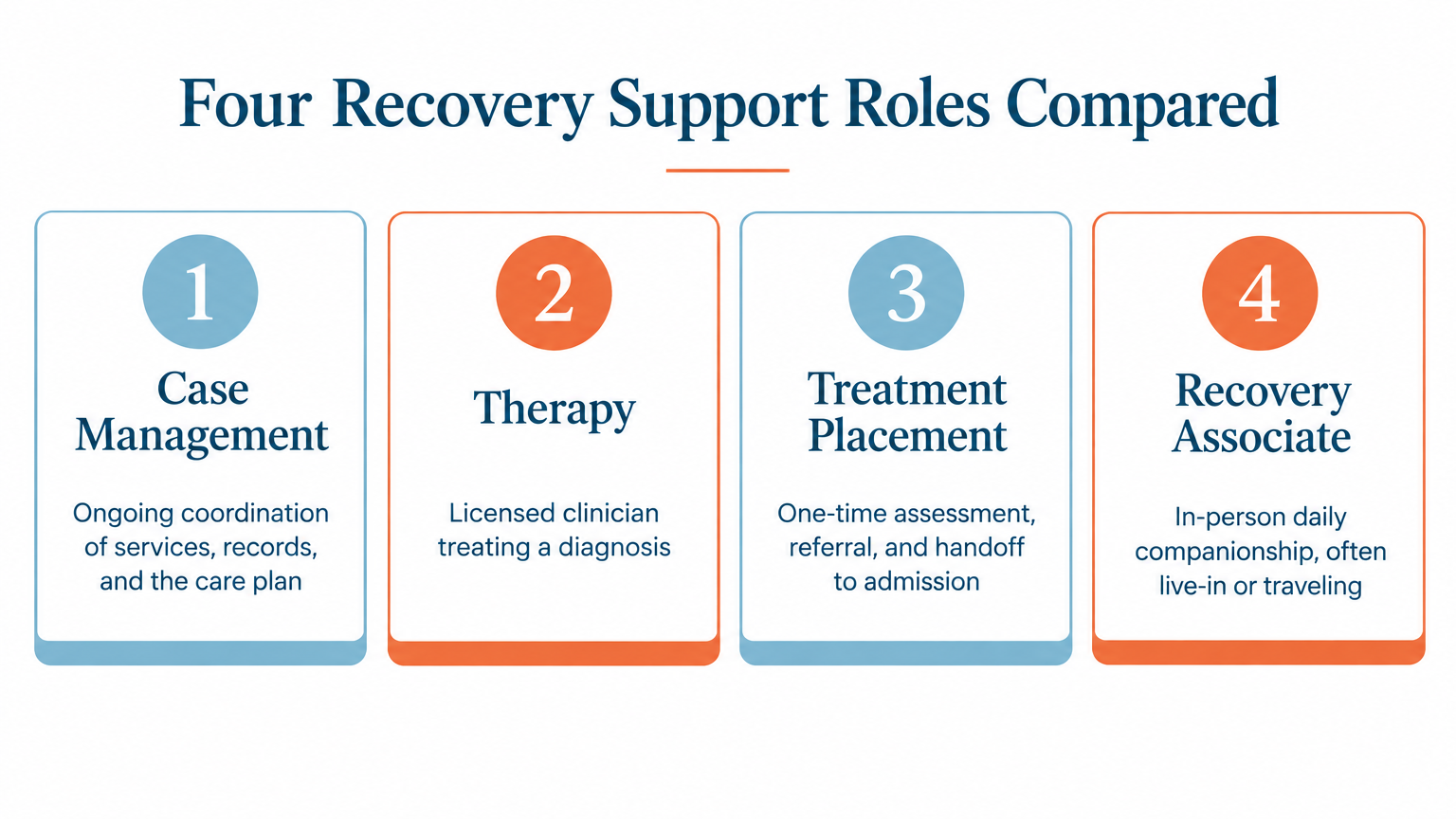
Four services sit near each other in the recovery-support landscape, and families routinely mix them up on the first call. Sorting them out saves money and prevents the wrong hire.
- Case management
- Locates services, links the client to them, and monitors receipt of those services on the client's behalf 3. It's ongoing, consent-based, and accountable to a plan 1. The case manager is who you call when the psychiatrist's office hasn't returned the outpatient program's records in a week.
- Therapy
- Direct clinical treatment delivered by a licensed clinician — a psychologist, LMHC, LMFT, LCSW, or psychiatrist. A therapist treats a diagnosis. A case manager does not. If a firm's "case managers" are also providing counseling to the same client, ask who is licensed to do what and under which state's rules.
- Treatment placement
- A one-time referral: an assessment, a program recommendation, and often a warm handoff into admission. Once your loved one is admitted, the placement professional's job is largely done. Case management is what continues after admission — through the program, through discharge, and into whatever comes next.
- A recovery associate
- Sometimes called a sober companion — provides in-person companionship and daily support, often live-in or travel-based. They're with the person. A case manager is working the phones, the records, the appointments, and the plan behind the scenes. The two roles frequently work together on the same case; neither replaces the other.
If you're trying to tell which role you actually need, start with the question: who is accountable when something falls through the cracks? If the answer isn't obvious, you're probably looking at case management 2.
Why Coordination Matters More When Conditions Overlap
Most of the people who need serious case management aren't dealing with one problem in isolation. They're dealing with two or three at once, and the clinicians treating each piece often aren't talking to each other.
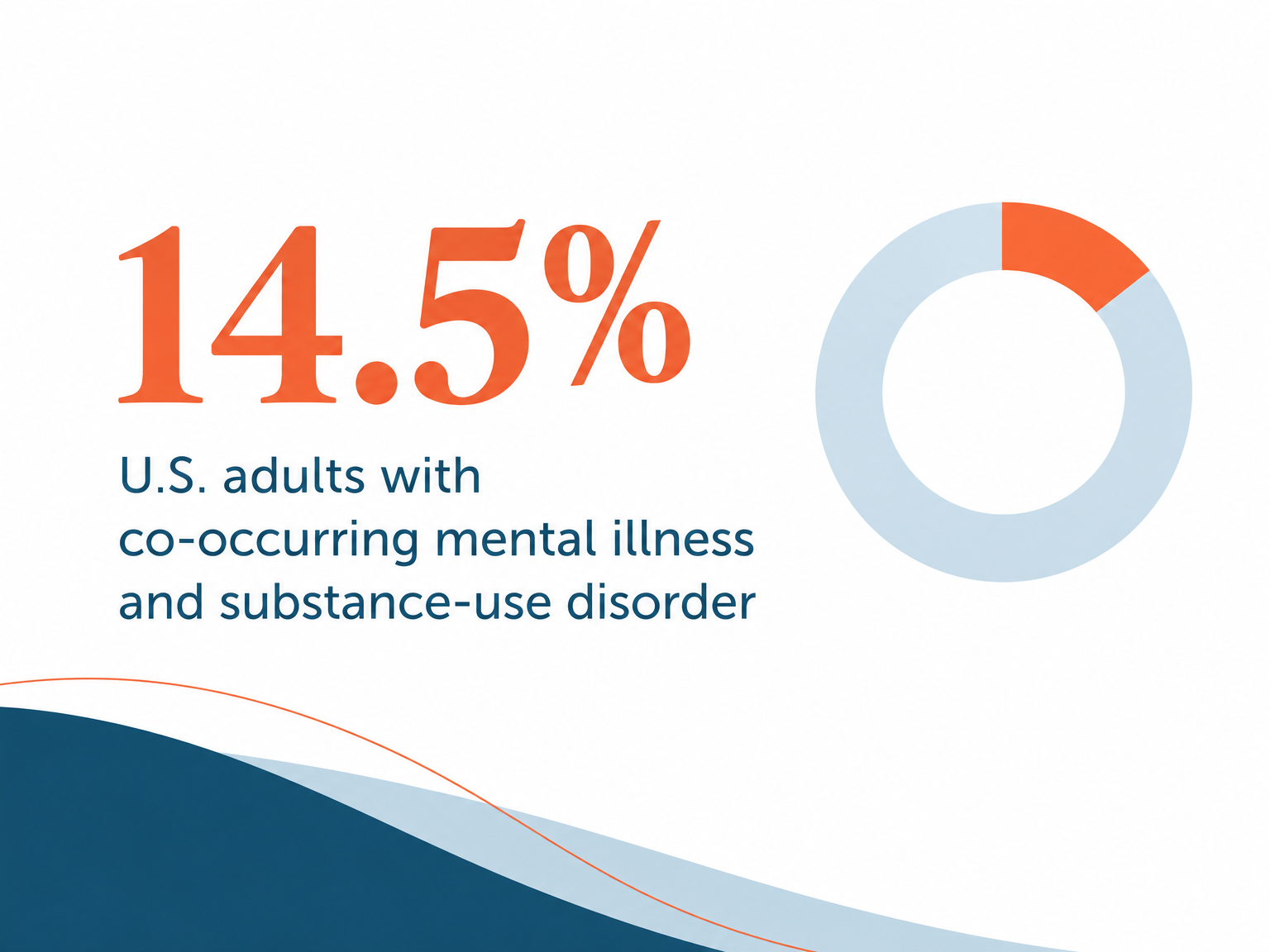
SAMHSA's 2024 National Survey on Drug Use and Health reports that an estimated 21.2 million U.S. adults had both a substance-use disorder and any mental illness in the past year 18. The number is a reminder: co-occurring conditions are common enough that a plan built around only one diagnosis will usually miss something that matters.
CDC's addiction medicine primer is blunt about the implication. Coordinating co-occurring mental-health and other medical conditions is integral to substance-use-disorder care, not a nice-to-have 4. A psychiatrist adjusting medication needs to know what the eating-disorder dietitian is seeing at weigh-ins. The outpatient program needs to know your loved one just started a new SSRI. The primary-care physician needs the discharge summary from residential before the first follow-up appointment.
When you're evaluating a firm, this is the practical test: can they hold more than one condition in view at the same time, and can they get the clinicians treating each piece to behave like a team instead of parallel strangers?
Five Steps to Find the Right Fit
Step 1: Define the Scope You Actually Need
Before you compare firms, write down what you actually need coordinated. Scope creep is the most expensive mistake families make at this stage — paying for a wraparound service when the real need is a tight handoff from residential to outpatient, or hiring a narrow referral-focused service when the situation calls for daily oversight across four clinicians.
Start with a plain inventory. Who is already involved — psychiatrist, therapist, primary-care physician, dietitian, outpatient program, attorney, nutritionist, trustee? What's about to change — a discharge, a move, a new medication, travel, a return to work or school? What has already gone wrong — missed appointments, medication gaps, a provider who stopped returning calls, records that never reached the next team?
SAMHSA's provider guidance frames case management as individualized by design — the plan is built around the person's needs, not a fixed menu 2. That means a good firm should ask you questions, not read you a package. If the first conversation feels like a sales script, you haven't found individualized coordination.
Three questions to bring to any first call:
- Will you give us a written scope of services describing what you will and will not do on this case?
- Who is the single accountable point of contact, and who covers when they're unavailable?
- How do you adjust scope if the situation changes mid-engagement — a relapse, a hospitalization, a new diagnosis?
The firm that answers specifically, in writing, is the one worth a second conversation.
Step 2: Verify Qualifications and How Consent Is Handled
Case management sits at the seam between clinical and nonclinical work, and the title isn't regulated the way "psychologist" or "registered nurse" is. That means you have to look past the business card. Ask who is actually assigned to the case, what their credentials are, how long they've been doing this work, and which licensed clinicians they coordinate with inside their own network.
You're looking for a mix: experience with substance use, mental health, or eating disorders depending on the situation; relationships with licensed professionals — psychiatrists, LMHCs, LMFTs, psychologists, RNs, dietitians, addiction-medicine specialists — who can be convened around a shared, person-centered plan that spans physical health, behavioral health, and social supports 7; and a working understanding of the privacy rules that govern what gets shared with whom.
That last piece is where many firms thin out. Substance-use records carry heightened federal protection under 42 CFR Part 2. The 2024 final rule aligned Part 2 more closely with HIPAA and permits a single patient consent to cover future uses and disclosures for treatment, payment, and health-care operations, with a compliance date of February 16, 2026 9. In practice, this means a qualified firm should walk you through a written consent document before information moves — not after.
Ask directly:
- Who, specifically, will be assigned to this case, and what are their credentials and years of experience with situations like ours?
- Show us the consent form you use. What exactly does it authorize? How is it revoked? How do you handle redisclosure to additional providers 10?
- When a family member calls asking for an update, what can and can't you share without the client's written consent?
A firm that handles consent as a thoughtful conversation — not a form shoved across the table — is signaling how it will handle everything else.
Step 3: Test Coordination Depth With the Clinicians Already Involved
This is the step most families skip, and it's the one that separates a firm that coordinates care from a firm that forwards emails. Coordination depth is testable. You don't have to take anyone's word for it.
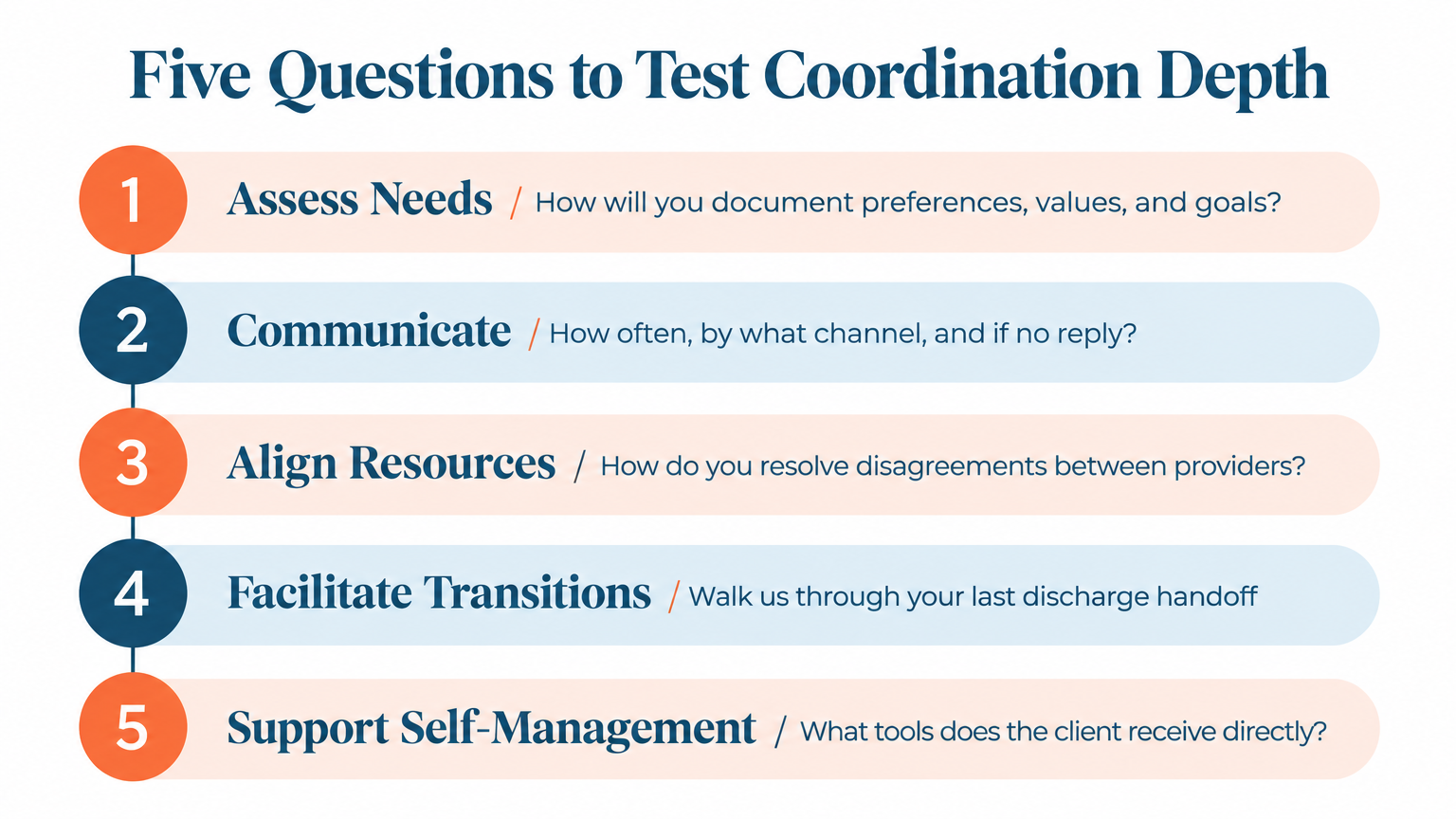
AHRQ's care coordination framework names the domains that distinguish real coordination from the appearance of it: assessing needs and goals, communicating information, facilitating transitions, aligning resources, supporting self-management, and monitoring follow-through 5. You can turn each domain into a direct question and listen for whether the answer is specific or theatrical.
- Assess needs and goals: How will you document what matters to our loved one — not just the diagnosis, but their preferences, values, and what a good month looks like to them?
- Communicate information: How often will you speak with the psychiatrist and the outpatient program, by what channel, and what happens if a provider doesn't respond within your expected window?
- Align resources: If the dietitian recommends something the psychiatrist disagrees with, how do you convene a conversation to resolve it rather than letting the client sit in the middle?
- Facilitate transitions: Walk us through the last discharge you coordinated. What records moved, who confirmed receipt, and what follow-up appointment was in place before the client left the previous setting 6?
- Support self-management: What do you give the client — a shared document, a weekly check-in, a visible plan — so they know what's being coordinated on their behalf?
- Monitor follow-through: How do you know when something didn't happen, and how fast do you know it?
A firm that answers with named processes, response windows, and real examples is doing the work. A firm that answers in adjectives — "close communication," "strong relationships" — is describing what it hopes to be.
Step 4: Pressure-Test Crisis and Transition Handling
Everything looks fine in the quiet moments. The real test of a case-management firm is what happens at 11 p.m. on a Saturday when a medication isn't working, a relapse is unfolding, or a discharge was moved up two days and no one told the outpatient team.
SAMHSA's model definitions for crisis-related services describe what good post-crisis coordination looks like: evidence-informed care coordination, follow-up after the event, warm identification of community providers, and recovery planning built collaboratively around the person's goals 8. A case manager isn't a crisis clinician and isn't a substitute for 988 or 911 — but they should be the person who shows up in the hours and days after, making sure the follow-up appointment is confirmed, the records moved, and the clinicians already involved know what happened.
Transitions are the other pressure point. AHRQ identifies transitions between ambulatory settings as vulnerable to safety gaps caused in part by ineffective communication and inadequate patient engagement 16. For young people moving between child and adult services, or across levels of care, 2025 consensus work on transitions for youth and young adults with eating disorders and mental-health conditions strongly recommends integrated, collaborative transition approaches that minimize gaps through early joint planning, information sharing, clinical meetings, or overlapping care 13.
Questions worth asking out loud:
- What's your after-hours availability, and when do you escalate to 988 or 911 rather than handle something yourselves?
- Walk us through a real transition you managed — what did you do in the week before and the week after?
- How do you prepare our loved one for a new appointment, confirm records moved, and close the loop with the sending provider?
Step 5: Confirm Measurable Follow-Through and Honest Expectations
The last step is where overpromising gets exposed. You want a firm that will tell you what it tracks, how it reports, and what the evidence does and doesn't support about outcomes.
Here's the honest frame. A systematic review of 14 studies of case-management interventions for substance-use disorders — published through 2016 — found that treatment adherence mostly improved, substance use decreased in only about a third of included studies, and roughly half reported improved overall functioning 11. A separate review of community-based case management for adults with substance-use problems found improvements in abstinence, social problems, unmet service needs, and satisfaction in some comparisons, with mixed effects on health-care utilization 12. These findings should be read alongside newer federal guidance, but the translation holds: coordination tends to help people stay engaged and get their needs met. It is not a cure, and no responsible firm will tell you otherwise.
So ask what gets measured and how you'll see it:
- What do you report back to us — appointment attendance, medication adherence, provider communication logs, goal progress — and how often?
- What does success look like for a case like ours in the first 30, 60, and 90 days?
- Where have past engagements fallen short, and what did you change afterward?
Privacy as a Selection Criterion, Not a Disclaimer
Privacy isn't a line at the bottom of the engagement letter. In this work, it's the shape of the engagement itself. Who gets told what, when, and by whom determines whether coordination can happen at all — and whether your loved one trusts the person coordinating it.
Substance-use records carry heightened federal protection under 42 CFR Part 2, which sits alongside HIPAA with stricter rules on consent and redisclosure. With limited exceptions, Part 2 records can be shared only with written patient consent or a court order; emergency medical treatment is one of the narrow exceptions 10. The 2024 final rule, which required compliance by February 16, 2026, allows a single written consent to cover future uses and disclosures for treatment, payment, and health-care operations, and lets certain HIPAA-covered recipients redisclose records under HIPAA 9. In practice, that means a well-run firm can build a consent document once, with your loved one, that holds up across the psychiatrist, the outpatient program, the primary-care physician, and the dietitian — without a new signature for each handoff.
The tension families feel is real: you want updates, and your adult loved one may not want you to have all of them. A qualified firm handles that out loud. They'll tell you what the client has authorized, what they haven't, and how the consent can be adjusted or revoked. Use privacy as the vetting lens — ask to see the form, ask who the client can share with and exclude, and ask how the firm documents revocation. The answers tell you how the firm will treat every other sensitive piece of this case.
If You're a Referring Professional Vetting a Firm
A quick scope shift for the attorneys, psychiatrists, wealth managers, and trust officers reading this: your vetting standard sits higher than a family's. You're putting your client's name next to the firm's work, and your referral has to hold up to scrutiny from co-counsel, co-trustees, or treating clinicians who weren't in the room.
Three things worth confirming before you make the call. First, ask for a written scope of services and a sample consent document. Part 2's 2024 final rule allows a single written consent to cover future treatment, payment, and health-care operations, with compliance required by February 16, 2026 — a firm that cannot explain how its consent interacts with HIPAA and Part 2 is not ready for a complex case 9. Second, confirm multidisciplinary reach: can they convene a psychiatrist, primary-care physician, dietitian, and outpatient program around a shared, person-centered plan that spans health and social-service systems, rather than acting as a passive referral desk 7? Third, ask about cross-jurisdiction coordination. When licensed clinicians provide telehealth across state lines, registration and scope-of-practice rules apply — Florida Statute 456.47 is one example 17. A firm that answers these three cleanly is one you can refer to without hedging.
Starting the Conversation
You don't have to have the whole situation figured out before you make a call. Most families start with a mess of partial information — a discharge date that keeps moving, a psychiatrist who won't return the outpatient program's emails, a loved one who agreed to help on Tuesday and changed their mind by Thursday. A good first conversation with a case-management firm is diagnostic, not transactional. You describe what's actually happening, and they help you see what kind of coordination the situation needs.
At Next Level Wellness & Behavioral Health, founder Amanda Marino built the firm around a relationship-based approach — one accountable point of contact, a written scope, and support before, during, after, or in place of treatment. If you're a family weighing options or a referring professional vetting a firm for a client, a confidential conversation costs nothing and tends to clarify the next step quickly. That's where Creating Lasting Change begins.
Frequently Asked Questions
What's the difference between medical case management and therapy?
Therapy is direct clinical treatment delivered by a licensed clinician who treats a diagnosis. Medical case management is the coordination work around that treatment — locating services, linking your loved one to them, and monitoring whether they actually happen 3. A therapist runs the session. A case manager makes sure the psychiatrist, the outpatient program, and the primary-care physician are working from the same plan 1.
Does a case manager replace a treatment program?
No. A case manager doesn't deliver clinical treatment and doesn't admit anyone to a program. The role is to build and protect a plan that licensed clinicians carry out — before, during, after, or in place of a program 2. If your loved one is in residential care, the case manager is who stays with the plan when discharge arrives. If they're declining a program, the case manager coordinates whatever support they will accept.
How does consent work when a family hires a case manager for a loved one?
If your loved one is an adult, they sign the consent. The firm works for them, and what gets shared with you depends on what they authorize in writing. Substance-use records carry extra protection under 42 CFR Part 2; the 2024 final rule allows a single written consent to cover future treatment, payment, and health-care operations disclosures, with compliance required by February 16, 2026 9, 10. A good firm walks everyone through what the consent covers and how it can be revoked.
What should I ask before hiring a medical case management firm?
Ask for a written scope of services, the name and credentials of the person actually assigned to the case, and the consent form you'll be signing. Then test coordination depth: how often will they speak with the psychiatrist and the outpatient program, what records move at discharge, and how do they know when something didn't happen 5, 6? Ask about after-hours availability and when they escalate to 988 or 911 rather than handle something themselves 8.
Can case management coordinate care across state lines or internationally?
Yes, and this is one of the reasons families hire a firm rather than piece things together alone. The caveat is that licensed clinicians providing telehealth across state lines have to meet the destination state's registration and scope-of-practice rules — Florida Statute 456.47 is one example 17. A qualified firm knows which rules apply to which providers in which locations and builds the coordination plan around those limits rather than ignoring them.
Is private medical case management covered by insurance?
Private concierge case management is generally private pay. Some firms will help you prepare documentation to submit for out-of-network reimbursement, but coverage varies widely by plan and is never guaranteed. Ask upfront for a written fee structure, what's included, what triggers additional charges, and whether the firm provides superbills or other paperwork for reimbursement submissions. Clarity on money at the start prevents difficult conversations later.
References
- TIP 27: Comprehensive Case Management for Substance Abuse Treatment. https://library.samhsa.gov/sites/default/files/sma15-4215.pdf
- COMPREHENSIVE CASE MANAGEMENT FOR SUBSTANCE USE DISORDERS: Guidance to Providers. https://library.samhsa.gov/sites/default/files/PEP20-02-02-013.pdf
- 2025 Uniform Reporting System Data Definitions. https://www.samhsa.gov/data/sites/default/files/URSTables2025/2025-URS-Data-Definitions.pdf
- Addiction Medicine Primer. https://www.cdc.gov/overdose-prevention/media/pdfs/2024/07/Addiction-Medicine-Primer.pdf
- Chapter 3. Care Coordination Measurement Framework. https://www.ahrq.gov/ncepcr/care/coordination/atlas/chapter3.html
- Care Coordination. https://www.ahrq.gov/ncepcr/care/coordination.html
- Certified Community Behavioral Health Clinic (CCBHC). https://www.samhsa.gov/sites/default/files/ccbhc-compliance-checklist-march-2026.pdf
- Model Definitions for Behavioral Health Emergency, Crisis, and Crisis-Related Services. https://library.samhsa.gov/sites/default/files/model-definitions-pep24-01-037.pdf
- Fact Sheet 42 CFR Part 2 Final Rule. https://www.hhs.gov/hipaa/for-professionals/regulatory-initiatives/fact-sheet-42-cfr-part-2-final-rule/index.html
- Understanding Confidentiality of Substance Use Disorder (SUD) Patient Records or “Part 2”. https://www.hhs.gov/hipaa/part-2/index.html
- Effect of Case Management Interventions for Patients with Substance Use Disorders: A Systematic Review. https://pubmed.ncbi.nlm.nih.gov/28428761/
- Community-based case management effectiveness in populations that abuse substances. https://pubmed.ncbi.nlm.nih.gov/26058816/
- Transitions for youth and young adults with eating disorders and mental health conditions. https://pmc.ncbi.nlm.nih.gov/articles/PMC12306118/
- Strategies for Interating Behavioral Health and Primary Care. https://effectivehealthcare.ahrq.gov/sites/default/files/nt_docs/topic-brief-integrated-care_0.pdf
- Adding Better Mental Health Care to Primary Care. https://www.nimh.nih.gov/news/science-updates/2016/adding-better-mental-health-care-to-primary-care
- Toolkit to Engage High-Risk Patients In Safe Transitions Across Ambulatory Settings. https://www.ahrq.gov/hai/tools/ambulatory-care/safe-transitions.html
- 2025 Statutes 0456.47. https://www.flhouse.gov/Statutes/2025/0456.47/
- Key Substance Use and Mental Health Indicators in the United States: Results from the 2024 National Survey on Drug Use and Health. https://www.samhsa.gov/data/sites/default/files/reports/rpt56287/2024-nsduh-annual-national-report.pdf
Insight Beyond Treatment
At Next Level Wellness & Behavioral Health, we believe meaningful change starts with perspective, not just protocols.
That philosophy is directly led by Amanda Marino, whose voice in behavioral health extends beyond clinical settings into leadership, culture, and personal growth.
Through keynote speaking and live events, Amanda explores the deeper themes that show up in recovery, family systems, and life transitions: authenticity, resilience, accountability, and the courage to change. Her work invites audiences to move past labels and into honest conversations that create lasting impact.
A Voice Shaping the Conversation
The topics explored here—change, self-awareness, recovery, and growth—are the same themes Amanda Marino brings to audiences nationwide through speaking engagements and live events.
Known for her appearances on A&E’s Intervention and Digital Addiction, Amanda speaks to organizations, communities, and leadership teams about navigating adversity, embracing vulnerability, and building lives rooted in purpose. Her message resonates far beyond treatment, offering insight that applies to families, professionals, and anyone standing at a crossroads.



Heal on your terms—any time, anywhere.