

Finding a Mental Health Interventionist You Can Trust

Key Takeaways
- A mental health interventionist coordinates assessment, family preparation, and connection to clinicians rather than delivering a dramatic confrontation, and should name who takes over clinical care after the handoff.
- Match the response to the situation: call 988 or 911 for immediate danger, seek urgent psychiatric evaluation for escalating symptoms, and reserve a planned engagement for serious but non-emergency scenarios 8.
- Vet specialists with six questions covering licensure, method, written safety protocol, fees, privacy practices, and continuity, because the specific answers matter more than the label on a business card.
- For an adult loved one, information flows through signed releases naming each recipient and topic; HIPAA and sometimes 42 CFR Part 2 shape what can be shared back to the family 12, 17.
- Walk away from guaranteed outcomes, 24-hour booking pressure, vague credentials, missing written agreements, or anyone who treats the meeting itself as the finish line 16.
- Concierge families should raise discretion, travel logistics, and coordination with existing psychiatrists, attorneys, or physicians on the first call, before signing any agreement 17.
- Common missteps include treating the meeting as the whole plan, misreading resistance as unwillingness, skipping cultural adaptation, and going quiet with existing clinicians 3, 4, 5.
What a mental health interventionist actually does
A mental health interventionist is a trained specialist who coordinates a careful, voluntary path from a worried family to appropriate clinical care. The job is less about delivering a dramatic speech and more about assessment, planning, and connection: understanding what your loved one is facing, preparing the people who love them, and arranging a soft landing with clinicians who can actually treat the condition.
You might picture a tense circle of relatives reading letters aloud. In practice, a thoughtful specialist spends most of their time before that moment ever happens. They ask about safety, patterns, past treatment, medications, family dynamics, and what your loved one tends to respond to. Their work should align with SAMHSA's trauma-informed care framework, which emphasizes awareness of trauma's impact, validated screening and assessment tools, and avoiding retraumatization 6. They coach you on language, timing, and boundaries. If a formal meeting happens at all, it is one scene inside a longer arc of support.
Equally important is what an interventionist is not. They are not usually your loved one's therapist, prescriber, or diagnostician, and family involvement is meant to complement individualized clinical care rather than replace it 1. A trustworthy specialist will say so plainly, name the licensed professionals who will take over clinical decisions, and describe how family support continues after the handoff. If someone promises to "get them to say yes" without talking about any of this, you are hearing a sales pitch, not a plan.
Interventionist, clinician, or crisis response: choosing the right next step
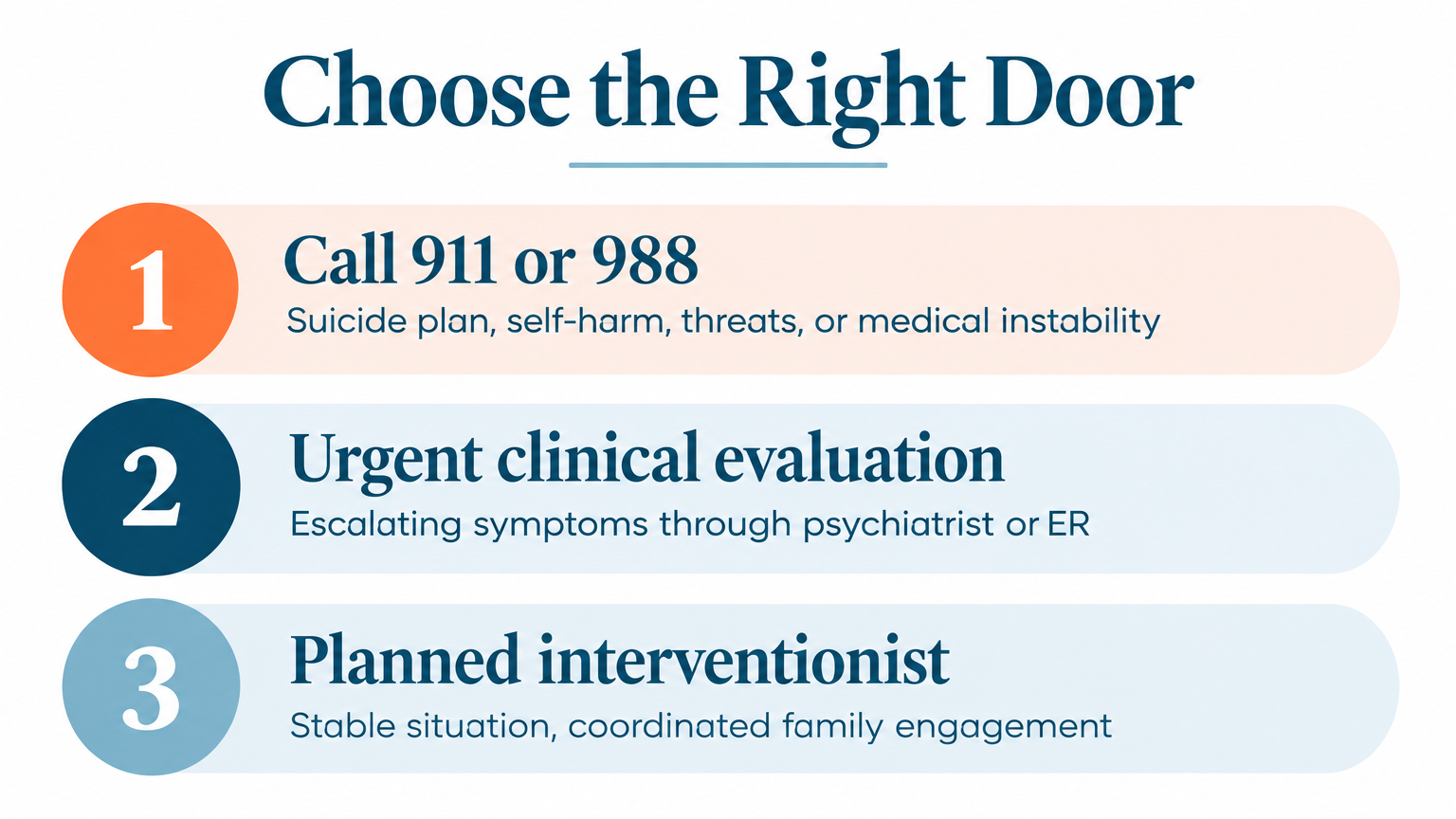
Before you hire anyone, decide which door you actually need to walk through. A planned engagement with an interventionist is one path. An urgent clinical evaluation is another. A 988 or 911 call is a third. Confusing them costs time you may not have.
SAMHSA frames the crisis system in three parts: someone to contact, someone to respond, and a safe place for help. The 988 Suicide & Crisis Lifeline is someone to contact. Mobile crisis teams are someone to respond. Stabilization services are the safe place 8. The 2025 national crisis-care guidelines ground this model in person-centered, trauma-informed practice and spell out when coordinated public response, rather than a private meeting, is the right answer 7.
Call 911 or 988 right now if your loved one is talking about suicide with a plan, has access to lethal means, has already harmed themselves, is threatening others, or is medically unstable. NIMH is direct on this: do not leave the person alone, do not promise secrecy about suicidal thoughts, and use 911 for immediate danger and 988 for crisis support 20. No private specialist should ask you to wait through that.
Reach for an urgent clinical evaluation, usually a psychiatric assessment through a trusted physician, outpatient psychiatrist, or emergency department, when symptoms are escalating but not immediately life-threatening. NIMH describes warning signs like growing suspiciousness, confused or disorganized speech, severe social withdrawal, disrupted sleep, and a noticeable decline in self-care as reasons to seek professional help promptly 9. The NIMH self-check guide is a useful companion for triaging whether you need routine care, an urgent assessment, or emergency help 10.
A planned engagement with a mental health interventionist fits a different scenario: your loved one is declining, resistant, or stuck, the picture is not an active emergency, and you have time to prepare the family, coordinate with clinicians, and arrange a soft landing. If any of that changes between your first call and the meeting, a trustworthy specialist will pivot to the appropriate crisis path without hesitation.
The six questions that separate a specialist from a confident stranger
Credentials: licensure, certifications, and scope of practice
Ask directly: what are you licensed to do, and what are you not? The specific answer matters more than the label on a business card.
Look for a verifiable clinical license (LMFT, LMHC, LCSW, LPC, psychologist, RN, or physician) or a recognized specialty interventionist certification. Ask where the license is held, the license number, and whether you can confirm it on the state board site. A clean record is the floor, not the ceiling.
Then ask about scope. If your loved one is showing signs of psychosis, severe eating disorder behaviors, or acute suicidality, the specialist should name the clinicians who will handle diagnosis and treatment and describe their own role as coordination and family support 1. Someone who says they can "handle all of it" alone is overstating their scope.
Ask too about ongoing training in trauma-informed practice, which SAMHSA frames as a concrete set of behaviors around safety, trustworthiness, and choice rather than a credential anyone can self-award 6.
Method: Johnson model, CRAFT-style engagement, motivational interviewing, and family psychoeducation
Ask what method they use and what the evidence actually shows for it. A specialist who answers in plain language, with honest limits, is telling you something important about how they will treat your family.
The Johnson model is the classic family meeting most people picture, and it leans on structured confrontation that benefits from heavy rehearsal. CRAFT (Community Reinforcement and Family Training) takes a different route: it coaches the concerned family member over multiple sessions to change their own responses, improve communication, and invite treatment without an ambush. In a specific body of substance use trials where the two were compared, CRAFT produced roughly three times the treatment engagement of Al-Anon or Nar-Anon support groups and about twice the engagement of the Johnson model, with about two-thirds of loved ones attending treatment, often after four to six sessions 19. Those numbers come from an older and limited set of substance use trials and should not be stretched to cover every mental health scenario, but they explain why many families now ask about nonconfrontational engagement first.
Motivational interviewing is a conversational style that reduces defensiveness and draws out a person's own reasons for change. It is a method, not a credential, and the evidence shows mixed effects when it is used alone and stronger effects when paired with other evidence-based support, with training quality making a real difference 15. Family psychoeducation is the quieter, longer-arc option: teaching the family about the condition, communication skills, warning signs, and how to coordinate with clinicians. SAMHSA lists it among established evidence-based practices with implementation toolkits 14, and family-recovery reviews describe it as part of a continuing support process rather than a one-time event 3.
A trustworthy specialist will often blend methods and tell you why. They will also say what their approach cannot promise. Improving help-seeking attitudes, for example, is not the same thing as sustained recovery, and good specialists describe outcomes in that precise register 16.
Safety plan: what happens if risk escalates before, during, or after the meeting
Ask for the written safety protocol. If there isn't one, keep looking. A planned engagement can shift into a crisis quickly, and the specialist should be able to describe exactly what they will do, in what order, with whom.
Specifically, the protocol should name the triggers that pause or cancel the meeting: suicidal statements with a plan, access to lethal means, signs of psychosis, medical instability, or threats of violence. It should spell out that no one promises secrecy about suicidal thoughts and that the person is not left alone when danger is present, which is the standard NIMH gives for suspected suicide risk 20. It should also describe how the specialist coordinates with 988, mobile crisis teams, and emergency departments rather than trying to contain a crisis privately, which is the model SAMHSA's 2025 crisis-care guidelines ask behavioral-health providers to use 7.
Ask who holds the plan during the meeting itself, who calls 911 if needed, and who stays with your loved one in the hours afterward. A specialist who has done this work will answer in minutes, not days.
Fees and written agreement: questions to ask before you sign
Ask for the fee structure in writing before the second call. A trustworthy specialist will send a plain-language engagement letter that spells out who is paying, who the services cover, what is included, and what is not.
Useful questions to put on the table: Is the fee a flat professional fee that covers assessment, family preparation, the meeting itself, and a defined window of follow-up, or is it hourly? If hourly, is there a written estimate and a cap? Are there separate line items for travel (airfare, ground transportation, lodging, per diem), treatment placement coordination, and post-meeting support such as case management or recovery companion time? Are admission fees to a treatment program separate? How do refunds work if your loved one declines, and what happens if the meeting is postponed because of a safety concern?
On payment, ask whether the specialist is private pay and whether they will prepare documentation you can submit for out-of-network reimbursement, with no guarantee of what your plan actually covers. Get the answers in writing.
Continuity: what the week after looks like
Ask what happens on day two, day seven, and day thirty. The meeting is one scene; recovery is the rest of the film. A specialist who treats the handoff as the finish line is handing you a cliff.
Press for specifics. Who confirms admission to the treatment program? Who rides along for transport, especially if travel crosses state lines? Who checks in with the clinicians during the first week to share collateral information from the family? Who stays in touch with you, and how often? Family-recovery reviews describe this continuing arc, with psychoeducation and family toolkits that build communication and coping over time, as more clinically meaningful than any single meeting 3.
Ask what happens if your loved one declines treatment. A thoughtful specialist will describe a CRAFT-style path forward, coaching the family on changed responses and keeping the door open, rather than closing the file 19. Continuity is where you find out whether you hired a coordinator or a closer.
Privacy for an adult loved one: HIPAA, 42 CFR Part 2, and what releases to expect
Before anything is said in a planning call, settle one question: who is the client? For a planned engagement with an adult loved one, the person being helped is usually the client, even when the family is paying. That single answer shapes who signs what, who hears what, and what the specialist can tell you after the meeting ends.
HIPAA governs how covered health providers handle protected information. It permits a provider to share relevant information with family, friends, or caregivers when the patient agrees, does not object in the circumstances, or when a serious and imminent threat is present, and it limits what is shared to what those people need for involvement in care 12. HHS also makes clear that a provider may listen to concerned family members and incorporate what you share, even if they cannot disclose information back to you 18. For an adult client, expect a signed release naming each person who may receive updates, the specific topics covered, and an expiration date 17.
If substance use is part of the picture, 42 CFR Part 2 may apply. It gives extra protection to records about diagnosis, treatment, or referral for substance use within federally assisted programs, and it governs when and how those records can be used or disclosed 11. A private interventionist may or may not be a Part 2 program themselves, and HIPAA does not automatically cover every independent consultant. Ask directly: are you a HIPAA covered entity, are you a Part 2 program, and what written privacy notice will you give us?
A clear specialist will walk you through this in plain language before you sign anything. They will explain what you can share with them (almost anything), what they can share back (only what releases allow), and how they handle a safety exception, which under HIPAA permits disclosure to people reasonably able to lessen a serious and imminent threat 12. They will describe where notes are stored, who on their team sees them, and how long records are kept. If your loved one is already working with a psychiatrist, therapist, or primary care physician, expect a release that lets the specialist coordinate with those clinicians rather than operating in parallel.
Two practical asks to put on the table: a sample engagement letter and a sample release form before the second call. Read both. If the privacy answers are vague, verbal only, or framed as a formality, that is a signal worth trusting.
Red flags that should end the conversation
Some answers on a first call should make you hang up and keep dialing. Trust the pattern you are hearing, not the credentials on the website.
End the conversation if you hear a guaranteed outcome. No one can promise your loved one will say yes, enter treatment, or stay sober. Help-seeking research shows that even well-designed approaches improve attitudes and intentions in some people, not every person, and improved intentions are not the same as sustained recovery 16. A specialist who guarantees results is selling something research does not back.
Walk away from pressure tactics. If you are told to book within 24 hours, wire a deposit before receiving a written agreement, or hide the plan from a treating psychiatrist, that is a sales script, not a safety process.
Vague credentials are a hard stop. "Years of experience" without a license number, state board, or specialty certification you can verify is not a credential. Neither is self-awarding "trauma-informed" without concrete training, supervision, or screening practices to point to 6.
No written agreement, no sample release form, no privacy notice? Keep looking. Same for anyone who cannot name which established practice informs their work or how fidelity is assessed 14.
Finally, be wary of anyone who treats the meeting as the finish line. If you cannot get a clear answer about day two, day seven, and day thirty, you are hiring a closer, not a coordinator.

Discretion, travel, and coordination for concierge families
If privacy and logistics are nonnegotiable for your family, raise those requirements on the first call, not after you've signed. A specialist who regularly supports high-profile or high-net-worth clients will treat discretion as part of the clinical plan, not an upcharge.
Ask how the specialist protects your loved one's identity in practical terms. Where are notes stored, and who on the team has access? Are devices encrypted? Will communications stay off shared email threads and group texts? How are hotel reservations, flights, and ground transportation booked so names and locations are not visible to vendors who do not need them? If a treatment program is involved, how is admission arranged without creating a paper trail across assistants, household staff, or executive teams?
Travel is its own category. For families spread across cities or countries, you want a specialist who can meet your loved one where they already are, coordinate a safe handoff to the next level of care, and ride along if needed. Ask about licensure or legal considerations if the plan crosses state lines or borders, whether a recovery associate will accompany your loved one in transit, and how medical needs or prescriptions are handled en route.
Coordination with your loved one's existing circle matters too. If there is already a psychiatrist, therapist, concierge physician, trust officer, or family attorney in the picture, the specialist should ask for releases to collaborate with them rather than working around them 17. SAMHSA's family guidance frames connection to treatment and ongoing support services, not a single meeting, as the standard for how family-inclusive care should feel 13. If the specialist bristles at coordinating with professionals who already know your loved one, that is useful information before you sign anything.
What families often get wrong before the first call
Most families call too late, call with the wrong goal, or call expecting the specialist to solve what only the family can decide. Knowing the common missteps before you dial saves weeks of frustration and spares your loved one a process that was never going to land.
The first mistake is treating the meeting as the whole plan. A single conversation, however well-rehearsed, is a moment inside a longer arc that includes psychoeducation, communication coaching, and sustained connection to clinicians 3. If you are picturing one dramatic afternoon that fixes everything, you will choose the wrong specialist and judge them by the wrong outcome.
The second is confusing resistance with unwillingness. When your loved one has declined past offers of help, it is tempting to read that as stubbornness. Research on family engagement points to practical and psychological barriers—scheduling, transportation, beliefs about treatment, shame, exhaustion—that a thoughtful specialist will actually ask about rather than steamroll 5.
The third is skipping cultural, language, and family-structure questions. Ask how the approach will be adapted to who your family actually is 4. A specialist who runs the same playbook for every household is giving you a script, not a plan.
The last is going quiet with existing clinicians. If your loved one has a psychiatrist or therapist already, loop them in early. Family support is meant to complement clinical care, not route around it 1.
Starting the conversation
You do not need a perfect script to make the first call. You need a short list of questions and permission to hang up if the answers feel off. Ask about credentials, method, safety protocol, privacy practices, fees, and what the week after looks like. Trust what you hear in the pauses as much as the words.
If your loved one is in immediate danger, call 911 or 988 first. Everything else can wait until they are safe.
When you are ready for a quiet conversation about discreet, concierge support before, during, after, or in place of treatment, Next Level Wellness & Behavioral Health is here to listen. Founded by Amanda Marino and based in Boca Raton with clients across the country and abroad, Next Level works alongside your existing clinicians to help families move forward with dignity. Creating Lasting Change starts with one call.
Frequently Asked Questions
What is the difference between a mental health interventionist and a therapist?
A therapist provides ongoing clinical treatment: diagnosis, psychotherapy, and often coordination with a prescriber. A mental health interventionist is a coordinator who assesses the situation, prepares your family, and arranges a voluntary connection to clinicians who can actually treat the condition. Family involvement is designed to complement individualized clinical care, not replace it 1. A trustworthy specialist will name who handles treatment once the handoff happens.
How do I know if we need an interventionist or if this is a crisis that requires 988 or 911?
Call 911 or 988 right now if your loved one has a suicide plan, access to lethal means, has already harmed themselves, is threatening others, or is medically unstable. Do not leave them alone and do not promise secrecy about suicidal thoughts 20. A planned engagement fits when the picture is serious but not an active emergency, giving you time to prepare the family and coordinate with clinicians 8.
How much does hiring a mental health interventionist typically cost?
Fees vary by specialist. Common questions to ask include whether the fee is structured as a flat professional fee covering assessment, family preparation, the meeting, and a defined follow-up window, or as an hourly rate with a written cap; how travel, treatment placement coordination, and post-meeting support are billed; whether the specialist is private pay and whether they will prepare documentation you can submit for out-of-network reimbursement. Ask for the engagement letter in writing before the second call.
Can an interventionist share information with our family if our loved one is an adult?
Not automatically. For an adult client, information flows through signed releases naming each person who may receive updates and the topics covered 17. HIPAA-covered providers may share relevant information when the patient agrees or does not object, and may act on a serious and imminent threat 12. A specialist can usually listen to your concerns even when they cannot disclose back 18. Ask for a sample release before signing anything.
What happens after the intervention meeting is over?
The meeting is one scene inside a longer process. Expect the specialist to confirm admission, coordinate transport, share collateral information with treating clinicians during the first week, and check in with your family on a defined schedule. Family-recovery reviews describe continuing support, including psychoeducation and family toolkits, as more clinically meaningful than a single conversation 3. If your loved one declines, a thoughtful specialist coaches the family forward rather than closing the file.
What questions should I ask on my first call with a potential interventionist?
Ask six things: what are you licensed to do and where; what method informs your work and what does the evidence show; what is your written safety protocol if risk escalates; who is the client and what releases will we sign; what is the fee structure in writing; and what does day two, day seven, and day thirty look like? Ask too which established practice informs your approach and how fidelity is assessed 14.
References
- Family-centered collaborative care for patients with chronic mental illness: A systematic review. https://pubmed.ncbi.nlm.nih.gov/36974116/
- Effects of caregiver and family interventions on patients with common mental health problems in primary care: a systematic review. https://pubmed.ncbi.nlm.nih.gov/40396507/
- Family Recovery Interventions with Families of Mental Health Service Users: A Systematic Review of the Literature. https://pubmed.ncbi.nlm.nih.gov/34360150/
- Exploring the effectiveness of family-based interventions for mental health problems in low- and middle-income countries: A systematic review. https://pubmed.ncbi.nlm.nih.gov/35699742/
- Review of Interventions to Improve Family Engagement and Retention in Child Mental Health Programs. https://pubmed.ncbi.nlm.nih.gov/20823946/
- Trauma-Informed Care in Behavioral Health Services. https://library.samhsa.gov/sites/default/files/sma15-4912.pdf
- 2025 National Guidelines for a Behavioral Health Coordinated System of Crisis Care. https://library.samhsa.gov/sites/default/files/national-guidelines-crisis-care-pep24-01-037.pdf
- National Behavioral Health Crisis Care Guidance. https://www.samhsa.gov/mental-health/national-behavioral-health-crisis-care
- Understanding Psychosis. https://www.nimh.nih.gov/health/publications/understanding-psychosis
- My Mental Health: Do I Need Help? - NIMH. https://www.nimh.nih.gov/health/publications/my-mental-health-do-i-need-help
- Substance Use Disorders: Statutes, Regulations, and Guidelines. https://www.samhsa.gov/substance-use/treatment/statutes-regulations-guidelines
- HIPAA helps mental health professionals to prevent harm. https://www.hhs.gov/sites/default/files/hipaa-helps-prevent-harm.pdf
- Resources for Families Coping with Mental and Substance Use Disorders. https://www.samhsa.gov/mental-health/children-and-families/coping-resources
- How to Use the Evidence-Based Practices KITs. https://library.samhsa.gov/sites/default/files/sma08-4344-howtouseebpkits.pdf
- Motivational Interviewing in Child Welfare Services: A Systematic Review. https://pubmed.ncbi.nlm.nih.gov/31826663/
- Interventions to improve mental health help-seeking: a systematic review. https://pubmed.ncbi.nlm.nih.gov/42064325/
- Is a health care provider permitted to discuss an adult patient's mental health information with family members or other caregivers?. https://www.hhs.gov/hipaa/for-professionals/faq/health-care-provider-permitted-discuss-adult-patients-mental-health-information-patients.html
- What options do family members of an adult patient with mental illness have if they are concerned about the patient's mental health?. https://www.hhs.gov/hipaa/for-professionals/faq/what-options-do-family-members-adult-patient-mental-illness-have-if-they-are-concerned-about.html
- Community reinforcement and family training: an effective option to engage treatment-resistant substance-abusing individuals in treatment. https://pubmed.ncbi.nlm.nih.gov/20626372/
- Frequently Asked Questions About Suicide. https://www.nimh.nih.gov/health/publications/suicide-faq
Insight Beyond Treatment
At Next Level Wellness & Behavioral Health, we believe meaningful change starts with perspective, not just protocols.
That philosophy is directly led by Amanda Marino, whose voice in behavioral health extends beyond clinical settings into leadership, culture, and personal growth.
Through keynote speaking and live events, Amanda explores the deeper themes that show up in recovery, family systems, and life transitions: authenticity, resilience, accountability, and the courage to change. Her work invites audiences to move past labels and into honest conversations that create lasting impact.
A Voice Shaping the Conversation
The topics explored here—change, self-awareness, recovery, and growth—are the same themes Amanda Marino brings to audiences nationwide through speaking engagements and live events.
Known for her appearances on A&E’s Intervention and Digital Addiction, Amanda speaks to organizations, communities, and leadership teams about navigating adversity, embracing vulnerability, and building lives rooted in purpose. Her message resonates far beyond treatment, offering insight that applies to families, professionals, and anyone standing at a crossroads.



Heal on your terms—any time, anywhere.