

How to Find Professional Adderall Intervention Services

Key Takeaways
- A professional Adderall intervention is a coordinated clinical process where a credentialed facilitator screens for risk, prepares the family, and leads a planned conversation using motivational and family-systems methods.
- Not every pattern of Adderall use calls for an intervention; a qualified facilitator distinguishes prescription disruptions, nonmedical performance use, stimulant-use disorder, and emergencies before anyone gathers.
- Overdose signs, suicidal statements, acute paranoia, or chest pain belong to 911 or 988, not a family meeting, and a credible service will say so on the first call.
- A coordinated intervention runs in three phases: careful preparation and safety screening, a facilitated conversation grounded in motivational interviewing, and a handoff into evidence-informed treatment with family follow-through.
- Vet services by confirming facilitator credentials like CIP, documented training in motivational interviewing and CRAFT, and a licensed clinical network that can actually deliver next steps 16, 10, 15.
- Privacy depends on specific mechanics under HIPAA and the 2024 Part 2 final rule, so review release-of-information forms and consent structures before signing anything 2, 11.
- The week after the meeting determines outcomes, with the best services coordinating assessment slots, prescriber communication, and access to contingency management and CBT rather than handing families a referral list.
- For high-privacy families and referring professionals, discretion shows up in narrowly scoped consents, logistics planning, and demonstrated fluency with confidentiality rules, not in marketing language.
What a Professional Adderall Intervention Actually Involves
A professional Adderall intervention is a coordinated behavioral-health process, not the ambush you may have seen on television. A credentialed facilitator screens for medical and psychiatric risk, prepares the family, leads a planned conversation using motivational and family-systems methods, and connects your loved one into evidence-informed treatment and continuing support 16, 18.
If you are picturing a surprise circle of relatives reading letters, set that image aside. The clinical reality looks closer to a quiet, prepared meeting in a private setting, with a trained professional guiding the conversation and a treatment plan already arranged in the background. SAMHSA's motivational framework emphasizes empathy, collaboration, personalized feedback, and respect for the person's autonomy, which is the opposite of coercion or shame 16, 17.
Three things distinguish a professional service from a well-intentioned family meeting:
- A qualified facilitator assesses what you are actually dealing with before anyone sits down together. Prescribed Adderall used as directed, nonmedical performance use among a graduate student, diverted pills shared with a roommate, and a stimulant-use disorder with cardiac or psychiatric symptoms each call for a different response 19, 14.
- The service coordinates care, not just conversation. For prescription-stimulant concerns, treatment is primarily behavioral, individualized, and often involves multiple components, so the intervention needs to open a door into real clinical care rather than close with a dramatic moment 15.
- A professional service plans for safety and privacy from the first phone call, including when to pause and route to emergency help instead of a family meeting 1.
Think of the family conversation as one carefully prepared step inside a larger plan, with a clinician holding the thread before, during, and after.
When Adderall Use Crosses From Concern to Crisis
Reading the Specific Signals With Adderall
Adderall concerns rarely show up as one dramatic moment. They accumulate: a prescription that keeps running out early, nights without sleep followed by crashes, a new jumpiness or irritability, pills found in a jacket pocket that belong to someone else. Reading these signals accurately matters because the right response depends on what you are actually seeing.
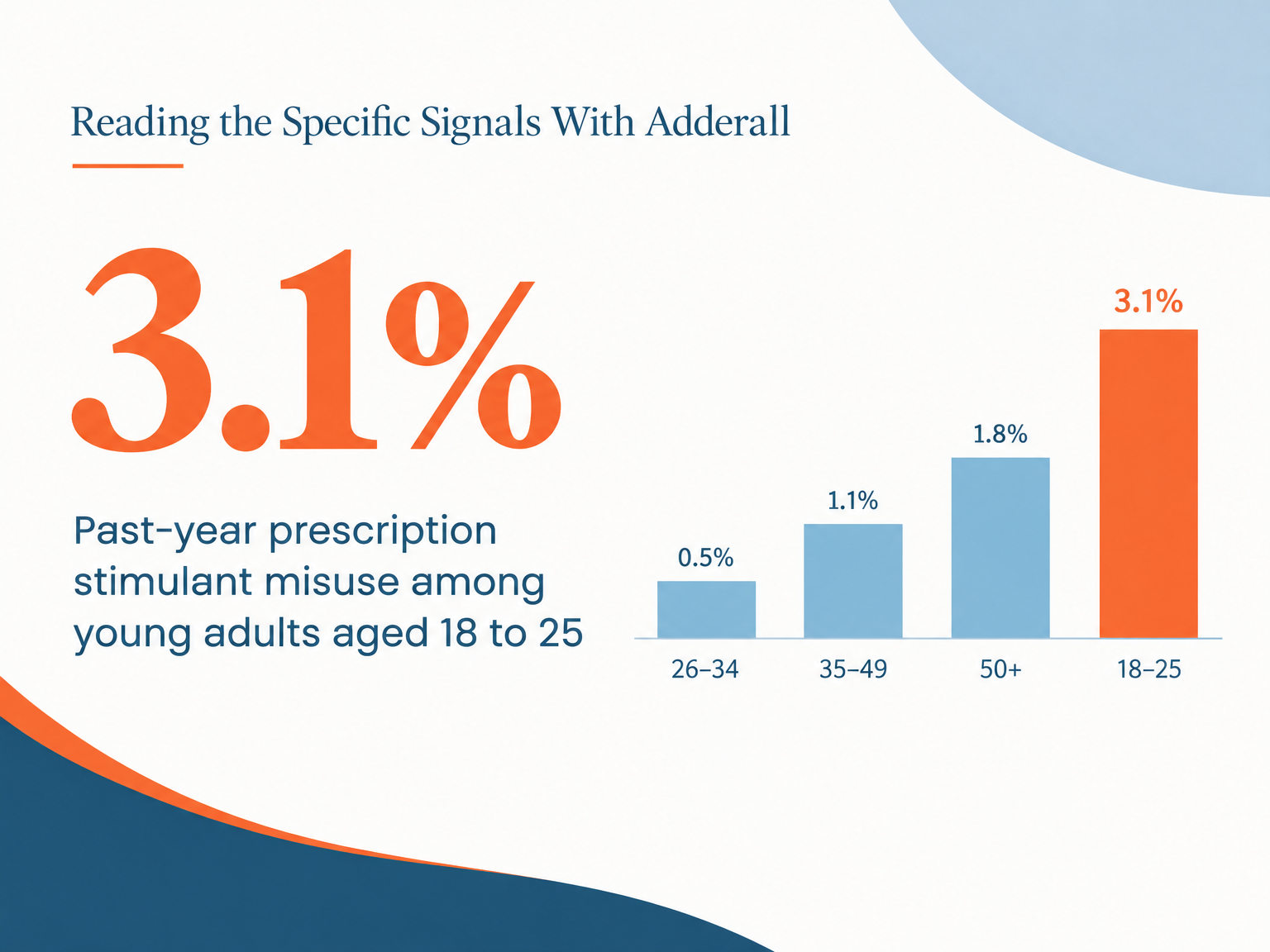
Not every nonmedical use signals a disorder. In 2023 NSDUH data, past-year prescription-stimulant misuse among adults aged 18 to 25 was 3.1%, with Adderall commonly reported among the misused stimulants 14. That number is worth sitting with. It tells you the behavior exists at meaningful rates in the age group most families worry about, and it tells you that misuse and stimulant-use disorder are not the same thing.
So you want to notice the pattern, not just the pill. Four scenarios tend to look alike from the outside but call for different responses:
- A prescription taken as directed that has become disrupted by supply shortages is a prescriber conversation, not an intervention 13.
- Nonmedical performance use during exams or deadlines, often involving pills shared between students or colleagues, is a diversion and safety concern the FDA has flagged in its boxed-warning updates 19.
- Escalating use with cardiac symptoms, paranoia, weight loss, or sleep collapse points toward a clinical assessment.
- Suspected overdose is an emergency.
A qualified facilitator sorts through these before anyone sits in the same room. If a service does not ask about prescription history, dose, route, co-occurring conditions, and recent sleep, keep calling.
When to Call 911 or 988 Instead of an Interventionist
Some moments do not belong in a family meeting. If your loved one shows signs of a stimulant overdose, call 911. If they are talking about suicide or self-harm, call or text 988.
MedlinePlus lists overdose signs for amphetamine products that include panic, hallucinations, rapid or irregular heartbeat, rapid breathing, fever, seizures, or loss of consciousness 12. The CDC's stimulant guide reinforces that severe agitation, chest pain, trouble breathing, or an inability to wake someone are emergencies, not scheduling questions 1. A planned conversation cannot address a medical crisis unfolding in real time.
The same principle applies to severe psychiatric symptoms. Acute paranoia, hallucinations, or a sudden break with reality after heavy stimulant use needs an emergency department or a psychiatric crisis line, not a facilitator working through a prepared script. The CDC Health Alert Network has specifically recommended routing people with acute psychological distress related to stimulants to 988 and SAMHSA's 1-800-662-HELP line when indicated 13.
A credible intervention service will tell you this directly. On the first call, they should ask screening questions about current symptoms and give you clear instructions on when to hang up and dial 911 or 988 instead of booking a meeting. If a provider pushes to schedule without asking about safety, that is a signal to pause. The goal is help, and sometimes help arrives in an ambulance before it arrives in a living room.
The Before, During, and After of a Coordinated Intervention
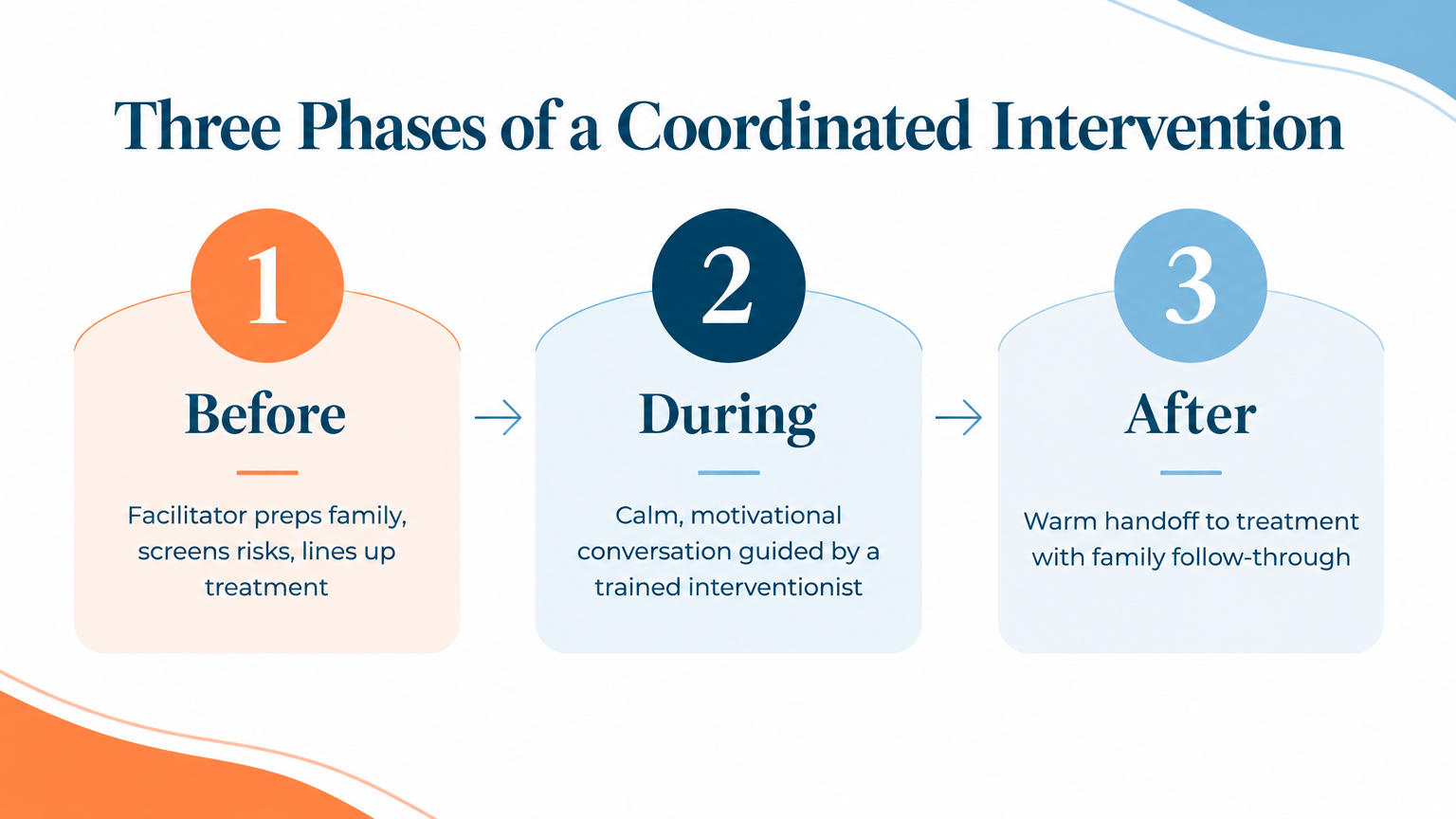
A coordinated Adderall intervention runs in three phases: a preparation and safety screen that shapes who is in the room and what gets said; a facilitated conversation that uses motivational and family-systems methods rather than pressure; and a handoff into evidence-informed treatment with family-centered follow-through. The meeting is the hinge, not the whole hinge-and-door 16, 18, 15.
Before. Preparation usually takes days, sometimes a week or two, and it is the phase that most families underestimate. A credentialed facilitator will interview you and other participants separately, build a timeline of your loved one's Adderall use, speak with the prescribing physician when consent allows, and screen for medical and psychiatric red flags. They will also coach each family member on what to say and, just as important, what not to say. SAMHSA's family-involvement guidance makes the point directly: how family members are prepared, what roles they take, and how dynamics are addressed in advance shape whether the meeting opens a door or closes one 18. During this phase, the service also arranges the next step—an assessment slot, an outpatient program, a residential bed, a psychiatric consultation—so that a yes on Sunday afternoon does not become a logistical dead end by Monday morning 15.
During. The facilitated conversation itself tends to be quieter than families expect. A skilled interventionist leans on motivational interviewing, which SAMHSA describes as an evidence-based technique for helping someone resolve ambivalence by drawing out their own reasons for change rather than arguing them into it 17, 16. Expect open questions, reflective listening, and personalized feedback instead of ultimatums. Family members speak from prepared notes about specific observations and specific requests. The facilitator holds the structure, redirects if the conversation drifts into old grievances, and keeps the arranged next step on the table as a concrete option.
After. The handoff is where interventions succeed or quietly fall apart. For prescription-stimulant concerns, treatment is primarily behavioral—cognitive behavioral therapy, contingency management, community reinforcement, motivational approaches—and it typically involves multiple components tailored to the person 15, 6. A credible service does not wave goodbye at the curb. They coordinate the first week of care, keep in contact with the treatment team under the appropriate consents, and provide the family with its own support plan, including guidance on communication, boundaries, and self-care 8. If your loved one declines treatment that day, the after phase still begins: the family continues to work with the facilitator on engagement strategies and keeps the door open, which is often how a second or third conversation lands differently than the first.
How to Vet an Adderall Intervention Service
Credentials and Clinical Training to Look For
A credible Adderall intervention service is built around a trained facilitator and a licensed clinical network, not a charismatic solo operator. You want to see specific credentials, documented training in the methods the work actually uses, and a clear line between the person facilitating the meeting and the clinicians who can assess, treat, and prescribe.
Start with the facilitator. A professional interventionist typically holds a credential such as CIP (Certified Intervention Professional) along with a clinical or counseling background. Ask directly: what is your license or certification, when was it issued, where can I verify it, and who supervises your clinical work? If the person leading your family's conversation cannot answer those questions in two sentences, keep looking.
Then look at method training. The techniques that work with ambivalent loved ones are specific. SAMHSA identifies motivational interviewing as an evidence-based way to help someone resolve ambivalence by drawing out their own reasons for change, and TIP 35 describes how motivational approaches increase participation and retention in treatment 17, 16. For reluctant loved ones, the CRAFT model is a research-supported approach for increasing treatment engagement among people who show little readiness to enter care 10. A credible service should be able to name the training programs their facilitators have completed in these methods and describe how they are used in a family meeting.
Finally, confirm the clinical bench behind the facilitator. Prescription-stimulant treatment is primarily behavioral and often involves multiple components tailored to the person, so the service needs working relationships with licensed therapists, psychiatrists, and addiction medicine physicians who can take the next step 15.
Privacy, Consent, and Information Sharing
Privacy in an Adderall intervention is a set of mechanics, not a slogan. A service that handles it well can walk you through exactly which laws apply, what forms you will sign, and how information moves between the facilitator, the prescribing physician, the treatment program, and the people in your family.
Two federal frameworks usually come into play. HIPAA protects identifiable health information held by covered providers, and federally assisted substance-use-disorder programs carry additional confidentiality protections under 42 CFR Part 2 11, 20. The 2024 Part 2 final rule changed the mechanics in ways that matter for your family. It allows a single patient consent for future uses and disclosures for treatment, payment, and health-care operations, while separately protecting SUD counseling notes through a specific-consent requirement 2. In practice, that means your loved one may sign one well-drafted consent that lets the intervention service, the prescriber, and the treatment team coordinate care, with tighter protections kept around counseling notes.
Ask the service to show you their release-of-information forms before anything is signed. Who is named on the release? What information is shared, with whom, and for how long? Is there a provision for secure communication channels and for revoking consent? How are family members handled—as participants with their own information, or as recipients of your loved one's protected records?
Also ask what happens when consent is not given. HIPAA permits certain disclosures for care coordination and for serious health or safety concerns, but it does not mean family members automatically receive information 11, 20. A good facilitator will explain how family updates work when your loved one declines broad releases, how emergency exceptions apply, and how coordination with an outside attorney, concierge physician, or employer is handled with a separate, narrowly scoped consent.
Questions to Ask on the First Call
The first call tells you most of what you need to know. A service that answers specific questions with specific answers—credentials, methods, consents, handoffs, escalation—is operating at a different level than one that reassures you in generalities.
Bring a short list and take notes. Useful questions include:
- Who will facilitate the meeting, what is their license or certification, and who supervises their clinical work?
- What training do your facilitators have in motivational interviewing and in family-engagement approaches like CRAFT 16, 10?
- How do you screen for medical and psychiatric risk before scheduling, and when would you tell us to call 911 or 988 instead?
- How will you coordinate with my loved one's prescribing physician, and what consent is needed under HIPAA and 42 CFR Part 2 2, 11?
- What treatment options can you arrange on short notice, and can you coordinate with programs that offer contingency management and CBT 15?
- What does your work with our family look like in the week after the meeting, whether or not our loved one agrees that day 18?
- Is the service private pay, and can you assist with insurance reimbursement submissions?
Listen for pacing. A facilitator who asks you more questions than you ask them on the first call is usually doing the work right.
What Happens After the Family Meeting
The family meeting is the beginning of care, not the end of it. What happens in the week, month, and year after your loved one agrees to help is what actually changes the trajectory of their Adderall use, which is why a credible intervention service treats placement, coordination, and continuing support as part of the engagement, not as someone else's problem.
For prescription-stimulant concerns, the next step is almost always behavioral treatment, often with multiple components tailored to the person 15. A good service has an assessment slot or a program bed arranged before the meeting happens, so the hours between "yes" and the first clinical appointment are measured in hours, not weeks. They also coordinate with the prescribing physician under the appropriate consents, so medication decisions are made by the right clinician rather than negotiated at the kitchen table 2.
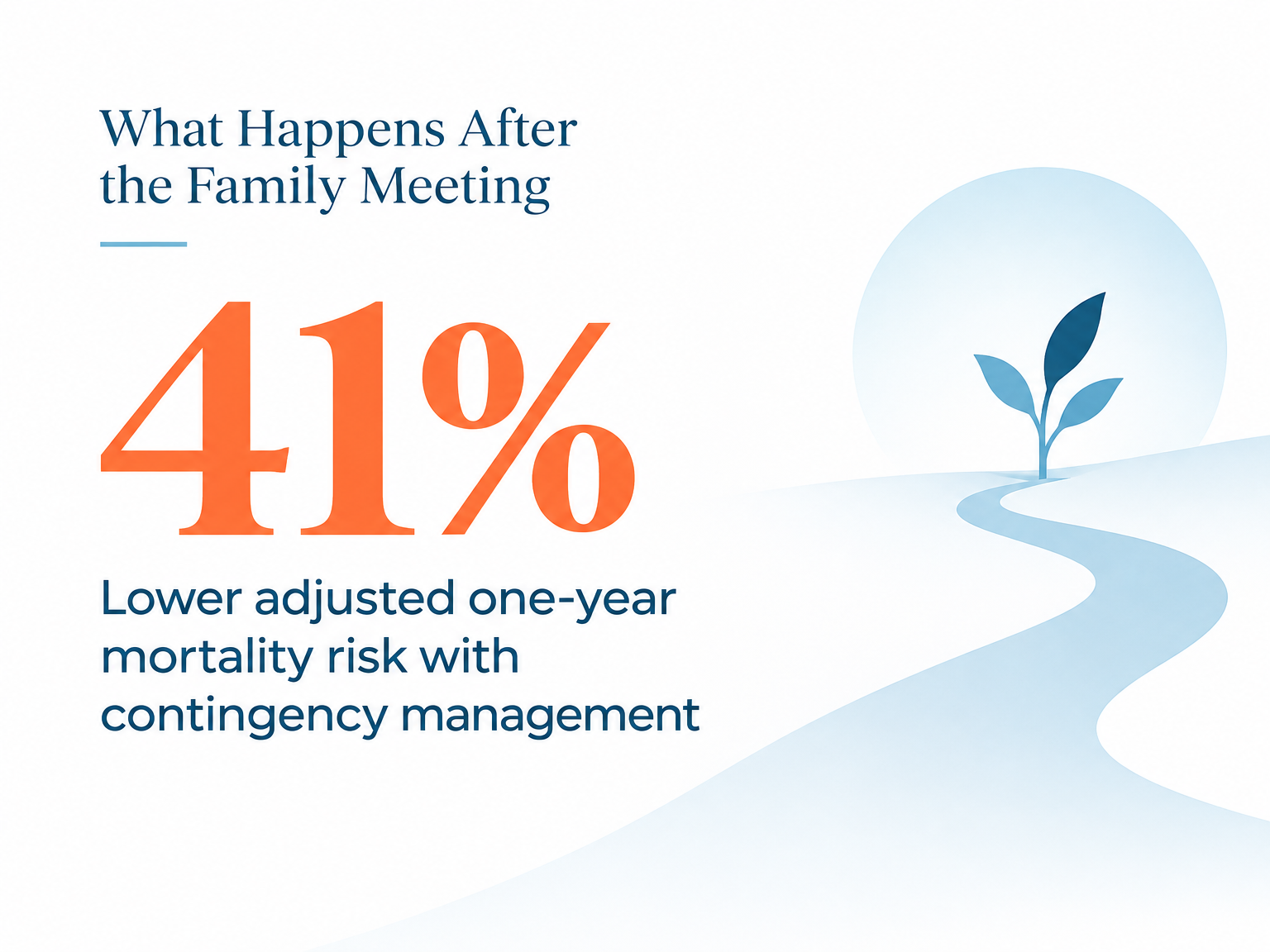
Ask specifically whether the service can coordinate with programs that offer contingency management. The approach has the strongest evidence base among psychosocial treatments for stimulant-use disorder, and a 2025 matched-cohort study of 1,481 pairs found contingency management was associated with a 41% lower adjusted one-year mortality risk among people with stimulant-use disorder 4, 6. The design shows association, not causation, and access remains uneven—fewer than half of facilities in a 2024 national analysis reported frequent use of contingency management or motivational incentives 5. That gap is exactly why coordination matters. A service that can only hand you a list of local programs is not doing the same work as one that knows which programs actually deliver these approaches.
Family-centered follow-through is the other half. SAMHSA's family-therapy advisory describes how involving family members can positively affect engagement, retention, and outcomes, and a credible facilitator continues working with you on communication, boundaries, and your own support in the weeks after the meeting 18. If your loved one declines treatment that day, the after phase still begins—using engagement approaches like CRAFT, the facilitator keeps working with the family so a second conversation can land differently 10.
Discretion for High-Privacy Families and Professionals
Discretion for a high-privacy family is operational, not atmospheric. It shows up in how a service structures consent, who signs what, how messages move between the facilitator and your loved one's prescriber, attorney, or concierge physician, and whether the firm can work quietly across homes, offices, and travel without leaving a paper trail you did not approve.
Start with the paperwork before anyone meets. Ask to see the specific release-of-information forms the service uses and the single consent for treatment, payment, and health-care operations now permitted under the 2024 Part 2 final rule, which also keeps tighter protections around SUD counseling notes 2. For a family whose loved one is a founder, physician, or public-facing professional, a well-drafted release names each recipient individually—the prescribing psychiatrist, a specific attorney, a trusted internist—rather than opening a broad channel. HHS is explicit that HIPAA does not automatically grant family members access to records, and that permitted disclosures, patient authorization, and emergency exceptions must be distinguished carefully 11, 20.
Then ask about the logistics. Where does the first meeting happen—your home, a private residence, a hotel suite, an office after hours? How are notes stored and transmitted? Which staff see what, and under what supervision? Can the facilitator coordinate with a trust and estates attorney or an executive assistant through narrowly scoped consents without disclosing clinical detail? For families based or traveling internationally, ask how the firm handles communication across time zones and borders while maintaining the same consent structure. Discretion that cannot be described in specifics is marketing.
A Note for Referring Professionals
A quick scope shift: this section speaks to the attorneys, concierge physicians, psychiatrists, wealth managers, and trust officers who are often the first to hear that something is wrong. Your warm handoff carries weight, so the vetting bar should be higher than a Google search.
Before referring, confirm three things:
- The facilitator's credential and the clinical supervision behind them, not just a biography page.
- Documented training in motivational interviewing and in family-engagement approaches like CRAFT, since these are the methods that actually move ambivalent loved ones toward care 16, 10.
- Demonstrated fluency with HIPAA and the 2024 Part 2 final rule, including how the service structures narrowly scoped consents so you can coordinate without overexposing your client's records 2, 11.
Ask what the service does in the week after the meeting. For prescription-stimulant concerns, treatment is primarily behavioral and often multi-component, so you want a referral partner who can place your client into assessment quickly and keep working with the family if the first answer is no 15, 18.
Starting the Conversation With a Concierge Behavioral Health Firm
You do not have to have a plan before you make the first call. A good concierge behavioral health firm will take the pieces you have—what you are seeing with your loved one's Adderall use, what you are afraid to say out loud, what the prescribing physician has told you, what your schedule and privacy constraints look like—and help you shape them into something workable.
Next Level Wellness & Behavioral Health, founded by Amanda Marino, works with families and individuals from its Boca Raton base and across the country and abroad, coordinating facilitated interventions, case management, and recovery associate support before, during, after, or in place of treatment. The firm's approach is relationship-based rather than program-based, which matters when an Adderall situation does not fit neatly into a standard intake form.
When you are ready, a confidential call is the next step—for a spouse weighing whether a conversation is premature, for a parent whose adult child's prescription keeps running out early, or for a referring attorney or physician looking for a vetted partner. Bring your questions and your constraints. That is where Creating Lasting Change actually begins.
Frequently Asked Questions
How is a professional Adderall intervention different from a confrontation?
A professional intervention is a prepared, facilitated conversation, not an ambush. A credentialed clinician screens for medical and psychiatric risk, coaches family members in advance, and leads the meeting using motivational interviewing—an evidence-based method for helping someone resolve ambivalence by drawing out their own reasons for change rather than pressuring them 17, 16. Treatment is arranged before anyone sits down 15.
When should we call 911 or 988 instead of an interventionist?
Call 911 for signs of a stimulant overdose—panic, hallucinations, rapid or irregular heartbeat, rapid breathing, fever, seizures, or loss of consciousness 12. Call or text 988 if your loved one is talking about suicide or self-harm. Severe agitation, chest pain, trouble breathing, or acute paranoia after heavy stimulant use are medical emergencies, not scheduling questions 1, 13. A planned conversation cannot address a crisis unfolding right now.
What credentials and training should an Adderall intervention service have?
Look for a facilitator with a verifiable certification such as CIP, a clinical or counseling background, and documented training in motivational interviewing and family-engagement approaches like CRAFT 16, 10. Behind the facilitator, you want a licensed clinical network—therapists, psychiatrists, addiction medicine physicians—who can assess, treat, and coordinate with the prescribing physician, since prescription-stimulant treatment is primarily behavioral and typically multi-component 15.
How is our family's privacy protected during and after the intervention?
Privacy runs on specific mechanics. HIPAA protects identifiable health information, and federally assisted SUD programs carry extra protections under 42 CFR Part 2 11, 20. The 2024 Part 2 final rule allows a single consent for future treatment, payment, and health-care operations, while keeping tighter protections around SUD counseling notes 2. Ask to see release-of-information forms before signing anything.
What happens after the family meeting if our loved one agrees to get help?
The facilitator moves them into the assessment slot or program bed arranged in advance—often within hours, not weeks—and coordinates with the prescribing physician under appropriate consents 2, 15. Expect behavioral treatment with multiple components: cognitive behavioral therapy, contingency management, community reinforcement, and family counseling, tailored to your loved one 6. The service also keeps working with your family on communication, boundaries, and support 18.
Does insurance cover a professional intervention, or is it private pay?
Reputable concierge intervention services are typically private pay, and many will assist with insurance reimbursement submissions for the treatment that follows. Coverage for the family meeting itself is uncommon, while covered benefits more often apply to the assessment, outpatient care, residential treatment, or psychiatric services the facilitator coordinates. Ask directly about fees, what is included in preparation, meeting, and follow-through, and how reimbursement paperwork is handled.
References
- Division of Overdose Prevention STIMULANT GUIDE. https://www.cdc.gov/overdose-prevention/media/pdfs/2024/03/CDC-Stimulant-Guide.pdf
- Fact Sheet 42 CFR Part 2 Final Rule. https://www.hhs.gov/hipaa/for-professionals/regulatory-initiatives/fact-sheet-42-cfr-part-2-final-rule/index.html
- Psychosocial interventions for stimulant use disorder. https://pubmed.ncbi.nlm.nih.gov/38357958/
- Contingency Management for Stimulant Use Disorder and Association With Mortality: A Cohort Study. https://pubmed.ncbi.nlm.nih.gov/40926572/
- Provision of recommended treatment for stimulant use disorder in the United States. https://pmc.ncbi.nlm.nih.gov/articles/PMC13456385/
- Executive Summary - Treatment for Stimulant Use Disorders. https://www.ncbi.nlm.nih.gov/books/NBK576539/
- Psychosocial interventions in stimulant use disorders: a systematic review and qualitative synthesis of randomized controlled trials. https://pubmed.ncbi.nlm.nih.gov/30353199/
- Chapter 1—Substance Use Disorder Treatment. https://www.ncbi.nlm.nih.gov/books/NBK571084/
- Engagement, Initiation, and Retention in Medication Treatment for Young Adults With Opioid Use Disorder. https://pmc.ncbi.nlm.nih.gov/articles/PMC11392652/
- Family Involvement in Treatment and Recovery for Substance Use Disorders Among Transition-Age Youth. https://pmc.ncbi.nlm.nih.gov/articles/PMC8380649/
- Information Related to Mental and Behavioral Health, including Mental Health Information Related to COVID-19. https://www.hhs.gov/hipaa/for-professionals/special-topics/mental-health/index.html
- Dextroamphetamine and Amphetamine: MedlinePlus Drug Information. https://medlineplus.gov/druginfo/meds/a601234.html
- Health Alert Network (HAN) - 00510: Disrupted Access to Prescription Stimulant Medications Could Increase Risk of Injury and Overdose. https://www.cdc.gov/han/2024/han00510.html
- Misuse of ADHD Prescription Stimulants in Adults. https://www.ncbi.nlm.nih.gov/books/NBK620122/
- How can prescription drug addiction be treated? | National Institute on Drug Abuse. https://nida.nih.gov/publications/research-reports/misuse-prescription-drugs/how-can-prescription-drug-addiction-be-treated
- TIP 35: Enhancing Motivation for Change in Substance Use Disorder Treatment. https://www.samhsa.gov/resource/ebp/tip-35-enhancing-motivation-change-substance-use-disorder-treatment
- Using Motivational Interviewing in Substance Use Disorder Treatment. https://library.samhsa.gov/sites/default/files/PEP20-02-02-014.pdf
- The Importance of Family Therapy in Substance Use Disorder Treatment. https://library.samhsa.gov/sites/default/files/pep20-02-02-016.pdf
- FDA Updating Warnings to Improve Safe Use of Prescription Stimulants. https://www.fda.gov/safety/medical-product-safety-information/fda-updating-warnings-improve-safe-use-prescription-stimulants-used-treat-adhd-and-other-conditions
- Mental Health & Substance Use Disorders. https://www.hhs.gov/hipaa/for-individuals/mental-health/index.html
Insight Beyond Treatment
At Next Level Wellness & Behavioral Health, we believe meaningful change starts with perspective, not just protocols.
That philosophy is directly led by Amanda Marino, whose voice in behavioral health extends beyond clinical settings into leadership, culture, and personal growth.
Through keynote speaking and live events, Amanda explores the deeper themes that show up in recovery, family systems, and life transitions: authenticity, resilience, accountability, and the courage to change. Her work invites audiences to move past labels and into honest conversations that create lasting impact.
A Voice Shaping the Conversation
The topics explored here—change, self-awareness, recovery, and growth—are the same themes Amanda Marino brings to audiences nationwide through speaking engagements and live events.
Known for her appearances on A&E’s Intervention and Digital Addiction, Amanda speaks to organizations, communities, and leadership teams about navigating adversity, embracing vulnerability, and building lives rooted in purpose. Her message resonates far beyond treatment, offering insight that applies to families, professionals, and anyone standing at a crossroads.


Heal on your terms—any time, anywhere.