.svg)

Finding Safe Sober Transportation in Philadelphia

Key Takeaways
- Safe sober transport in Philadelphia is a trained recovery associate accompanying your person through the full day, not simply a driver moving them between two addresses.
- Private sober transport differs from rideshare, MATP Medicaid rides, and paratransit; each operates under different rules, eligibility, and clinical responsibility 6, 8.
- Philadelphia sits mid-corridor between Moynihan and Union Station, and I-95 reconstruction near PHL means buffer time and pre-trip coordination protect the day 13, 14.
- Before booking, compare provider protocols on naloxone, treatment-team coordination under HIPAA authorization, handoff documentation, and whether the day signals a need for higher-level care 11, 15, 20.
Why a Travel Day Is a Recovery Day
If you are the one arranging a car to the airport, a train to Manhattan, or a transfer from a treatment facility back home, you already know this day is not ordinary. A travel day for someone in early recovery, or returning to work after a treatment episode, is a day with more decision points than most. Where to wait. What to eat. Who sits beside them in the quiet car. Whether a two-hour delay turns into an unstructured afternoon in a hotel bar. You are not being dramatic for taking it seriously. You are being accurate.
Philadelphia sits inside a difficult public-health picture, and that context matters when you plan a trip. The city recorded 1,069 unintentional overdose deaths in 2024, an 18% decrease from the year before. Opioids were detected in 77% of those deaths, stimulants in 70%, and 50% involved both substances together 18. The downward trend is real and worth acknowledging. The polysubstance pattern is why experienced families stop assuming a single-category risk and start thinking about the whole day, not just the vehicle.
That is the frame for everything that follows. A safe sober transport in Philadelphia is not a car with a sober driver. It is a trained associate alongside your person, holding the structure of the day so recovery stays intact between the pickup and the handoff. The goal of this guide is to help you arrange that well.
What Sober Transportation Actually Is (and Isn't)
A Trained Associate Who Happens to Handle the Logistics
Here is the shift that changes everything about how you book this: a safe sober transport is not a driver with good manners. It is a trained recovery associate whose job is your person, with the vehicle and the schedule serving that job. The car, the Amtrak ticket, the hotel key, the airport queue — those are logistics the associate manages so your loved one can keep their attention on staying well.
In practice, the associate is someone with experience in recovery support, often with peer or clinical credentials, who can hold a conversation during a long train ride, read the room when fatigue or anxiety is rising, and know when a scheduled coffee stop should become a quiet hour in a lounge instead. SAMHSA describes this kind of accompaniment as support that can precede formal treatment, go with treatment, or help after treatment ends 9. That continuity is the point. The associate is still with your person when the car ride is over and the hard part — the hotel check-in, the family dinner, the morning of a court date — begins.
You are hiring a person, not a ride.
How It Differs from Rideshare, Car Service, and MATP
Three categories get mixed up constantly, and the confusion matters because they are not interchangeable. Clearing it up protects your planning.
A rideshare or black car is transportation. The driver is accountable for getting a passenger from A to B safely and lawfully. They are not trained to notice early withdrawal signs, de-escalate a panic response at a security line, or stay with your person through a two-hour gate delay. If something goes wrong on the trip, the trip ends. That is not a flaw of the category; it is the category.
Pennsylvania's Medical Assistance Transportation Program (MATP) is a different animal. It is a no-cost, non-emergency medical transport benefit for eligible Medicaid recipients, covering trips to Medicaid-enrolled providers — including drug-and-alcohol treatment, psychiatry, and psychology appointments 6. MATP routes consumers to qualified Medicaid-enrolled providers of their choice and can include an escort when needed 6, 7. It is a vital public resource, but it is tied to Medicaid eligibility and covered medical visits. It is not a service for private travel between Philadelphia, New York, and D.C., or for someone whose care is paid privately.
Paratransit, in Pennsylvania's regulatory language, is non-emergency medical transportation for people under healthcare supervision whose condition makes ordinary transport unsafe 8. That is a medical-transport framework, distinct from a recovery associate accompanying a client to a work meeting or treatment handoff.
Private sober transport sits outside all three. It is private-pay recovery accompaniment with logistics attached.
Why Transportation Is a Care Issue in the First Place
What the Research Says About Travel, Distance, and Retention
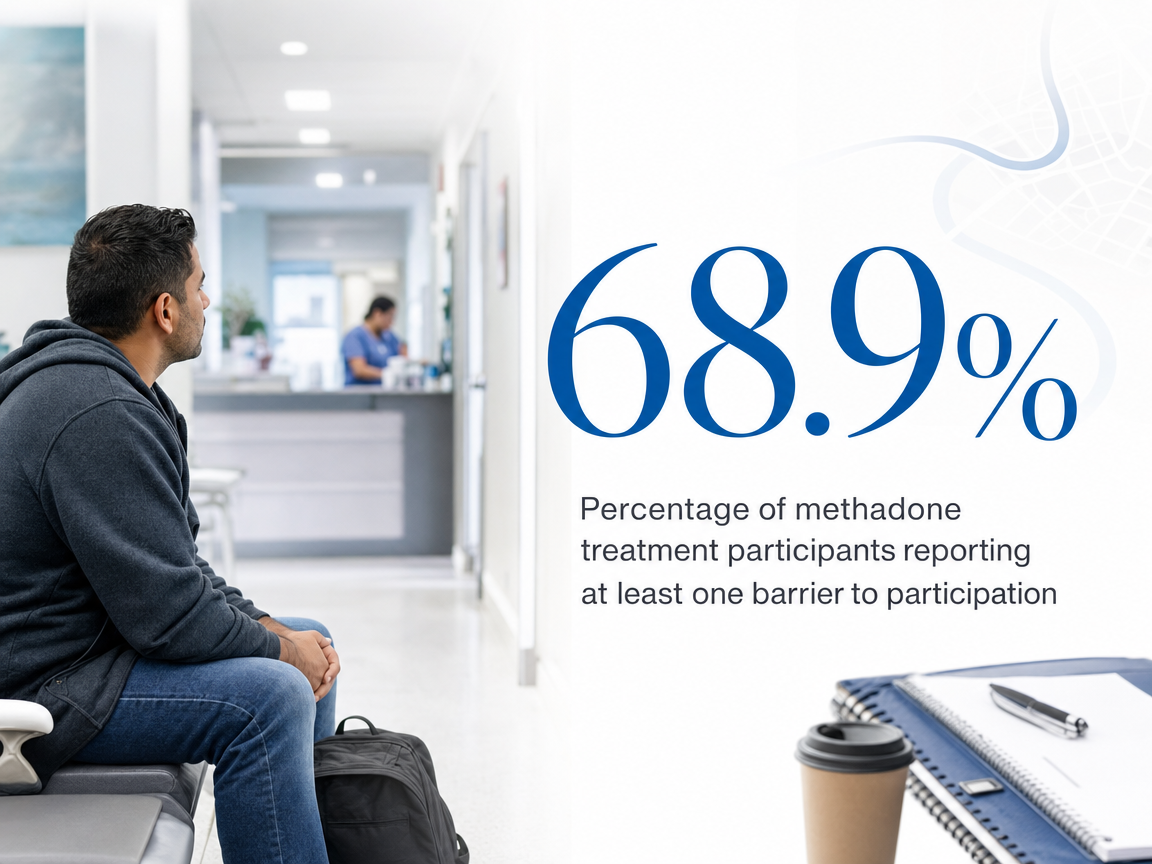
If you have ever tried to get a loved one to a weekly appointment, you already know that "just a ride" is rarely just a ride. The research backs you up. In a study of 267 adults in methadone treatment, 68.9% agreed or strongly agreed that at least one barrier made participation difficult, and 53.6% reported multiple barriers stacked on top of each other. Travel hardships and work schedules were the most commonly endorsed problems 1. That is not a convenience complaint. That is a clinical signal about why people fall out of treatment.
Distance matters too. A multistate study of medication for opioid use disorder, which clinicians shorten to MOUD, found that people living within five miles of their treatment program were more likely to stay engaged and remain in their original program at 18 months 2. Proximity is protective. When your person lives in Rittenhouse but their prescriber is in University City, or when a treatment handoff is scheduled in Boca and the flight boards at PHL, every added mile is a point where the day can come apart.
Philadelphia providers see this plainly. In a 2024 qualitative study of local MOUD prescribers caring for adolescents and young adults, clinicians named transportation problems and conflicting work obligations as practical reasons their patients missed required in-person visits 3. The pattern is not abstract. It is the appointment your person did not make last month.
The Honest Caveat: Rides Alone Don't Fix Retention
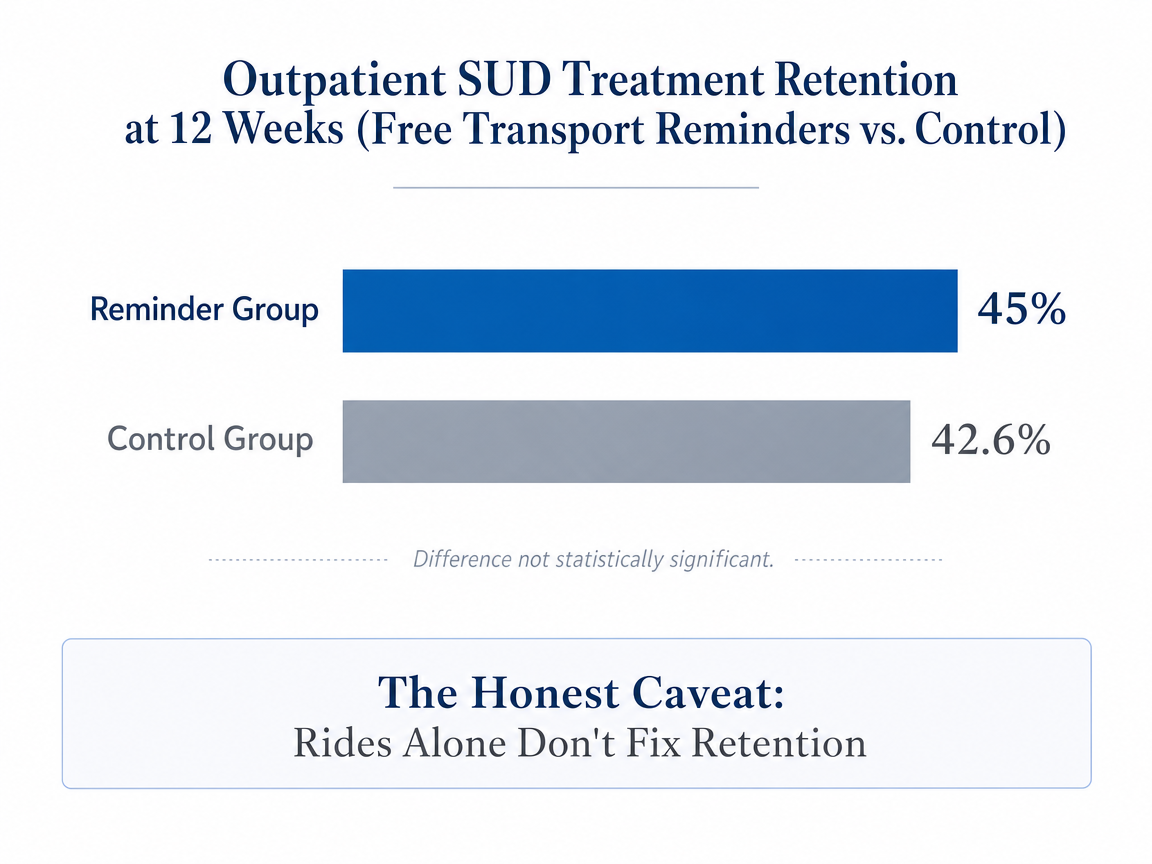
Here is where a lot of marketing goes wrong, and where you deserve the straight version. Giving someone a free ride, by itself, is not a retention cure. A 2025 pragmatic pilot tested text-message reminders about free transportation for outpatient substance-use-disorder treatment. At 12 weeks, retention was 45.0% in the reminder group versus 42.6% in the control group, a difference that was not statistically significant. By 24 weeks, the pattern had drifted the other way: 25.7% in the reminder group versus 28.4% in the control 4. Access alone did not move the needle.
That finding is important for how you spend your energy and your budget. The older literature points in a complementary direction: a national longitudinal analysis found that provider-organized car, van, or contracted transportation was associated with better retention, while individual vouchers and public-transit payments were not 5. The common thread is accompaniment and integration, not the vehicle itself. A ride handed to someone in a difficult moment is still a solo trip. A ride that comes with a trained person, coordinated with the treatment team, is a different clinical event.
Philadelphia as the Northeast Corridor Hinge
30th Street to Moynihan to Union: One Operational Theater
Here is a geographic truth that most families only notice when they need it: Philadelphia is not a stop on the Northeast Corridor. It is the middle of it. 30th Street Station is roughly 90 minutes south of Moynihan Train Hall and 90 minutes north of Union Station, and for a client whose work, treatment, and family obligations are scattered across those three cities, you are not planning three separate trips. You are planning one continuous operational theater, and Philadelphia is the hinge.
What that means practically: a Monday morning Acela boarding at 30th Street can hand off to a receiving associate in New York by late morning, cover a two-hour meeting in Midtown, and return your person to a Center City apartment by dinner. A Thursday afternoon departure to Union Station can line up with a Friday morning admission to a D.C.-area program. The train is the easy part. The hinge is everything that happens on the Philadelphia side — the pickup, the pre-board check-in with the treatment team, the quiet-car seat selection, the lunch that is not a bar car.
A good associate treats all three stations as one job with three sets of doors.
I-95, PHL, and Buffer Time That Protects the Day
The train is predictable. The road, right now, is not. PennDOT is in the middle of a $311 million reconstruction of roughly 1.3 miles of I-95 between Tioga Street and Wheatsheaf Lane in Northeast Philadelphia, with traffic shifts, lane closures, and ramp restrictions projected to continue for about two years, and the agency is openly telling drivers to allow extra time 13. South of the city, rehabilitation of the I-95 Girard Point Bridge is underway near the airport and stadium district; PennDOT has said three lanes in each direction will be maintained at the start, while warning that later work could affect travel conditions 14. Earlier Northeast Philadelphia bridge and ramp work has produced the same guidance: use alternate routes or build in extra time 19.
Translate that for a travel day. A PHL departure that would have asked for a 60-minute buffer two years ago now asks for more, especially if the pickup is north of Center City and routes through the Girard Point corridor. Build the cushion in on paper, not in the car. A client who sits calmly in an airport lounge for 40 extra minutes is in a very different hour than one who watches a construction backup from the back seat.
Insight Beyond Treatment
At Next Level Wellness & Behavioral Health, we believe meaningful change starts with perspective, not just protocols.
That philosophy is directly led by Amanda Marino, whose voice in behavioral health extends beyond clinical settings into leadership, culture, and personal growth.
Through keynote speaking and live events, Amanda explores the deeper themes that show up in recovery, family systems, and life transitions: authenticity, resilience, accountability, and the courage to change. Her work invites audiences to move past labels and into honest conversations that create lasting impact.
What a Travel Day Actually Looks Like
Pre-Trip Coordination with the Treatment Team
The work on a good travel day starts 48 to 72 hours before anyone opens a car door. Your associate should be on a call with the sending clinician, the receiving program, and whoever in the family is holding the decisions. The agenda is small but concrete: current medications and dosing times, any recent changes in sleep or appetite, what the client knows about the trip, what they do not, and the exact language the team is using with them. Nothing improvised.
This is the kind of information-sharing HHS describes under HIPAA's care-coordination permissions, where covered entities may share protected health information for healthcare operations when there is an existing treatment relationship and a permitted purpose 15. In practice, that means written authorizations get signed before, not during, the trip, and the associate works from the minimum information needed to keep your person safe.
The pre-trip call also sets the handoff point in writing. Who is meeting the client at Union Station. What time. What the fallback is if the train runs late. If the receiving program expects a 2 p.m. intake, the associate works backward from that, not forward from a hopeful departure.
The Hours in Motion: Station, Platform, Hotel, Handoff
Morning of. The associate arrives at the home or hotel earlier than needed, usually with coffee and a quiet plan for the first hour. Medications are confirmed, not assumed. Bags are already packed; the associate is not folding shirts. If the departure is from 30th Street, the car leaves with enough margin that a backup at the Vine Street Expressway or a shift near the Girard Point work zone does not become the story of the day 14.
At the station, the associate holds the tickets, manages the gate, and chooses seats deliberately — often a business-class pair away from the cafe car, or a quiet-car seat if conversation is not the point. The train hours are not dead time. They are the longest uninterrupted stretch the associate will have with your person all day, and the right associate uses them well: a meal, a check-in with the treatment team by text, a walk to the vestibule when restlessness builds.
Midtown or D.C. arrival follows the same discipline. The hotel room is pre-registered under the associate's name when discretion matters. The handoff at a receiving facility is in person, with a brief verbal report and a written one, and the associate does not leave until the receiving clinician signs for the client. A good trip ends with a phone call to the family that night confirming your person arrived, settled, and is safe.
Safety Protocols Any Credible Provider Should Have
Ask any provider you are considering what happens if the day goes sideways. The answers should be specific, not reassuring.
Naloxone should be carried on every trip involving a client at risk of opioid exposure, in a form the associate is trained to use. CDC guidance is direct: when overdose is suspected, administer naloxone, call 911, keep the person breathing and on their side, and do not leave them alone 11. Naloxone can restore normal breathing in two to three minutes, though stronger opioids like fentanyl may require more than one dose 10. Your associate should know this cold and carry extra.
Beyond the medication, ask about the escalation chain. Who gets called first if the client refuses to board. What the policy is on alcohol service in the Acela cafe car. Where the nearest emergency department is to the hotel. How the associate documents the trip for the clinical team. A credible provider has written answers. A less credible one improvises.
Discretion, Consent, and the Limits of HIPAA
Privacy is often the first thing a family asks about and the last thing a provider explains honestly. So here is the honest version. HIPAA permits covered entities — your person's clinicians, hospitals, and health plans — to share protected health information for care coordination and healthcare operations when there is an existing treatment relationship, the information fits that relationship, and the disclosure serves a permitted purpose 15. That permission is the legal lane a prescribing physician uses to brief a receiving program about a patient's current medications before an admission.
What HIPAA does not do is automatically authorize your person's clinician to share clinical details with a private sober-transport associate. The associate is usually not a covered entity. For the trip to be clinically integrated — medication timing, allergies, recent changes, aftercare plan — your person signs a written authorization naming the associate or the transport agency, and the clinician works to the minimum necessary. The signing happens before the trip, not from the back seat of a car.
Discretion, meanwhile, is operational, not legal. Who holds the hotel reservation. Whose name is on the Amtrak ticket. Whether the pickup is at the lobby or the garage. A credible provider will ask you these questions. If no one asks, assume no one has thought about them.
A Decision Framework for Families and Chiefs of Staff
When Sober Transport Is the Right Call
Sober transport earns its place when your person is clinically stable but the day is structurally risky. Think of the discharge day from a Center City detox back to a Boca Raton residential program, with a flight out of PHL and a four-hour window where no one is watching. Think of the Acela to Moynihan for a Tuesday board meeting, three weeks into outpatient care, when a hotel minibar and a long dinner are on the schedule. Think of the ride from a 30th Street arrival to a prescriber in University City, where the five-mile proximity that protects retention 2still has to be bridged by a person who will not reschedule.
The right call looks like this: your person has a current treatment plan, a working relationship with a clinician, and a day with identifiable pressure points — travel, meetings, unstructured hours, or a handoff between programs. Accompaniment, not just a vehicle, is what reduces the risk. That is the lane sober transport was built for.
When It Signals the Need for a Higher Level of Care
Sometimes the request for transport is really a request for something more. If you find yourself arranging escorted trips every week because your person cannot get through a weekday without supervision, that pattern is clinical information. NIAAA notes that limited access to transportation, unstable living conditions, and additional health issues can indicate a person would benefit from residential or hospital-based care rather than outpatient visits alone 20. The transport need is a symptom, not the plan.
Arranging a Philadelphia Sober Transport (and When to Call Next Level)
When you are ready to book, keep the request short and specific. Share the pickup address, the destination, the clinician's name and number, the medication schedule, and the identifiable pressure points of the day — a layover, a meeting, a handoff window. A credible provider will ask follow-ups about consent forms, who the associate can speak with, and what the fallback is if the train is delayed or the receiving program's intake runs long. If the first conversation does not include those questions, keep calling.
Give the office 48 to 72 hours when you can. Same-day requests are sometimes workable, but the pre-trip calls with the sending and receiving clinicians are the quiet work that makes the day hold together, and that work needs hours, not minutes.
If a Philadelphia pickup, an Acela to Moynihan, a PHL departure, or a treatment handoff is on your calendar this week, Next Level's Safe Sober Transport service is built for exactly this kind of accompaniment — a trained associate alongside your person, with the logistics handled around them. You are not overreacting by arranging it. You are making the appointment, getting on the train sober, and landing where the team is expecting you. That is the day worth protecting.
Frequently Asked Questions
How is sober transportation different from a rideshare or car service?
A rideshare driver is responsible for the vehicle. A sober transport associate is responsible for your person. The associate is trained in recovery support, carries naloxone, coordinates with the treatment team, and stays with the client through delays, meetings, and handoffs 9, 11. If the day goes sideways, the trip does not end — the care does not.
Is private sober transport the same as Pennsylvania's MATP program?
No. Pennsylvania's Medical Assistance Transportation Program provides no-cost non-emergency rides for eligible Medicaid recipients to Medicaid-enrolled providers, including drug-and-alcohol treatment 6, 7. Private sober transport is privately paid recovery accompaniment that travels with the client between homes, workplaces, hotels, airports, and treatment programs — including out-of-state trips MATP does not cover.
Can a sober transport associate coordinate directly with my family member's treatment team?
Yes, when consent is in place. HIPAA permits clinicians to share information for care coordination within an existing treatment relationship 15, but a private associate is usually not a covered entity. Your person signs a written authorization naming the associate or agency before the trip, and the clinician shares only what the day requires.
Does sober transportation work for Amtrak trips between Philadelphia, New York, and Washington?
Yes, and the Northeast Corridor is one of the strongest use cases. A single associate can accompany your person from a Philadelphia pickup through 30th Street Station, into Moynihan Train Hall or Union Station, and on to a meeting, hotel, or treatment handoff. Seat selection, meals, and check-ins with the treatment team happen in motion.
How much notice do we need to arrange a trip?
Aim for 48 to 72 hours when possible. Same-day requests are sometimes workable, but the pre-trip calls with sending and receiving clinicians — medication timing, handoff logistics, PennDOT construction windows along I-95 that can add time to a PHL run 13, 14— need hours of preparation. The quiet work before the trip is what makes the day hold.
When is sober transport not enough, and what should we consider instead?
If your person needs weekly escorted trips just to get through the week, or is in active withdrawal, recent return to use, or crisis, call the treating clinician before booking a car. NIAAA notes that limited transportation combined with unstable conditions or additional health issues often points toward residential or hospital-based care 20. Transport is a later step, not the plan.
References
- Cumulative barriers to retention in methadone treatment. https://pmc.ncbi.nlm.nih.gov/articles/PMC9284487/
- Barriers to retention in medications for opioid use disorder. https://pmc.ncbi.nlm.nih.gov/articles/PMC11060890/
- Opportunities to enhance retention on medication for opioid use disorder for adolescents and young adults: results from a qualitative study with medical providers in Philadelphia, PA. https://pmc.ncbi.nlm.nih.gov/articles/PMC11587537/
- Text Message Reminders About Free Transportation for Outpatient Substance Use Disorder Treatment: A Pragmatic Pilot Study. https://pmc.ncbi.nlm.nih.gov/articles/PMC12855645/
- Transportation and retention in outpatient drug abuse treatment. https://pubmed.ncbi.nlm.nih.gov/11551738/
- Medical Assistance Transportation Program. https://www.pa.gov/services/dhs/medical-assistance-transportation-program
- MATP 101. http://matp.pa.gov/PDF/MATP-Basics-Revised-01-01-2026.pdf
- Application for Motor Common Carrier of Persons in Paratransit. https://www.puc.pa.gov/pcdocs/1663233.pdf
- What are Peer Recovery Support Services. https://library.samhsa.gov/sites/default/files/sma09-4454.pdf
- Lifesaving Naloxone. https://www.cdc.gov/stop-overdose/caring/naloxone.html
- Preventing Opioid Overdose. https://www.cdc.gov/overdose-prevention/prevention/index.html
- Implementation Update. https://www.phila.gov/media/20240311130540/Phila2035-Implementation-Update-REVISED.pdf
- I-95 Reconstruction at Allegheny Avenue in Northeast Philadelphia. https://www.pa.gov/agencies/penndot/news-and-media/newsroom/district-6/2026/i-95-reconstruction-at-allegheny-avenue-in-northeast-philadelphi
- PennDOT to Begin Construction on I-95 Girard Point Bridge Rehabilitation. https://www.pa.gov/agencies/penndot/news-and-media/newsroom/district-6/2026/penndot-to-begin-construction-on-i-95-girard-point-bridge-rehabi
- HIPAA and Health Plans – Uses and Disclosures for Care Coordination and Continuity of Care. https://www.hhs.gov/hipaa/for-professionals/faq/uses-and-disclosures-for-care-coordination-and-continuity-of-care/index.html
- 2024 Data Brief - Fatal and Non-Fatal Drug Overdoses in Pennsylvania. https://www.pa.gov/content/dam/copapwp-pagov/en/health/documents/topics/documents/programs/pdmp/Pennsylvania%20Overdose%20Data%20Brief%202024.pdf
- SUDORS Dashboard: Fatal Drug Overdose Data – Accessible Version. https://www.cdc.gov/overdose-prevention/data-research/facts-stats/sudors-dashboard-fatal-overdose-data-accessible.html
- Unintentional drug overdose fatalities in Philadelphia in 2024. https://www.phila.gov/2026-05-11-unintentional-drug-overdose-fatalities-in-philadelphia-in-2024/
- Construction Planned on Interstate 95 in Northeast Philadelphia. https://www.pa.gov/agencies/penndot/news-and-media/newsroom/district-6/2025/construction-planned-on-interstate-95-in-northeast-philadelphia
- Why Do Different People Need Different Options?. https://alcoholtreatment.niaaa.nih.gov/what-to-know/different-people-different-options
A Voice Shaping the Conversation
The topics explored here—change, self-awareness, recovery, and growth—are the same themes Amanda Marino brings to audiences nationwide through speaking engagements and live events.
Known for her appearances on A&E’s Intervention and Digital Addiction, Amanda speaks to organizations, communities, and leadership teams about navigating adversity, embracing vulnerability, and building lives rooted in purpose. Her message resonates far beyond treatment, offering insight that applies to families, professionals, and anyone standing at a crossroads.



Heal on your terms—any time, anywhere.