.svg)

Finding Treatment Placement in Bethesda, MD

Key Takeaways
- Montgomery County's Access line at 240-777-1770 screens and refers, but it is not a placement service and cannot manage complex out-of-state residential admissions on your behalf.
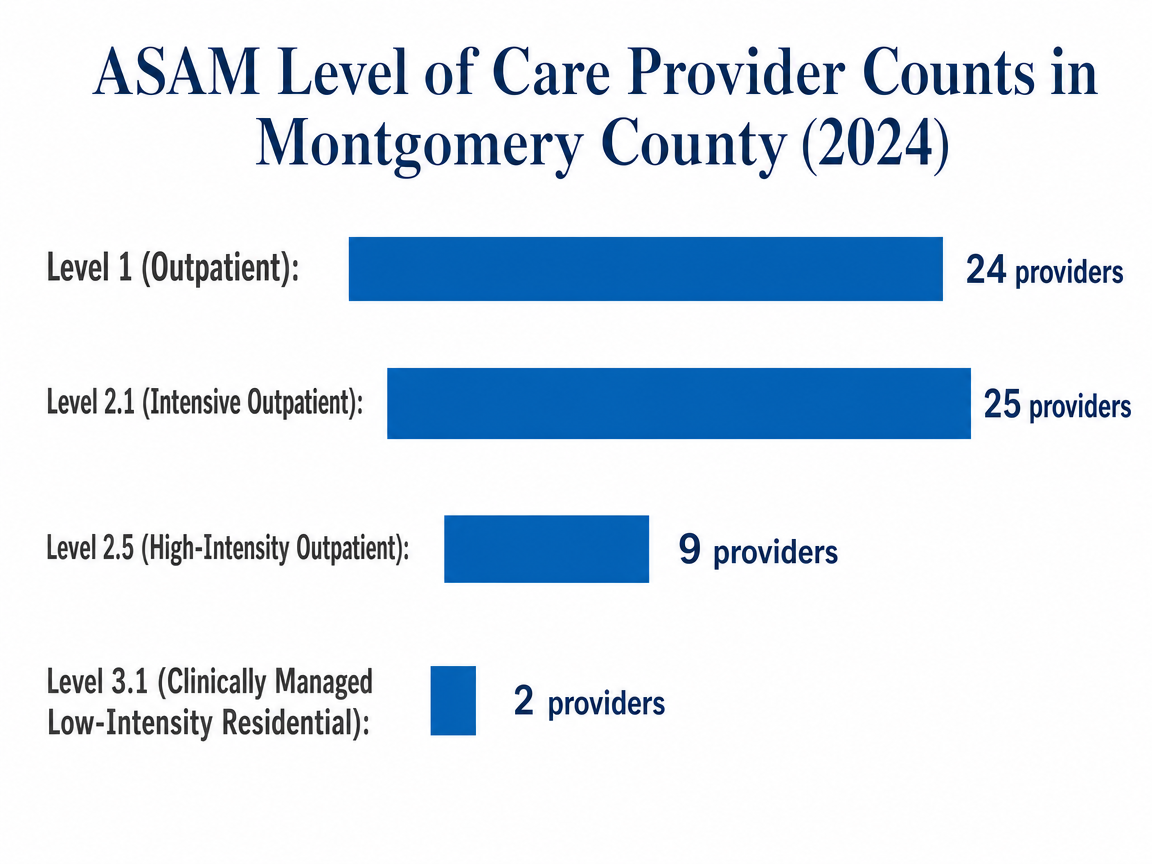
- Local capacity skews heavily outpatient — only 2 Level 3.1 residential providers operate in the county against 24 outpatient and 25 IOP options 3, so residential matches usually require crossing jurisdictions.
- Matching ASAM level of care to clinical severity and co-occurring conditions matters more than program reputation, since a famous facility with the wrong medical staffing is still the wrong placement 4.
- Before acting, compare who owns clinical assessment review, payer strategy, direct vetting calls with clinical directors, transport, privacy scoping, and post-discharge coordination through the first 90 days.
The Call You Weren't Prepared to Make
You are standing in your kitchen in Chevy Chase, or in a hotel room in another city, holding a phone that has gone quiet. The person on the other end was your sister, your son, your husband — and something they said, or something they didn't say, made it clear the situation is no longer manageable from a distance. You need to get them into treatment. Soon. And you have no idea how.
That is where most families in Bethesda, Potomac, McLean, and Northwest DC start. Not with a plan. With a phone that just went quiet.
Here is what is true, and worth saying out loud before anything else: you are not supposed to know how to do this. There is no reason a partner at a firm, a physician, or a retired diplomat would know the difference between ASAM Level 2.1 and Level 3.1, or which residential program in the mid-Atlantic actually takes clients with a co-occurring eating disorder and a lorazepam taper. This is technical work. It has its own vocabulary, its own gatekeepers, and its own quiet rules about who gets a bed on a Tuesday.
What follows is a map of the DMV treatment system as it actually functions — where the public entry points are, where the real bottlenecks sit, and what a private case manager does that a directory of phone numbers cannot.
Why the DMV Treatment System Is Harder to Navigate Than It Looks
The Public Entry Point: Montgomery County's Access Line
If you start with a Google search, you will end up at the same place a lot of Bethesda families do: Montgomery County's Access to Behavioral Health Services line at 240-777-1770, staffed Monday through Friday. The county describes it plainly — the line exists for residents who need help understanding the system of providers, along with mental health and substance use screening and referral 1. A 24-hour Crisis Center backs it up for acute situations 1.
That is a real resource, and it is worth knowing the number before you need it. What it is not is a placement service in the concierge sense. The Access line is designed to screen, triage, and refer — to point you toward a program that has capacity and takes your insurance or your loved one's Medicaid. It is not designed to spend three days on the phone with a residential admissions coordinator in Pennsylvania negotiating a Sunday intake for someone tapering off Klonopin.
There is also a quieter issue. When your last name is on a building at NIH or a partner track at a K Street firm, calling a county line to describe your spouse's fentanyl use is not a neutral act. The county has strong confidentiality practices, but the felt experience of that call — of putting your family's crisis into a public system — is often the reason people freeze and do nothing for another two weeks.
Know the number. Use it if it fits. Just do not confuse it with a plan.
What's Actually Available Locally — and What Isn't
Here is where the map gets uncomfortable. Montgomery County's own 2024 Sequential Intercept Model Mapping Report counted the substance use treatment providers operating across the county by ASAM level of care. The numbers:
- 24 Level 1 outpatient providers
- 25 Level 2.1 intensive outpatient providers
- 9 Level 2.5 high-intensity outpatient providers
- and only 2 Level 3.1 clinically managed low-intensity residential providers 3
Read that again. Twenty-five intensive outpatient options. Two residential.
For most families walking into this, that is the single most important thing to understand about the local landscape. If your loved one can safely live at home and drive to a program three to five days a week, Bethesda and the surrounding county have real depth. Suburban Hospital Addiction Treatment Center in Bethesda is one of the outpatient adult programs the county specifically names 2, and North Bethesda has additional outpatient options on the county's list 2. Care coordination, medication management, individual and group therapy — these are available and, in many cases, excellent.
The moment the clinical picture calls for someone to leave the house — because withdrawal is medically risky, because the home environment is unsafe, because outpatient has already failed twice — the local shelf gets very short, very fast. Two Level 3.1 residential programs in the entire county 3 means most families needing residential care will not be placing their person a fifteen-minute drive from home.
Crossing Jurisdictions: DC, Fairfax, and Out-of-Region Placement
Once you accept that a good residential match may not be in Montgomery County, the DMV opens up — and gets more complicated. A Bethesda family might look at a program in Northwest DC, a dual-diagnosis facility in Fairfax or Loudoun, a residential option on the Eastern Shore, or a specialty program in Pennsylvania, Virginia, or further out.
Each border you cross changes something. Maryland's public system oversees a specific ASAM continuum — Levels 1, 2.1, 2.5, 3.1, 3.3, 3.5, 3.7, and 3.7WM under state administration 7, with residential and withdrawal management coverage built out through the state's 1115 waiver 9. DC and Virginia have their own licensing bodies, their own Medicaid rules, and their own private-pay markets. A program licensed in Virginia may not accept a Maryland Medicaid client. A DC-based psychiatrist your loved one already sees may not be credentialed to continue medication management once they cross into a Pennsylvania residential program.
None of this is insurmountable. It is, however, the kind of thing that eats a week if no one is tracking it. When you are choosing between three residential programs in three different states, someone has to hold the whole picture: who takes the insurance, who has a bed on the right day, who can coordinate with the psychiatrist in Chevy Chase, and who will actually pick up the phone on day fourteen when you need to know how your son is doing.
Insight Beyond Treatment
At Next Level Wellness & Behavioral Health, we believe meaningful change starts with perspective, not just protocols.
That philosophy is directly led by Amanda Marino, whose voice in behavioral health extends beyond clinical settings into leadership, culture, and personal growth.
Through keynote speaking and live events, Amanda explores the deeper themes that show up in recovery, family systems, and life transitions: authenticity, resilience, accountability, and the courage to change. Her work invites audiences to move past labels and into honest conversations that create lasting impact.
Matching Clinical Severity to the Right Level of Care
The ASAM Continuum, in Plain English
Before you can pick a program, someone has to name where your loved one actually falls on the clinical map. In Maryland, that map is the American Society of Addiction Medicine (ASAM) continuum, and the Maryland Department of Health administers the statewide continuum of behavioral health treatment across ASAM Levels 1, 2.1, 2.5, 3.1, 3.3, 3.5, 3.7, and 3.7WM, along with outpatient mental health clinics and partial hospitalization programs 7. Medicaid's 1115 waiver adds medically managed inpatient Level 4.0 on top of that 8. In plain English, here is what each level tends to look like from a family's chair:
- Level 1 — Outpatient.
- Weekly or biweekly therapy, medication management, standard step-down care.
- Level 2.1 — Intensive Outpatient (IOP).
- Nine or more clinical hours a week, typically three to five days, while living at home.
- Level 2.5 — Partial Hospitalization (PHP).
- Twenty-plus hours a week, closer to a full clinical day, still sleeping at home 6.
- Level 3.1 — Clinically Managed Low-Intensity Residential.
- A structured 24-hour living environment with lighter clinical dosing 6.
- Level 3.3 & 3.5 — Higher-Intensity Residential.
- Population-specific and clinically managed residential care for people who need more structure.
- Level 3.7 — Medically Monitored Intensive Inpatient.
- 24-hour nursing and daily physician availability for complex cases 8.
- Level 3.7WM — Medically Monitored Withdrawal Management.
- Residential detox with medical oversight, appropriate for alcohol, benzodiazepine, and opioid withdrawal that isn't safe at home 8.
- Level 4.0 — Medically Managed Inpatient.
- Hospital-level care for the most acute presentations 8.
You do not need to memorize these. You do need someone in your corner who can look at a psychiatric evaluation, a medication list, and a two-week history and say, out loud, "This is a 3.7WM followed by a 3.5, not a 2.1." That single sentence prevents a great deal of failure downstream.
Why Matching Matters More Than Program Reputation
The instinct, when the phone finally goes quiet, is to reach for the most well-known name — the program a friend mentioned at a dinner in Kalorama, the facility with the polished website and the alumni testimonials. That instinct is understandable. It is also how families end up spending sixty thousand dollars on the wrong level of care.
The National Institute on Drug Abuse is direct about it: effective treatment has to match the severity of the disorder and address co-occurring medical, psychiatric, and social needs, not simply place a person into whatever program has a bed 4. A famous residential program that runs a strong trauma curriculum but has no on-site medical detox is the wrong answer for someone who needs 3.7WM first. An IOP with an excellent group therapist is the wrong answer for someone whose bipolar disorder is unstable and whose drinking has already triggered two ER visits this quarter.
Reputation tells you what a program is good at. It does not tell you whether it is good for your person, this month, with this medication list and this home environment. That match — clinical severity to level of care to specific program — is the actual work. When it is done well, the program's job gets easier and the odds of the placement holding go up. When it is done poorly, a family ends up cycling through two or three admissions in a year, each one more expensive and more demoralizing than the last.
A case manager's first job is not to recommend a facility. It is to make sure the level of care is right before anyone tours a website.
What a Concierge Case Manager Actually Does
Pre-Admission: Assessment Review and Program Vetting
Before a single admissions coordinator picks up the phone, a case manager is doing something less visible and more important: reading the clinical record with a skeptical eye. That means pulling the last psychiatric evaluation, the medication list, any recent ER discharge summaries, and — where they exist — prior treatment records from earlier admissions. It also means a direct conversation with your loved one's current psychiatrist in Bethesda or Chevy Chase, and often with the internist, because polypharmacy and medical comorbidities shape which programs can safely accept the admission.
Only then does program vetting start. Vetting is not reading a website. It is a series of specific calls to the clinical director or admissions clinician at each candidate program: What is your medical staffing pattern on nights and weekends? Do you have a psychiatrist on-site or on-call, and how often are they physically present? What is your protocol for a benzodiazepine taper on top of alcohol use disorder? How do you handle a client whose eating disorder behaviors escalate mid-stay? Can you coordinate with an outside prescriber for stimulant medication?
Those answers separate a brochure from a real clinical fit. NIDA's guidance is that effective treatment must address the whole person — medical, psychiatric, and social needs — not just the substance 4. The vetting call is where that principle gets operationalized, one program at a time, before anyone tours a facility or signs a financial agreement.
Admissions Logistics, Transport, and the First 72 Hours
Once a program is chosen, the logistics compress fast. Insurance verification or private-pay agreements, financial paperwork, medical clearance, a current TB test if the program requires one, prescriber releases so medications can be continued without a gap, and an intake date that actually works — all of it usually inside 48 to 72 hours. If the program is out of state, add flights or ground transport, a chaperone, and a plan for what happens if your loved one changes their mind at the gate.
A case manager runs that stack in parallel while you do the harder work: telling a teenager their parent is leaving for a while, briefing a co-parent, or fielding a call from an executive assistant who does not need to know why the calendar just cleared for six weeks. Safe transport is not a luxury line item here. For someone in early withdrawal, tapering off benzodiazepines, or ambivalent about going at all, having a trained companion between the front door in Potomac and the intake desk in another state is often what makes the placement actually happen.
The first 72 hours inside the program matter disproportionately. A case manager stays reachable — to the program, to the family, and often to your loved one — through that window.
Staying Accountable After the Client Walks Through the Door
This is the piece most families do not realize they are missing until it is too late. A referral ends at admission. Case management does not.
Once your loved one is inside a program, someone still has to hold the arc: attending weekly clinical calls with the treatment team, tracking whether the initial diagnosis is holding up under observation, flagging when the level of care needs to step down or step up, and starting discharge planning in week one — not week five. That includes lining up the step-down IOP or PHP in Bethesda or DC, re-engaging the outpatient psychiatrist, scheduling family sessions, and building the sober living or return-home plan before the residential stay ends.
The evidence here is not soft. A systematic review of care coordination in mental health services found that coordinated case management interventions often improve continuity of care and patient satisfaction 5. In practice, continuity is what prevents the pattern most families in the DMV have already seen once — a good 30-day stay followed by a disorganized handoff, followed by a relapse in month two, followed by another admission.
A concierge case manager stays the accountable party across that whole arc. The program owns the treatment episode. The family owns the love and the long relationship. The case manager owns the connective tissue between them — the calls, the scheduling, the clinical translation, and the willingness to say, out loud, when something is not working and needs to change.
The Workstreams Placement Actually Requires
When families ask what a case manager actually does all day, the honest answer is: the work you do not have time to do, in the order it has to be done. Below is the concrete stack for a single placement — no invented dollar figures, just the workstreams.
- Clinical assessment review. Pull the current psychiatric evaluation, medication list, recent labs, and prior treatment records. Talk directly with the treating psychiatrist in Bethesda, Chevy Chase, or Northwest DC. Confirm the working diagnosis and the level-of-care recommendation against the ASAM framework Maryland uses 7.
- Payer decisioning. Insurance versus private-pay is a strategy question, not a paperwork question. In-network coverage may constrain program choice; private-pay preserves optionality and privacy. Where Medicaid is in play, the full continuum through Level 4.0 is available under the state's 1115 waiver 9, but authorization timelines still have to be managed.
- Program vetting calls. Three to six direct conversations with clinical directors, not admissions marketers. Staffing patterns, on-call psychiatry, medication protocols, co-occurring capabilities.
- Admissions paperwork. Financial agreements, medical clearance, TB testing where required, prescriber releases, HIPAA authorizations scoped tightly enough to protect the family.
- Transport. Ground or air, with a trained companion. Planned for the reality that the client may waver at the door.
- Family briefings. Scheduled updates for spouse, adult children, and any co-parent or attorney who needs to know, in the shape they need to know it.
- Post-discharge coordination. Step-down IOP or PHP in the DMV, re-engagement of the outpatient prescriber, sober living or return-home logistics, and weekly clinical touchpoints for at least the first 90 days.
You can absorb this yourself. Many people try. What it usually costs, in the currency families actually spend, is two to three weeks of your working attention and a great deal of sleep.
Privacy, Reputation, and the HNW-Specific Stakes
There is a category of concern that rarely gets named on a first phone call but sits under every decision: what happens if this becomes known. A partner at a Georgetown firm, a physician at a Bethesda hospital system, a federal appointee in Northwest DC, a founder mid-fundraise in Tysons — the clinical picture is the same as anyone else's, but the exposure map is different.
Practical stakes to name out loud:
- a custody or co-parenting file that a spouse's attorney will scrutinize;
- an executive continuity plan that has to hold for six weeks without the CEO being at the wheel;
- board disclosure obligations;
- a security clearance;
- a college-age child whose peers all attend the same three schools.
None of these change what level of care is clinically right. They do change how admission, records, communications, and post-discharge follow-up have to be structured.
A concierge case manager works in that space deliberately. HIPAA authorizations get scoped narrowly, not broadly. Family briefings run on a defined distribution, not a group text. Records requests from the outpatient prescriber in Chevy Chase are coordinated so nothing lands in a chart that does not need to be there. Transport is planned so a Sunday intake does not require a family member to explain a Monday absence.
Behavioral health need does not track wealth — NIMH's national prevalence data makes that clear 11. What tracks wealth is the cost of a leak. Building the placement around that reality is not extra. It is the work.
Frequently Asked Questions
What's the difference between calling Montgomery County's Access to Behavioral Health Services line and hiring a private case manager?
The county line at 240-777-1770 is a screening and referral resource — it will help you understand the provider system and point you toward programs that fit 1. A private case manager owns the outcome: reading the clinical record, vetting programs by direct calls to clinical directors, running admissions and transport, and staying involved after your loved one is inside the program. One is an entry point. The other is a plan.
Why can't we just find a residential program in Bethesda or Montgomery County?
You can find outpatient depth locally, but residential capacity is genuinely thin. Montgomery County's 2024 mapping report counted only 2 Level 3.1 clinically managed low-intensity residential providers across the entire county, against 24 outpatient and 25 intensive outpatient options 3. When the clinical picture calls for residential care, a good match almost always means looking outside the county, and sometimes outside Maryland.
How does a case manager decide which ASAM level of care my loved one actually needs?
The case manager reviews the current psychiatric evaluation, medications, recent ER or treatment records, and talks directly with the treating psychiatrist. That picture is mapped against the ASAM continuum Maryland administers — Levels 1 through 3.7WM under state oversight 7, plus 4.0 through Medicaid — and matched to severity and co-occurring conditions, which NIDA identifies as the core of effective placement 4.
What happens if the right program is in DC, Fairfax, or out of the region entirely?
Cross-jurisdictional placement is common and workable, but it adds moving parts. Licensing bodies, Medicaid rules, and prescriber credentialing differ across DC, Virginia, Maryland, and states further out. The case manager handles the payer decisioning, coordinates with your outpatient psychiatrist in Chevy Chase or Bethesda so medications continue without a gap, arranges transport with a trained companion, and keeps the family briefed through the intake window.
How do you protect privacy for a public-facing executive or professional during placement?
HIPAA authorizations are scoped narrowly, not broadly. Records requests are coordinated so information only lands in charts where it belongs. Family briefings run on a defined distribution rather than a group text. Transport and intake timing are planned around executive continuity, board obligations, or custody considerations. Behavioral health need does not track wealth 11, but the cost of a leak does, and the placement is built around that.
Does the case manager stay involved after admission, or does the family take over from there?
Staying involved is the point. The case manager attends weekly clinical calls with the treatment team, tracks whether the diagnosis and level of care are holding, and starts discharge planning in week one — lining up step-down IOP or PHP in the DMV, re-engaging the outpatient prescriber, and building the return-home plan. Coordinated case management is associated with better continuity of care and patient satisfaction 5.
References
- Get Help – Opioid and Overdose Information for Montgomery County, MD. https://www.montgomerycountymd.gov/opioids/get-help.html
- Outpatient Treatment – Opioids – Montgomery County, MD. https://www.montgomerycountymd.gov/opioids/resources_outpatient.html
- Montgomery County Sequential Intercept Model Mapping Report (2024). https://gocpp.maryland.gov/wp-content/uploads/FINAL-Montgomery-Co.-2024-SIM-Mapping-Report-3.pdf
- Treatment Approaches for Drug Addiction – National Institute on Drug Abuse. https://nida.nih.gov/publications/drugfacts/treatment-approaches-drug-addiction
- Care Coordination in Mental Health Services: A Systematic Review. https://www.ncbi.nlm.nih.gov/pmc/articles/PMC5844534/
- Maryland Public Behavioral Health System (PBHS) Level of Care Appendix. https://health.maryland.gov/pophealth/Documents/Local%20Health%20Department%20Billing%20Manual/LHD%20Billing%20Manual%20V31/Section%20IV%20LDH%20Programs/Optum%20Maryland%20PBHS%20LOC%20Appendix_BH2555_FINAL_REVISED%2012.17.20.pdf
- Treatment and Recovery Services Unit – Maryland Department of Health. https://health.maryland.gov/bha/pages/treatment-and-recovery-services-unit.aspx
- Medicaid Section 1115 SUD and SMI/SED Demonstrations – Maryland HealthChoice Quarterly Report, Part B (Jan–Mar 2025). https://www.medicaid.gov/medicaid/section-1115-demonstrations/downloads/md-healthchoice-sud-smi-qtrly-rpt-partb-jan-mar-2025.pdf
- Medicaid Section 1115 Substance Use Disorder & Serious Mental Illness/Serious Emotional Disturbance Retrospective Monitoring Report, Part B (Jan 2022–Dec 2024). https://www.medicaid.gov/medicaid/section-1115-demonstrations/downloads/md-healthchoice-smi-retro-monitor-rpt-partb-jan2022-dec2024.pdf
- Mental Health, Substance Use, and Suicidal Ideation During the COVID-19 Pandemic – United States, June 24–30, 2020. https://www.cdc.gov/mmwr/volumes/69/wr/pdfs/mm6947a1-H.pdf
- Mental Illness – National Institute of Mental Health Statistics. https://www.nimh.nih.gov/health/statistics/mental-illness
A Voice Shaping the Conversation
The topics explored here—change, self-awareness, recovery, and growth—are the same themes Amanda Marino brings to audiences nationwide through speaking engagements and live events.
Known for her appearances on A&E’s Intervention and Digital Addiction, Amanda speaks to organizations, communities, and leadership teams about navigating adversity, embracing vulnerability, and building lives rooted in purpose. Her message resonates far beyond treatment, offering insight that applies to families, professionals, and anyone standing at a crossroads.



Heal on your terms—any time, anywhere.