

What Are Psychosocial Interventions in Recovery?

Key Takeaways
- Psychosocial interventions are structured, non-medication supports, including CBT, motivational interviewing, contingency management, family work, peer support, and case management, used alone or alongside medication.
- A family 'intervention' is a single meeting, while psychosocial interventions are an ongoing category of relationship-based supports that can run before, during, after, or in place of formal treatment.
- Evidence is strongest for contingency management in stimulant use disorder and trauma-focused psychotherapies like CPT, EMDR, and Prolonged Exposure for PTSD 12, 5, while co-occurring conditions typically need integrated care rather than talk therapy alone 9.
- Matching the right support to the moment, protecting privacy, and coordinating clinicians through case management often determine whether a plan holds together between appointments.
The Non-Medication Side of Getting Better
Psychosocial interventions are structured, non-medication supports that help you or your loved one change how you think, cope, relate to others, and move through daily life. They include talk therapies like cognitive behavioral therapy, motivational interviewing, family work, peer support, contingency management, and the practical coordination that stitches it all together. They can stand alone or work alongside medication.
If you are reading this after a difficult week, a hospital call, or a quiet decision to look into options, you already know the territory feels crowded with jargon. Clinicians use shorthand. Consultants hand you acronyms. The term psychosocial sounds clinical, but what it describes is deeply human: the slow, specific work of rebuilding motivation, skills, relationships, and routines.
Federal guidance from SAMHSA frames recovery as a process of improving health and wellness, living a self-directed life, and working toward your full potential 1. Psychosocial interventions are the tools that make that process possible, and the rest of this guide walks you through what they actually look like.
Psychosocial Intervention vs. "An Intervention": Clearing Up the Confusion
Two very different ideas share almost the same name, and that trips up almost everyone.
"An intervention," the way most people picture it, is a single meeting: family members, sometimes a professional interventionist, gathered in a living room to ask a loved one to accept help. It is one event, usually tied to a specific crisis.
A psychosocial intervention is something broader. The word covers an entire category of non-medication approaches that work on the psychological and social parts of your life: how you think, how you cope, how you relate to the people around you, and how your daily environment either supports or undermines change. Cognitive behavioral therapy is a psychosocial intervention. So is motivational interviewing, family therapy, peer support, contingency management, and the case-management work that keeps appointments, housing, and treatment plans from falling apart 3.
Put simply: a family intervention is one tool. Psychosocial interventions are the whole toolbox of human, relationship-based supports that can be used before, during, after, or in place of formal treatment. When a clinician mentions "psychosocial support" for your loved one, they usually mean an ongoing plan, not a one-time conversation.
Six Families of Psychosocial Interventions and What Each One Actually Does
Motivation-Building Approaches
Change rarely starts with certainty. It usually starts with ambivalence, the pull between wanting something different and wanting things to stay the same. Motivational interviewing meets your loved one exactly there. Instead of lecturing or pressuring, a trained clinician asks careful questions that help the person voice their own reasons for change, in their own words.
You can think of it as the opposite of a sales pitch. The clinician listens for the person's values, worries, and small flickers of readiness, then reflects them back. SAMHSA lists motivational interviewing among the evidence-based practices for stimulant use disorders 4, and NIDA includes motivational enhancement therapy among the core behavioral therapies that help people engage with treatment and respond to triggers 3. For a family watching someone refuse help, this is often the first door that actually opens.
Skills and Thinking: CBT and Related Therapies
Cognitive behavioral therapy, usually shortened to CBT, teaches your loved one to notice the thoughts and situations that lead to use or to a crisis, and then to practice different responses. It is structured, skills-based, and typically time-limited. Sessions might cover how to handle a craving on a Tuesday afternoon, how to turn down a drink without an awkward speech, or how to interrupt the spiral of self-criticism that follows a slip.
CBT sits inside a wider family that includes dialectical behavior therapy and acceptance and commitment therapy. For trauma, the VA/DoD guideline recommends specific manualized psychotherapies, including Cognitive Processing Therapy, EMDR, and Prolonged Exposure, over medication as first-line care 5. That matters because it shows these approaches are not a soft alternative to "real" treatment. They often are the real treatment.
Contingency Management and Behavioral Reinforcement
Contingency management is the most straightforward of the six families, and also the most misunderstood. The idea: when your loved one meets a specific recovery goal, usually a negative drug test, they receive a small, immediate reward, often a modest voucher or prize. The reward is tied to the behavior you want to see more of, and it comes quickly enough that the brain learns the connection.
It sounds simple, and the evidence is unusually strong. A 2024 meta-analysis using formal evidence criteria reported, among moderate-quality meta-analyses, a post-treatment effect size of d = 0.54 for abstinence, with a strong recommendation in favor 14. The ASAM/AAAP clinical practice guideline identifies contingency management as the current standard of care for stimulant use disorder 12, and SAMHSA includes it among the evidence-based practices for the same population 4. The honest caveat belongs here too: the follow-up effect in that same analysis was d = 0.08 14, which means the gains can fade when the structure ends. That is a planning problem, not a reason to skip the tool.
Family and Systems Work
Substance use and serious mental illness happen inside relationships, not around them. Family and systems work treats that reality as a clinical fact. Sessions might include your loved one and a partner, siblings, or parents, and focus on communication patterns, boundaries, and the way everyone has quietly reorganized life around the crisis.
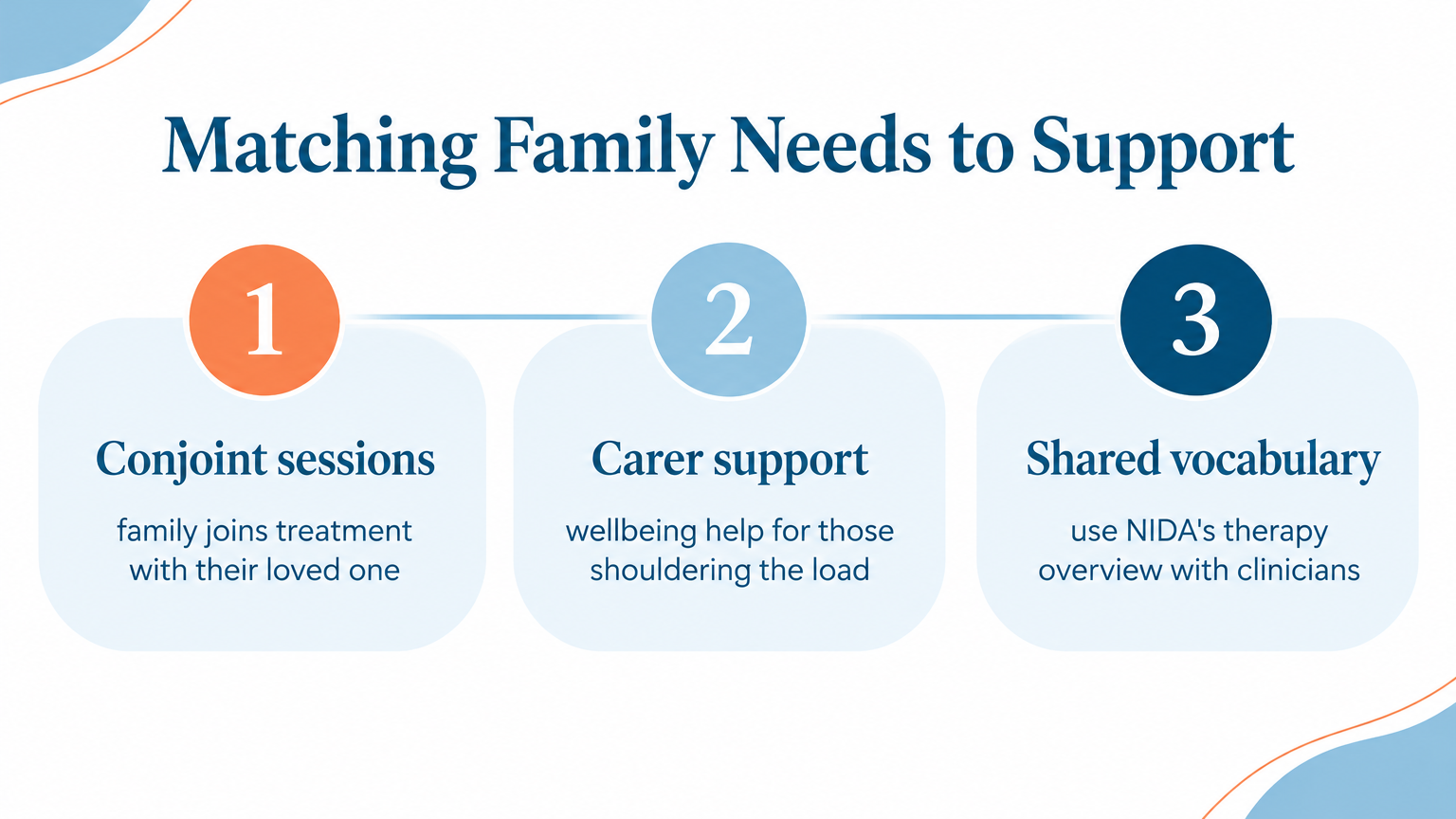
A review of 65 papers from 58 trials found that conjoint behavioral interventions, meaning sessions that include the person in recovery together with family members, improved relationship satisfaction, stability, and overall family functioning 16. Individually focused components, delivered to family members on their own, offered psychological benefit to those carrying the weight 16. NIDA lists family therapy among the behavioral approaches that support recovery from substance use disorders 3. For families, the shift is often from managing someone else's behavior to tending their own.
Peer Support and Recovery Coaching
Peer support is help from someone who has lived through something similar. SAMHSA describes peer workers as people with lived experience who provide recovery-oriented, person-centered, voluntary, relationship-focused, and trauma-informed support 2. They are not therapists, and the distinction matters. A peer specialist walks alongside your loved one, shares practical experience, and helps them stay connected to the next appointment, the next meeting, the next week.
The evidence favors engagement outcomes more than clinical ones. A systematic review of 28 studies covering 12,601 participants found peer recovery support services most reliably improved treatment engagement and retention, while effects on substance use remained preliminary 8. In schizophrenia specifically, a 2024 meta-analysis reported standardized mean differences of 0.29 for recovery and 0.22 for empowerment 6. A qualitative synthesis of certified peer specialists adds helpful context on role identity, supervision, and boundaries that keep this work healthy 20.
Case Management and Care Coordination
The last family is the connective tissue. Case management is the practical, often invisible work of keeping a recovery plan from falling apart between appointments. It covers the referrals, the follow-up calls, the housing question, the prescription that needs refilling, the sibling who needs a conversation, the flight to be arranged, the step-down from residential care that nobody scheduled.
NIDA treats coordinated behavioral support as part of how recovery actually gets delivered rather than an administrative add-on 3. In first-episode psychosis, a 2025 review of 35 studies found that specialized first-episode psychosis programs generally improved continuity of care and reduced hospitalization 18. For a high-performing individual balancing work and privacy, or a family juggling a dozen clinicians across states, this is often the quiet layer that makes everything else possible.
How to Read the Evidence Without Being Misled
Where the Signal Is Strong
Two areas stand out when you look at the research honestly. The first is contingency management for stimulant use disorder, where both the ASAM/AAAP clinical practice guideline and SAMHSA's evidence-based practices guide identify it as the current standard of care 12, 4. The second is trauma-focused psychotherapy for PTSD, where the VA/DoD guideline recommends manualized approaches like CPT, EMDR, and Prolonged Exposure over medication as first-line care 5. These are not soft endorsements. They are the kind of guidance a referring psychiatrist should recognize immediately.
Real-world adoption is catching up to the evidence, slowly. An implementation study of contingency management across the U.S. Veterans Health Administration found that stimulants were the target substance in 86.42% of visits between 2018 and 2022, though the same study noted that only a small minority of veterans with stimulant use disorder received contingency management 15. That figure describes one federal system during a specific window, not national practice, but it tells you where clinicians who use the tool are pointing it.

Where Results Are Mixed
Peer support is the clearest example of an intervention that helps in some ways and not others, depending on what you are measuring. A 2024 umbrella review covering 35 reviews and 426 primary studies found that 97% of the included reviews were rated low or critically low quality 7. That is a sobering number, and it does not mean peer support fails. It means the research base has not caught up to the practice. The same review still pointed to possible improvements in depression symptoms, self-efficacy, and recovery 7.
Cannabis use disorder tells a similar nuanced story. A recent systematic review found that motivational-enhancement plus CBT increased point abstinence compared with inactive or nonspecific comparators, but also noted reduced treatment completion and rated the overall certainty of evidence low to very low 19. One intervention can help the outcome you most want while quietly hurting another one you also care about. When a clinician says the evidence is mixed, this is often what they mean.
Where Psychosocial Care Alone Underperforms
The honest limits show up most clearly in co-occurring conditions. A systematic review and meta-analysis of 35 randomized trials involving roughly 5,176 participants with co-occurring psychosis and substance use disorders reported a pooled effect on substance use of SMD −0.05, with a 95% confidence interval from −0.16 to 0.07 9. The authors concluded that current evidence was not sufficient to recommend psychosocial interventions over alternatives for the major outcomes they examined 9. A 2026 review focused on schizophrenia with co-occurring substance use disorders found a small effect on overall symptoms, SMD −0.11, and no overall difference in substance use 10.
Matching Support to the Moment
Early Ambivalence, Before Anyone Has Said Yes to Help
If your loved one has not agreed to treatment, pressure usually backfires. This is the moment where motivational interviewing earns its keep. SAMHSA lists it among the evidence-based practices to consider early, before more intensive work is possible 4. A skilled clinician or recovery associate can meet with your loved one for coffee, a walk, or a quiet conversation at home, and spend weeks helping them hear their own reasons for change.
Family coaching runs in parallel. You learn how to stop arguing about the problem and start noticing openings. That slower pace is often what turns a closed door into a cracked one.
During Treatment and the Weeks Right After
The weeks after a residential stay are statistically the shakiest. Skills-based work like CBT translates insight into daily practice: how to handle an afternoon craving, a work trip, a difficult call with a parent. For stimulant use specifically, contingency management belongs in this window if it is available, because the ASAM/AAAP guideline identifies it as the standard of care 12.
Peer support fits here too. The systematic review of 28 studies covering 12,601 participants found its strongest signal was keeping people engaged with treatment and attending the next appointment 8. A recovery associate can bridge the gap between structured care and ordinary life, which is often where plans quietly unravel.
Co-Occurring Conditions and Complex Cases
When your loved one lives with both a psychiatric condition and a substance use disorder, no single psychosocial approach is enough. The meta-analysis of 35 trials in co-occurring psychosis and substance use found a pooled effect on substance use of SMD −0.05, essentially no detectable benefit from psychosocial care alone 9. That is not a reason to abandon these approaches. It is a reason to layer them with integrated psychiatric care, medication where indicated, and tight coordination.
For first-episode psychosis, a 2025 review of 35 studies found that specialized first-episode psychosis programs generally improved continuity of care and reduced hospitalization 18. The lesson is practical: ask who is holding the whole picture, not just one piece of it.
When the Family Is Carrying the Weight
Sometimes the person in crisis is not the one who first needs support. Families spend months, sometimes years, absorbing worry, logistics, and sleep debt. A review of 65 papers from 58 trials found that conjoint behavioral work, where family members join sessions together with their loved one, improved relationship satisfaction, stability, and overall family functioning 16. A separate review found overall wellbeing benefits for carers of people with substance use disorders, though the authors noted the evidence base was limited 17.
Mapping the moment to the right support gives you language to use with clinicians. NIDA's overview of behavioral therapies for substance use disorders is a useful shared vocabulary when you sit down to piece a plan together 3.
Discretion as a Clinical Variable, Not an Afterthought
For a high-performing individual or a well-known family, privacy is not a luxury item bolted onto care. It shapes which supports your loved one will actually accept, attend, and tell the truth inside of. A group program that works beautifully for one person can be a non-starter for someone whose photo would end up on a phone before the first break.
SAMHSA's peer-support principles describe help that is voluntary, person-centered, and relationship-focused 2, and those words matter here. Voluntary means the person has to choose to show up again next week. Relationship-focused means trust is the active ingredient. If the setting itself feels exposing, every other evidence-based tool loses some of its edge.
Discreet delivery often means one-to-one sessions at home, a quiet office, or during travel, rather than a scheduled group across town. It means a recovery associate who understands confidentiality the way an attorney or physician does, and a case manager who can coordinate clinicians, flights, and family communication without leaving a paper trail across a dozen inboxes. Treat privacy as part of the clinical plan, not something you negotiate around it.
How Psychosocial Support Gets Coordinated in Real Life
On paper, a recovery plan looks tidy: a therapist on Tuesdays, a psychiatrist once a month, a peer support meeting twice a week, maybe a nutritionist or an outpatient program layered in. In real life, the plan runs through someone's calendar, someone's inbox, and someone's capacity to make a hard phone call at 7 p.m. on a Sunday. That is where psychosocial support either holds together or quietly falls apart.
Case management is the role that keeps the pieces talking to each other. A good case manager tracks what each clinician is working on, flags when a medication refill is about to lapse, calls the airline when a transition flight needs rebooking, and makes sure the therapist and the psychiatrist are not working from different versions of the same story. NIDA frames coordinated behavioral support as part of how recovery actually gets delivered, not an administrative extra 3.
Recovery and wellness associates do the on-the-ground work: a walk after a hard session, a quiet presence during a work trip, a steady voice through the first weekend home. Next Level Wellness & Behavioral Health, founded by Amanda Marino and based in Boca Raton with national and international reach, built its model around this relationship-based coordination, offering case management, recovery associates, and family support that moves with your loved one rather than asking them to fit a program's shape.
Starting the Conversation
If you have read this far, you already know more than most families do when they first pick up the phone. You can tell a motivational interviewing session from a contingency management plan, and you can ask a clinician which outcomes they are actually tracking. That vocabulary is not a small thing. It changes the quality of every conversation that follows.
What you cannot do from a web page is figure out which combination fits your loved one, this week, with the privacy their life requires. That part is a conversation. If you want to talk through what coordinated, discreet support could look like, Next Level is a confidential call away, for families and for the attorneys, psychiatrists, and advisors who refer them. Creating Lasting Change tends to start with one honest hour.
Frequently Asked Questions
Are psychosocial interventions the same as therapy?
Not exactly. Therapy is one kind of psychosocial intervention. The broader category also includes contingency management, peer support, family coaching, psychoeducation, and the case-management work that keeps a plan running 3. Think of therapy as one room inside a larger house. Your loved one may need one room, several, or a different combination at different points in recovery.
Can psychosocial interventions work without medication?
For some conditions, yes. The VA/DoD guideline recommends trauma-focused psychotherapies like CPT, EMDR, and Prolonged Exposure over medication as first-line PTSD care 5. For opioid use disorder, NIDA emphasizes that behavioral therapies enhance medication effectiveness rather than replace it 3. The honest answer depends on the diagnosis, severity, and what a prescribing clinician determines after a careful assessment.
Which psychosocial intervention has the strongest evidence?
For stimulant use disorder, contingency management has the clearest signal. The ASAM/AAAP guideline names it the current standard of care 12, and a 2024 meta-analysis using formal evidence criteria issued a strong recommendation in its favor 14. For PTSD, trauma-focused psychotherapies hold that status 5. Strongest evidence is condition-specific, not a single universal winner across every diagnosis or situation.
How do psychosocial interventions help families, not just the person in recovery?
Families carry real weight, and the research treats that as a clinical reality. A review of carers of people with substance use disorders found overall wellbeing benefits from psychosocial interventions designed for them, though the evidence base was limited 17. Conjoint behavioral work that includes family members alongside their loved one improved relationship satisfaction, stability, and family functioning 16. Support goes both directions.
Can someone access psychosocial support without entering a treatment program?
Yes. Many psychosocial supports work well outside residential or outpatient programs. Motivational interviewing, CBT, family coaching, peer support, and case management can be delivered privately, at home, or during travel. SAMHSA frames peer support as voluntary and relationship-focused 2, which fits readers who need discretion. For a high-performing individual, this often means one-to-one work rather than group settings across town.
How do you choose the right psychosocial intervention for a specific situation?
Start with what the moment calls for. Early ambivalence usually responds to motivational interviewing 4. Post-treatment weeks benefit from CBT skills and peer support, which most reliably improves engagement and retention 8. Co-occurring conditions need integrated care, not talk therapy alone 9. A good clinician or case manager will match tools to the situation rather than offering one default approach.
References
- SAMHSA's Working Definition of Recovery. https://library.samhsa.gov/sites/default/files/pep12-recdef.pdf
- Core Competencies for Peer Workers: Behavioral Health. https://www.samhsa.gov/substance-use/recovery/peer-support-workers/core-competencies
- Treatment and Recovery - Drugs, Brains, and Behavior: The Science of Addiction Treatment and Recovery. https://nida.nih.gov/publications/drugs-brains-behavior-science-addiction/treatment-recovery
- Treatment of Stimulant Use Disorders. https://library.samhsa.gov/sites/default/files/pep20-06-01-001.pdf
- VA/DoD Clinical Practice Guideline for Management of Posttraumatic Stress Disorder and Acute Stress Disorder: Provider Summary. https://www.healthquality.va.gov/HEALTHQUALITY/guidelines/MH/ptsd/VA-DoD-CPG-PTSD-Provider-Summary.pdf
- The effectiveness of peer support on the recovery and empowerment of people with schizophrenia: A systematic review and meta-analysis. https://pubmed.ncbi.nlm.nih.gov/39423701/
- The effectiveness, implementation, and experiences of peer support approaches for mental health: a systematic umbrella review. https://pubmed.ncbi.nlm.nih.gov/38418998/
- Peer Recovery Support Services and Recovery Coaching for Substance Use Disorder: A Systematic Review. https://pubmed.ncbi.nlm.nih.gov/41551498/
- Psychosocial Interventions for Individuals With Comorbid Psychosis and Substance Use Disorders: Systematic Review and Meta-analysis of Randomized Studies. https://pubmed.ncbi.nlm.nih.gov/38938221/
- Psychological and Psychosocial Interventions for People With Schizophrenia and Co-Occurring Substance Use Disorders: A Systematic Review and Meta-Analysis. https://pubmed.ncbi.nlm.nih.gov/41637064/
- Psychosocial interventions for stimulant use disorder. https://pubmed.ncbi.nlm.nih.gov/38357958/
- The ASAM/AAAP Clinical Practice Guideline on the Management of Stimulant Use Disorder. https://pubmed.ncbi.nlm.nih.gov/38669101/
- Contingency Management for the Treatment of Substance Use Disorders: Enhancing Access, Quality, and Program Integrity for an Evidence-Based Intervention. https://pubmed.ncbi.nlm.nih.gov/39250570/
- Contingency Management for Drug Use Disorders: Meta-Analysis and Application of Tolin's Criteria. https://pubmed.ncbi.nlm.nih.gov/38863566/
- Contingency management for substance use disorders in the U.S. Veterans Health Administration: 2018-2022. https://pubmed.ncbi.nlm.nih.gov/38735480/
- Psychosocial Interventions to Improve Psychological, Social and Physical Wellbeing in Family Members Affected by an Adult Relative's Substance Use: A Systematic Search and Review of the Evidence. https://pubmed.ncbi.nlm.nih.gov/33673199/
- Psychosocial interventions for carers of people with severe mental and substance use disorders: a systematic review and meta-analysis. https://pubmed.ncbi.nlm.nih.gov/37997647/
- Optimizing recovery in first-episode psychosis: A systematic review of psychosocial interventions. https://pubmed.ncbi.nlm.nih.gov/39733592/
- Effectiveness and safety of psychosocial interventions for the treatment of cannabis use disorder: A systematic review and meta-analysis. https://pubmed.ncbi.nlm.nih.gov/40318070/
- Experiences of Certified Peer Support Specialist Providing Formal Peer Support in Mental Health Services: A Systematic Review and Meta-Synthesis. https://pubmed.ncbi.nlm.nih.gov/39252191/
Insight Beyond Treatment
At Next Level Wellness & Behavioral Health, we believe meaningful change starts with perspective, not just protocols.
That philosophy is directly led by Amanda Marino, whose voice in behavioral health extends beyond clinical settings into leadership, culture, and personal growth.
Through keynote speaking and live events, Amanda explores the deeper themes that show up in recovery, family systems, and life transitions: authenticity, resilience, accountability, and the courage to change. Her work invites audiences to move past labels and into honest conversations that create lasting impact.
A Voice Shaping the Conversation
The topics explored here—change, self-awareness, recovery, and growth—are the same themes Amanda Marino brings to audiences nationwide through speaking engagements and live events.
Known for her appearances on A&E’s Intervention and Digital Addiction, Amanda speaks to organizations, communities, and leadership teams about navigating adversity, embracing vulnerability, and building lives rooted in purpose. Her message resonates far beyond treatment, offering insight that applies to families, professionals, and anyone standing at a crossroads.


Heal on your terms—any time, anywhere.