

What Is the Science Behind Addiction? A Clear Guide

Key Takeaways
- Addiction is a treatable medical condition in which repeated substance exposure reshapes the brain's reward, stress, and self-control circuits, not a character flaw or willpower failure 1, 3.
- A three-stage cycle organizes the neuroscience: reward learning in the basal ganglia, stress and negative affect in the extended amygdala, and weakened prefrontal control over cravings 4.
- Four forces shape vulnerability—genes (heritability near 50%), developmental timing, environment, and lived experience including trauma and co-occurring mental health conditions 6, 11.
- Sustained remission may take up to eight years and multiple treatment or support engagements, so coordinated medication, behavioral care, and ongoing human support matter more than any single episode 20.
Why the Explanation You Believe Changes the Help You Accept
If you're reading this at 2 a.m. after another hard conversation, you're not alone. In 2024, 48.4 million people in the United States aged 12 or older—16.8% of the population—met criteria for a past-year substance use disorder 12. Behind each of those numbers is someone searching for an explanation that finally fits.
Here's the quiet problem: the story you tell yourself about why this is happening shapes the help you'll accept. If you believe addiction is a character flaw, you'll keep looking for more willpower. If you believe it's purely genetic fate, you'll stop looking at all. Neither story is accurate, and neither points anywhere useful.
The science points somewhere better. Addiction is a treatable medical condition in which repeated substance exposure reshapes the brain's reward, stress, and self-control circuits, interacting with genes, development, environment, and lived experience 1, 3. That mental model does something the shame story can't. It replaces blame with a map—one that shows where change is actually possible, and what kind of support tends to work.

What Addiction Actually Is, in Plain Terms
A Working Definition That Replaces Willpower-and-Shame
Addiction is a treatable medical condition in which someone keeps using a substance despite real harm, because repeated exposure has changed how the brain's reward, motivation, learning, and self-control systems work 1. That's the whole definition in one sentence. It isn't a verdict on anyone's character, and it isn't the absence of love for the people watching.
Two things to hold onto. First, the behavior is compulsive, not casual—the person is pulled toward use by circuits that have learned the substance too well, not by a lack of caring 2. Second, it's a spectrum. A substance use disorder can be mild, moderate, or severe, and the picture can shift over time rather than sitting in a single fixed category 18. If the explanation you've been using is some version of "they could stop if they really wanted to," the science asks you to swap it for something more accurate and, honestly, more useful.
How Common It Is, and Who Lives With It
Substance use disorders show up across every income bracket, profession, and ZIP code—including the quiet, high-functioning households that look fine from the outside. The 2024 National Survey on Drug Use and Health gives the clearest picture of who is actually living with this in the U.S. right now, and the breakdown is worth sitting with for a moment.
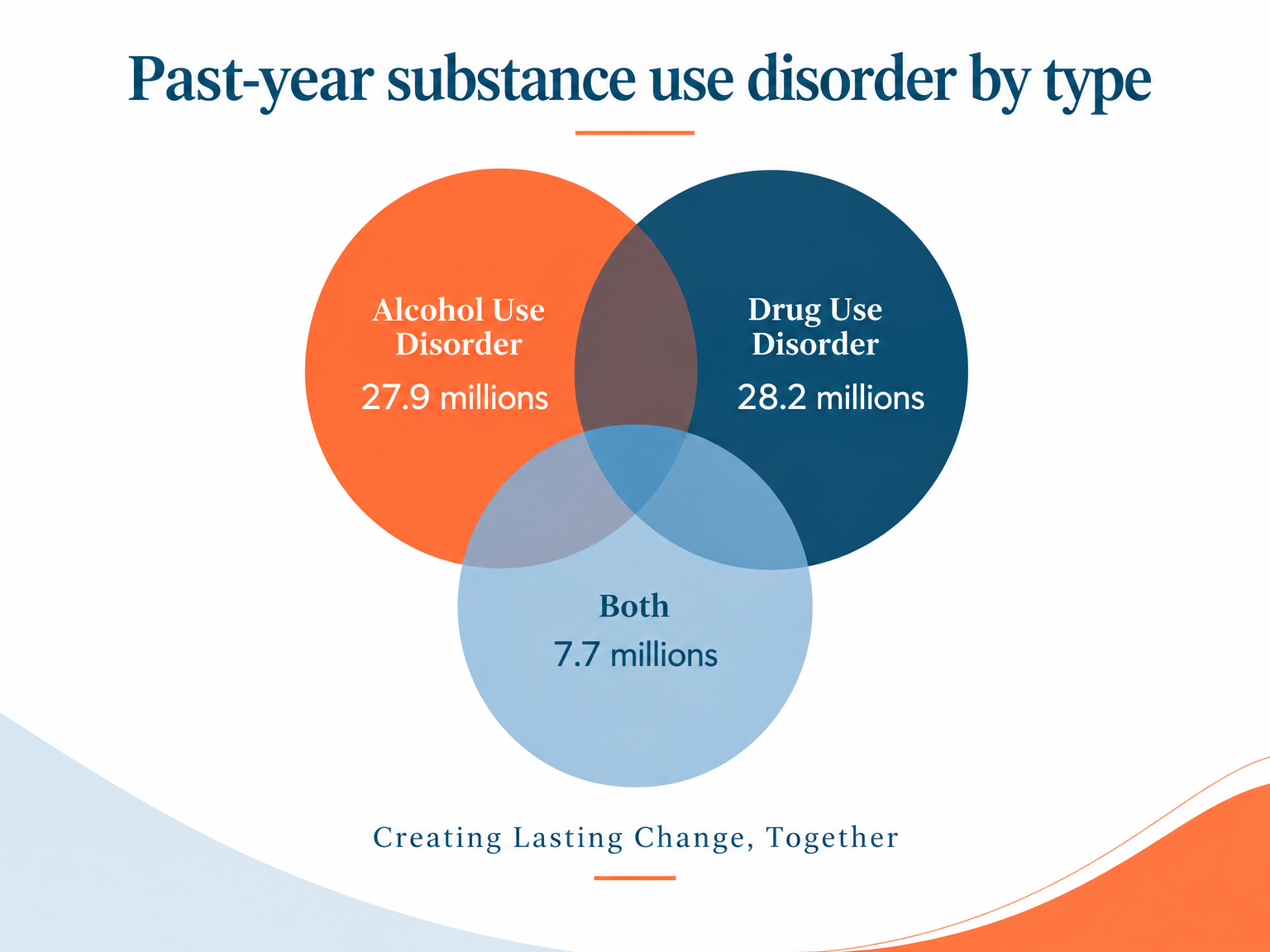
Among people aged 12 or older in 2024, an estimated 27.9 million had an alcohol use disorder, 28.2 million had a drug use disorder, and 7.7 million had both at the same time 12. The overlap matters. Families often assume alcohol problems and drug problems live in separate rooms—different causes, different kinds of people, different conversations. The data says otherwise. A substantial share of people meeting criteria for one are also meeting criteria for the other, which is one reason a careful assessment matters more than a single label.
If you recognize someone you love in those numbers, you're seeing the shape of a public-health reality, not a private failing.
The Three-Stage Cycle That Organizes the Neuroscience
Binge and Intoxication: The Reward Circuit Learns Too Well
The first stage of the cycle is the one everyone recognizes, even if they'd never call it a stage. A substance enters the system, and the brain's reward circuitry—centered in the basal ganglia—lights up with a surge of dopamine signaling 4. That signal doesn't just register pleasure. It tells the brain, in effect, remember exactly what just happened and how to find it again.
This is where the learning becomes a problem. Natural rewards like food, connection, or accomplishment release dopamine too, but the quantities and timing involved with addictive substances are far outside what the brain evolved to handle 2. Over repeated exposures, the reward circuit becomes increasingly sensitive to cues tied to the substance—a specific bar, a certain phone contact, the end of a workday—while becoming less responsive to the smaller, slower rewards of ordinary life 1.
Think of it as the volume knob the brain keeps turning down. The person isn't chasing a bigger high so much as trying to hear the music at all. That's not weakness. That's a reward system doing exactly what reward systems do, applied to an input it was never built for.
Withdrawal and Negative Affect: Why Cravings Peak When Things Feel Worst
The second stage is the one families most often misread. When the substance wears off, the brain doesn't simply return to baseline. The stress and emotional circuitry—anchored in the extended amygdala—shifts into a negative state marked by anxiety, irritability, low mood, and a felt sense that something is wrong 4. Sleep gets worse. Small frustrations feel enormous. The world dims.
If you've watched someone relapse right after what looked like a stable stretch, this is often what you were seeing. Not a lack of commitment. A stress circuit that got louder while the self-control circuitry was already running on empty. The behavior makes sense once you can see what the brain is actually doing.
Preoccupation and Craving: The Prefrontal Cortex Loses Its Grip
The third stage is where decisions get made—and where they get hijacked. The prefrontal cortex is the brain region responsible for planning, weighing consequences, and overriding impulses. With repeated substance exposure, communication between the prefrontal cortex and the reward and stress circuits below it becomes disrupted, which weakens the top-down control that would normally say not today 3, 4.
What this looks like from the outside is preoccupation. Mental bandwidth narrows around the substance: when, where, how, with whom. Cues trigger intense craving that can override stated intentions, sometimes within minutes. The person may genuinely want to stop and still find themselves acting against that wish. The disconnect isn't a lie. It's a circuit problem, and it's a core reason the three stages—binge/intoxication in the basal ganglia, withdrawal/negative affect in the extended amygdala, and preoccupation/craving in the prefrontal cortex—feed each other in a loop that's harder to interrupt the longer it runs 4.
Seeing the whole cycle at once changes what helpful support looks like. You stop trying to argue someone out of a craving and start thinking about how to steady the environment, the stress load, and the hours when the loop closes tightest.

Four Forces, Not One: Genes, Development, Environment, Experience
What Family History Really Means (and What It Doesn't)
If addiction shows up on your family tree, you've probably wondered whether the branch bends toward you too. The honest answer from the research is: family history matters, and it isn't destiny. Twin studies place the heritability of substance use disorders roughly between 30% and 80%, with a consensus estimate near 50% 6. In plain language, about half of the variation in who develops a substance use disorder across a population tracks with genetic differences. The other half doesn't.
Two things get lost when that number travels through a dinner-table conversation. First, heritability is a population statistic, not a personal forecast. It describes how much of the differences between people are linked to genes, not whether any one person will or won't develop a problem 6. Second, the genetics are polygenic—many small-effect variants spread across many genes, with substantial overlap in liability across alcohol, nicotine, cannabis, and other substances. There is no single "addiction gene," and current genetic findings are not clinical prediction tools 7.
What family history earns you is useful information, not a verdict. Knowing your risk is higher is a reason to be thoughtful about exposure, not a sentence.
Adolescence, Early Exposure, and Pre-existing Vulnerability
Adolescence is a window, not a flaw. The brain is still wiring the prefrontal control circuits that will eventually help weigh consequences, while the reward and social-emotional systems are already running at adult volume. That mismatch is why risk-taking peaks in these years, and why early alcohol or other substance use is associated with greater likelihood of later substance use and of developing a substance use disorder 8.
A 2024 analysis from the Adolescent Brain Cognitive Development study added a careful twist to that story. In nearly 10,000 adolescents, researchers identified five global brain-structure differences between those who reported substance initiation before age 15 and those who did not—and some of those differences were present before use began 9. That reframes a conversation families often have in blame: what can look like "bad choices" may be pre-existing vulnerability meeting exposure at a developmentally sensitive moment.
Two cautions sit alongside that finding. Brain structure cannot predict any individual adolescent's path, and association is not causation 9. What it does support is a steadier posture at home: delaying first exposure, taking a parent's or sibling's substance use history seriously, and treating early experimentation as a signal worth responding to rather than a phase to wait out.
Trauma, Stress, and Co-occurring Mental Health Conditions
Behind many substance use disorders is a second condition that nobody named. Depression. Anxiety. PTSD. ADHD. The symptoms blur into each other, and the substance often started as the most available tool for turning the volume down. NIDA notes that children and adolescents who experience trauma may be particularly susceptible to developing a substance use disorder later in life, and that treating PTSD alongside a substance use disorder can improve PTSD symptoms more than treating the substance use disorder alone in some research 11.
This is why a careful assessment matters more than a quick label. NIMH describes integrated care—combining mental-health and substance-use treatment, with components that can include cognitive behavioral therapy, contingency management, motivational interviewing, family interventions, medications, and care management—as the standard worth asking for when both conditions are present 10. Fragmented care, where one clinician treats the drinking and another treats the depression and neither talks to the other, is a common reason progress stalls.
If any of this sounds like your loved one—or like you—it isn't a second problem on top of the first. It's often the quieter half of what's actually going on, and it deserves to be in the room during any conversation about help.
What the Science Supports in Treatment
Medications, Behavioral Work, and Integrated Care
If the brain's reward, stress, and self-control circuits are what change, then helpful treatment has to work on all three. In practice, that usually means some combination of medication, behavioral therapy, and coordinated care for anything else going on at the same time—not any single piece in isolation.
For opioid use disorder, the FDA has approved three medications: buprenorphine, methadone, and naltrexone, all with demonstrated safety and effectiveness when used under qualified medical care 15. For alcohol use disorder, NIAAA identifies naltrexone, acamprosate, and disulfiram as FDA-approved options 18. The VA/DoD clinical practice guideline, which organizes 35 evidence-based recommendations across screening, pharmacotherapy, withdrawal, and co-occurring conditions, recommends buprenorphine/naloxone or methadone strategies for opioid use disorder and identifies medication options for alcohol use disorder as part of a broader care plan 16. These are medical decisions, not lifestyle ones, and they belong in a conversation with a qualified prescriber.
Behavioral work does the other half. NIMH describes integrated care—treating substance use and mental-health conditions together rather than in separate silos—as the standard worth asking for, with components that can include cognitive behavioral therapy, contingency management, motivational interviewing, family interventions, and care management 10. When those pieces are coordinated instead of scattered across unrelated providers, more of what the science actually supports tends to reach the person in front of you.
Alcohol Use Disorder and the Brain's Capacity to Recover
Alcohol deserves its own paragraph because the story families are told about it is often the most outdated. NIAAA defines alcohol use disorder as a medical condition involving impaired control over drinking despite social, occupational, or health consequences, on a spectrum from mild to moderate to severe 18. It isn't a binary, and it isn't a character description.
Repeated heavy exposure can produce progressive changes in brain structure and function that compromise how the brain works and help drive the transition from controlled use to a disorder 17. The part that often surprises people: some of those changes may improve, and possibly reverse, after months without drinking 17. Brain recovery doesn't automatically mean recovery from every relational or functional consequence, and the pace varies by person. But the organ most involved in this condition is also one of the most capable of adapting back. That's a reason to treat early engagement with care as worth the discomfort it costs.
Recovery on a Realistic Timeline
Why Sustained Remission Often Takes Years and Multiple Engagements
What that means in practice: a first treatment episode is often a beginning, not a verdict. Recurrence of use during that window isn't evidence that treatment failed or that your loved one didn't mean it. It's part of a longer trajectory the research now documents, with evidence of structural and functional brain recovery in several regions among people who stay engaged over time 20. The circuits that reshaped under exposure can, with sustained care, reshape again.
So when the second or third conversation about help feels discouraging, consider what the science says instead: you may be further along than it feels.
The Role of Sustained Human Support After Acute Care
Acute care ends. The cues, stress, and ordinary Tuesdays don't. That's the gap sustained human support is designed to fill, and it's where a lot of recoveries quietly succeed or quietly stall.
SAMHSA describes peer support—people with lived recovery experience who help others engage in and sustain recovery—as a way to extend care beyond the clinical setting through shared understanding, practical assistance, navigation, and encouragement, and notes it can help reduce the likelihood of recurrence 19. The mechanism is less mysterious than it sounds. Someone steady is present in the hours when the three-stage loop closes tightest: late evenings, travel days, the week after a stressful work event, the first holiday back home.
This is also where concierge, relationship-based support—often called a sober companion in search terms, more accurately a recovery or wellness associate—fits for people who need discretion and flexibility alongside clinical care. It isn't a substitute for medical treatment or licensed therapy. It's the human continuity that makes the rest of the plan reachable on an ordinary day.
Using the Model in Daily Life
The three-stage cycle isn't just a textbook diagram. It's a tool you can use on an ordinary Wednesday. Once you can see where in the loop your loved one—or you—tends to get caught, the daily choices stop feeling like a referendum on character and start looking like decisions about environment, stress, and timing.
A few practical translations:
- Cues matter more than most people realize, because the reward circuit learned them specifically; changing the route home, the phone contacts visible on a screen, or who's in the kitchen on a hard evening isn't avoidance, it's circuit-aware planning 1.
- Stress load matters because withdrawal-stage circuitry gets louder when sleep, nutrition, and connection thin out—so protecting those basics is clinical, not optional 3.
- Self-control isn't a tank you refill with effort; it's a function of a prefrontal cortex that works better when it isn't being asked to override a flooded stress system alone 4.
When something slips, use the model instead of the shame story. Ask what stage was active, what cue preceded it, what else was depleted. That question has somewhere to go. The other one doesn't.
Starting a Confidential Conversation
If any of this has helped the picture come into focus, the next step is smaller than it probably feels. You don't need a diagnosis, a plan, or the right words to begin. You need one honest conversation with someone who understands both the science and the lived reality of what you're navigating.
Next Level Wellness & Behavioral Health is a concierge behavioral health firm founded by Amanda Marino, built around a relationship-based rather than program-based approach. From Boca Raton and working with clients nationally and internationally, Next Level offers discreet case management, recovery and wellness associates, intervention support, and family coaching that fits before, during, after, or in place of treatment. If you're a family member trying to make sense of what's happening, a professional quietly thinking about your own use, or a referring attorney, clinician, or advisor, a confidential call is a reasonable place to start. Creating Lasting Change begins with that conversation.
If you or someone you love is in immediate danger, call or text 988 for the Suicide & Crisis Lifeline, or call 911.
Frequently Asked Questions
Is addiction a disease or a choice?
It's a treatable medical condition, not a character flaw or a simple choice. Repeated substance exposure changes how the brain's reward, motivation, learning, and self-control circuits work, which is why continued use becomes compulsive rather than casual 1, 3. People retain some agency, and biology, environment, development, and lived experience all shape vulnerability 5.
If addiction runs in my family, will I or my loved one develop it too?
Not necessarily. Twin studies place heritability of substance use disorders roughly between 30% and 80%, with a consensus near 50%, and risk is polygenic rather than tied to any single gene 6. That number describes variation across populations, not individual destiny, and current genetics aren't a clinical prediction tool 7. Family history is useful information about risk, not a verdict.
Why can't someone with a substance use disorder just stop using?
Because the circuits that drive the behavior have been reshaped by repeated exposure. The reward system becomes highly reactive to cues, the stress system turns up the volume on discomfort between episodes, and prefrontal control over impulses weakens 3, 4. Wanting to stop and finding yourself unable to isn't dishonesty. It's a circuit problem that typically needs medical, behavioral, and sustained human support.
Can the brain actually recover from addiction?
Yes, within limits. NIAAA notes that some alcohol-related changes in brain structure and function may improve, and possibly reverse, after months without drinking 17. NIDA similarly describes evidence of structural and functional recovery in several brain regions among people who stay engaged in care over time 20. Pace and extent vary by person, substance, and length of use, so recovery is realistic without being guaranteed.
Why does relapse happen even after treatment, and does it mean treatment failed?
Recurrence is common because stress, cues, and depleted self-control circuitry keep pulling toward the substance long after acute care ends 3, 4. NIDA reports that sustained remission may take as many as eight years and four to five treatment or mutual-support engagements after initial remission 20. A return to use isn't proof that treatment failed. It's often part of a longer trajectory worth staying engaged with.
How do mental health conditions and trauma fit into the science of addiction?
They often sit underneath it. NIDA notes that children and adolescents who experience trauma may be particularly susceptible to developing a substance use disorder later in life, and that treating PTSD alongside substance use can improve PTSD symptoms more than treating the substance use alone in some research 11. NIMH describes integrated care, which treats both conditions together, as the standard worth asking for 10.
References
- Drugs, Brains, and Behavior: The Science of Addiction. https://nida.nih.gov/sites/default/files/soa_0.pdf
- Drugs, Brains, and Behavior: The Science of Addiction. https://nida.nih.gov/publications/drugs-brains-behavior-science-addiction/drugs-brain
- Neurobiologic Advances from the Brain Disease Model of Addiction. https://pubmed.ncbi.nlm.nih.gov/26816013/
- Neurobiology of addiction: a neurocircuitry analysis. https://pubmed.ncbi.nlm.nih.gov/27475769/
- Beyond the brain circuit: a biopsychosocial integrative framework of addiction and neuromodulation-based treatment approaches. https://pmc.ncbi.nlm.nih.gov/articles/PMC13587339/
- Generalized genetic liability to substance use disorders. https://pmc.ncbi.nlm.nih.gov/articles/PMC11142744/
- Genetics of substance use disorders: a review. https://pmc.ncbi.nlm.nih.gov/articles/PMC8477224/
- The Adolescent Brain and Substance Use. https://nida.nih.gov/research-topics/adolescent-brain-substance-use
- Brain structure differences are associated with early use of substances among adolescents. https://nida.nih.gov/news-events/news-releases/2024/12/brain-structure-differences-are-associated-with-early-use-of-substances-among-adolescents
- Finding Help for Co-Occurring Substance Use and Mental Disorders. https://www.nimh.nih.gov/health/topics/substance-use-and-mental-health
- Trauma and Stress. https://nida.nih.gov/research-topics/trauma-and-stress
- Key Substance Use and Mental Health Indicators in the United States: Results from the 2024 National Survey on Drug Use and Health. https://www.samhsa.gov/data/sites/default/files/reports/rpt56287/2024-nsduh-annual-national-report.pdf
- 2024 NSDUH: Substance Use Treatment Among People Who Had a Substance Use Disorder in the Past Year. https://www.samhsa.gov/data/report/nsduh-2024-past-yr-substance-use-trt-among-sud
- Drug Overdose Deaths in the United States, 2023–2024. https://www.cdc.gov/nchs/products/databriefs/db549.htm
- Information about Medications for Opioid Use Disorder (MOUD). https://www.fda.gov/drugs/food-and-drug-administration-overdose-prevention-framework/information-about-medications-opioid-use-disorder-moud
- VA/DoD Clinical Practice Guideline for the Management of Substance Use Disorders: Provider Summary. https://healthquality.va.gov/guidelines/MH/sud/VADoDSUDCPGProviderSummary.pdf
- Alcohol and the Brain: An Overview. https://www.niaaa.nih.gov/publications/alcohol-and-brain-overview
- Understanding Alcohol Use Disorder. https://www.niaaa.nih.gov/publications/brochures-and-fact-sheets/understanding-alcohol-use-disorder?bid=bid_bc16e1cb726c9b7936910f2943dcd0c1
- Peer Support Workers for Those in Recovery. https://www.samhsa.gov/substance-use/recovery/peer-support-workers
- Advancing recovery research. https://nida.nih.gov/about-nida/noras-blog/2025/06/advancing-recovery-research
Insight Beyond Treatment
At Next Level Wellness & Behavioral Health, we believe meaningful change starts with perspective, not just protocols.
That philosophy is directly led by Amanda Marino, whose voice in behavioral health extends beyond clinical settings into leadership, culture, and personal growth.
Through keynote speaking and live events, Amanda explores the deeper themes that show up in recovery, family systems, and life transitions: authenticity, resilience, accountability, and the courage to change. Her work invites audiences to move past labels and into honest conversations that create lasting impact.
A Voice Shaping the Conversation
The topics explored here—change, self-awareness, recovery, and growth—are the same themes Amanda Marino brings to audiences nationwide through speaking engagements and live events.
Known for her appearances on A&E’s Intervention and Digital Addiction, Amanda speaks to organizations, communities, and leadership teams about navigating adversity, embracing vulnerability, and building lives rooted in purpose. Her message resonates far beyond treatment, offering insight that applies to families, professionals, and anyone standing at a crossroads.


Heal on your terms—any time, anywhere.