.svg)

Finding Discreet Case Management in Boca Raton, FL

Key Takeaways
- Discreet case management in Boca Raton coordinates therapists, prescribers, and family communication around a demanding calendar, keeping care connected while you continue running a practice, firm, or household.
- Palm Beach County's 2024 behavioral health plan and Florida statute 394.4573 set expectations for neutral coordination and certified case managers, giving you a credentialing baseline to measure any concierge provider against.1,10
- Evidence shows case management reliably improves treatment adherence and daily functioning, but the clinical work itself is what shifts substance use, so both roles need to be staffed and communicating.3
- Before hiring, compare scheduling cadence, named contacts, written care plans, credential mix across the team, family authorization protocols, and billing structure, whether retainer, hourly, or bundled.
When Your Calendar Can't Pause for Recovery
You're reading this between meetings, or after the kids are asleep, or in the twenty quiet minutes before a deposition. That's the first thing worth naming. You are not shopping for recovery in a leisurely way. You are trying to fit a very personal decision into a life that still expects you to show up on Monday.
That reality is exactly why discreet case management exists as a category worth understanding on its own terms. It is not a lighter version of clinical treatment. It is the person, or the small team, who keeps every moving part of your care talking to every other part while you keep running your practice, your firm, your team, or your household.
Palm Beach County's own 2024 behavioral health plan describes the goal as a person-centered system with neutral care coordination that eases transitions and removes barriers between providers. That is the public-sector language. Translated into your Tuesday: someone senior, credentialed, and quiet is holding the map so you don't have to.1
This guide walks through what case management actually includes, what the research honestly supports, how Florida regulates it, and how a concierge version differs from what you'd get inside a standard system. You deserve a clear read, not a sales pitch. Let's get into it.
What Case Management Actually Does (and What It Doesn't)
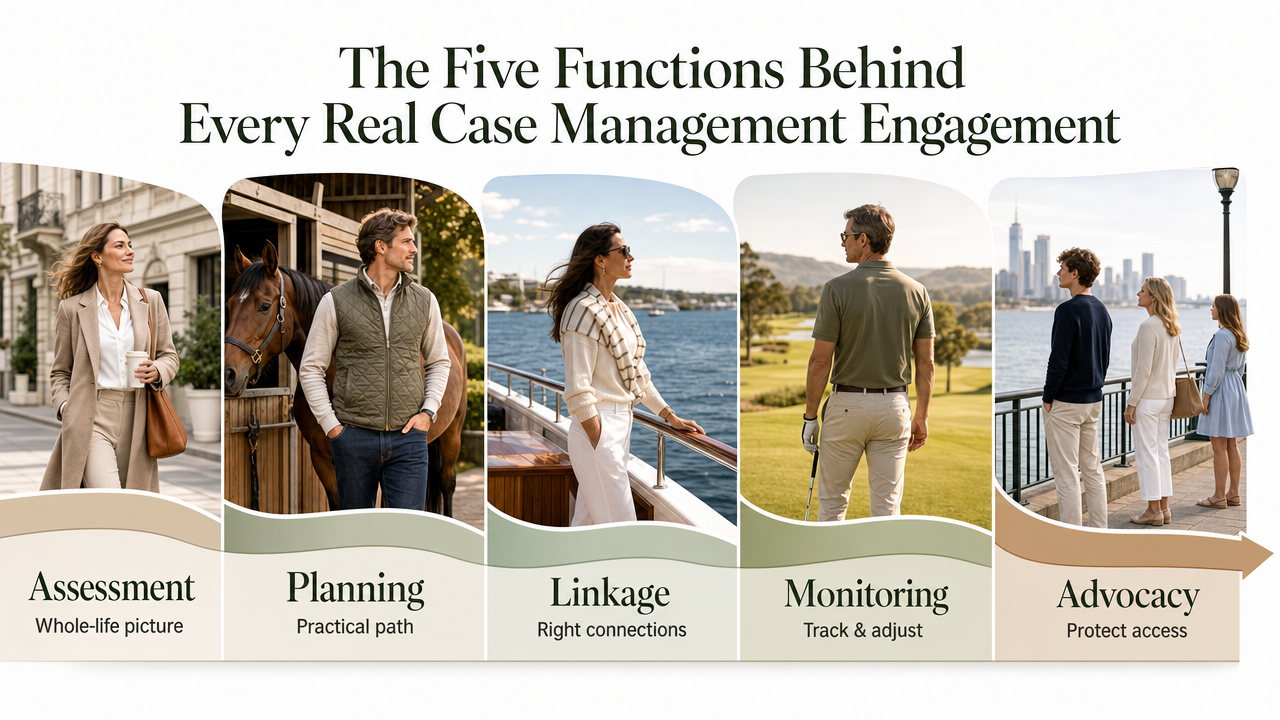
The Five Functions Behind Every Real Case Management Engagement
Strip away the marketing language and case management is a defined set of social service functions built to help someone access what they need to recover. SAMHSA's Treatment Improvement Protocol lays it out in five parts: assessment, planning, linkage, monitoring, and advocacy. Every legitimate engagement, whether it happens inside a public agency or through a private concierge team, runs on those same five gears. What changes is the setting, the pace, and the level of privacy around them.5
Here is what each function looks like translated into your actual life:
- Assessment — Not a clipboard intake. A real conversation about your health, your work obligations, your family dynamics, your legal exposure if any, and what you are unwilling to disrupt. This becomes the working picture your case manager holds.
- Planning — A written care plan that names goals in your language, not diagnostic codes. It includes clinical treatment, medical care, family communication, and the operational scaffolding around your calendar.
- Linkage — The introductions and warm handoffs to therapists, psychiatrists, medical specialists, attorneys, and any recovery support you use. Your case manager makes the calls so you don't have to explain your situation seven times.
- Monitoring — Regular check-ins, appointment tracking, medication oversight where appropriate, and early warning when something is drifting. This is where most self-directed plans quietly fall apart.
- Advocacy — Speaking on your behalf with providers, insurers, or family members when you have authorized it. A good case manager will push back on a treatment plan that ignores your work reality.
Those five gears are the operational spine. If a provider cannot walk you through how each one shows up in their week, they are selling something else.
Where It Belongs Next to Clinical Treatment
Case management is not therapy. Your case manager is not your psychiatrist, your primary care doctor, or your therapist. They also don't replace any of them. What they do is make sure those people are actually working from the same page about you, and that the plan those clinicians build is one you can follow while you're still leading a team or a family.
Think of it this way. Clinical treatment does the direct work on substance use, mental health, or co-occurring conditions. Case management handles the surrounding needs that quietly determine whether treatment holds — the housing questions, the employment pressures, the medical appointments, the family communication. SAMHSA's own comprehensive guidance frames case management as the piece that helps people stay in treatment specifically because it clears the co-occurring obstacles that pull attention away from recovery.4
For a professional with a heavy calendar, that distinction matters. The therapist you meet with on Thursday afternoon cannot also confirm your psychiatrist got the updated lab results, coordinate with your family attorney, and make sure your Monday morning is protected. That's the case manager's lane. When both roles are staffed and communicating, you get something closer to actual continuity. When either is missing, you get gaps, and gaps are where relapse and burnout live.
Realistic Outcomes: What the Research Supports
You are not looking for hype, so this section will not deliver any. Here is what the evidence actually says about what case management does and does not reliably change.
The clearest picture comes from a systematic review of randomized controlled trials of case management for adults with substance use disorders, published between 1996 and 2016. Across those studies, treatment adherence mostly improved. Overall functioning — the umbrella term for how someone is doing across work, family, health, and daily life — improved in roughly half of the studies. Substance use itself decreased in about a third of the studies as a stand-alone effect of case management.3
Read that carefully, because it is the most honest sentence in this whole guide. Case management is very good at helping you stay in the treatment that is doing the direct clinical work, and it is meaningfully associated with better day-to-day functioning. It is not, by itself, the thing that ends substance use. That job belongs to the clinical treatment your case manager is helping you actually attend and complete.
A separate peer-reviewed review points in the same direction, finding that case management may improve linkage to care and reduce acute service use, such as emergency visits, though the size of the effect depends on the model and how well it is matched to the person. Translation: whether this works for you depends heavily on the quality of the relationship and how the service is designed around your life.9
One more finding is worth naming carefully. A review of intensive case management for people experiencing homelessness with substance use disorders found reduced substance use in six of ten trials. That is a promising signal for intensive models, but the studied population is not you. Do not let a provider use that number to promise you outcomes it was never designed to measure.6
What this means for how you plan: expect case management to keep your treatment on the rails, protect your ability to function through the process, and catch problems early. Expect the clinical work — therapy, medical care, medication where appropriate — to be what actually shifts substance use itself. When both are staffed well and talking to each other, you have a real shot at durable change.
How Boca Raton and Palm Beach County Frame This Work
The Local Regulatory Floor
Before you pick a provider, it helps to know what the state actually expects behind the scenes. Florida Statute 394.4573 sets the ground rules for the coordinated system of care in behavioral health. It defines case management as direct services that assess needs, plan services, coordinate providers, link systems, monitor delivery, and evaluate outcomes — and it requires that case managers providing Medicaid-funded targeted case management hold valid certification from an approved credentialing entity.4
On the Medicaid side, Fla. Admin. Code R. 59G-4.199 layers on more structure, requiring providers of mental health targeted case management to follow the state's Coverage and Limitations Handbook and Provider Reimbursement Handbook. That is the standardized track. It exists for good reason, and for many people it works.11
A separate piece of the picture, CS/CS/SB 12, defines how case management shows up in treatment-based mental health court programs — service referral, coordination, monitoring, and tracking — and reinforces certification expectations for publicly funded case managers. If your situation touches the justice system in any way, that intersection matters.12
Concierge case management operates outside the Medicaid framework but does not operate outside professional standards. The credentials, the coordination discipline, and the documentation habits should still be there. What changes is who sets the schedule and how tightly the service wraps around your actual life.
Behavioral Health Need in Palm Beach County Isn't Fringe
You are not an outlier for needing this kind of help. The Florida Department of Health's Behavioral Risk Factor Surveillance System report for Palm Beach County tracks adults ever told they had a depressive disorder, adults engaging in heavy or binge drinking, and adults reporting poor mental health on 14 or more of the past 30 days. These are not fringe categories. They cut across income levels and professional status.8
That matters for one reason. If you have been carrying the private assumption that people like you — the ones running practices, closing deals, holding families together — do not deal with this, the county data says otherwise. Plenty of your neighbors are having some version of the same quiet week you are having.
The county's 2024 Behavioral Health System of Care plan responds to that reality by pushing for neutral care coordination and person-centered supports that ease transitions between providers. That is the public-sector answer. Concierge case management is the private-sector answer to the same underlying need for coordination, applied with more schedule flexibility and privacy control.1
Insight Beyond Treatment
At Next Level Wellness & Behavioral Health, we believe meaningful change starts with perspective, not just protocols.
That philosophy is directly led by Amanda Marino, whose voice in behavioral health extends beyond clinical settings into leadership, culture, and personal growth.
Through keynote speaking and live events, Amanda explores the deeper themes that show up in recovery, family systems, and life transitions: authenticity, resilience, accountability, and the courage to change. Her work invites audiences to move past labels and into honest conversations that create lasting impact.
Concierge vs. Standard Coordinated Care in Florida
Both models are trying to solve the same problem: keep your care from falling apart between providers. They just do it from opposite ends of the schedule. Understanding the difference helps you pick honestly, without any implied insult to the public system that serves a lot of people well.
Florida's standard coordinated care runs on defined structure. Under statute 394.4573, case managers assess, plan, coordinate, link, monitor, and evaluate outcomes on a documented cadence, and Medicaid-funded targeted case management requires certification from an approved credentialing entity. Layer in Fla. Admin. Code R. 59G-4.199, and providers are also working from the state's Coverage and Limitations Handbook and Provider Reimbursement Handbook. That structure produces consistency and accountability. It also produces a schedule and a paperwork rhythm that assumes the person receiving services can adapt their week to the system.10,11
Concierge case management flips that assumption. The SAMHSA Treatment Improvement Protocol is explicit that the five core functions — assessment, planning, linkage, monitoring, advocacy — must be tailored to the specific setting where the person actually lives their life. In a concierge model, that tailoring shows up in five practical ways:5,11
- Scheduling cadence — Standard: business-hours appointments, agency-set. Concierge: early mornings, late evenings, weekends, or between your existing calendar blocks.
- Communication access — Standard: message the assigned worker, response on a business-day cycle. Concierge: direct line to a small named team, response measured in hours.
- Privacy protocol — Standard: HIPAA compliance inside a large records system. Concierge: HIPAA plus a tightly limited contact list, discreet meeting locations, and coded scheduling.
- Credential mix — Standard: state-certified case managers under handbook rules. Concierge: often a layered team pulling in LMHC, LMFT, LPN, and interventionist credentials as your plan requires.
- Family involvement — Standard: participation shaped by program policy. Concierge: participation shaped by written authorizations you control, with clear boundaries about what gets shared and when.
Neither model is a lighter or better version of the other. Standard coordinated care is a public floor with real teeth. Concierge is a private overlay built for people whose calendar and privacy constraints would break that floor. Choose the one that matches how your actual week runs.
What Discretion Actually Looks Like on a Tuesday
Discretion is not a promise. It is a set of operating habits you can actually watch happen. Here is a composite Tuesday, drawn from how concierge case management typically runs when it is done well.
That is the shape of it. Coded scheduling, a tight named contact list, written authorizations that you control, and handoffs that happen without your calendar ever telling on you.
How to Vet a Discreet Case Manager in Boca Raton
Credentials to Ask About by Name
You are hiring a person to hold a lot of sensitive weight. Ask for their credentials in writing, and ask what each one actually authorizes them to do. Florida's own statute for the coordinated system of care sets the baseline expectation that case managers providing publicly funded targeted case management hold valid certification from an approved credentialing entity. Concierge providers work outside that Medicaid track, but the credentialing discipline should still be visible.10
Here are the names worth asking about, and why each one matters for you:
- CIP (Certified Intervention Professional) — Trained specifically in interventions and family systems work. Useful if a formal intervention is part of your path or if family dynamics are complicated.
- CRC (Certified Recovery Coach or Certified Rehabilitation Counselor, depending on issuer) — Recovery-focused coaching credentials that signal experience with the day-to-day mechanics of staying in recovery.
- LMHC and LMFT — Florida-licensed mental health counselor and marriage and family therapist. Clinical credentials that expand what the team can do in-house.
- LPN — Licensed practical nurse, useful for medication oversight and coordination with prescribers.
- FASAM-adjacent expertise — Access to physicians trained in addiction medicine for prescriber-level questions.
A single person will not hold all of these. A serious team will.
Questions That Reveal How the Practice Actually Runs
Credentials tell you what a provider is allowed to do. These questions tell you how they actually work. Ask them directly, and pay attention to how quickly the answer comes back. Hesitation here is data.5
- Who is my named point of contact, and who covers when they are unavailable? A real answer includes two names and a coverage rhythm.
- How do you document my care plan, and how do I get a copy? The SAMHSA framework treats written planning and monitoring as core functions, not extras. If nothing is written down, nothing is being managed.
- What is your process for warm handoffs to my therapist, psychiatrist, and primary care physician? Listen for specifics — who calls whom, what gets sent, and how you consent to each exchange.
- How do you handle a situation where my treatment plan conflicts with a work obligation I cannot move? A good case manager will describe advocacy, not just compliance.
- What does your monitoring cadence look like in the first 30 days versus month six? Intensity should shift as your stability shifts.
- How do you communicate with my family, and only within the boundaries I set in writing?
If the answers are vague, keep interviewing.
How Cost Is Structured Without Inventing a Number
Concierge case management is not billed the way Medicaid-targeted case management is billed. There is no handbook rate. What you should ask about instead is the structure, so you can compare providers honestly.11
Three structures are common. A monthly retainer covers a defined scope of coordination, communication access, and monitoring across a set period. Hourly billing tracks time spent on calls, meetings, documentation, and provider coordination, usually with a monthly minimum. Bundled arrangements pair case management with recovery companion hours, transportation, or family coaching under one agreement.
Before you sign anything, ask for a written scope of work that names what is included, what triggers additional charges, and what the cancellation terms are. Ask how travel time is handled if any of your care happens outside Boca Raton. Ask whether any portion of the work can be submitted to health insurance for potential reimbursement through out-of-network benefits, and how the provider supports that paperwork. You are entitled to clarity on the money the same way you are entitled to clarity on the care.
Coordinating Care for a Family Member From a Distance
If you are the one holding this together for a parent, a sibling, or an adult child in Boca Raton while you live somewhere else, the calculus shifts. You are trying to keep a job in Chicago or a practice in New York and still know, on a Wednesday night, that the person you love got to their appointment and took the right medication.
A concierge case manager becomes your local presence. They attend appointments you cannot fly in for, coordinate directly with the therapist and prescriber, and give you one written weekly update instead of six fragmented text threads. SAMHSA's framework names advocacy and monitoring as core functions for exactly this reason — someone has to hold the plan and speak up when it drifts.5
Put the authorizations in writing early. Name what you get to know, what stays between your family member and their clinicians, and who calls whom in a crisis. That single conversation, done cleanly, prevents most of the painful phone calls that come later.
A Direct Next Step
If any of this is landing, the most useful thing you can do this week is a single 30-minute conversation with a concierge case management team. Not a commitment. A working call where you describe what your calendar actually looks like, what your family knows, what your clinicians are already doing, and where the gaps are showing up.
Bring three things to that call: a rough list of your current providers, the two or three moments in a typical week that feel most fragile, and the privacy boundaries that are non-negotiable. A team like Next Level Wellness & Behavioral Health can take it from there.
Frequently Asked Questions
How is concierge case management different from what a treatment center already provides?
Treatment centers focus on clinical care during your time in their program. A concierge case manager works across all your providers, before, during, and after treatment, and around your work calendar. SAMHSA frames case management as assessment, planning, linkage, monitoring, and advocacy tailored to your specific setting. That tailoring is the difference you feel on a Tuesday morning.5
Will a case manager talk to my employer, my attorney, or my family without my permission?
No. Every outside conversation runs through written authorizations you sign and can revoke. You name each person, what they get to know, and what stays private. A good case manager will ask you to put those boundaries on paper early and revisit them when your situation changes. If a provider is vague about how consent gets documented, keep interviewing.
What credentials should a qualified case manager in Boca Raton actually hold?
Florida statute requires certification from an approved credentialing entity for Medicaid-funded targeted case management. Concierge teams should meet or exceed that bar. Ask about CIP for interventions, CRC for recovery coaching, LMHC and LMFT for clinical work, LPN for medication oversight, and access to physicians with addiction medicine training. One person will not hold every credential. A serious team will.10
Can case management help if I'm not ready to stop working or take a leave of absence?
Yes, and this is exactly where concierge coordination earns its keep. Your case manager builds the plan around your calendar, not the other way around. Appointments get scheduled early, late, or between meetings. Communication happens on a direct line. SAMHSA's guidance names co-occurring needs like employment as central to what case management addresses. Continuing to work can be part of the plan.4
How is discreet case management typically billed, and does insurance cover it?
Three structures are common: monthly retainer, hourly with a minimum, or bundled with recovery companion and transportation services. Concierge work is not billed under Medicaid handbook rates. Some portions may qualify for out-of-network reimbursement through your health insurance, depending on your plan and the services delivered. Ask for a written scope of work and a clear answer on insurance paperwork support.11
Can I coordinate case management for a family member who lives in Boca Raton while I'm out of state?
Yes. A local concierge case manager becomes your presence on the ground. They attend appointments, coordinate with clinicians, and send you one consolidated weekly update instead of scattered texts. SAMHSA identifies advocacy and monitoring as core case management functions for situations like this. Get the authorizations in writing early, so everyone knows what you receive and what stays between the clinicians and your family member.5
References
- Advancing a Behavioral Health System of Care – 2024 Plan (Palm Beach County). https://discover.pbc.gov/communityservices/BHSUCOD/Documents/BHSUCOD2024plan_051324_final.pdf
- Dependency Court Benchbook (Unabridged) – Florida Courts, 2020. https://www.flcourts.gov/content/download/402736/file/2020_DP_Benchbook_Unabridged_2020_05_14.docx
- Effect of Case Management Interventions for Patients with Substance Use Disorders: A Systematic Review. https://pmc.ncbi.nlm.nih.gov/articles/PMC5382199/
- Comprehensive Case Management for Substance Use Disorder Treatment – SAMHSA. https://library.samhsa.gov/sites/default/files/PEP20-02-02-013.pdf
- Substance Abuse and Case Management: An Introduction (TIP). https://www.ncbi.nlm.nih.gov/books/NBK571736/
- The Effectiveness of Case Management Interventions for Homeless Populations with Substance Use Disorders. https://pmc.ncbi.nlm.nih.gov/articles/PMC7313544/
- Substance Abuse Specific Intensive Case Management – Literature Review. https://isr.unm.edu/centers/center-for-applied-research-and-analysis/behavioral-health-initiative-reports/summarized-literature-reviews/intensive-case-management.pdf
- 2017–2019 Florida Behavioral Risk Factor Surveillance System – Palm Beach Combined Report. https://www.floridahealth.gov/wp-content/uploads/2025/10/PalmBeachCombinedReport.pdf
- Case Management for Individuals with Substance Use Disorders: A Systematic Review. https://www.ncbi.nlm.nih.gov/pmc/articles/PMC5106128/
- 394.4573 Coordinated system of care; annual assessment; essential elements; measures of performance; system improvement grants; reports. – 2016 Florida Statutes. https://www.flsenate.gov/laws/statutes/2016/394.4573
- Fla. Admin. Code Ann. R. 59G-4.199 – Mental Health Targeted Case Management. https://www.law.cornell.edu/regulations/florida/Fla-Admin-Code-Ann-R-59G-4-199
- CS/CS/SB 12 – Mental Health and Substance Abuse – Enrolled Text (E3). https://www.flsenate.gov/Session/Bill/2016/12/BillText/e3/HTML
- Florida 2019 Uniform Reporting System (URS) Output Tables. https://www.samhsa.gov/data/sites/default/files/reports/rpt27939/Florida%202019%20URS%20Output%20Tables/Florida%202019%20URS%20Output%20Tables.pdf
- Evaluation of Financial Impacts of EMS On-Scene Treatment Programs – Final Report 2025. https://www.floridahealth.gov/wp-content/uploads/2026/01/doh-ems-impact-analysis-onscene-treatment-programs-final-report-2025.pdf
A Voice Shaping the Conversation
The topics explored here—change, self-awareness, recovery, and growth—are the same themes Amanda Marino brings to audiences nationwide through speaking engagements and live events.
Known for her appearances on A&E’s Intervention and Digital Addiction, Amanda speaks to organizations, communities, and leadership teams about navigating adversity, embracing vulnerability, and building lives rooted in purpose. Her message resonates far beyond treatment, offering insight that applies to families, professionals, and anyone standing at a crossroads.



Heal on your terms—any time, anywhere.