.svg)

Why Case Management Mental Health Is Key for Recovery

Key Takeaways
- Recovery often falters between appointments, when prescribers, therapists, and aftercare programs hold separate pieces of your story and rarely communicate without a dedicated coordinator bridging them.
- Case management applies five core functions—assessment, planning, linking, monitoring, and advocacy—to dual diagnosis care, turning disconnected appointments into one shared plan guided by a single point of contact.5
- Coordinated care measurably improves attendance, psychiatric symptoms, and engagement, but evidence shows mixed results on retention and substance use outcomes, so it supports recovery rather than replacing active participation.3,4
- Evaluate whether your care is truly coordinated by checking for a named coordinator, shared notes, a jointly visible aftercare plan, and someone other than you resolving refill and communication breakdowns.
The space between appointments is where recovery breaks down
The most challenging moments often occur outside of scheduled appointments. These can include issues like a prescription refill not processing, an emergency room visit not communicated to your outpatient team, or the quiet week between discharge and your first aftercare appointment when support structures are suddenly absent.
When managing both a mental health condition and recovery from substance use, care involves multiple relationships: a prescriber, a therapist, perhaps a primary care doctor, an aftercare program, and family support. Each holds a piece of your story, and they don't automatically communicate with each other.
This lack of communication between providers can lead to significant challenges. A medication change might go unnoticed by your therapist, a difficult night might not reach your psychiatrist, or you might struggle to report a setback because you're unsure who to inform first. The Substance Abuse and Mental Health Services Administration (SAMHSA) emphasizes coordinated case management as a way to organize treatment and external services, ensuring timely and connected care. Essentially, a case manager is responsible for connecting these different aspects of your care, so you don't have to manage it alone.5
This article explores the practical application of case management, particularly during the vulnerable months following primary treatment, a period when the risk of setbacks is highest. By seeking this information, you are already taking a proactive step in your recovery journey.
What case management actually does when two conditions share one life
The five core functions, translated for dual diagnosis
While textbooks outline case management functions, in reality, each function addresses a specific moment where support can prevent a negative outcome.
SAMHSA's Treatment Improvement Protocol 27 identifies five core functions: assessment, planning, linking, monitoring, and advocacy. Here's how each applies when you are managing both a mental health condition and substance use recovery:5
These five functions collectively ensure that all components of your care communicate effectively, relieving you of the burden of coordinating information yourself.
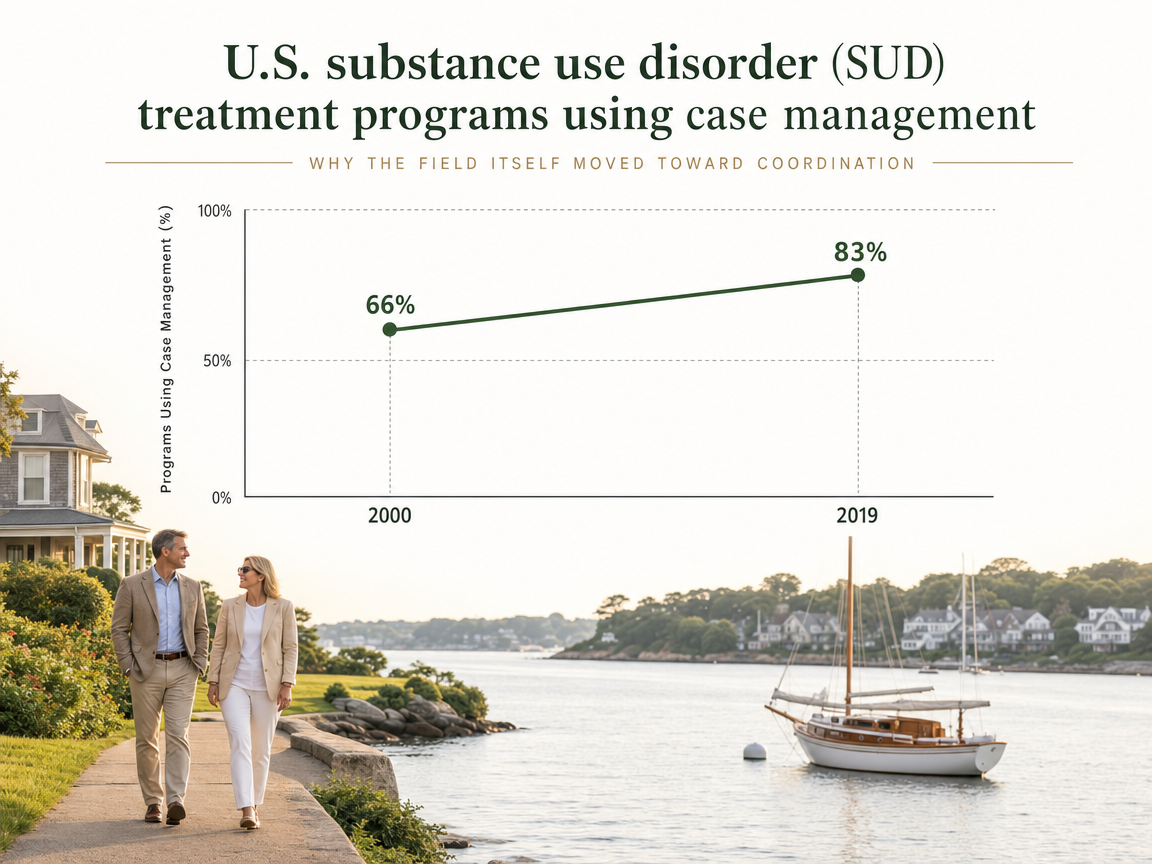
Why the field itself moved toward coordination
Coordinated care is increasingly becoming the standard, a trend that has evolved over two decades.
The percentage of U.S. substance use disorder treatment programs utilizing case management increased from 66% in 2000 to 83% in 2019, as noted in SAMHSA's guidance on comprehensive case management. This trend within the treatment system reflects a critical understanding: connecting individuals to services, supporting them through challenges, and coordinating across providers significantly impacts treatment adherence.10
The shift towards coordination is rooted in practical evidence. SAMHSA's research indicates that case management helps individuals remain in treatment and recovery, and enhances engagement with necessary services. When two conditions are present, this engagement is even more crucial, as disengaging from one aspect of care can destabilize the other.10
It's important to acknowledge the scope of case management. While it significantly improves treatment-related tasks like attendance and follow-through, its impact on every personal outcome may vary. Coordination acts as a supportive framework, enabling the broader recovery process rather than being a standalone cure.10
This means that if you believe coordinated care should be a standard offering rather than something you have to assemble yourself, your perspective aligns with current professional understanding. The key is to determine if the coordination you receive is genuinely integrated—with a shared plan, a single point of contact, and active communication among providers—or merely a concept mentioned in discharge summaries.
Fragmented care vs. coordinated care: the same week, two different lives
Consider a typical week in mid-October. In both scenarios, you have the same diagnosis, medications, job, and family. The critical difference lies in whether your care providers communicate with each other.
The fragmented week. On Monday morning, during a therapy session, you mention disrupted sleep and a missed medication dose due to pharmacy access issues. Your therapist notes this, but as they don't prescribe your medications, the information remains isolated. On Tuesday, attempting to refill your prescription, you discover a prior authorization has expired and leave a voicemail for your prescriber's office. By Wednesday, there's no callback. On Thursday, during a fifteen-minute video visit, your prescriber is unaware of the missed dose, the refill problem, or your therapist's observations about a specific trigger pattern. When asked how you are, you respond "fine," unsure where to begin. By Friday, you cancel your aftercare group, feeling overwhelmed by managing everything yourself.
The coordinated week. The same Monday therapy session occurs. By the end of the day, your case manager receives an update: rough sleep, one missed dose, and a flag for attention. By Tuesday afternoon, the prior authorization is being managed by your case manager, and a temporary medication supply is arranged to prevent any disruption. Your prescriber arrives at Thursday's visit already informed about the weekend's events, allowing the conversation to start at a deeper level than a general "how are you doing." On Friday, you attend aftercare, perhaps tired, but present and supported.
The distinction isn't about clinical expertise, but about effective information flow. The Institute of Medicine's work on coordinated care highlights case management, shared records, and formal agreements among providers as essential mechanisms for transforming disparate appointments into a cohesive, monitored plan. When these mechanisms are in place, you are no longer solely responsible for relaying information between your providers.2
Acting as the messenger between providers is a hidden burden of fragmented care. You repeatedly share your story, decide what information to disclose to whom, and attempt to discern clinically important details from everyday struggles. This is a significant responsibility for someone actively engaged in the demanding work of recovery.
Care coordination for individuals with serious mental illness and other health conditions is effective because it integrates mental health, primary care, and social services into a unified perspective, rather than maintaining them as separate entities. Practically, this means having a case manager who communicates directly with your therapist, has access to your prescriber's portal, and is in regular contact with your pharmacy—viewing all three as interconnected parts of their role.18
You are simply seeking a system where your care providers are aware of what others already know. This fundamental communication makes all the difference.
Medication management when a psychiatrist and a prescriber both hold pieces
Medications often represent a critical point of disconnect in dual diagnosis care.
You might have a psychiatrist managing a mood stabilizer or antidepressant, and a separate prescriber handling medications related to substance use recovery, such as buprenorphine, naltrexone, or anti-craving medications. This can involve two different clinicians, two patient portals, and sometimes two pharmacies. Each provider focuses on a specific aspect of your health, but your body experiences all these medications simultaneously.
SAMHSA's practice guidance for co-occurring conditions explicitly states that care should include coordination with mental health counselors and prescribers to ensure that interactions between conditions are understood and treatment plans are aligned. A case manager often facilitates this coordination by ensuring both prescribers have access to your current medication list, flagging new prescriptions that might interact with existing ones, and ensuring that a dose change from one provider doesn't surprise the other.13
Seemingly minor issues can have significant impacts: a lapsed refill due to an expired prior authorization, a sleep medication added by your psychiatrist that your recovery prescriber should know about, or a pharmacy switching to a generic without informing anyone. In fragmented care, you are typically the one to discover these issues, often after a problem has already arisen. In coordinated care, someone else helps monitor your calendar, portal messages, and pharmacy interactions.
SAMHSA's guidance also views dual diagnosis through a multi-problem lens, recognizing that your medications, therapy, physical health, housing, and support system are interconnected, forming a single system. A case manager operating with this perspective will also consider your primary care doctor, as changes in blood pressure medication or thyroid dosage can affect your well-being in ways that might appear to be a mental health flare-up.13
You don't need to become an expert in pharmacology to ensure your safety. Instead, you need a single point of contact who understands your complete medication regimen, a unified plan that guides all prescribers, and a reliable way to get assistance when a refill issue arises, especially on a Friday afternoon. This is the core responsibility of effective case management.
Insight Beyond Treatment
At Next Level Wellness & Behavioral Health, we believe meaningful change starts with perspective, not just protocols.
That philosophy is directly led by Amanda Marino, whose voice in behavioral health extends beyond clinical settings into leadership, culture, and personal growth.
Through keynote speaking and live events, Amanda explores the deeper themes that show up in recovery, family systems, and life transitions: authenticity, resilience, accountability, and the courage to change. Her work invites audiences to move past labels and into honest conversations that create lasting impact.
The aftercare window: where most articles stop and where your real risk lives
What structured aftercare actually looks like
Many guides conclude at discharge, but this is often when your vulnerability is highest.
In the weeks following primary treatment, the intensity of support often diminishes. Daily group therapy might reduce to once a week, and the close supervision you received transitions to a self-managed schedule. The Institute of Medicine's continuum of care model identifies this stage as maintenance, emphasizing that recovery is an ongoing process requiring continuous services and coordinated support beyond initial treatment.11
Structured aftercare involves specific elements:
- A dedicated case manager who remains with you throughout the transition, rather than a new one at each level of care.
- A written aftercare plan that includes your outpatient therapist, prescriber, primary care doctor, and community supports.
- A consistent monitoring rhythm—such as a check-in call, portal message, or standing appointment—to detect any challenges early, especially within the first two weeks when they are most likely to occur.
Research on aftercare programs for substance use recovery indicates that structured continuing care, including case management and coordinated outpatient services, is linked to lower relapse rates and improved long-term outcomes compared to minimal or no aftercare. This finding represents a consistent pattern observed across various studies.17
Structured aftercare should not consist of merely a discharge folder with a few phone numbers and a general wish of good luck. If your plan exists only on paper and isn't integrated into anyone's schedule, it's not truly a plan. If no one is actively monitoring for missed appointments or unfulfilled prescriptions, the monitoring function is not effectively in place.
You have every right to expect more than this. A single point of contact, a shared plan visible to all your providers, and a first outpatient appointment scheduled before you leave primary treatment—rather than two weeks later when momentum might have waned—are not luxuries. These are specific components that differentiate a theoretical plan from one that provides genuine, sustained support.
The honest evidence: what coordination does and doesn't fix
It's reasonable to seek an honest assessment of what coordinated care can achieve.
Research supports that coordinated care improves engagement. A 2024 study involving individuals with dual diagnoses found that coordinated care led to higher attendance and lower dropout rates compared to less coordinated approaches. Specialized dual diagnosis programs that incorporate outpatient and case management services have demonstrated improvements in residential stability, work participation, reductions in substance use symptoms, and decreased reliance on acute mental health services over time.4,8
However, the same 2024 study noted that coordinated care did not show a significant difference in overall retention. While attendance and dropout improved, long-term retention remained a persistent challenge.4
A 2023 systematic review comparing integrated versus non-integrated dual diagnosis treatment found a clear advantage for integrated care in improving psychiatric symptoms, but no consistent superiority regarding substance use outcomes or retention. This suggests that coordination more reliably supports the mental health aspect of recovery than the substance use aspect. Both are important, and neither outcome is guaranteed.3
Practically, this means coordinated care is valuable and worth pursuing, but it is not a complete solution. It reduces obstacles, identifies problems earlier, and facilitates the overall recovery process. However, it does not eliminate the need for your active participation in recovery, nor does it prevent the possibility of challenging weeks.
This offers a more realistic perspective than many claims about aftercare. You remain the central figure in your recovery journey. Case management provides a supportive structure, ensuring you don't have to navigate it alone or act as the intermediary between your care providers. During the vulnerable period following primary treatment, establishing such a structure is a deliberate and worthwhile effort.
What good coordination feels like from the inside
Effective coordinated care often manifests as the absence of stress—no frantic scrambling, no repetitive storytelling, and no uncertainty about who to contact.
You'll notice it in subtle ways. The intake form for a new outpatient appointment might already be partially completed because your case manager proactively shared relevant information. Your prescriber may begin your visit already aware of a challenging weekend, sparing you from recounting it from scratch. A message left on a Thursday evening receives a follow-up call on Friday morning, not days later. A pharmacy call regarding a prior authorization is handled by someone whose job it is to manage it, not by you during your busy day.
You'll also observe it in your schedule. There's a single, shared plan outlining your care components and their timing. Your therapy, medication check-ins, primary care visits, and aftercare group sessions are arranged in a consistent rhythm that someone monitors, rather than being haphazardly scheduled. When changes occur, the impact is managed. A vacation, work trip, or family emergency doesn't require you to reconstruct your entire support system from your phone at an airport.
The tone of your appointments will also shift. Providers ask fewer basic questions and delve into deeper discussions more quickly. The multidisciplinary team model, a hallmark of evidence-based integrated care, isn't just about clinicians discussing your case; it's the tangible sense that everyone involved in your care is working from a unified understanding.19
Most importantly, you'll notice what you are no longer doing. You're not translating information between providers, acting as a record-keeper, or serving as a communication hub. This conserved energy—which is valuable, finite, and hard-won—can then be redirected towards the essential work of recovery itself, where it rightfully belongs.
How to tell if your current care is actually coordinated
To assess the coordination of your current care, consider these questions:
- Is there a specific individual responsible for coordinating your care, someone you can contact directly, rather than a rotating role?
- Do your therapist and prescriber share notes, or do you find yourself repeatedly sharing the same information with each of them?
- If you experienced a difficult weekend, was anyone on your care team aware of it by Monday afternoon without you having to organize the communication?
- Is your aftercare plan a document accessible to all your providers, or is it merely a list of phone numbers on a discharge sheet?
If a prescription refill encounters a problem, who resolves it—you or someone else? When your primary care doctor prescribed a new medication last month, did anyone cross-reference it with your recovery medications? SAMHSA's guidance explicitly states that dual diagnosis care should involve coordination between mental health counselors and prescribers to ensure a comprehensive understanding of your conditions and aligned treatment plans.13
If most of your answers indicate that you handle these tasks yourself, your care is likely operating in parallel rather than being coordinated. This is not a reflection of any shortcoming on your part, but rather an identified gap that warrants attention and a request for support.
Frequently Asked Questions
Who actually coordinates my care in a dual diagnosis case management model?
A dedicated case manager is responsible for coordinating your care. This individual acts as the central point of contact for your entire team—including your therapist, prescriber, primary care doctor, and aftercare supports—ensuring that information flows effectively between them. SAMHSA describes this role as organizing treatment and external services to provide timely and connected care. In practice, this means having one consistent point of contact who understands your complete treatment plan.5
How is case management different from just having a therapist and a psychiatrist?
Having a therapist and a psychiatrist does not automatically equate to coordinated care. While both providers are essential, they may not communicate with each other. Case management adds a crucial layer of connection through shared records, collaborative treatment planning, and active follow-up among providers. This eliminates your role as the messenger between appointments, as someone else maintains a comprehensive view of your care, ensuring your team works from a unified plan rather than separate ones.2
What happens to case management after I finish primary treatment?
This phase is particularly critical. The Institute of Medicine's continuum of care model emphasizes that recovery is an ongoing process, requiring continuous services and coordinated support beyond initial treatment. Effective case management ensures continuity, with the same individual supporting you through transitions across different levels of care. Research on aftercare indicates that structured continuing care, which includes case management, is associated with lower relapse rates compared to minimal or no aftercare.11,17
How does a case manager help with medications when more than one prescriber is involved?
A case manager ensures that your current medication list is visible to all prescribers involved in your care. SAMHSA's practice guidance explicitly states that dual diagnosis care should coordinate with mental health counselors and prescribers to ensure that interactions between conditions are understood and treatment plans are aligned. This involves proactively identifying potential interactions between new and existing prescriptions, managing prior authorizations, and ensuring that any dose changes from one provider are communicated to others.11
Does coordinated care actually improve outcomes for dual diagnosis?
The evidence suggests that coordinated care generally improves outcomes, though with certain limitations. A 2024 study found that coordinated care led to higher attendance and lower dropout rates for individuals with dual diagnoses, although significant differences in overall retention were not observed. A 2023 systematic review indicated that integrated care improves psychiatric symptoms, but showed mixed results regarding substance use outcomes. Coordinated care reduces obstacles and helps identify problems earlier, thereby facilitating the recovery process, but it does not replace the individual's active engagement in their recovery journey.3,4
How can I tell if my current care is truly coordinated or just running in parallel?
To assess your care, ask yourself: Is there a specific person you can contact for coordination? Do your therapist and prescriber share notes, or do you repeat your story to each? If a refill issue arises, who handles it? Is your aftercare plan a shared document, or just a list of phone numbers? If you find yourself managing most of these tasks yourself, your care is likely parallel rather than coordinated.
References
- Managing Life with Co-Occurring Disorders. https://www.samhsa.gov/mental-health/serious-mental-illness/co-occurring-disorders
- Coordinating Care for Better Mental, Substance-Use, and General Health. https://www.ncbi.nlm.nih.gov/books/NBK19833/
- Integrated vs non-integrated treatment outcomes in dual diagnosis: A systematic review. https://pmc.ncbi.nlm.nih.gov/articles/PMC10157410/
- Examining Profiles and Treatment Outcomes in Dual Diagnosis Clients According to Treatment Modality. https://pubmed.ncbi.nlm.nih.gov/38478999/
- TIP 27: Comprehensive Case Management for Substance Abuse Treatment. https://library.samhsa.gov/product/tip-27-comprehensive-case-management-substance-abuse-treatment/sma15-4215
- Intensive Care Coordination for Children and Youth with Complex Mental and Substance Use Disorders: State and Community Profiles. https://library.samhsa.gov/product/intensive-care-coordination-children-and-youth-complex-mental-and-substance-use-disorders
- Intensive Care Coordination for Children and Youth with Complex Mental and Substance Use Disorders. https://www.samhsa.gov/resource/ebp/intensive-care-coordination-children-youth-complex-mental-substance-use-disorders
- Evaluating changes in symptoms and functioning of dually diagnosed clients in specialized treatment. https://pubmed.ncbi.nlm.nih.gov/7796208/
- Certified Community Behavioral Health Clinics (CCBHCs). https://www.samhsa.gov/communities/certified-community-behavioral-health-clinics
- Comprehensive Case Management for Substance Use Disorder Treatment. https://library.samhsa.gov/sites/default/files/PEP20-02-02-013.pdf
- The Institute of Medicine's Continuum of Care. https://www.samhsa.gov/resource/sptac/institute-medicines-continuum-care
- Integrated Models for Behavioral Health and Primary Care. https://www.samhsa.gov/resource/ebp/integrated-models-behavioral-health-primary-care
- Substance Use Disorder Treatment for People with Co-Occurring Disorders. https://library.samhsa.gov/sites/default/files/pep20-06-04-006.pdf
- Case management for people with severe mental illness: A systematic review. https://pubmed.ncbi.nlm.nih.gov/19296779/
- Assertive community treatment of persons with severe mental illness: A meta-analysis of controlled clinical trials. https://pubmed.ncbi.nlm.nih.gov/10755092/
- The effectiveness of case management for substance use disorders: A systematic review. https://pubmed.ncbi.nlm.nih.gov/20122348/
- Effectiveness of aftercare programs in reducing relapse among individuals with substance use disorders. https://pubmed.ncbi.nlm.nih.gov/25415402/
- Care coordination for patients with serious mental illness and comorbid medical conditions. https://pubmed.ncbi.nlm.nih.gov/28318870/
- Integrated treatment for co-occurring disorders: A review of evidence-based models. https://pubmed.ncbi.nlm.nih.gov/30646850/
A Voice Shaping the Conversation
The topics explored here—change, self-awareness, recovery, and growth—are the same themes Amanda Marino brings to audiences nationwide through speaking engagements and live events.
Known for her appearances on A&E’s Intervention and Digital Addiction, Amanda speaks to organizations, communities, and leadership teams about navigating adversity, embracing vulnerability, and building lives rooted in purpose. Her message resonates far beyond treatment, offering insight that applies to families, professionals, and anyone standing at a crossroads.



Heal on your terms—any time, anywhere.