.svg)

Digital Addiction Recovery Boca Raton: Restore Focus

Key Takeaways
- Problematic digital use is defined by patterns like preoccupation, withdrawal, tolerance, and loss of control lasting three months, not by raw screen-time totals.7
- Evidence points to structured CBT paired with scheduled exercise as the strongest outpatient approach, moving through behavior change, cognitive work, and life rebuilding.1,8
- Concierge outpatient care in Boca Raton fits working adults through private sessions, in-home or video options, and movement built around the local geography.
- Compare programs on modalities used, all three CBT stages, family involvement, and how slips and month-six maintenance are handled before committing.
When the Phone Stops Feeling Optional
You already know something has shifted. The phone is the first thing you reach for before your feet hit the floor, and the last thing you set down after your partner has fallen asleep. You have opened the same three apps in a loop for twenty minutes, closed them, and opened them again. If you are reading this in Boca Raton at 11:47 p.m. with the blue light on your face, you are not alone, and you are not weak.
What you are noticing has a clinical shape. Researchers have spent the last decade separating ordinary heavy use from patterns that meet criteria for problematic internet and smartphone use, and the distinction matters more than the raw screen-time number in your settings. Distress tracks the pattern, not the hours.9
This article is written for the adult who is quietly evaluating whether a real course of care makes sense, and for the parent, spouse, or referring professional trying to understand what discreet outpatient support actually involves. No detox retreats. No dramatic device confiscation. Just an honest map of what the evidence supports, what treatment looks like week to week, and what is available locally when you are ready to move.
What Actually Qualifies as a Clinical Problem
The Six Signals Clinicians Watch For
Before you decide whether what you are experiencing warrants care, it helps to see the frame a clinician would actually use. Not a lifestyle checklist. Not a screen-time app scolding you at Sunday brunch. The clinical literature on problematic internet use converges on six signals that, taken together, separate a heavy habit from something more serious.7
- The first is preoccupation. Your mind returns to the device, the game, the feed, even when you are trying to be somewhere else.
- The second is withdrawal: irritability, restlessness, or a low hum of anxiety when the phone is out of reach.
- Third is tolerance, the quiet creep of needing more time, more tabs, more stimulation to get the same relief.
- Fourth is loss of control — you meant to check one thing and forty minutes disappeared.
- Fifth is continued use despite harm, whether that harm shows up in your sleep, your marriage, your work product, or your body.
- And sixth is clinically significant functional impairment lasting at least three months, typically alongside roughly six or more hours of non-essential internet use per day.
That last threshold is the one that catches most people off guard. Three months. Six-plus hours of non-essential use. Read that again without flinching. If you are recognizing yourself in three or four of these signals rather than one, that is not a character flaw. It is a pattern with a name, and a pattern with a name is something a good clinician can actually work with.
You do not need to score yourself perfectly right now. You just need to know that a real framework exists, and that honest self-observation against it is the first useful thing you can do tonight.
Why Distress Tracks Patterns, Not Screen Time
Here is the piece that most digital-wellness content gets wrong. The raw hours on your device are not what predicts whether you feel anxious, depressed, or fragmented. The pattern is.
Reviews of problematic smartphone use consistently find that depression, anxiety, and stress track the compulsive quality of engagement, not device ownership or general daily use. A person who spends four hours a day on their phone for work, family logistics, and a genuinely enjoyable podcast habit can be fine. A person who spends two hours a day but does so in reactive, cue-driven bursts — checking mid-conversation, scrolling to avoid a hard email, waking at 3 a.m. to see who reacted — can be quietly unraveling.9
This distinction matters for two reasons. First, it releases you from the shame of a screen-time number and points you toward the more useful question: when and why are you reaching for it? Second, it reshapes what recovery looks like. The goal is not to hit some virtuous hour count. The goal is to change the shape of your engagement so it stops functioning as an escape hatch from the parts of your life that need you awake in them. That is a very different project, and a much more honest one.
What Evidence-Based Treatment Actually Looks Like
Ranking Interventions by Effect Size
If you are going to spend real time and real money on this, you deserve to know which approaches carry the most weight in the research, not just the ones with the best marketing.
A 2026 systematic review and meta-analysis pooled 125 studies, including 73 randomized controlled trials, to compare interventions for problematic internet, smartphone, and gaming behaviors. The pattern that emerged is worth sitting with. Structured psychological therapies produced a mean effect size of roughly -2.68 for problematic internet use and -1.49 for problematic smartphone use. Exercise-based programs for problematic smartphone use posted the strongest single number in the comparison at approximately -3.07. In this context, larger negative values mean larger reductions in problematic behavior, so those are meaningful shifts, not rounding errors.1
Read that sequence carefully, because it changes what a serious course of care should include. Talk therapy alone is well supported. Movement alone is well supported. The combination — which is what an honest concierge outpatient plan tends to look like — is where the evidence pushes hardest.
What this does not mean is that you sign up for a bootcamp. Exercise here is not punishment. It is a scheduled, sustainable input that competes with the same reward system your phone has been training. A morning walk on the beach, a strength session three times a week, a swim before your first meeting — these become part of the clinical plan, not a wellness extra you get to if there is time.
The other honest read from this comparison: pharmacological options, neuromodulation, and web-only programs have their place in specific cases, but the everyday spine of care for a high-functioning adult is talk therapy plus movement, delivered on a schedule you actually keep. That is the shape you should expect from a program worth your time.1

The Three Stages of CBT for Compulsive Digital Use
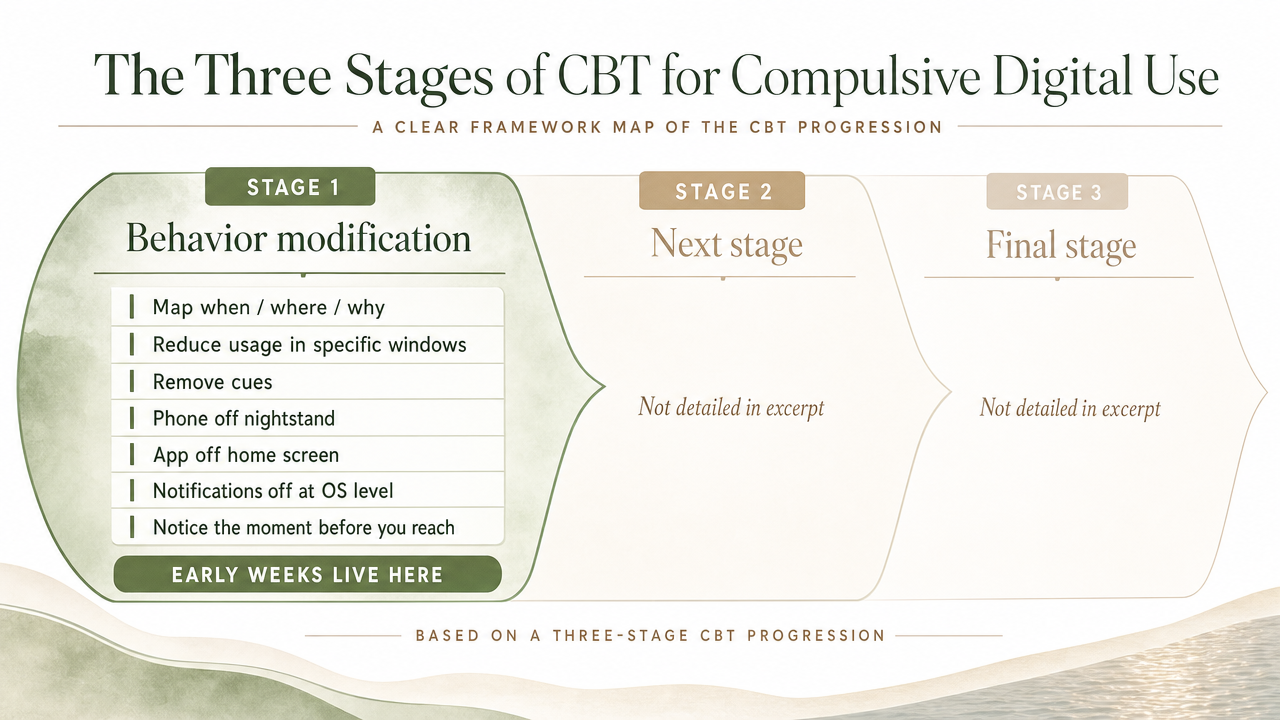
When people hear "cognitive behavioral therapy," they often picture a worksheet. That is not what a good CBT course for compulsive digital use looks like. The clinical literature describes a three-stage progression, and knowing the stages ahead of time makes it much easier to tell whether the work you are doing is actually going somewhere.8
- Stage one is behavior modification. This is the mechanical layer. You and your clinician map when, where, and why the reaching happens. You reduce total usage hours in specific windows. You remove cues — the phone off the nightstand, the app off the home screen, the notifications killed at the operating system level. You learn to notice the exact moment before you reach, which is the only moment you can actually change. Early weeks live here, and they should. Nothing else works if the environment keeps pulling you back in.
- Stage two is cognitive reconstruction. Once the behavior loosens, the beliefs underneath it become visible. "I'll fall behind if I don't check." "I can't tolerate this feeling." "I'm only relaxing." These are not moral failures. They are learned scripts, and they respond to being examined directly. This is where the work gets more personal and, honestly, harder. You are not just changing what you do at 10 p.m. You are changing what you believe about what that hour is for.
- Stage three is functional problem solving. With the pattern quieter and the beliefs updated, the question becomes: what were you using the phone to avoid, numb, or replace? Sleep. A stalled career decision. A marriage that needs a real conversation. A body that needs to move. This stage rebuilds the life domains the compulsive use was crowding out — sleep, work, relationships, physical health, offline interests.
A course of care that never leaves stage one is a screen-time app with a therapist attached. A course of care that skips to stage three without doing the earlier work tends not to hold. You want all three, in order, at the pace your life can sustain.
Where the Evidence Is Still Thin
You should also hear the honest part.
An umbrella review synthesizing five separate meta-analyses on interventions for digital addiction recovery Boca Raton concluded that while most approaches — CBT, group counseling, exercise, psychosocial interventions, screen-time reduction — can improve lifestyle, emotional health, mental health, and social relationships, the overall evidence base is still rated as weak. Trials tend to be small. Diagnostic criteria vary. Long-term follow-up is limited. Some subtypes of problematic use, particularly newer social platform behaviors, have barely been studied at all.1,2
This is not a reason to wait. It is a reason to be a discerning consumer of your own care. Ask what modalities your clinician actually uses and why. Ask what maintenance looks like at month six, not just month one. Ask what happens on the weeks you slip, because you will have some.
The evidence is strong enough to act on and honest enough to admit its edges. That combination is what serious care looks like right now — not certainty, but a well-supported direction, delivered by someone who can adjust when your life does.
Insight Beyond Treatment
At Next Level Wellness & Behavioral Health, we believe meaningful change starts with perspective, not just protocols.
That philosophy is directly led by Amanda Marino, whose voice in behavioral health extends beyond clinical settings into leadership, culture, and personal growth.
Through keynote speaking and live events, Amanda explores the deeper themes that show up in recovery, family systems, and life transitions: authenticity, resilience, accountability, and the courage to change. Her work invites audiences to move past labels and into honest conversations that create lasting impact.
What Concierge Outpatient Care Looks Like in Practice
A Realistic Week: Sessions, Movement, Family Touchpoints
Forget the treatment brochure. Here is what a real week of concierge outpatient care for problematic digital use tends to look like when it is built around a working adult in Boca Raton.1,8
- You start with two individual therapy sessions, usually spaced Tuesday and Friday. One is deeper CBT work — the stage-appropriate mix of behavior mapping, belief examination, or life rebuilding described in the clinical literature. The other is shorter, more tactical: what happened this week, what cues fired, what you want to try next. Sessions can happen at a private office, at your home, or over secure video when travel or a board meeting makes an in-person visit impossible.
- Movement is scheduled, not suggested. Three to four structured sessions a week — a beach walk before work, a strength block with a trainer who understands you are in care, a swim, a spin class you already like. This is the exercise input that the intervention research keeps pointing to as one of the strongest single moves for problematic smartphone use. Your clinician tracks it the same way they track your sleep and your session attendance.
- One family touchpoint per week, when the situation involves a partner, an adult child, or a parent. Sometimes this is a joint session. Sometimes it is a fifteen-minute call between your clinician and your spouse to align on what support looks like at home. Add a case manager check-in for logistics, a psychiatric consult if mood or sleep needs medication support, and a short daily practice you actually do — journaling, a morning walk without the phone, a wind-down protocol at night.
That is the shape. Six to ten touchpoints a week, most of them under an hour, arranged around a life you are still living.
Controlled Re-Engagement, Not Abstinence
The goal of this work is not to make you a person who no longer uses a phone. That person does not exist in your job, your family, or your zip code, and pretending otherwise sets you up to fail in week three.
The goal is controlled re-engagement. Your clinician will help you design what use looks like when it is working for you rather than around you. Email in defined windows. Group chats muted except for the people who actually need to reach you. Social platforms allowed on a laptop, not a phone, or allowed on the phone for fifteen minutes at a set time. The device sleeps outside the bedroom. The first hour of your morning belongs to your body and your family, not to whatever happened online at 2 a.m.
This is deliberate because the distress-driving element is the compulsive pattern, not the technology itself. Strip out the reactive, cue-driven, escape-hatch use, and what remains is a tool you can live with. That is a different destination than "digital detox," and a much more durable one.9
You will slip. Everyone does. A good outpatient plan treats a slip as data — what cue, what feeling, what time of day — not as a failure that resets the clock. Every honest observation you bring back to session is progress, even when it does not feel like it yet.
The Boca Raton and Palm Beach County Context
There is a quiet assumption that money insulates. That a house on the Intracoastal, a corner office in Mizner Park, or a strong academic record at a private school somehow buffers a person from the same patterns pulling at everyone else. It does not.
County behavioral health data tells a more honest story. A recent Palm Beach County planning report drawing on state surveillance found that roughly 15% of adults reported frequent mental distress in 2020, and that 42% of Palm Beach County students in the 2022 Florida Youth Substance Abuse Survey said they felt depressed or sad on most days. Adult depressive disorder prevalence tracked in the local Behavioral Risk Factor Surveillance System reinforces that mood conditions are common across income bands, not concentrated in the populations most people picture when they hear "behavioral health need". Compulsive digital patterns rarely sit alone. They travel with sleep loss, low mood, and anxiety, which is exactly the intersection this county's data keeps surfacing.11,12
What this means for you, practically, is that discreet outpatient care is not a luxury add-on here. It is the appropriate level of care for a lot of people who look, on paper, like they are doing fine. The Boca Raton context also offers something that matters clinically: the geography supports the plan. Morning light on the beach for the movement piece. Private offices and in-home session options for the therapy piece. A network of specialists close enough that a psychiatric consult or a family session does not require rearranging your week.
You do not have to fly somewhere to get serious care. It is already down the road, arranged around the life you have built here.
If You Are Supporting an Adolescent or Young Adult
The scope of this section shifts. If you are reading as a parent of a teenager or a young adult in your household, what follows is written to you, not to the person you are worried about.
Start with a calibration. A meta-analysis of 12 studies on adolescents aged 11 to 18 found a small but statistically significant correlation between social media use and depressive symptoms — roughly r = .11, with high variation across studies. That number is honest, and it is smaller than the headlines suggest. What the more recent review work clarifies is where the risk actually concentrates: general use shows weak, inconsistent links to mood, while problematic patterns — the compulsive, cue-driven, sleep-eroding kind — are consistently tied to poorer mental health outcomes. Specific exposures matter too. Cyberbullying, upward social comparison, and reactive late-night scrolling carry more weight than raw hours.10,13
Treatment-wise, the news is genuinely encouraging. A systematic review of 10 randomized controlled trials on internet-related concerns in adolescents and young adults found moderate to large effect sizes for several approaches, with brief, manualized CBT programs standing out. Outpatient, structured, family-aware — the same shape of care that works for adults, adjusted for developmental stage and school schedules. You do not need to send them away. You do need to bring in someone trained, and to be willing to look at the household patterns alongside theirs.3
Signals It Is Time to Bring in Structured Support
You do not need every warning light on the dashboard flashing at once. A few, steady, over weeks, is enough.
- Sleep is usually the first one to go. If you are losing the last ninety minutes of your night to a screen most weeks, and waking tired most mornings, that alone is worth a conversation.
- The second signal is the one people minimize: the fight you keep having with your partner about the phone at dinner, in bed, in the car on the way home from your kid's game. When the people who love you have started naming the pattern out loud, the pattern is already loud.
- Work is the third. Missed deadlines, work you used to do in ninety minutes now stretched across a fragmented afternoon, a growing gap between the caliber of thinking you know you are capable of and what you actually shipped this week.
- And the fourth is the quiet one — the private recognition that you have tried on your own, more than once, and the change has not held past week two.
Any two of these, sustained, is a reasonable threshold to bring in structured help. You are not waiting for a crisis. You are catching a pattern early, which is the version of this decision that costs you the least.
A Quieter Next Step
You have read this far, which already tells you something. The pattern has your attention, and attention is the raw material every good course of care is built from.
You do not need a dramatic decision tonight. You need one honest conversation with someone who does this work for a living, and a plan that respects the life you have built here. Concierge outpatient care in Boca Raton exists precisely for this — private, evidence-based, arranged around your calendar rather than replacing it. The team at Next Level Wellness & Behavioral Health is one place to start that conversation, on your terms and at your pace.
Set the phone down after this paragraph. Take a breath. Reach out when you are ready — this week, next week, whenever the noticing turns into moving. That is the step that counts.
Frequently Asked Questions
Is digital addiction actually a recognized clinical condition?
The short answer: the clinical picture is real, even if the label is still catching up. Reviews of problematic internet and smartphone use describe a consistent cluster — preoccupation, tolerance, loss of control, continued use despite harm, and functional impairment lasting at least three months. Diagnostic naming varies across trials, but the pattern your clinician will assess against is well established.7
Do I have to give up my phone or go offline completely to recover?
No. The distress driving your concern tracks the compulsive pattern, not device ownership itself. A good outpatient plan aims for controlled re-engagement — email in defined windows, the phone out of the bedroom, social platforms on your terms — rather than total avoidance. You keep the tools you actually need for work and family, and change the shape of how you use them.9
How is outpatient digital recovery different from a wellness retreat or digital detox?
A retreat interrupts the pattern for a week. Outpatient care changes the pattern in the environment where it actually lives. Structured psychological therapies show consistent benefit across 125 studies and 73 randomized trials, particularly when paired with scheduled movement. Detox weekends can feel restorative, but the evidence sits with sustained, therapist-led work delivered inside your regular life, not outside of it.1
What does a typical course of treatment actually involve?
Expect a CBT-based arc across three stages: behavior modification first, cognitive reconstruction next, then functional problem solving to rebuild sleep, work, and relationships. In practice, that translates to roughly two therapy sessions weekly, scheduled exercise, a family touchpoint when relevant, and psychiatric or case-management support as needed. Early weeks focus on cues and environment. Later weeks work on what the use was replacing.8
My teenager's screen use worries me. Is this the right kind of care for them?
Often, yes. A systematic review of 10 randomized trials in adolescents and young adults found moderate to large effect sizes across several approaches, with brief, manualized CBT programs standing out. Outpatient, family-aware care fits developmental stage and school schedules better than sending them away. Start with an honest assessment of the pattern — not the hours — and let a trained clinician calibrate from there.3
Can I keep working and maintain privacy while in treatment in Boca Raton?
Yes, and this is where concierge outpatient care earns its name. Sessions can happen at a private office, at home, or over secure video around board meetings and travel. There is no facility badge, no shared waiting room, no visible interruption to your calendar. Given local data showing mental distress is common across income bands here, discreet outpatient support is a routine level of care.11
References
- Therapeutic Interventions Targeted at Problematic Use of Digital Technology: Systematic Review and Meta-Analysis of Evidence. https://pubmed.ncbi.nlm.nih.gov/42119142/
- Interventions for Digital Addiction: Umbrella Review of Meta-Analyses. https://pmc.ncbi.nlm.nih.gov/articles/PMC11862776/
- Treatment Modalities for Internet Addiction in Children and Adolescents: A Systematic Review of Randomized Controlled Trials. https://pmc.ncbi.nlm.nih.gov/articles/PMC10179495/
- A Narrative Review of Digital Addiction and Health. https://pmc.ncbi.nlm.nih.gov/articles/PMC12857582/
- A Meta-Analysis of the Association Between Adolescent Social Media Use and Depressive Symptoms. https://pubmed.ncbi.nlm.nih.gov/32734903/
- Key Substance Use and Mental Health Indicators in the United States: Results from the 2022 National Survey on Drug Use and Health. https://www.samhsa.gov/data/report/2022-nsduh-annual-national-report
- Internet addiction and problematic Internet use: A systematic review of clinical research. https://pmc.ncbi.nlm.nih.gov/articles/PMC4804263/
- Cognitive behavioral intervention in dealing with Internet addiction. https://pmc.ncbi.nlm.nih.gov/articles/PMC8769783/
- Problematic smartphone use: A conceptual overview and systematic review of relations with psychopathology. https://pubmed.ncbi.nlm.nih.gov/27736736/
- A Systematic Review and Meta-Analysis of Recent Evidence on Social Networking Sites and Mental Disorders in Adolescents and Young Adults. https://pmc.ncbi.nlm.nih.gov/articles/PMC12649677/
- Implementation of the Crisis Now Model in Palm Beach County (Final Report). https://discover.pbc.gov/communityservices/BHSUCOD/Documents/Implementation%20of%20the%20Crisis%20Now%20Model_Final%20Report%20(5).pdf
- Florida Behavioral Risk Factor Surveillance System – Palm Beach Combined Report. https://www.floridahealth.gov/wp-content/uploads/2025/10/PalmBeachCombinedReport.pdf
- Review: Social media use and adolescent mental health. https://pubmed.ncbi.nlm.nih.gov/41589024/
A Voice Shaping the Conversation
The topics explored here—change, self-awareness, recovery, and growth—are the same themes Amanda Marino brings to audiences nationwide through speaking engagements and live events.
Known for her appearances on A&E’s Intervention and Digital Addiction, Amanda speaks to organizations, communities, and leadership teams about navigating adversity, embracing vulnerability, and building lives rooted in purpose. Her message resonates far beyond treatment, offering insight that applies to families, professionals, and anyone standing at a crossroads.



Heal on your terms—any time, anywhere.