.svg)

Flexible Outpatient Treatment for Depression: What to Know

Key Takeaways
- Match treatment intensity to function, not feeling — weekly therapy fits intact functioning, while a nine-hour IOP threshold becomes the honest match when deadlines, sleep, or meetings start slipping.
- Structured outpatient care produces clinically meaningful results, with multidisciplinary models reaching a Cohen's d of 1.18 and remote IOP reaching 0.79 for depression symptom reduction.6,7
- Roughly one in four people drop out of outpatient CBT for depression, so ask any program who owns continuity when travel, side effects, or work disruptions hit.
- Plan around a 90-day IOP minimum, name co-occurring anxiety or substance use at intake, and choose format — remote or in-person — before choosing a provider.8,10
When stepping away isn't an option
You already know something has shifted. The mornings feel heavier than they should. The work still gets done, mostly, but the cost of doing it has gone up. And the standard advice — take a leave, check into a 30-day program, hit pause on your life — isn't a real option for you. You have a team, a docket, a board, a family that depends on the version of you who shows up.
That tension is real, and you don't have to resolve it by gritting your teeth or by disappearing. Outpatient care for depression has grown well beyond the once-a-week therapy hour. Structured programs now deliver clinically meaningful treatment while you keep working, parenting, and traveling. The Indian Psychiatric Society's clinical guidelines note that the majority of depression cases — mild to moderate — can be effectively managed in outpatient settings with personalized plans built around the person, not the calendar. The National Institute of Mental Health echoes that psychotherapy and medication are the standard tools, and both adapt well to working schedules.1,2
What follows isn't a generic overview. It's a planning guide for matching treatment intensity to the life you're actually living — including when a higher-touch program makes sense, what the schedule really looks like, and how to protect your privacy without shortchanging your care.
Matching treatment intensity to your lifestyle
Standard outpatient therapy: one hour, once a week
The classic format is what most people picture when they hear "therapy": a 50-minute session, once a week, with a licensed clinician. For mild to moderate depression, this can be enough. Clinical guidelines support outpatient management as the appropriate setting for the majority of depression cases, particularly when symptoms haven't started eroding your ability to function. Cognitive behavioral therapy and interpersonal therapy carry the strongest evidence at this level, and either one can be combined with medication managed by your prescriber.1,2
If you're sleeping reasonably well, hitting your deadlines, and your relationships still feel intact even when your mood doesn't — weekly therapy is a defensible starting point. You meet on a Tuesday at 7 a.m. or a Thursday at lunch, you do the homework, you adjust.
The honest limitation is dosage. One hour out of 168 leaves a lot of week to navigate alone, and that gap is where many people stall. If you've been at it for a couple of months and your sleep, focus, or sense of dread isn't shifting, that's not a personal failing. It's a signal that the intensity may not match what you're carrying.
Intensive Outpatient Programs: the 9-hour threshold
An Intensive Outpatient Program, or IOP, is the next level up — and it's defined by hours, not by intent. The Department of Veterans Affairs and other clinical bodies use the same threshold: at least nine hours per week of structured outpatient treatment to qualify as intensive. SAMHSA describes the format as a mix of one-on-one therapy, group sessions, and coping-skill work that runs longer and more often than a standard weekly appointment.5,9
In practice, that usually looks like three sessions per week, three hours each — often clustered into mornings or evenings so you can still hold your job. Some programs run 9 a.m. to noon, leaving the rest of your workday intact. Others run 6 to 9 p.m. so you don't miss a single meeting. Partial hospitalization sits one tier higher, typically 20 or more hours weekly, closer to a part-time job.
Here's the schedule reality, mapped against a 40-hour work week:9
- Standard outpatient: ~1 hour/week (about 2.5% of your work week)
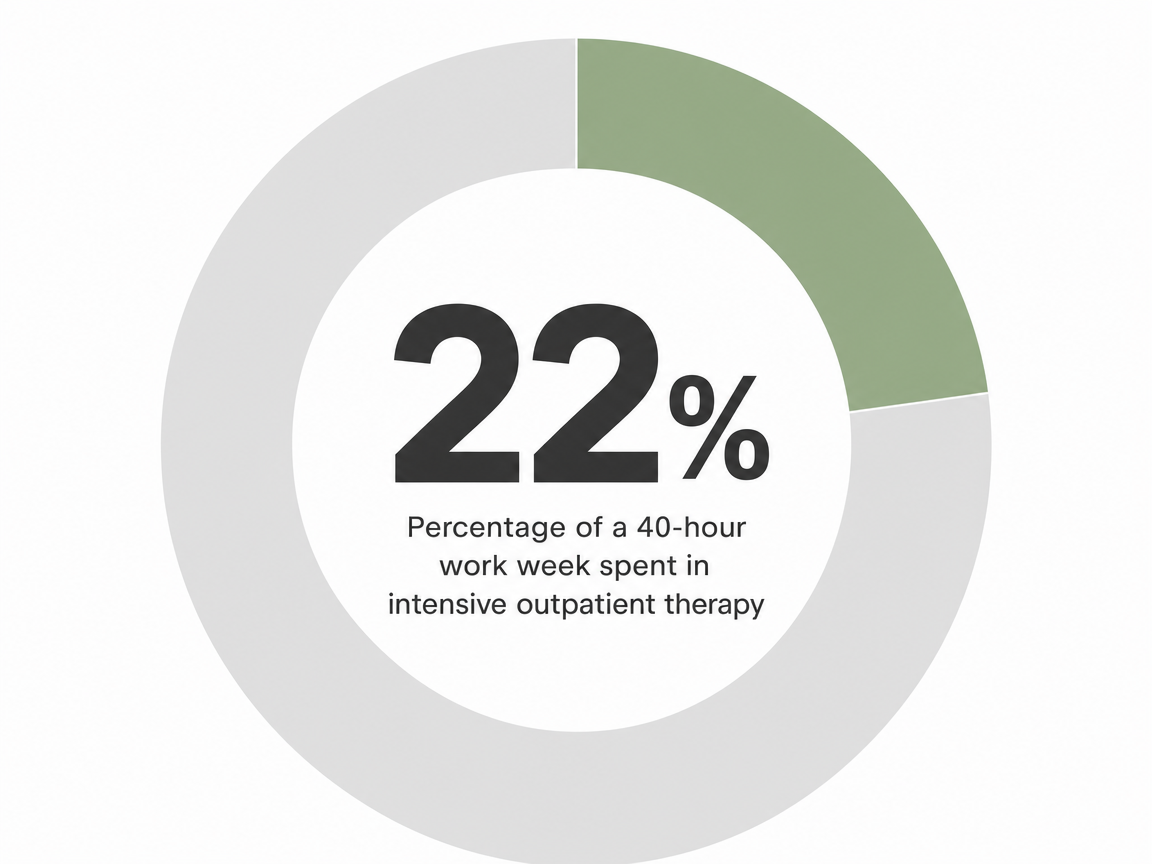
- Intensive Outpatient Program: 9+ hours/week (about 22% of your work week)
- Partial hospitalization: 20+ hours/week (about 50% of your work week)
That jump from one hour to nine isn't just more therapy — it's a different kind of treatment. You're getting group skill-building, individual sessions, and often medication management within the same coordinated program. The structure itself does work that a single weekly hour can't replicate. If your depression is interfering with sleep, decision-making, or how you show up at home, the 9-hour threshold is where the clinical math starts to favor more intensive care.
Partial hospitalization and step-down: when more structure helps short-term
Partial hospitalization programs (PHPs) deliver the most structure you can get without checking into a hospital bed. You're in clinical care most of the day, then home at night. For someone whose depression has tipped into something heavier — persistent suicidal thinking, an inability to get out of bed, recent crisis — PHP can stabilize things in a way weekly therapy simply cannot.
Most people don't stay at that level for long. The point is to step down. Research on DBT-informed treatment found that an intensive outpatient program produced symptom reductions equivalent to partial hospitalization for participants whose intake severity placed them in the IOP track. Translation: once you're stabilized, IOP can carry the same therapeutic weight at a fraction of the time commitment.3
That step-down logic is the planning insight. You don't have to choose one level forever. You might start at PHP for two or three weeks, drop to IOP for the next phase, then transition to weekly therapy as a maintenance layer. The continuum is built to flex with how you're actually doing — not how you were doing the day you signed up.

What good outcomes actually look like in structured outpatient care
If you're trying to decide whether the time investment is worth it, you need a real answer to a fair question: how much better do people actually get? "Better" in clinical research is often measured by something called Cohen's d, an effect size that captures how much a treatment moves the needle. Anything above 0.8 is considered a large effect. That's the bar.
A 2025 study of a multifaceted outpatient model called TEAM — built on testing, empathy, agenda-setting, and methods — reported a Cohen's d of 1.18 for depression improvements. That's a large effect by any honest reading, achieved in a structured, time-limited outpatient setting rather than a hospital. For context, remote intensive outpatient programs delivered to young adults produced a Cohen's d of 0.79 for depression symptoms — also a meaningful, near-large effect, achieved entirely through a screen.6,7
Two takeaways are worth sitting with. First, structured outpatient care, when it's designed well, isn't a watered-down version of more intensive treatment — it can produce the kind of symptom reduction that genuinely changes how your week feels. Second, the modality matters less than the structure. In-person multidisciplinary work and remote group-and-individual programming both clear the threshold for clinically meaningful improvement.
What does that look like in your actual life? Sleep that returns to something close to normal. The capacity to read a contract or a chart without your mind sliding off the page. Mornings that don't require a 20-minute pep talk before you can stand up. The dread that's been sitting on your chest gets quieter — not gone, but quieter — and the version of you your team is used to starts showing up again, more days than not.
None of this happens in week one. The TEAM data and the remote IOP data both reflect time-limited courses of treatment, measured at completion or follow-up. You're investing weeks, not days. The point is that the investment has a defensible return, and the return is large enough to justify rearranging your calendar around it.6,7
Virtual and remote IOP: the discreet path for professionals who travel
If your week includes airports, client dinners, or a calendar that gets rebuilt every Sunday night, in-person group therapy three nights a week may sound impossible — and that's a fair read. The good news is that remote intensive outpatient programming has matured into a real clinical option, not a compromise.
A 2023 study of remote IOP delivered to young adults found a Cohen's d of 0.79 for depression symptom reduction — a near-large effect, achieved entirely through video. That number matters because it puts virtual care in the same conversation as in-person structured treatment, not several rungs below it. You can join a 7 a.m. group from a hotel room in Denver, take a noon individual session from your home office, and finish a skills group at 6 p.m. before dinner — without anyone in the lobby knowing where you've been.6
The discretion piece is worth naming directly. There is no parking lot. There is no waiting room where a client or a colleague might recognize you. Your assistant doesn't need to block out three weekly afternoons for an unexplained appointment across town. The treatment shows up on your laptop, runs on a schedule you helped build, and ends with you closing the lid and rejoining your day.
Remote IOP isn't right for every clinical picture. If you're in acute crisis or your safety is in question, in-person care offers things a screen cannot. But for high-functioning professionals managing moderate depression around a demanding role, the virtual format removes the two most common reasons people don't start: the schedule conflict and the privacy concern. The clinical evidence says you don't have to trade one for the other.6
Addressing the dropout problem in treatment
Here's something most treatment websites don't put on the homepage: a meta-analysis of outpatient cognitive behavioral therapy for adult depression found a weighted mean dropout rate of 24.63%. Roughly one in four people who start an evidence-based course of CBT for depression don't finish it. The therapy works — the same analysis found that gains held at six-month follow-up for those who completed treatment — but only if you stay in the room.8
That number isn't a verdict on you. It's a planning problem, and it deserves to be named honestly before you commit to a schedule. People disengage for reasons that have very little to do with motivation:
- A travel week blows up three sessions in a row, and the program never quite restarts.
- The intake clinician was a poor fit and rebooking with someone new felt like starting over.
- A medication side effect went unaddressed for two weeks.
- A billing snag turned into a phone-tag spiral.
- Work got loud, and therapy was the first thing that got cut.
None of those are character flaws. They're logistics, and logistics is exactly what a high-functioning professional should not have to manage on top of depression. This is where the structure of your care matters as much as the modality. A program that hands you a phone number and a follow-up slot in three weeks is making you the project manager of your own treatment — at the moment you have the least capacity for it.
What changes the math is care coordination. Someone whose job is to hold the schedule, flag a missed session before it becomes two, troubleshoot the prescription, and rebook the fit issue inside 48 hours. That kind of concierge-style continuity is the difference between being a statistic in a meta-analysis and being someone who completed treatment and kept the gains. If you're choosing between programs, ask directly who owns continuity when life interrupts — because life will interrupt.
Insight Beyond Treatment
At Next Level Wellness & Behavioral Health, we believe meaningful change starts with perspective, not just protocols.
That philosophy is directly led by Amanda Marino, whose voice in behavioral health extends beyond clinical settings into leadership, culture, and personal growth.
Through keynote speaking and live events, Amanda explores the deeper themes that show up in recovery, family systems, and life transitions: authenticity, resilience, accountability, and the courage to change. Her work invites audiences to move past labels and into honest conversations that create lasting impact.
Why staying connected to care prevents relapse
Depression has a memory. Even after symptoms ease and you feel like yourself again, the conditions that helped it land — sleep debt, isolation, unprocessed stress, a tough quarter — tend to recur. Continuity of care is what keeps a hard week from becoming a hard quarter.
The data on this is direct. A quality-improvement project tracking adults with major depressive disorder found a 15-percentage-point gap in re-hospitalization rates between patients who engaged in outpatient treatment after a hospital stay and those who did not. That study looked specifically at post-hospitalization follow-up, not first-time outpatient care, but the underlying lesson generalizes: the bridge between acute treatment and the rest of your life is where relapse either gets caught early or gets a running start.4
For a working professional, staying connected doesn't have to mean staying in IOP forever. It often means stepping down to weekly therapy, keeping a standing medication check, and having someone in your corner who notices when two missed sessions become a pattern. The goal isn't perpetual treatment. The goal is that the next rough stretch — and there will be one — finds you already in the room with people who know your history.
Choosing your modality: CBT, DBT-informed, IPT, and combinations
The acronyms can blur together when you're tired and trying to make a decision. Here's the short version of what actually distinguishes them — and when each one tends to earn its place in a flexible outpatient plan.
Cognitive behavioral therapy (CBT) is the workhorse. It targets the thought patterns and behaviors that keep depression looping — the 3 a.m. catastrophizing, the canceled plans, the avoidance that makes the next day harder. Clinical guidelines name CBT and interpersonal therapy as the two psychotherapies with the best-documented efficacy for depression, and NIMH treats CBT as a first-line option for outpatient care. If your depression is feeding on rumination and a shrinking life, CBT is usually where you start.1,2
Interpersonal therapy (IPT) works a different angle. It treats depression as something that lives inside your relationships — a recent loss, a role transition, a conflict that won't resolve, a pattern of isolation. For a professional whose mood dipped after a divorce, a job change, or the death of a parent, IPT often lands faster than pure cognitive work because it names what your gut already knows.
DBT-informed treatment — originally built for emotion regulation — has become a real option for depression that runs hot: intense mood swings, urges to self-harm, relationships that keep combusting. A study of DBT-informed intensive outpatient programming found symptom reductions equivalent to partial hospitalization for participants placed in the IOP track. If standard CBT has felt too cerebral for what you're carrying, DBT skills work — distress tolerance, mindfulness, interpersonal effectiveness — often translates better.3
Most structured outpatient programs don't ask you to pick one and commit. You'll get CBT-based individual sessions, DBT-informed group skills, and often a medication consult that runs alongside the therapy. Combining psychotherapy with antidepressant medication is standard practice for moderate-to-severe presentations, and the combination tends to outperform either alone when symptoms have started touching sleep, appetite, or concentration. The right modality is the one your clinician matches to your actual presentation in week one — not the one with the best brand recognition.2
Planning the 90 days: what the timeline actually looks like
Ninety days is the planning horizon worth holding in your head. Clinical guidance on the intensive outpatient continuum cites 90 days as the recommended minimum duration of the IOP phase — not because something magical happens on day 91, but because that's the window where structured treatment has time to compound.
Here's a realistic shape for those three months.
- Weeks one through four are the steepest. You're learning the schedule, meeting your individual therapist, sitting in your first few groups, and probably tweaking medication if it's part of your plan. Energy will feel uneven. Some sessions will land hard. Sleep often shifts before mood does.
- Weeks five through eight are where the work starts paying back. The skills you've been practicing — challenging a thought spiral, scheduling something you'd usually cancel, naming what you're feeling without flinching — start showing up unprompted. Most people notice they're arguing with their own depression instead of agreeing with it.
- Weeks nine through twelve are the step-down conversation. You and your clinician decide what comes next: continued IOP, a drop to weekly therapy, a maintenance medication check. The 90 days isn't the finish line. It's the point where you have enough recovery and enough data to plan the next phase honestly.
When depression travels with anxiety or substance use
Depression rarely shows up alone. For a lot of high-functioning professionals, it's traveling with anxiety that makes a 9 a.m. inbox feel like a threat, or with a drinking pattern that started as decompression and quietly became something else. Treating one and ignoring the others tends to leave you partially better and fully frustrated.
The good news is that integrated outpatient programming was built for this. A 2025 study of clients who completed a four-month integrated intensive outpatient program for co-occurring conditions found meaningful satisfaction and engagement when depression was treated alongside the conditions feeding it, rather than in separate silos. The TEAM outpatient model that produced large depression effect sizes also reported large improvements in anxiety symptoms in the same multidisciplinary structure. You don't have to pick which problem to address first.7,11
If you suspect more than one thing is in the room with you, say so at intake. The schedule, the modality, and the medication plan all change when the picture is honest from day one.
A decision framework you can use this week
If you've read this far, you probably don't need more information — you need a way to choose. Here's a framework you can run through in ten minutes, today.1,9,11
- Start with function, not feeling. Are you still meeting your obligations, or have things started slipping in ways your colleagues might notice within a month? If function is mostly intact, weekly therapy with a CBT or IPT clinician is a reasonable starting point. If function is fraying — missed deadlines, canceled meetings, sleep collapsing — the 9-hour IOP threshold becomes the more honest match.
- Name what's traveling with the depression. If anxiety, a drinking pattern, or a recent crisis is in the picture, integrated programming handles all of it at once rather than asking you to triage.
- Decide on format before you decide on a provider. If discretion or travel is non-negotiable, remote IOP earns serious consideration. If you'd benefit from physically leaving your office for treatment, in-person works.
- Then ask one question of any program you call: who owns continuity when my week falls apart? That answer tells you everything.
For support that meets you right where you are—anytime, anywhere—connect with us today.
Frequently Asked Questions
Can I treat depression without taking time off work?
Yes, for most mild-to-moderate presentations. Clinical guidelines support outpatient management as the appropriate setting for the majority of depression cases. Standard weekly therapy fits around a workday, and even an Intensive Outpatient Program at nine hours weekly can be scheduled in early-morning or evening blocks. The question isn't whether to keep working — it's matching session intensity to what you're carrying.1,9
What's the difference between standard outpatient therapy and an IOP?
Standard outpatient is typically one 50-minute session per week with a licensed clinician. An Intensive Outpatient Program delivers at least nine hours of structured treatment weekly, usually combining individual therapy, group skills work, and coping strategies in the same coordinated program. The jump from one hour to nine isn't just more therapy — it's a different clinical dose with built-in structure between sessions.5,9
How long does outpatient depression treatment usually last?
For an Intensive Outpatient Program, 90 days is cited as the recommended minimum duration of the IOP phase. Standard weekly therapy often runs longer and tapers as you stabilize. After the structured phase, many people step down to weekly therapy and a maintenance medication check rather than ending care abruptly. Treatment gains from outpatient CBT have held at six-month follow-up for those who complete it.8,10
Is virtual or remote IOP as effective as in-person care?
For moderate depression in stable presentations, the clinical evidence is encouraging. A study of remote IOP for young adults found a Cohen's d of 0.79 for depression symptom reduction — a near-large effect achieved entirely through video. Remote care isn't right for acute crisis or active safety concerns, but for high-functioning professionals managing a demanding role, it removes the schedule and privacy barriers that otherwise stall treatment.6
What if I'm dealing with depression alongside anxiety or substance use?
Integrated outpatient programming is built for exactly this. A 2025 study of clients completing a four-month integrated intensive outpatient program for co-occurring conditions reported meaningful satisfaction and engagement when depression was treated alongside the conditions feeding it. Multidisciplinary outpatient models have also shown large improvements across mood and anxiety together. Name everything at intake — the schedule and modality plan changes when the picture is honest.7,11
How do I know if I need an IOP instead of weekly therapy?
Start with function. If you're meeting obligations and weekly therapy is producing gradual shifts in sleep and mood, stay there. If function is fraying — missed deadlines, canceled meetings, sleep collapsing, or weekly sessions feel like trying to fill a bucket with a thimble — the nine-hour IOP threshold becomes the more honest match. Severity at intake reliably predicts which level of care fits.3,9
References
- Clinical Practice Guidelines for the management of Depression. https://pmc.ncbi.nlm.nih.gov/articles/PMC5310101/
- Depression - National Institute of Mental Health (NIMH). https://www.nimh.nih.gov/health/publications/depression
- DBT-informed treatment in a partial hospital and intensive outpatient .... https://pmc.ncbi.nlm.nih.gov/articles/PMC7513610/
- Examining the Effects of Outpatient Treatment for Depression .... https://arch.astate.edu/cgi/viewcontent.cgi?article=1067&context=dnp-projects
- Treatment Types for Mental Health, Drugs and Alcohol | SAMHSA. https://www.samhsa.gov/find-support/learn-about-treatment/types-of-treatment
- Treating Depression in Adolescents and Young Adults Using .... https://pmc.ncbi.nlm.nih.gov/articles/PMC10131586/
- A Multifaceted Outpatient Treatment Model for Mood and Anxiety .... https://pmc.ncbi.nlm.nih.gov/articles/PMC12636090/
- Effectiveness of and dropout from outpatient cognitive behavioral .... https://www.ncbi.nlm.nih.gov/books/NBK126903/
- Guide to VA Mental Health Services for Veterans & Families. https://www.mentalhealth.va.gov/docs/guide_to_va_mental_health_srvcs_final12-20-10.pdf
- Chapter 3. Intensive Outpatient Treatment and the Continuum of Care. https://www.ncbi.nlm.nih.gov/books/NBK64088/
- Clients' Experiences and Satisfaction with an Integrated Intensive .... https://pmc.ncbi.nlm.nih.gov/articles/PMC11898248/
A Voice Shaping the Conversation
The topics explored here—change, self-awareness, recovery, and growth—are the same themes Amanda Marino brings to audiences nationwide through speaking engagements and live events.
Known for her appearances on A&E’s Intervention and Digital Addiction, Amanda speaks to organizations, communities, and leadership teams about navigating adversity, embracing vulnerability, and building lives rooted in purpose. Her message resonates far beyond treatment, offering insight that applies to families, professionals, and anyone standing at a crossroads.



Heal on your terms—any time, anywhere.