

9 Common Family Intervention Questions, Answered Clearly

Key Takeaways
- A family intervention is a prepared, consent-informed conversation with a concrete offer of care, not the ambush-style confrontation depicted on television.
- Well-prepared family involvement is consistently linked to better treatment engagement and retention, with one trial showing roughly three times higher odds of staying in care 3.
- Keep the room small, three to six emotionally steady people your loved one respects, and screen out anyone whose presence raises safety or stability risks 10.
- The conversation follows five steps: safety screening, planning the message, holding the meeting, offering a specific next step that day, and following through in the first 72 hours.
- A "no" is information, not failure; CRAFT-informed approaches help families keep the offer open, with families often reporting treatment engagement over time 13.
- Preparing for an intervention still helps even when your loved one refuses, reducing family anxiety, depression, and distress while improving relationships 2, 4.
- Bring in a professional facilitator when there is a history of violence, threats, coercion, or extreme instability that makes a joint family meeting inadvisable 10, 9. Prior refusals, co-occurring serious mental illness, eating disorders, adolescents, or acute crisis risk are additional situations where professional facilitation is commonly recommended as a matter of practice.
- The approach shifts for mental health crises, eating disorders, and teenagers: longer family work, medical evaluation first, or youth-specific models like multidimensional family therapy 8, 6.
- The week after the meeting makes or breaks follow-through, requiring pre-assigned logistics, warm check-ins, and immediate escalation to 988 or 911 if acute risk appears.
- Vet facilitators by asking about training, preparation depth, 72-hour follow-through, privacy contracts, and willingness to decline cases that aren't right for their approach 9.
What families actually mean when they say "intervention"
When you say you want to hold an intervention, you probably mean something very specific, even if you haven't put words to it yet. You mean a prepared conversation with someone you love about what you're seeing, what you're afraid of, and what help is available right now.
That's it. Not a sting operation. Not a surprise ambush. A structured family meeting, often guided by a trained facilitator, built around clear language, a concrete offer of care, and attention to everyone's safety, including yours. Federal guidance from SAMHSA frames family involvement as a planned, consent-informed process that fits the person's situation and the family's readiness, not a one-size script 10.
The nine questions ahead are the ones families actually ask in private, often at 11 p.m. after another hard day. You deserve answers that treat you like an intelligent adult carrying something heavy. If you're reading this on behalf of a parent, spouse, sibling, or adult child, take a breath. There's more room to move here than you think.
Is a family intervention really that dramatic confrontation we see on TV?
No. A well-run family intervention looks almost nothing like a reality TV reveal. There are no spotlights, no choreographed accusations, no stranger reading from a script while someone cries on a couch. What you actually plan for is a quiet, prepared conversation in a safe setting, with people who love your family member, backed by a concrete offer of care.
Federal guidance treats family involvement as a tailored, consent-informed process, not a surprise event. SAMHSA's TIP 39 frames the work as assessing family functioning, matching the approach to the person's readiness and circumstances, and screening for situations where a joint meeting could do harm, like domestic violence, threats, or extreme instability 10. That is a very different posture from an ambush.
The televised version also skips the preparation that makes any of this useful. Before anyone sits down together, a skilled facilitator helps you decide who should speak, what each person will say, what treatment option is actually available that day, and what you'll do if the answer is yes, not yet, or no. The conversation itself is often shorter and gentler than you expect.
If your mental picture is a confrontation, you can set it down. What you're really preparing is a direct, loving, specific invitation to accept help, delivered by the people whose words carry the most weight.
Do family interventions actually work?
Short answer: yes, more often than not, when they're well-prepared. Family involvement in treatment is one of the most consistently supported ideas in the substance use literature, though no one honest will promise you a specific outcome.
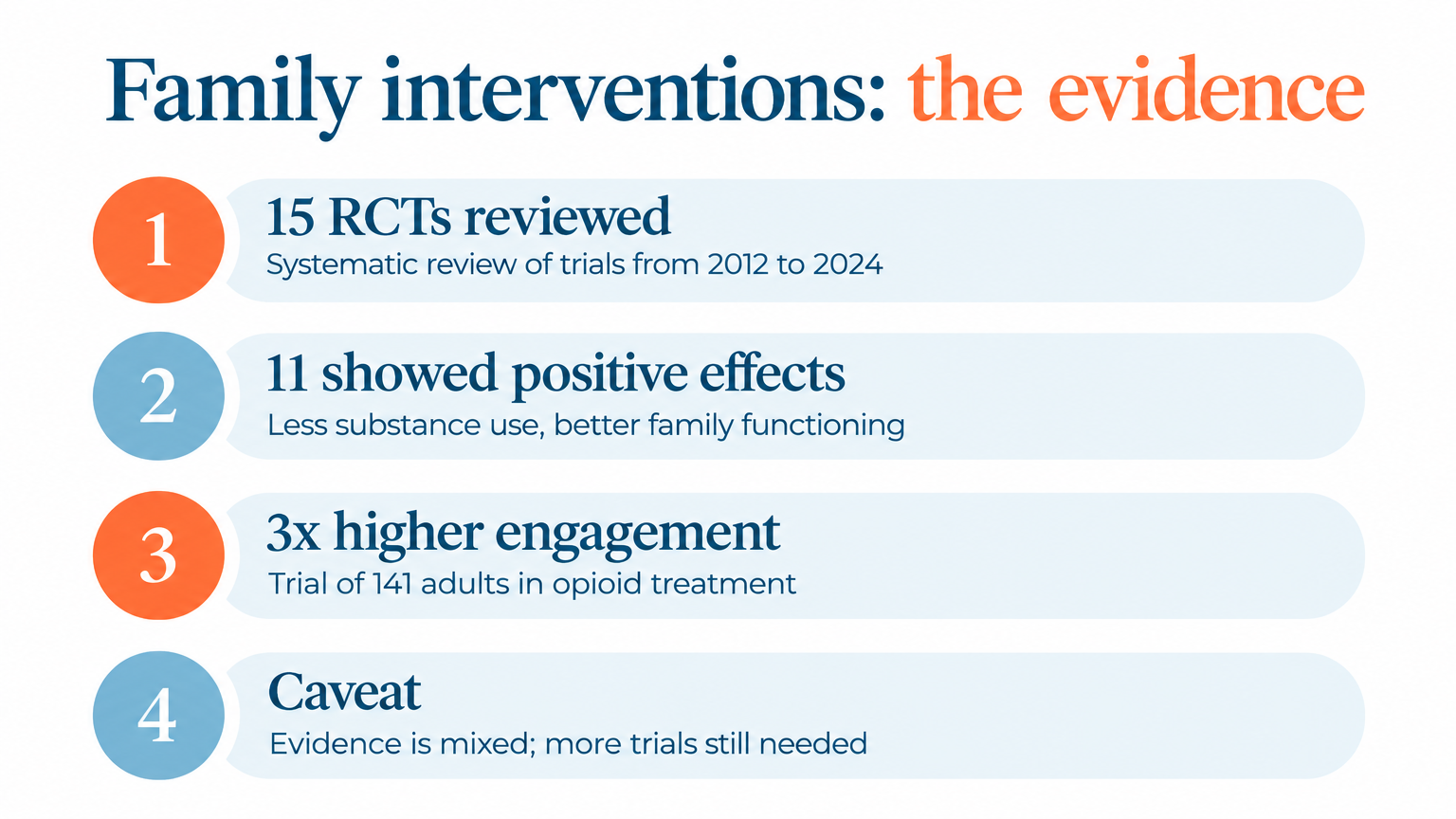
Here's the clearest recent read on the evidence. A 2026 systematic review of randomized controlled trials of family-based interventions for substance use disorders, covering trials published from 2012 through 2024, included 15 studies that met strict inclusion criteria. Of those, 11 reported significant positive effects, including reductions in substance use and improvements in family functioning. The authors are careful to add that the underlying trial evidence is heterogeneous and that more high-quality randomized trials are still needed, which is a fair caveat you should hear 1. A separate 2024 systematic review and meta-analysis of family-centered interventions reached a compatible conclusion: across models like multidimensional family therapy, multisystemic therapy, psychoeducation, motivational approaches, and Community Reinforcement and Family Training (CRAFT), families being involved was associated with better treatment engagement, better retention, reduced substance use, and stronger family resilience 12.
There's a specific finding worth sitting with. In a randomized trial of 141 adults receiving outpatient opioid agonist treatment, family engagement was associated with roughly three times higher odds of staying in treatment. Notably, it was not independently linked to opioid-use outcomes 3. Translation: when your family shows up thoughtfully, your loved one is more likely to keep showing up too. Retention isn't the whole story, but it's often the step that makes the rest of recovery possible.
What the evidence does not say is that any single conversation guarantees sobriety, or that love alone cures a serious illness. What it does say is that families who prepare, who get coached, and who stay involved give their loved one a meaningfully better chance at engaging and staying with care. That's a reason to proceed carefully, not a reason to hesitate.
Who should be in the room, and who should not?
Keep the circle small, trusted, and emotionally steady. The right room usually holds three to six people your loved one actually respects, each with a specific role, and no one whose presence would raise the temperature or widen old wounds.
Start with the people whose voices carry weight: a spouse or partner, a parent, an adult sibling, a close friend, sometimes a longtime mentor, clergy member, or employer who knows the person well. You want people who can speak from direct experience ("Here's what I saw at Thanksgiving") without pivoting into blame. If someone in your family tends to lecture, cry uncontrollably, or hijack conversations, love them from outside the room this time. They can be part of the plan without being part of the meeting.
Some people should be screened out, not because they don't matter, but because their presence changes what the meeting can safely do. SAMHSA's guidance is direct about this: joint family meetings are inappropriate when there is a history of domestic violence, threats, coercion, or extreme instability 10. A relative who is actively using in a way that will derail the conversation, a family member in acute mental health crisis, or anyone your loved one is afraid of should not be at the table. If any of those dynamics are live in your family, say so to whoever is helping you plan.
Young children generally do not belong in the room. Teenagers sometimes do, if they're mature, want to be there, and have been prepared for what they might hear. A facilitator can help you decide. If you are considering whether to include a professional (a recovery associate, interventionist, or clinician in a collaborative network), think of them as a steady presence who holds the structure so the family can speak from the heart, not as the person doing the talking for you.
One more quiet point: you belong in the room too. Your own steadiness, not just your words, is part of what makes the invitation land.
What actually happens during the conversation?
The meeting itself is usually shorter and quieter than families expect. Picture a living room, not a boardroom. Three to six people, seated, speaking in turn, with a facilitator holding the shape of the conversation so no one has to carry the structure and their feelings at the same time.
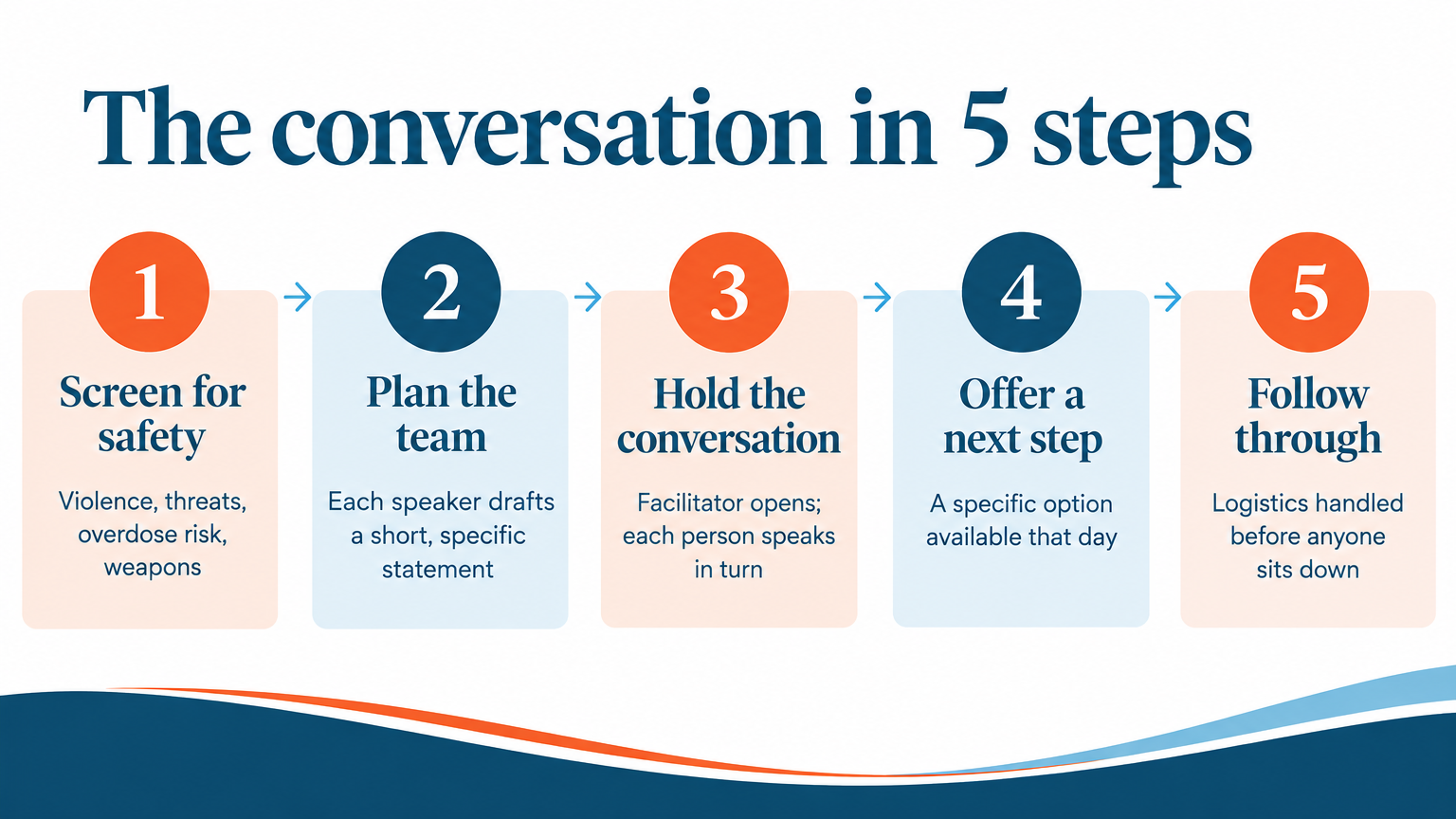
It usually moves through five steps, in roughly this order.
- Assess and screen for safety well before anyone sits down. A facilitator asks about domestic violence, threats, acute suicide or overdose risk, weapons in the home, and whether a joint meeting is appropriate at all. SAMHSA's TIP 39 is clear that family interventions should be matched to the person's situation and that providers should screen for situations where joint contact may be inadvisable, including domestic violence, threats, and extreme instability 10. If any of those risks are live, the plan changes, and 988 and 911 belong in the conversation from the start.
- Plan the team and the message. Each speaker drafts a short, specific statement: what you've seen, how it has affected you, and what you're asking for. No speeches, no inventories of past wrongs.
- Hold the conversation. The facilitator opens, invites each person to speak, and keeps the pace steady when emotions rise. Your loved one is asked to listen first, then respond.
- Offer a concrete next step. Not "get help someday" but a specific option available that day, with logistics already handled: a bed held, a clinician on standby, transportation ready, a bag quietly packed.
- Follow through in the first 72 hours and beyond. Whether the answer is yes, not yet, or no, somebody has already agreed to make the next call, keep the door open, and support the family in the days that follow.
Most of the real work happens before the meeting. By the time you sit down, you already know what you'll say, what you're offering, and what you'll do with any answer you receive.
What if your loved one says no?
A "no" is not a failure. It is information, and it is often the beginning of the next conversation, not the end of the story. Plan for it, and the meeting still does real work.
First, decide ahead of time what you will not do. You will not slam the door. You will not deliver a speech you've been saving. You will not pretend the meeting didn't happen. What you will do is thank your loved one for listening, leave the specific offer on the table, and name one small next step you're asking them to consider by a specific day. Keep your tone warm and your terms clear.
The research is encouraging here. Community Reinforcement and Family Training (CRAFT) is a structured approach that coaches family members in communication, positive reinforcement, and self-care, precisely for the situation where a loved one is refusing care. In a randomized pilot study of concerned family members, 60% of those who received CRAFT in a group format engaged their loved one in treatment compared with 40% in a self-directed condition, and both groups reported better family cohesion along the way, though the difference between formats was not statistically significant in this small pilot 13. Take the numbers as directional rather than guaranteed. The direction is still hopeful: steady, skillful family effort often moves someone from no to yes over weeks or months, not minutes.
Families also want this kind of support in forms that fit real life. A 2025 study of concerned significant others connected to people in opioid medication treatment found strong interest in CRAFT-informed groups delivered virtually, in the evenings or on weekends; the study measured interest and preferences, not treatment efficacy 5. If in-person feels impossible or exposing, flexible formats exist.
A "no" today does not require you to cut your loved one off. Ultimatums have their place, but they are not the only tool, and they are rarely the first one. What usually matters more is staying connected on your terms, continuing to work with a facilitator or CRAFT-trained clinician, and keeping the offer alive. Leave the door ajar. Most people who eventually accept help accepted it on the second, third, or fifth invitation, not the first.
Is this worth doing if the person you love refuses to participate?
Yes. Even when your loved one won't sit down with you, the work families do to prepare for an intervention tends to help the family itself, and it often reshapes what happens next.
Here's what the research actually shows about you, the family member. A systematic review of psychosocial interventions for adult family members affected by a relative's substance use pulled together 65 papers from 58 unique trials. Conjoint behavioral interventions improved family members' social well-being, including relationship satisfaction, stability, and family functioning, and were linked to reductions in intimate-partner violence 2. A separate meta-analysis of family-based interventions reported reductions in family members' anxiety, depression, sleep problems, and distress, along with improvements in social support 4. Your sleep. Your nervous system. Your sense that you are not alone in this. Those are legitimate outcomes, not consolation prizes.
There's also a practical return. When a concerned family member is coached, especially in a CRAFT-informed approach, families often report that their loved one eventually engages in care 13. You learn how to notice and reinforce the moments your loved one moves toward health, how to step back from the moments you've been accidentally cushioning, and how to speak in a way that keeps the relationship intact.
So the honest answer is this: a family intervention is still worth preparing for if your loved one won't participate today, because the preparation itself gives you tools, lowers your distress, and keeps a door open for the day they're ready to walk through it.
When should a professional facilitate instead of the family?
Bring in a trained facilitator when safety, complexity, or stuck patterns are shaping the room more than love is. A family-led conversation can be reasonable when the stakes are lower and the dynamics are workable; professional facilitation earns its keep when the risks or the history make a careful, outside hand necessary.
Here's a practical way to sort it out.
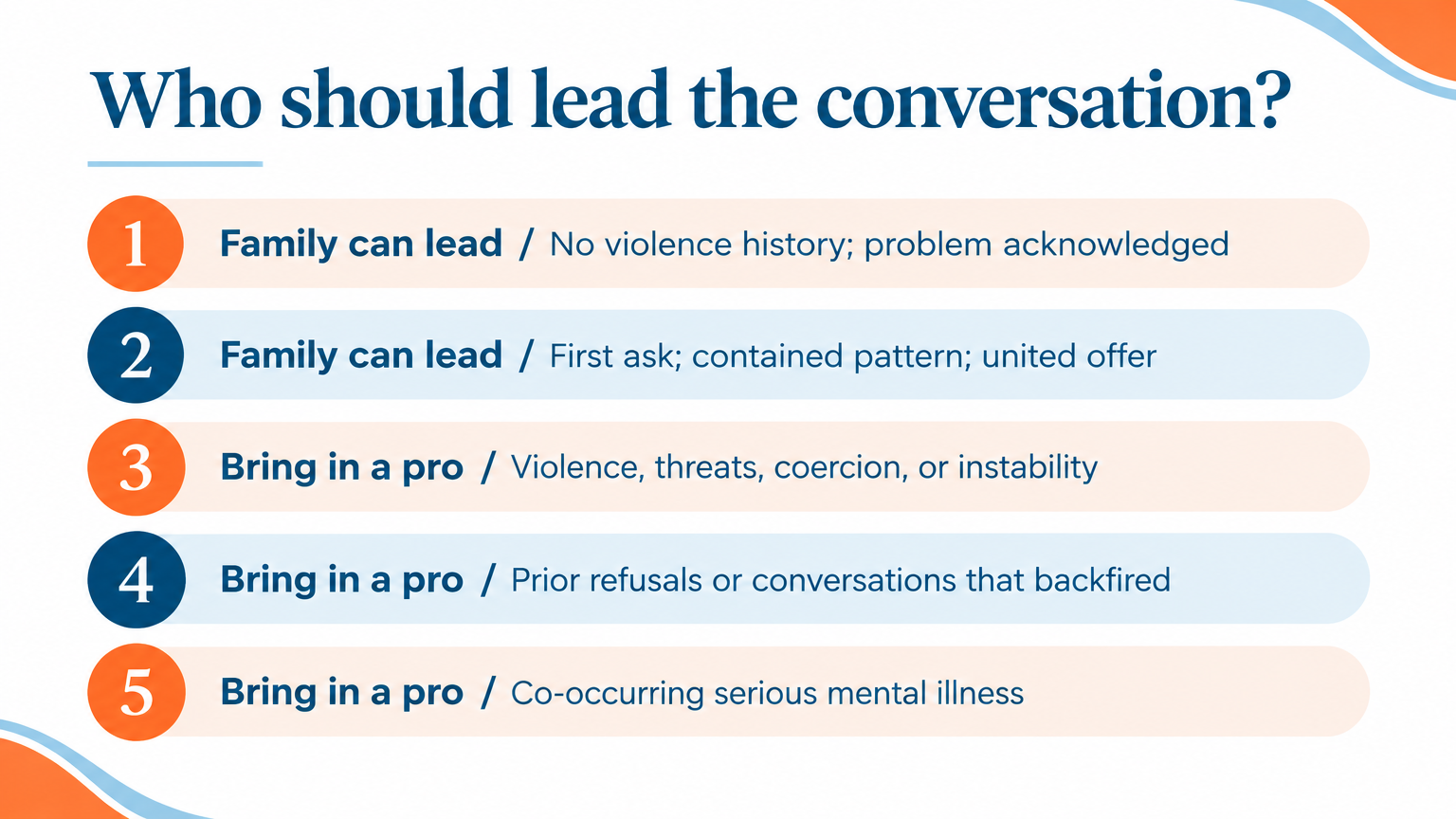
A family-led conversation may be enough when:
- There is no history of violence or coercion.
- Your loved one has acknowledged a problem in some form.
- This is a first or early concrete ask.
- The substance or behavior pattern is relatively contained.
- The family can agree on a single, specific offer without descending into old arguments.
Even then, a short consultation with a trained interventionist can tighten what you plan to say.
Professional facilitation usually helps when any of the following are in play:
- There is a history of domestic violence, threats, coercion, or extreme instability, in which case SAMHSA guidance is explicit that joint family meetings may be inadvisable and the plan needs to be redesigned before anyone sits down together 10, 9.
- Your loved one has refused help before, and prior family conversations have made things worse rather than better.
- There is a co-occurring serious mental illness, where evidence supports longer family programs that teach communication and problem-solving over several sessions rather than a single meeting 8.
- The concern involves an eating disorder, where medical risk and food-related dynamics raise the complexity.
- The person is an adolescent or emerging adult, where family models like multidimensional family therapy have specific evidence behind them 6.
- There is acute suicide, self-harm, or overdose risk, in which case 988 and 911 come first, and any family meeting is planned around that stabilization, not instead of it.
When you interview a facilitator, ask three plain questions:
- What is your training and approach, and how do you decide whether a joint meeting is appropriate at all?
- What does your preparation look like, and how many conversations with our family happen before the meeting?
- What happens in the 72 hours after, and who is actually making the next call?
A thoughtful answer will sound like assessment, not performance.
Does the model change for mental health crises, eating disorders, or a teenager?
Yes. The core posture stays the same (prepared, consent-informed, safety-screened), but what you say, who leads, and how long the work takes should shift with what your loved one is actually facing.
For a mental health crisis, slow down and reorder your priorities. Acute suicide risk, self-harm, or psychosis is not a moment for a prepared family meeting; it is a moment for 988, 911, or a local emergency department, with family support planned around that stabilization rather than instead of it. When a serious psychiatric illness co-occurs with substance use, the evidence tilts toward longer family work, not a single conversation. A randomized trial comparing brief family education with a longer program that added communication and problem-solving skills found improvements in both arms, with added gains from the longer approach 8. Expect several sessions, skill practice, and a slower arc.
For eating disorders, medical risk sits at the center of the room. Weight, labs, and vital signs can change what is even safe to discuss that day, and food-related dynamics make blunt confrontations backfire. The family's job is usually to open a door to a medical and therapeutic evaluation first, then let a specialty clinician shape what comes next. Scripts built for substance use do not transfer cleanly here.
For an adolescent or emerging adult, the model shifts most of all. Family is not an add-on; family is the treatment system. A 2024 systematic review of 41 studies of family interventions for young people found associations with reduced substance use, fewer behavioral problems, and improved family functioning, with models like multidimensional family therapy and multisystemic therapy carrying specific evidence 6. These findings should not be extrapolated to an older adult, and an older adult's playbook should not be forced onto a 16-year-old. With teenagers, confidentiality, school, peers, and developing autonomy all belong in the plan from the first conversation.
What happens the week after the meeting?
The week after is where interventions quietly succeed or quietly unravel, and most families underestimate how much it matters. Whatever answer your loved one gave in the room, the next seven days need a plan, not improvisation.
If the answer was yes, somebody already identified in your plan makes the first logistics call within hours, not days. Transportation happens. A bag goes in a car. Someone stays with your loved one until admission or the first appointment. Expect second thoughts between the yes and the front door; that's normal, not a betrayal. Keep the conversation small and warm, not persuasive.
If the answer was not yet, you hold the offer open and name a specific check-in: a call Thursday, coffee Sunday. You do not relitigate the meeting. You do watch for the openings CRAFT-trained families learn to notice and gently reinforce 13.
And the family needs its own week. Sleep. A walk. A call with the facilitator to debrief. If acute suicide or overdose risk emerges, 988 and 911 come first, every time. The meeting was one conversation. Recovery, and your steadiness inside it, is the longer work.
A quiet word about cost, privacy, and how to vet a facilitator
Professionally facilitated interventions are almost always private pay. Fees vary by scope, travel, and how much preparation and follow-through are built in, so ask any facilitator to put the scope and fee structure in writing before you commit. If insurance reimbursement is part of your picture, ask whether the firm can help you submit documentation afterward; many families find partial reimbursement is possible for related clinical services, even when the facilitation itself is not covered.
Privacy deserves the same directness. Ask who will know your family's name, how notes are stored, whether staff travel discreetly, and what the firm's policy is on media or public exposure. For high-profile families, confidentiality should be contractual, not aspirational.
When you vet a facilitator, pay attention to how they answer hard questions. A thoughtful one will decline a case that isn't right for their approach, name the limits of their training, and tell you plainly when 988, 911, or a medical evaluation comes before any family meeting 9. That restraint is the signal you want.
Starting a confidential conversation
If you've read this far, you're already doing the harder part of the work: trying to think clearly about someone you love while the ground is shifting. You don't have to decide today whether to hold a family intervention. You can start by talking it through with someone who does this quietly, for a living.
Next Level Wellness & Behavioral Health is a concierge behavioral health firm based in Boca Raton, Florida, serving families nationally and internationally. Our team, led by founder Amanda Marino, helps you assess the situation, plan a safe and prepared conversation, and coordinate care before, during, after, or in place of treatment. That's what Creating Lasting Change looks like in practice: steady support shaped around your family, not a template. If you're a referring professional reading on behalf of a client family, we welcome that call too.
Frequently Asked Questions
How long does it take to plan a family intervention?
Most prepared interventions take one to three weeks from the first call to the day you sit down together. Simple situations with a willing family and a clear treatment option can move faster. Complex ones, especially those involving safety screening, co-occurring mental illness, or coordinating travel, usually need longer. Rushing the preparation is where things most often go sideways.
Can we hold an intervention if our loved one is in active crisis?
No. If your loved one is at acute risk of suicide, self-harm, or overdose, call 988 or 911 and get them to a medical evaluation first. A prepared family conversation is not the right tool for a crisis moment. Federal guidance recommends screening for situations where joint meetings may be inappropriate, including extreme instability, so stabilization should come before any family meeting 10.
Should children or teenagers be present during the conversation?
Young children, no. Teenagers, sometimes. A mature teen who understands what might be said, wants to be there, and has been prepared for hard moments can speak honestly in ways that land. A teen who feels pressured or protective of a parent should not be put in that seat. When in doubt, let them write a letter someone else reads.
What do we say if our loved one agrees to treatment but changes their mind the next day?
Expect it. Second thoughts between yes and the front door are common, not a betrayal. Stay warm and specific. Remind them of what they said and what's already arranged (the bed, the ride, the person traveling with them), and ask what feels different today. Don't argue. Offer to go with them to the first appointment or admission, and keep the plan small and concrete.
Do we have to issue ultimatums or cut our loved one off if they refuse help?
No. Ultimatums have a place, but they are rarely the first move, and they only work when you can actually follow through. CRAFT-informed approaches coach families to stay connected, reinforce healthy moments, and keep the offer open, and families using these methods often see their loved one eventually engage in treatment 13. Boundaries protect you. Cutoffs are a last resort, not an opening bid.
How do we keep an intervention private in a small community or high-profile family?
Choose a facilitator who treats discretion as a contract, not a courtesy. Ask who will know your name, how notes are stored, whether staff travel without identifying materials, and what the policy is on media exposure. Hold the meeting somewhere unlinked to your family's public life. The smaller the circle of people who know, the easier privacy is to protect from the first call forward.
References
- Efficacy of Family-based Interventions in Addressing Substance Use Disorders: A Systematic Review on Randomized Controlled Trials. https://pubmed.ncbi.nlm.nih.gov/41970367/
- Psychosocial Interventions to Improve Psychological, Social and Physical Wellbeing in Family Members Affected by an Adult Relative's Substance Use: A Systematic Search and Review of the Evidence. https://pubmed.ncbi.nlm.nih.gov/33673199/
- The impact of family engagement in opioid assisted treatment: Results from a randomised controlled trial. https://pubmed.ncbi.nlm.nih.gov/33325311/
- A systematic review and meta-analysis of the effectiveness of family-based interventions for families of people with substance use disorders. https://pubmed.ncbi.nlm.nih.gov/34383317/
- "All I want is the best for my brother": interest in a Community Reinforcement and Family Training (CRAFT)-based group intervention among concerned significant others of individuals on office-based medications for opioid use disorder. https://pubmed.ncbi.nlm.nih.gov/40745287/
- Family Intervention Models for Young Adults with Substance Abuse: A Systematic Review. https://pubmed.ncbi.nlm.nih.gov/39564277/
- Family intervention for co-occurring substance use and severe psychiatric disorders: participant characteristics and correlates of initial engagement and more extended exposure in a randomized controlled trial. https://pubmed.ncbi.nlm.nih.gov/19375870/
- A randomized controlled trial of family intervention for co-occurring substance use and severe psychiatric disorders. https://pubmed.ncbi.nlm.nih.gov/22282453/
- The Importance of Family Therapy in Substance Use Disorder Treatment. https://library.samhsa.gov/sites/default/files/pep20-02-02-016.pdf
- TIP 39 Substance Use Disorder Treatment and Family Therapy. https://www.ncbi.nlm.nih.gov/books/NBK571080/pdf/Bookshelf_NBK571080.pdf
- Principles of Drug Addiction Treatment: A Research-Based Guide. https://nida.nih.gov/sites/default/files/podat-3rdEd-508.pdf
- Family-centred interventions for people with substance use disorders: a systematic review and meta-analysis. https://pmc.ncbi.nlm.nih.gov/articles/PMC11367307/
- Community Reinforcement and Family Training: A Pilot Study. https://pmc.ncbi.nlm.nih.gov/articles/PMC3331969/
Insight Beyond Treatment
At Next Level Wellness & Behavioral Health, we believe meaningful change starts with perspective, not just protocols.
That philosophy is directly led by Amanda Marino, whose voice in behavioral health extends beyond clinical settings into leadership, culture, and personal growth.
Through keynote speaking and live events, Amanda explores the deeper themes that show up in recovery, family systems, and life transitions: authenticity, resilience, accountability, and the courage to change. Her work invites audiences to move past labels and into honest conversations that create lasting impact.
A Voice Shaping the Conversation
The topics explored here—change, self-awareness, recovery, and growth—are the same themes Amanda Marino brings to audiences nationwide through speaking engagements and live events.
Known for her appearances on A&E’s Intervention and Digital Addiction, Amanda speaks to organizations, communities, and leadership teams about navigating adversity, embracing vulnerability, and building lives rooted in purpose. Her message resonates far beyond treatment, offering insight that applies to families, professionals, and anyone standing at a crossroads.



Heal on your terms—any time, anywhere.