.svg)

Sober Companion FL: What Professionals Should Know

Key Takeaways
- Florida regulates recovery housing tightly through FS 397.4873, FARR certification, and 2025's HB 1163, giving professionals concrete signals to verify a companion provider's legitimacy.1,6,8
- A sober companion offers peer-based, non-clinical support grounded in lived experience, while diagnosis, therapy, and medication decisions remain with licensed clinicians operating in clean, separate lanes.10
- Discretion in Florida means more than an NDA: confidentiality should cover case notes, payment routing, household integration, travel logistics, and separate written authorizations for each third party.
- Before hiring, verify credentials by name, ask directly about referral relationships and scope, and put hours, travel terms, coordination, and exit conditions in writing.
When Recovery Has to Fit a Calendar That Doesn't Stop
You already know what recovery is supposed to look like in a brochure. The version you're actually living looks different. There's a 6 a.m. flight to Miami on Tuesday, a deposition the following week, a board dinner in Palm Beach, and a family wedding in Naples that you cannot reasonably skip. Somewhere inside all of that, your sobriety has to hold.
That's the real question behind a search for sober companion support in Florida. Not what is this service, but can it actually move with my life without exposing it?
Florida is a useful place to ask. With a population of roughly 23.4 million as of July 2024, the state has built one of the most active recovery-support ecosystems in the country, and also one of the most regulated. There are referral rules under Chapter 397 that licensed providers have to follow, certifications you can verify, and ongoing 2025 legislative activity refining how residences and administrators are overseen. For a professional vetting private support, that regulatory density is actually a feature. It gives you signals to read.1,6,7
What follows isn't a primer on what a sober companion is. You can find that anywhere. This is closer to a peer briefing: how concierge companion work fits into a continuum of care, what Florida's oversight layers tell you about legitimacy, what discretion should mean operationally, and how to vet someone before you let them anywhere near your home, your calendar, or your family.
Wanting privacy while you protect your recovery isn't a character flaw. It's a reasonable design constraint. The rest of this article treats it that way.
What a Florida Sober Companion Actually Does (And What They Don't)
The Day-to-Day Work: Lived Experience, Not Clinical Care
Strip away the marketing language and a sober companion's day looks practical. They're with you, or near you, during the parts of your week where recovery would otherwise be exposed or unsupported. That can mean a morning routine before a 7 a.m. call, the hours between depositions, an out-of-town conference where the hotel bar is in the lobby, or the stretch between dinner and bedtime that has historically been the hardest part of your day.
SAMHSA describes peer recovery coaches as people who "walk side by side" with someone in recovery and help them "create their own recovery plans" using lived experience as the foundation. That phrase, walking alongside, is closer to the truth than any clinical-sounding job description. A companion isn't running your treatment. They're present while you run your life, and they bring a recovery framework into the ordinary hours where relapse usually starts — not in dramatic moments, but in the quiet ones.10
Day to day, that looks like a few specific things:
- Helping you keep recovery commitments when the calendar pushes back.
- Sitting with you through cravings or anxiety without trying to therapize them.
- Coordinating logistics around meetings, meals, sleep, and travel.
- Holding a thread of accountability that you've asked for, in a tone you've agreed to.
SAMHSA frames this kind of support as a way to help people stay engaged in recovery and reduce relapse risk, and that's the realistic claim — not a cure, but a held line.2
What it isn't: a sponsor, a therapist, a bodyguard, or a babysitter. The work is collaborative, and you're still the one driving.
Companion vs. Clinician: Where the Lines Sit
This is where confusion costs people money and, sometimes, continuity of care. A sober companion and a clinician are doing genuinely different jobs, and a good companion knows exactly where their work stops.
SAMHSA's peer coach brief is direct about the boundary. Peer recovery coaches walk alongside individuals, help build recovery plans, and offer practical and emotional support grounded in lived experience. They are not diagnosing. They are not prescribing. They are not delivering psychotherapy. SAMHSA's broader peer support framing reinforces the same line — peer workers extend treatment into daily life and help reduce relapse risk, but they sit beside clinical care, not on top of it.2,10
A useful way to see it side by side:
- Companion (peer-based, non-clinical): Lived experience. Recovery planning support. Real-time accountability. Logistics, routines, and environmental support. Presence during high-risk windows. Coordination with your treatment team when you authorize it.
- Clinician (licensed, scope-of-practice bound): Diagnosis of substance use or mental health conditions. Psychotherapy. Medication management. Treatment planning in a clinical sense. Documentation tied to a license and a payer.
The reason this matters operationally: if someone is selling you a "companion" who also promises to do therapy or adjust medications, that's a scope problem, not a feature. And if a clinician is offering to live in your home for a week to keep you accountable between sessions, that's also a scope problem, just in the other direction.
The strongest setups usually involve both, with clean lanes. Your psychiatrist or therapist holds the clinical work. Your companion holds the daily-life work. They talk to each other when you give written permission, and they don't try to do each other's jobs.
When you're vetting someone, listen for how they describe the line. A companion who can articulate what they don't do — cleanly, without defensiveness — is usually the one worth hiring. The ones who blur the line tend to blur other things too, and that's where families get hurt and recoveries get derailed. You deserve clarity here, and it's reasonable to ask for it in plain language during the first conversation.

The Evidence Base: What Peer Recovery Research Actually Shows
Here's where you deserve a straight answer instead of marketing. The honest version: peer recovery support has real, growing evidence behind it. Concierge sober companionship, as a specific service line, does not yet have its own dedicated body of randomized trials. Those two things can be true at the same time, and it's worth understanding the difference before you commit money or trust.
The most current synthesis comes from a 2025 systematic review of peer recovery support services and recovery coaching for substance use disorders. It found that these services are generally associated with improvements in substance use, treatment engagement, and psychosocial outcomes — meaning people tend to stay in treatment longer, use less, and function better in the parts of life that matter to them. The same review is candid about its limits: study designs vary, outcome measures aren't standardized, and the field still needs more rigorous trials before anyone can quote a clean effect size.4
Important scope note. That review studied peer recovery support and coaching broadly — community-based peers, recovery coaches inside treatment programs, telephonic check-ins, structured aftercare. It did not study concierge sober companions working with executives in Boca Raton or attorneys in Tampa. The mechanism is similar. The population studied was not.
SAMHSA's framing fills in the why. Peer support workers help people become and stay engaged in recovery and reduce the likelihood of relapse, and recovery itself is defined as a self-directed process of improving health and wellness over time, not a single endpoint. Companion work operates inside that frame — it extends treatment into the hours and locations where clinical care doesn't reach.2,3
What this means for you, practically: you should expect a companion arrangement to support your recovery, not guarantee an outcome. Anyone promising guaranteed sobriety is overselling, and the research doesn't back that language. What the evidence does support is the underlying idea — that having a trained peer present during high-risk windows, helping you keep recovery commitments while life keeps moving, is a reasonable and increasingly evidence-aligned use of your money and attention.
That's a more useful place to start a conversation with a provider than a glossy brochure.
Florida's Oversight Layers, and Why They Matter to You
FS 397.4873, FARR Certification, and the 2025 HB 1163 Updates
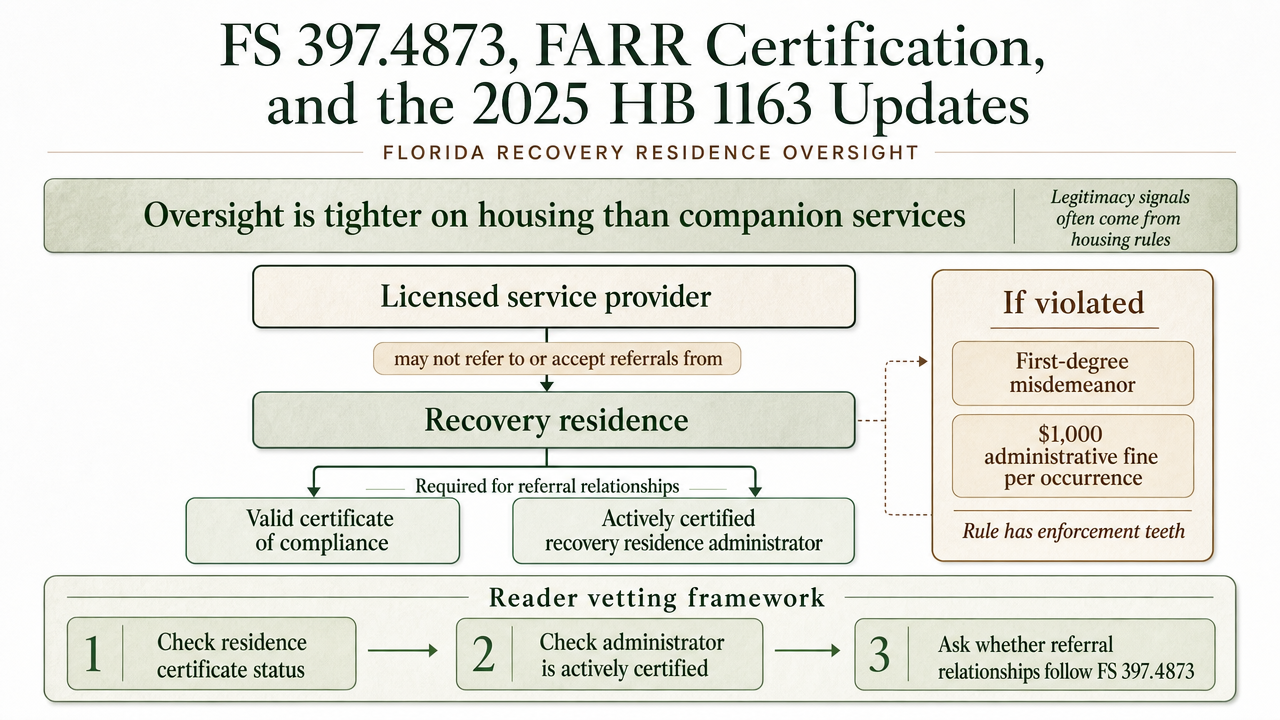
Florida regulates the housing side of recovery much more tightly than it regulates the companion side. That asymmetry is worth understanding, because most of the legitimacy signals you'll use to vet a companion provider actually come from the housing rules they intersect with.
Start with the statute. Florida Statute 397.4873 says that licensed service providers may not refer patients to a recovery residence — or accept referrals from one — unless that residence holds a valid certificate of compliance and has an actively certified recovery residence administrator. Violations aren't just bureaucratic. They can be charged as a first-degree misdemeanor, with $1,000 administrative fines per occurrence. That's the teeth behind the rule, and it's the reason any reputable provider in Florida is careful about who they refer to and who refers to them.1
The certification side is structured around two bodies. The Florida Association of Recovery Residences (FARR) certifies the residences themselves. The Florida Certification Board issues the administrator credentials that those residences are required to have on staff. If a companion provider is suggesting you stay somewhere, or is housed alongside a residence operation, those are the two credentials you can actually verify by name.8
The 2025 layer is HB 1163. The bill adds auditing requirements for Level IV certified recovery residences and adjusts how local governments may regulate certain multifamily settings. The accompanying Senate analyses confirm the same direction — more state oversight, clarified roles for certifiers, and continued tension with local zoning. None of this regulates a sober companion directly. But it tells you something useful: Florida is tightening the perimeter around recovery housing, and providers operating in good faith will be able to speak to these rules without flinching.5,6,8
When you ask a Florida companion provider how they handle housing referrals, you're really asking whether they understand 397.4873. The ones who do will answer in specifics. The ones who don't will change the subject.
Red Flags in Referral Relationships
The patterns to watch for are usually subtle, because the obvious ones got priced out of the market years ago.
Listen for who pays whom. If a companion provider is steering you toward a specific residence, treatment center, or detox facility and can't clearly explain the business relationship, that's a question worth pressing. FS 397.4873 exists precisely because financial benefit inside referral chains has historically distorted care decisions in Florida. A clean operator will tell you, without prompting, whether they have any financial relationship with a place they're recommending.1
Listen for vagueness around certification. "We work with great houses" is not an answer. "This residence holds a current FARR certificate of compliance and the administrator is credentialed through the Florida Certification Board" is an answer. You don't need to be the one verifying — you need to hear that the provider verifies, routinely, as a condition of working with anyone.8
A few other signals worth weighting:
- Pressure to decide quickly.
- Reluctance to put scope, hours, and coordination terms in writing.
- Discomfort when you ask to involve your existing therapist or physician.
- Promises that sound clinical from someone who isn't licensed to make them.
None of these are dealbreakers in isolation. Together, they tell you whether the person across from you treats Florida's oversight framework as a baseline or an inconvenience. You want the former. Your recovery, and your privacy, are easier to protect when the people supporting you already operate inside the lines the state has drawn.
Insight Beyond Treatment
At Next Level Wellness & Behavioral Health, we believe meaningful change starts with perspective, not just protocols.
That philosophy is directly led by Amanda Marino, whose voice in behavioral health extends beyond clinical settings into leadership, culture, and personal growth.
Through keynote speaking and live events, Amanda explores the deeper themes that show up in recovery, family systems, and life transitions: authenticity, resilience, accountability, and the courage to change. Her work invites audiences to move past labels and into honest conversations that create lasting impact.
What 'Discreet' Should Actually Mean in Practice
Confidentiality Structures, Not Just NDAs
An NDA is the floor. If that's the only confidentiality structure a provider can describe, you're looking at a thin operation.
What you actually want to hear about is how information moves, and how it doesn't:
- Who on the companion's team knows your name.
- Whether case notes are written, where they're stored, and who can access them.
- How payment is processed so that a charge on a corporate card doesn't tell your CFO a story you didn't authorize.
- Whether the companion's own household, partner, or roommates know who they're working with this week.
- How records are handled if you end the engagement.
- What happens if a subpoena lands on the provider's desk during a divorce or a regulatory inquiry.
You also want explicit written terms around communication with third parties. Your therapist, your psychiatrist, your attorney, your spouse, your assistant — each one is a separate authorization, not a bundle. SAMHSA's framing of recovery as a self-directed process is useful here in a practical sense: you decide who knows what, and the provider's job is to honor that with operational discipline, not just paperwork.3
A strong companion provider will walk you through these mechanics without being asked. If you have to drag the answers out of them, that tells you how confidentiality will function on a Tuesday afternoon when no one is watching.
Travel, Household Integration, and the EAP Question
Discretion gets tested by logistics. A red-eye to New York, a closing dinner in Coral Gables, a week at a rental in the Keys with extended family — each one is a small confidentiality problem waiting to be solved before it happens.
Ask how travel actually works. Whether the companion books their own flights or yours books theirs. What name appears on the hotel reservation. Whether they stay in an adjoining room, a separate floor, or a different property entirely. How they're introduced if a colleague sees you together at breakfast — the cover story should be one you helped write, not one improvised at the buffet.
Household integration is its own conversation. If a companion is in your home for a stretch, your kids, your housekeeper, your assistant, and the contractor finishing the kitchen will all notice. You decide in advance what each of them is told. "Family friend visiting from out of town" works for some households. A consultant working on a personal project works for others. The point is that the answer is set before anyone asks, not after.
The EAP question is where professionals often get stuck. Your employer's Employee Assistance Program may offer real benefits, but using it can create a record. A private companion arrangement sits outside that record entirely, and many professionals use SAMHSA's confidential National Helpline as a separate, anonymous information channel while keeping their private support fully off the corporate paper trail.11
A Vetting Checklist You Can Actually Use
Print this. Or hand it to the clinician helping you make the call. Either way, these are the questions that separate a legitimate Florida companion provider from a polished website.1,8,10
- On credentials and structure. What recovery-related certifications does the companion hold, and through which body? If housing is part of the conversation, does the residence hold a current FARR certificate of compliance, and is the on-site administrator credentialed through the Florida Certification Board? Can you verify both by name today, on the phone, while we're talking?
- On referral relationships. Do you have any financial relationship — direct, indirect, or marketing-based — with any treatment center, detox facility, or recovery residence you might recommend? Florida Statute 397.4873 restricts licensed providers from referring to or accepting referrals from a recovery residence without proper certification, and treats violations as a first-degree misdemeanor with administrative fines. A clean operator will answer this question without flinching.
- On scope. What specifically will the companion do, and what will they not do? You want to hear a clear non-clinical boundary — no diagnosis, no therapy, no medication decisions — consistent with how SAMHSA frames peer recovery coaching: walking alongside, supporting recovery planning, drawing on lived experience. If the answer blurs into clinical territory, stop.
- On coordination. How will the companion communicate with your existing therapist, psychiatrist, or physician, and under what written authorization? Who initiates check-ins, how often, and what gets documented? You're entitled to set the terms here.
- On the practical. What are the hours, the rate structure, the travel terms, and the exit terms in writing? How is payment processed so it doesn't surface where it shouldn't? Who is the backup if your assigned companion is unavailable on a Sunday night?
If a provider answers these in specifics, you're in a real conversation. If they answer in adjectives, you have your answer.
Coordinating Companion Support With Your Existing Care Team
The companion piece works best when it isn't working alone. If you already have a therapist, a psychiatrist, a primary care physician, or a treatment team you trust, the goal isn't to add another silo — it's to give those clinicians a set of eyes and ears in the parts of your week they never see.
Practically, that starts with written authorization. Each clinician you want looped in is a separate release, naming exactly what can be shared and in which direction. Your psychiatrist might need to know about sleep patterns and medication adherence on travel days. Your therapist might want a brief weekly note about what came up between sessions. Your physician might not need to be in the loop at all. You decide the granularity, and the companion documents the limits.
The cadence matters more than people expect. A short Sunday-evening check-in between the companion and your therapist, before the week starts, is often more useful than a long monthly summary written after the fact. SAMHSA frames recovery as a self-directed process, and that principle holds here — you set the rhythm that protects continuity without turning your life into a case file.3
One quiet test of a good arrangement: when something hard happens on a Wednesday night, the companion knows who to call, what they're allowed to say, and what stays with you until you decide otherwise.
For support that meets you right where you are—anytime, anywhere—connect with us today.
Frequently Asked Questions
Is a sober companion the same as a recovery coach or peer support worker in Florida?
The roles overlap more than they differ. All three draw on lived experience and non-clinical support, and SAMHSA describes peer recovery coaches as people who walk alongside someone building a recovery plan. Sober companion usually signals a concierge, lifestyle-integrated version of that work — more hours, more travel, more household presence — but the underlying scope is the same: peer-based support, not clinical treatment.10
Do sober companions in Florida need to be certified or licensed?
Florida does not license sober companions as a distinct profession. The state's heavier oversight sits on recovery residences and their administrators, with FARR certifying residences and the Florida Certification Board issuing administrator credentials. Companions themselves often hold peer recovery or coaching certifications voluntarily. Ask what credential they carry, which body issued it, and whether it's current. The absence of a state license makes voluntary credentialing more meaningful, not less.8
What factors influence the cost of concierge sober companion support?
Cost moves with structure, not a flat rate. The main drivers are hours of coverage, live-in versus hourly, travel demands, the companion's experience level and credentials, and how much clinical coordination is involved with your therapist or physician. A weekend at home reads differently than a week of cross-country travel. Ask for written terms covering hours, travel reimbursement, overnight rates, and exit conditions before you commit, not after.
Can a sober companion travel with me for work or family obligations?
Yes, and for many professionals that's the point. A companion can cover a deposition week, a board offsite, a closing dinner, or a family wedding in Naples. Settle the logistics in advance: who books flights, what name is on the hotel reservation, adjoining room or separate floor, and the cover story for colleagues or family. The arrangement should fit your life quietly, not announce itself in a hotel lobby.
How does a companion coordinate with my therapist, physician, or treatment team?
Through written authorization, one clinician at a time. You name who can be contacted, what can be shared, and in which direction. A common rhythm is a brief weekly check-in with your therapist and medication-adherence notes to your psychiatrist on travel days. SAMHSA frames recovery as a self-directed process, and that applies here — you set the cadence and the limits, and the companion documents within them.3
What confidentiality protections should I expect beyond a standard NDA?
An NDA is the starting line. Ask how case notes are stored and who can access them, how payment is processed so charges don't telegraph what they shouldn't, whether the companion's household knows who they're working with, and how records are handled if you end the engagement or a subpoena arrives. You should also expect separate written authorizations for each third party — therapist, attorney, spouse, assistant — rather than a single bundled release.
References
- Chapter 397 Section 4873 - 2022 Florida Statutes. https://www.flsenate.gov/laws/statutes/2022/397.4873
- Peer Support Workers for Those in Recovery - SAMHSA. https://www.samhsa.gov/substance-use/recovery/peer-support-workers
- Recovery and Support | SAMHSA. https://www.samhsa.gov/substance-use/recovery
- Peer Recovery Support Services and Recovery Coaching for Substance Use Disorders: A Systematic Review. https://pmc.ncbi.nlm.nih.gov/articles/PMC12811009/
- Recovery Residences - Florida Senate. https://www.flsenate.gov/Session/Bill/2025/1163/Analyses/h1163d.HHS.PDF
- CS/CS/HB 1163 (2025) - Certified Recovery Residences. https://www.flhouse.gov/Sections/Bills/billsdetail.aspx?BillId=81849
- Florida - U.S. Census Bureau QuickFacts. https://www.census.gov/quickfacts/fact/table/FL/PST045224
- Recovery Residences - Florida Senate. https://www.flsenate.gov/Session/Bill/2025/1163/Analyses/h1163b.IAS.PDF
- NSDUH Behavioral Health Barometer: Florida, Volume 8. https://www.samhsa.gov/data/report/nsduh-behavioral-health-barometer-florida-volume-8
- Peers Supporting Recovery from Substance Use Disorders. https://www.samhsa.gov/sites/default/files/programs_campaigns/brss_tacs/peers-supporting-recovery-substance-use-disorders-2017.pdf
- National Helpline for Mental Health, Drug, Alcohol Issues. https://www.samhsa.gov/find-help/helplines/national-helpline
A Voice Shaping the Conversation
The topics explored here—change, self-awareness, recovery, and growth—are the same themes Amanda Marino brings to audiences nationwide through speaking engagements and live events.
Known for her appearances on A&E’s Intervention and Digital Addiction, Amanda speaks to organizations, communities, and leadership teams about navigating adversity, embracing vulnerability, and building lives rooted in purpose. Her message resonates far beyond treatment, offering insight that applies to families, professionals, and anyone standing at a crossroads.


Heal on your terms—any time, anywhere.