.svg)

How to Find Discreet Addiction Help Near Me

Key Takeaways
- Searching for treatment privately is a rational risk assessment, and federal law already gives substance use records privacy protections that sit above standard medical rules.12
- 42 CFR Part 2 requires written consent for each disclosure of substance use records, forbids redisclosure, and blocks routine subpoenas, giving you leverage HIPAA alone does not.1,4,12
- The 2024 final rule taking effect February 16, 2026 streamlines consent mechanics but preserves core protections, so ask any prospective program how they are updating forms and systems.13
- Part 2's exceptions are narrow and defined, covering emergencies, audits, qualified research, and mandated abuse reporting, but not employers, insurers, or licensing boards.3
- SAMHSA's FindTreatment.gov and National Helpline let you build a shortlist anonymously, giving reconnaissance without creating any account or record tied to your name.7,8
- EAPs route you to third-party counselors whose records stay walled off from HR and personnel files, making them a fast confidential triage option.10,11
- Concierge and private outpatient care combine self-pay privacy with scheduling built around trials, call weeks, and travel, layered on top of Part 2's legal floor.12,14
- Vet telehealth providers on platform compliance, secured networks, encrypted storage, and clear intake language, and prepare your own private environment on the other end.5,6
The Search Itself Is an Act of Competence
You opened a private browser window. You typed something you have not said out loud yet. That is not weakness. That is the same risk assessment you run before a deposition, a board vote, a difficult diagnosis, or a term sheet. You are gathering information before you commit.
The worry underneath the search is usually not whether help exists. You already know it does. The worry is what happens to your name, your license, your firm, your family standing, and the professional identity you spent two decades building if the wrong person finds out you asked.
Here is what most articles about finding local addiction help miss: the privacy you need is already written into federal law. Substance use records receive protections that sit above standard medical privacy rules, with specific limits on disclosure, consent, and use in legal proceedings. Federal treatment locators are designed to be confidential and anonymous by default.7,12
So the real question is not where to look. It is how to choose a pathway that uses those protections on purpose. That is what the rest of this guide gives you.
The Privacy Architecture Already Built Around Your Care
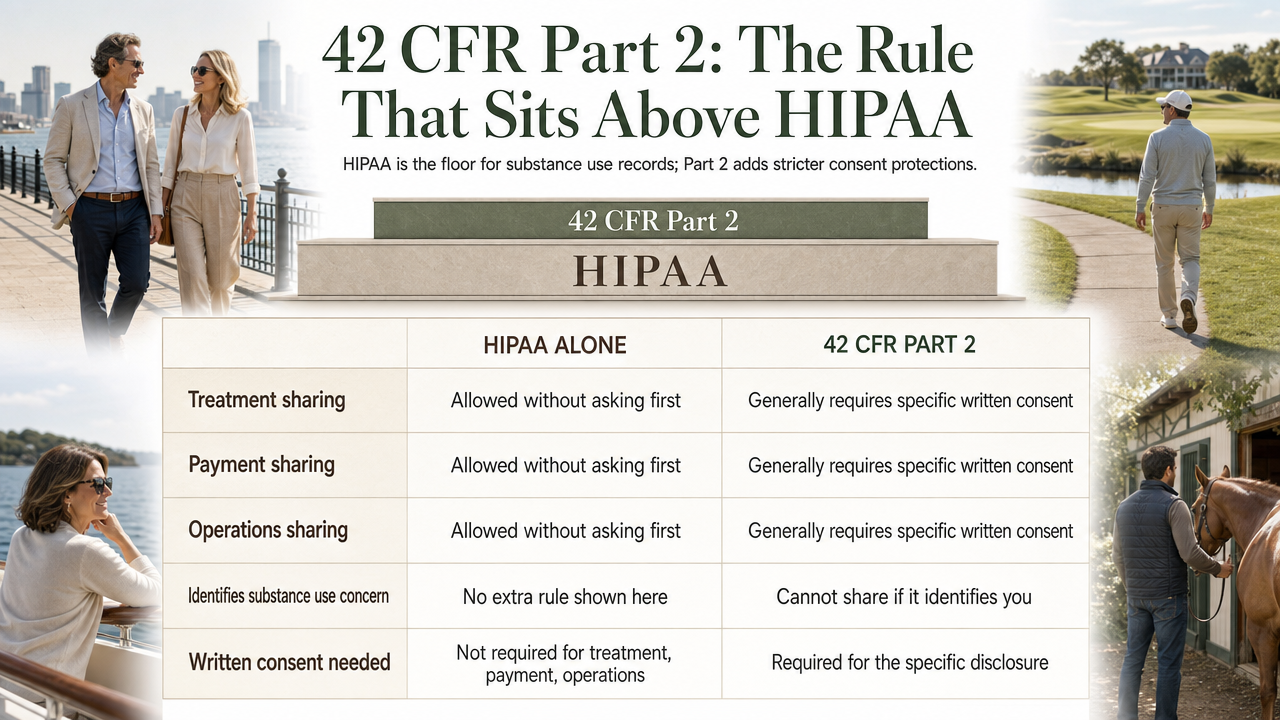
42 CFR Part 2: The Rule That Sits Above HIPAA
You already know HIPAA. Every intake form you have ever signed reminded you of it. What you may not know is that HIPAA is the floor for substance use records, not the ceiling. A second federal rule, 42 CFR Part 2, sits on top of it, and it was written specifically so that people in your position could seek help without their treatment history being used against them later.12
Here is the difference that actually matters to you. Under HIPAA alone, a covered provider can share your protected health information for treatment, payment, and operations without asking you first. Under Part 2, a program that specializes in substance use care generally cannot share anything that would identify you as having, or having had, a substance use concern unless you give written consent for that specific disclosure. Consent is required for each disclosure. Redisclosure by the recipient is forbidden unless you consent again.1,4
The comparison below is the leverage you have been looking for.
Read that fourth row again. A subpoena that would pry loose an ordinary medical record cannot, on its own, reach a Part 2 record. Opposing counsel, a licensing board investigator, or a curious insurer has to clear a higher bar. That is the protection you are stepping into when you choose a program that operates under Part 2.
What the February 16, 2026 Final Rule Changes
Part 2 is not static. In 2024, HHS finalized a rule that reshapes how substance use records are handled, and every covered program must comply by February 16, 2026. If you are choosing care right now, you are choosing it during a transition, and it is worth knowing what shifts under your feet.13
The final rule aligns several Part 2 provisions with HIPAA and HITECH while keeping the core protections intact. The categories of information that remain shielded are broad: your identity, diagnosis, prognosis, and treatment records tied to substance use care all stay inside the Part 2 fence. Written consent is still the gateway for disclosure. Redisclosure limits still apply.13
What changes is the mechanics. A single patient consent can now cover all future uses for treatment, payment, and health care operations, rather than requiring a fresh signature for each exchange. That reduces paperwork friction between your outpatient program and a coordinating physician you have already approved. It does not open the door to disclosures you did not authorize.
What this means for you: any program you interview between now and February 2026 should be able to explain, in plain language, how they are updating their consent forms, their notice of privacy practices, and their records systems to meet the new standard. If a provider cannot articulate this, that is a signal about how carefully they treat your information overall.
The Narrow Exceptions Worth Knowing
No privacy rule is absolute, and pretending otherwise would insult your intelligence. Part 2 has exceptions, but they are narrow and defined, which is different from the elastic exceptions you may be picturing.
A program can disclose limited information without your consent in these situations:3
- A genuine medical emergency
- When a qualified researcher meets specific criteria
- During an audit or evaluation of the program itself
- When there is suspected child abuse or neglect that state law requires be reported
A court can order disclosure, but only after making specific findings that Part 2 spells out, which is a materially higher bar than a routine subpoena.12
What is not on that list is worth noticing. Your employer is not on it. Your insurer, beyond what you authorize for payment, is not on it. A licensing board fishing for information is not on it. A family member who calls to check up on you is not on it.
If a scenario worries you specifically, ask a prospective provider how they would handle it. A program that has thought carefully about Part 2 will answer with precision. That precision is one of the clearest signals you will get about the culture of the place before you ever set foot in a session.
Three Discreet Pathways to Local Care
Pathway One: The Anonymous Federal Search
If you want to look before you leap, start with a tool that was designed for exactly that. SAMHSA's treatment locators are described as "the confidential and anonymous resource for persons seeking treatment for mental and substance use disorders" in the U.S. and territories. You do not create an account. You do not enter your name. You do not verify your insurance to see what is nearby.7
FindTreatment.gov lists state-licensed providers, and the National Helpline offers 24-hour, free, and confidential information and treatment referral. You can call from a personal phone on a personal network at 11 p.m. on a Sunday, describe your situation in your own words, and hang up with a list of options you can research further on your own timeline.8
What this pathway gives you is reconnaissance. You learn what outpatient programs exist within a reasonable drive of your home or office, which ones accept self-pay, and which ones specialize in the kind of care you actually want. What it does not give you is vetting. Being licensed and being right for a physician mid-career, a partner up for equity, or a founder in a funding round are three different bars. Use this pathway to build a short list, then apply the vetting criteria later in this guide before you contact anyone.
Pathway Two: EAP-Routed Care Without a Paper Trail
Your employer almost certainly offers an Employee Assistance Program. You may have never used it. You may have assumed that using it means signaling something to HR. That assumption is worth revisiting, because the way EAPs are structured is different from how they feel.
Federal guidance is direct about it. An OPM handbook for supervisors of federal employees dealing with alcohol concerns states plainly,
"This service is confidential,"
and specifies that counselors need a signed written release specifying what information may be released and to whom before sharing any details. The DHS privacy impact assessment for its EAP is more specific still: no DHS officials may compel an EAP service provider to disclose client information without the client's consent, and EAP records cannot be placed in an employee's Official Personnel Folder.10,11
Translate that into your own workplace. When you call the EAP number on the back of your badge or on the intranet, you reach a counselor who works for a third-party vendor, not your HR department. Your utilization is not itemized to your manager. Your intake notes do not flow into your personnel file. And if the EAP refers you into substance use care, those downstream records fall under Part 2 protections that require confidentiality of alcohol and substance use records and impose penalties for unauthorized release.9
The tradeoff is scope. EAPs typically cover a limited number of short-term sessions before referring you out. Use them as a triage and referral engine, not as your whole treatment plan.
Pathway Three: Concierge and Private Outpatient Care
The third pathway is the one most professionals eventually choose, sometimes after starting with one of the other two. You engage a private outpatient program or a concierge behavioral health team directly, self-pay or out-of-network, on terms you set.
The privacy math here is straightforward. When you pay privately, no claim flows to your insurer, which means no claims history sits in a database that could theoretically be pulled during a future underwriting review or a benefits audit. When you engage a program that operates under Part 2, your identity as someone in substance use care cannot be disclosed without your written consent for each specific recipient. Records cannot be used in civil, criminal, administrative, or legislative proceedings absent a court order that meets Part 2's specific criteria.1,12
What concierge and private outpatient models add on top of that legal floor is design. Sessions can be scheduled around a trial calendar, a call schedule, or a travel week. Coordination with your existing internist or psychiatrist happens only when you sign a specific, narrow consent naming that provider and that purpose. Your name never appears in a group directory. Your car is never in a parking lot with signage.14
You are paying for two things: clinical care, and the operational discipline that keeps your care from leaking. Both matter.
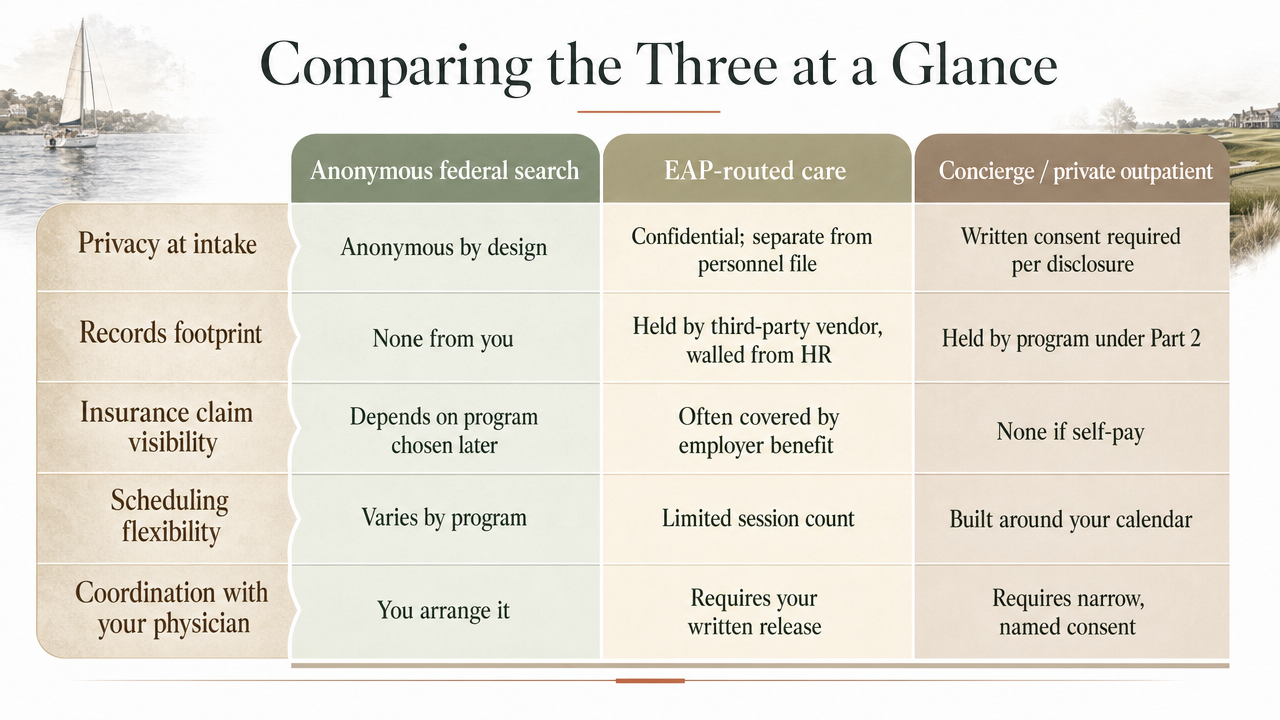
Comparing the Three at a Glance
Here is how the three pathways line up on the dimensions that actually shape your decision. Each column reflects protections and practices documented in the sources cited earlier.
Most professionals end up combining pathways: an anonymous search to survey the landscape, an EAP call for a fast confidential conversation, and a concierge or private outpatient engagement for the actual work.
Insight Beyond Treatment
At Next Level Wellness & Behavioral Health, we believe meaningful change starts with perspective, not just protocols.
That philosophy is directly led by Amanda Marino, whose voice in behavioral health extends beyond clinical settings into leadership, culture, and personal growth.
Through keynote speaking and live events, Amanda explores the deeper themes that show up in recovery, family systems, and life transitions: authenticity, resilience, accountability, and the courage to change. Her work invites audiences to move past labels and into honest conversations that create lasting impact.
Telehealth as the Working Professional's Default
What HHS Expects a Secure Virtual Session to Look Like
Telehealth is probably how you will do most of your care, and that is not a compromise. It is the format that fits your life. What matters is knowing what a real, secure session looks like so you can tell the difference between a provider who takes privacy seriously and one who is winging it.
HHS telehealth guidance for behavioral health is specific. Providers should avoid public Wi-Fi, use passwords, and keep confidential files secure when delivering substance use and mental health care remotely. Telehealth providers must apply HIPAA privacy and security rules to remote services and, where applicable, comply with the additional confidentiality requirements of 42 CFR Part 2. The platform is not the whole story. The environment on both ends is.5,6
Before you book, confirm five things with a prospective provider:5,6
- The video platform is HIPAA-compliant, not a generic consumer app.
- The clinician takes sessions from a private space on a secured network, not a coffee shop or an unsecured home Wi-Fi.
- Session notes and any recordings are stored with encryption and password protection.
- The intake paperwork spells out the limits of confidentiality in plain language, including the narrow Part 2 exceptions.
- You have a plan for your own environment: a door that closes, headphones, and a device that is not shared with family.
If a provider cannot answer these quickly, keep looking.
Fitting Sessions Around Court Dates, Shifts, and Board Weeks
The reason telehealth works for you is not that it is easier. It is that it disappears into your calendar without leaving a trace anyone else can read.
A Tuesday 7 a.m. session from your home office before board prep does not show up as a two-hour block downtown with parking receipts. A Thursday 9 p.m. call from a hotel room between depositions does not require you to explain a mid-day absence. A standing Sunday appointment survives a call schedule that would break any in-person cadence.
Ask a prospective program three operational questions:
- How far in advance do you need to reschedule without penalty when a trial runs long or a case pages you?
- Can the same clinician hold early-morning, late-evening, and weekend slots, or will you be handed off?
- If you travel across time zones for two weeks, do sessions continue on your local time?
The programs built for professionals answer these fluently. They have held sessions at 6 a.m. before rounds and at 10 p.m. after closing arguments. Your schedule is the design constraint they built around, not an inconvenience they tolerate.
How to Vet a Provider Before You Make the Call
By the time you pick up the phone, the shortlist should already be short. Vetting happens on your terms, in your time, before anyone has your name.
Start with five questions you can answer from a program's website and public materials, without any contact required:2,12,13,14
- Does the program identify itself as a Part 2 program, and does it describe how records are protected under that rule?
- Does the notice of privacy practices reference both HIPAA and the additional 42 CFR Part 2 requirements?
- Is there a clear written policy on how consent forms are structured, naming each recipient and each purpose separately?
- Does the program state how it handles subpoenas and court orders?
- Is there language explaining how the 2024 final rule is being implemented ahead of the February 16, 2026 compliance date?
A program that has thought carefully about privacy answers these in writing. A program that has not will use soft phrases like "we take your privacy seriously" without specifics.
The next layer is the first conversation itself. When you do call, use a personal phone. Ask to speak with someone about intake before giving your last name. Listen for how the person on the other end talks about records, consent, and coordination. Ask directly: if my physician calls asking about my care, what happens? The right answer is that nothing is shared until you sign a specific written consent naming that physician and the exact information to be released. If the answer sounds looser than that, end the call.4
Also ask what happens with your file if you stop treatment after two sessions or twenty. Records still fall under Part 2 protections regardless of how care ended. A program that treats a brief engagement with the same discretion as a long one is the one you want.1
Coordinating Care Without Exposing Yourself
You already have a physician you trust. Maybe a psychiatrist for the anxiety you have been managing for years. Maybe an internist who has known you since residency. The instinct is to loop them in. The question is how, and how narrowly.
Under Part 2, coordination happens through consent forms that name each recipient, each purpose, and each specific piece of information to be shared. You are not signing away access to your file. You are authorizing one named provider to receive one defined slice of information for one stated reason. Anything beyond that requires a new signature.4,14
Practically, that means you can tell your outpatient program: share my medication list with Dr. Chen at this address, for the purpose of avoiding prescribing conflicts, and nothing else. You can revoke that consent later in writing. Redisclosure by Dr. Chen to anyone else is forbidden without a new consent from you.4
What you should not do is assume coordination happens automatically because it would be clinically helpful. It does not. A program operating carefully under Part 2 will ask you, in writing, before any call is made or any record moves. If your program starts coordinating without that step, you have chosen the wrong program.
A Direct Path From Here
You are not starting from zero. You are starting with a clearer map than most people who begin this search ever get.
If you want to move today, pick one step, not three:8,10,11,12
- Open FindTreatment.gov from a personal device and build a short list of outpatient programs within a reasonable radius.
- Or call the number on the back of your badge and ask the EAP counselor what confidential referral options exist, knowing the conversation cannot be pushed into your personnel file without your written consent.
- Or reach out directly to a private outpatient or concierge team that operates under Part 2 and can schedule around your calendar rather than the other way around.
Whichever door you choose, the protections travel with you. Your identity as someone seeking care stays behind a written-consent gate you control. Your records cannot be pulled into a proceeding without meeting a specific court standard.1,12
Next Level Wellness & Behavioral Health was built for exactly this kind of decision. The next move is yours, and it can be a quiet one.
Frequently Asked Questions
Will my employer or insurer be able to see that I searched for or contacted addiction treatment?
A private-browser search on a personal device and network leaves nothing your employer or insurer can pull. SAMHSA's federal locators are designed to be confidential and anonymous, so you can browse without creating an account. If you self-pay, no claim reaches your insurer. If you use benefits, the claim exists, but the underlying treatment records still fall under 42 CFR Part 2 protections.7,12
How is 42 CFR Part 2 different from HIPAA, and why does that matter for me?
HIPAA lets covered providers share your records for treatment, payment, and operations without asking first. Part 2 sits on top of that for substance use care and generally forbids disclosing anything that identifies you as a patient without your specific written consent. Redisclosure by whoever receives the record is also forbidden without new consent. That gap is your protection.1,2,4
If I use my company's EAP, can my manager or HR find out?
No, not without your written consent. EAP counselors work for a third-party vendor, and federal guidance is explicit that the service is confidential and requires a signed release naming what may be shared and with whom. Federal privacy assessments confirm EAP records are kept separate from personnel files, and officials cannot compel providers to disclose client information without your consent.10,11
Are telehealth sessions for substance use care actually private?
Yes, when the provider follows the rules. HHS guidance requires telehealth clinicians to use HIPAA-compliant platforms, avoid public Wi-Fi, password-protect devices, and store session files securely. Where substance use care is involved, they must also apply the additional confidentiality requirements of 42 CFR Part 2. Your side matters too: a private room, headphones, and a device that is not shared.5,6
Can my treatment records be used against me in a court case, licensing review, or custody dispute?
Part 2 records cannot be used in any civil, criminal, administrative, or legislative proceeding without a court order that meets Part 2's specific criteria, which is a materially higher bar than a routine subpoena. Opposing counsel, a licensing board, or a custody investigator cannot simply request the file. Narrow exceptions exist for genuine medical emergencies, audits, research, and mandated abuse reporting.3,12
What is changing on February 16, 2026, and should I get care before then?
The 2024 final rule updating Part 2 must be implemented by February 16, 2026, aligning several provisions with HIPAA and HITECH while keeping identity, diagnosis, prognosis, and treatment records protected. A single consent can now cover treatment, payment, and operations rather than each exchange. Do not delay care over the date. The core protections stay intact; ask any prospective program how they are updating consents.13
References
- Understanding Confidentiality of Substance Use Disorder Patient Records. https://www.hhs.gov/hipaa/part-2/index.html
- Constraints on Sharing Mental Health and Substance-Use Treatment Information. https://www.ncbi.nlm.nih.gov/books/NBK19829/
- Privacy Protection for Patients with Substance Use Problems. https://pmc.ncbi.nlm.nih.gov/articles/PMC3846317/
- Confidentiality protections versus collaborative care in the treatment of substance use disorders. https://pmc.ncbi.nlm.nih.gov/articles/PMC3766245/
- Protecting patients’ privacy. https://telehealth.hhs.gov/providers/best-practice-guides/telehealth-for-behavioral-health/preparing-patients-for-telebehavioral-health/protecting-patients-privacy
- Privacy laws and policy guidance. https://telehealth.hhs.gov/providers/best-practice-guides/privacy-and-security-telehealth/privacy-laws-and-policy-guidance
- Treatment Locators: Mental Health, Drug, Alcohol Issues. https://www.samhsa.gov/find-help/locators
- Find Substance Use Disorder Treatment. https://www.samhsa.gov/substance-use/treatment/find-treatment
- Employee Wellness Programs (EWPs) – Legislation. https://www.opm.gov/policy-data-oversight/worklife/employee-wellness-programs/legislation/
- Alcoholism in the Workplace: A Handbook for Supervisors. https://www.opm.gov/policy-data-oversight/worklife/reference-materials/alcoholism-in-the-workplace-a-handbook-for-supervisors/
- DHS/ALL/PIA-066 DHS Employee Assistance Program Privacy Impact Assessment. https://dhs.gov/sites/default/files/publications/privacy-pia-dhsall066-eap-april2021.pdf
- 42 CFR Part 2 -- Confidentiality of Substance Use Disorder Patient Records. https://www.ecfr.gov/current/title-42/chapter-I/subchapter-A/part-2
- Fact Sheet 42 CFR Part 2 Final Rule. https://www.hhs.gov/hipaa/for-professionals/regulatory-initiatives/fact-sheet-42-cfr-part-2-final-rule/index.html
- Substance Use Disorders (SUD) Targeted Learning Opportunities: Strategy for Sharing Information. https://www.medicaid.gov/state-resource-center/innovation-accelerator-program/iap-downloads/20150413tlo2strategyforsharinginfo.pdf
A Voice Shaping the Conversation
The topics explored here—change, self-awareness, recovery, and growth—are the same themes Amanda Marino brings to audiences nationwide through speaking engagements and live events.
Known for her appearances on A&E’s Intervention and Digital Addiction, Amanda speaks to organizations, communities, and leadership teams about navigating adversity, embracing vulnerability, and building lives rooted in purpose. Her message resonates far beyond treatment, offering insight that applies to families, professionals, and anyone standing at a crossroads.



Heal on your terms—any time, anywhere.