.svg)

Beyond the Basics: Addiction Recovery Methods for Life

Key Takeaways
- Treat recovery as a chronic-care system rather than a program you finish, with structured continuing care for at least three to six months and follow-up contacts through twelve months.3
- A lapse is diagnostic, not a verdict—people who relapsed still made six-month gains in abstinence, mental health, employment, and housing when supports stayed in place.12
- For opioid use, the medication question is less about which drug is superior and more about which one you can start and stay on, since outcomes converge once induction succeeds.11
- Design a one-page architecture that layers clinical care, medication if relevant, telehealth continuity, peer and mutual-aid connection, and a briefed family circle—held together by someone coordinating the whole picture.4
The Bridge Between Treatment and a Life
You made it through the hardest part. Detox, residential, PHP, IOP—whatever combination got you here, you did the work. And now you are standing in your own kitchen on a Tuesday morning, and the calendar is suddenly yours again.
This is the part almost no one prepares you for. The first six months after treatment ask more of you than the treatment itself did. Not because you are weaker now, but because the scaffolding is thinner. There is no group at 10 a.m. There is no one asking how you slept. There is just work, family, travel, the quiet hours, and a version of your life you are trying to inhabit differently.4
The research is unusually clear on this point. Addiction recovery methods for professionals responds to the same longitudinal, coordinated care that we give other chronic conditions—not to a single episode of treatment followed by hoping for the best. Recovery is not something you graduate from. It is something you design, and then keep redesigning as your life changes.
This guide is written for you as the adult you already are. You know what CBT is. You have heard the acronyms. What follows is the next layer: how continuing care, medication decisions, daily-life tools, and the people around you fit together into an architecture you can actually live inside—discreetly, on your own timeline.
Recovery as a Design Problem, Not a Graduation
Why the Chronic-Care Frame Changes What You Build
Think about how someone manages a heart condition or diabetes. They do not attend a two-week program and consider themselves finished. They have a primary care relationship, a medication routine, labs on a schedule, and a plan for when something spikes. The care follows them into their life.
Substance use responds to that same longitudinal, coordinated approach. When care is fragmented, or when it stops abruptly at discharge, outcomes suffer. When care is treated as a chronic condition—integrated primary and specialty involvement, explicit evidence-based plans, coordinated case management, and steady engagement over time—people do measurably better. This is not a philosophical preference. It is what the outcome data keeps pointing back to.4
What this means for you, practically: stop thinking of your recovery as a series of episodes you complete. Start thinking of it as a system you are maintaining. The people, the appointments, the medications if they apply to you, the check-ins, the tools on your phone, the rhythm of your week—these are components of one architecture, not a checklist of programs to finish.
That reframe changes the questions you ask. Instead of "How long until I'm done?" you begin asking, "What does the next six months of my care look like, and who is holding it together with me?" Instead of measuring progress by silence—no crisis, no lapse—you measure it by the density and quality of the supports you have built into an ordinary week.
The Continuing-Care Timeline: 90 Days, 12 Months, Year Two
There is a shape to this work, and knowing the shape helps. The evidence points to at least three to six months of structured continuing care after primary treatment, combined with follow-up contacts extending to a minimum of twelve months post-discharge. That is the floor, not the ceiling. What follows is a rough map of what those windows tend to ask of you.3
The first 90 days: stabilization. This is the highest-risk window and the one where the scaffolding needs to be thickest. Expect weekly clinical contact of some kind—outpatient sessions, telehealth check-ins, or a combination. Sleep, nutrition, and daily structure often need explicit attention because they were held together by the treatment setting and are now yours to rebuild. If medication is part of your plan, this is when adherence patterns get set. If you are returning to work, expect a learning curve about which environments and hours are workable and which are not.
Months 3 through 12: structured continuing care. The cadence usually widens—biweekly or monthly clinical contact, ongoing peer or mutual-aid engagement, and a shift from crisis prevention to skill deepening. This is where continuing care does its quieter work: maintaining early gains, catching lapses early enough to limit their severity, and connecting you to supports around employment, housing, relationships, and meaningful activity. Recovery Management Checkups—brief, scheduled reassessments—belong here.2
Year two and beyond: recovery management. The intensity drops, but the connection does not disappear. Periodic checkups, sustained mutual-aid or peer involvement if that fits you, and a clear plan for what to do if the ground shifts—a bereavement, a job loss, a medical event, a move. The point of this phase is not vigilance for its own sake. It is that you have built something you can return to quickly if you need it, without starting over.
What matters about seeing it laid out this way: each phase asks different things of you, and the supports that work in month two are not always the supports that carry you in month fourteen. Designing your continuing care means matching the layer to the window—and updating both as your life changes.
Relapse Is Information, Not Verdict
Here is something the recovery world does not say out loud often enough: a return to use is data. It tells you which supports were thinner than you thought, which triggers you had not fully mapped, which hours of the week are structurally harder. It does not tell you that you have failed, and it does not erase what you built.
NIDA frames this plainly. Because substance use is a chronic condition, a lapse can be part of the process rather than proof that treatment did not work. Stress, cues tied to past use, and direct exposure are recognized triggers, and current relapse-prevention approaches are built to help you anticipate and respond to them over time. That is a very different starting point than shame.2
The outcome research reinforces the same idea. In a study of sober-living house residents, people who experienced a relapse still made significant six-month gains across the domains that actually shape a life: percent days abstinent went up, psychiatric symptoms went down, employment problems eased, and housing stability improved. Higher recovery capital—the sum of internal, social, and community resources someone has to draw on—predicted better outcomes, including more abstinent days. Progress, in other words, continued through the imperfection.12
What this means for the way you think about your own trajectory: if something slips, the useful questions are diagnostic, not moral. What preceded it? Who did you tell, and how quickly? Which part of your continuing-care plan did you drift from, and what would make it easier to return to? Rapid re-engagement matters more than a clean streak. Keep the housing, keep the appointments, keep the people. Treat the lapse as a signal to tighten the architecture, not to dismantle it.
Medication as a Decision Landscape
Buprenorphine, Naltrexone, and the Question of Adherence
If opioid use is part of your history, the medication conversation is not a footnote. It is one of the most consequential design choices you will make in this next chapter, and it deserves more nuance than the internet usually gives it.
The two options you will hear about most often outside of methadone are buprenorphine (usually as buprenorphine-naloxone) and extended-release naltrexone. They work differently. Buprenorphine is a partial opioid agonist, which means it occupies the same receptors that opioids do, quiets craving, and blunts withdrawal without producing the same reinforcement. Extended-release naltrexone is an opioid antagonist, delivered as a monthly injection, that blocks those receptors entirely. On paper, both belong in the toolkit. In practice, the numbers behind who actually stays on each medication tell a more complicated story.
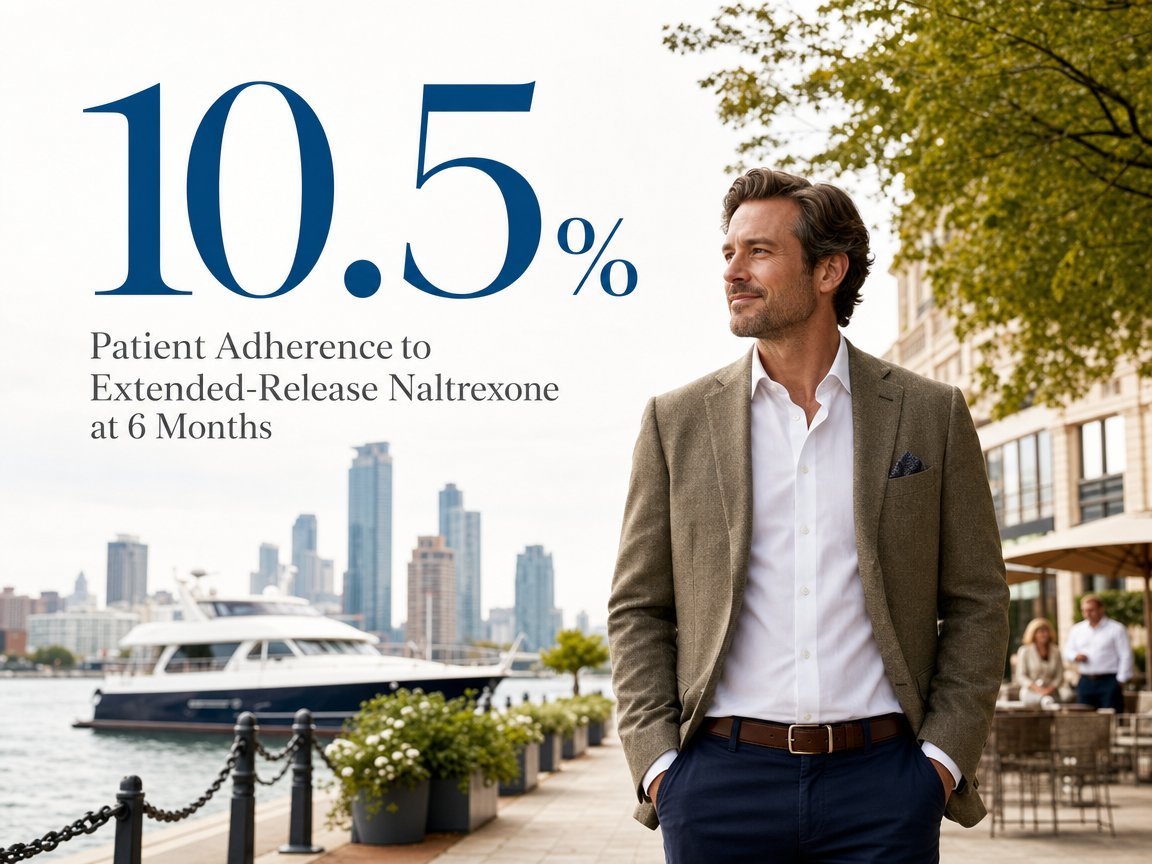
A systematic review of community settings found that only 10.5% of patients were adherent to extended-release naltrexone at six months. That is not a small gap. It reflects two real barriers: you have to be fully detoxified before you can start the injection, which is a hard ask right after treatment, and the monthly cadence leaves more room for a missed appointment to become a missed month. Buprenorphine, by comparison, tends to outperform in intention-to-treat analyses largely because more people successfully start it and more people stay on it over time.9,10
What you do with that information depends on your circumstances. If you have already completed a full detox and value the once-monthly rhythm, extended-release naltrexone can fit. If you are stepping down from treatment and want something you can start quickly with daily continuity, buprenorphine is often the more forgiving path. Neither choice is a character statement. It is a match between a medication's profile and the shape of your week.
Once Induced, Outcomes Converge
Here is the part that often gets lost in the buprenorphine-versus-naltrexone debate: once people are successfully started on either medication, short-term outcomes look remarkably similar. Across two independent clinical trials, patients who initiated their study medication showed comparable results on abstinent days, negative urine tests, and craving reduction, regardless of which one they were assigned. The gap you see in intention-to-treat analyses is largely a gap in getting people over the induction hurdle, not a gap in what the medication does once it is on board.11
That reframes the practical question. It is less "which medication is superior" and more "which one will you actually be able to start, and stay on, given the reality of your next several months?" Bring that question to a physician who prescribes both. Ask about the induction plan, what happens if you miss a dose or an injection date, and how the medication decision fits with your other continuing-care supports. The answer that keeps you engaged is the answer that works.
Tools That Meet You Inside Ordinary Days
Telehealth as Continuity, Not Convenience
The old framing of telehealth was that it was the runner-up option—fine if you could not get to the office, but not the real thing. The evidence has moved on from that.
In a study of patients entering substance use care, those who received video telehealth in the first 14 days after diagnosis had a hazard ratio for treatment dropout of 0.64 compared with people receiving in-person-only care, along with higher odds of staying engaged. That is a meaningful difference in the window where dropout tends to be highest. The study was observational and focused on early care, so treat the number as a signal about continuity rather than a promise about long-term outcomes—but the signal is consistent with a broader 2023 review finding that telemedicine for substance use treatment is generally acceptable and, over short follow-up periods, roughly as effective as in-person care for reducing use and keeping people in treatment.7,8
What this changes for you: the appointment you would otherwise cancel because of a flight, a client meeting, or a sick child does not have to be canceled. Continuity of contact is one of the active ingredients here. A 20-minute video session from a hotel room protects the thread. So does a scheduled phone check-in during a week when you cannot face another Zoom. Build a plan that assumes travel and unusual weeks will happen, and use telehealth to keep the cadence intact rather than as an emergency substitute.
Craving Apps and Ecological Momentary Support
The hardest moments in recovery rarely happen inside a therapist's office. They happen at 4:47 on a Wednesday afternoon, in a rental car, in a hotel bar's line of sight, in the ten minutes between a difficult call and the next thing on your calendar. The tools that actually help are the ones that show up there.
That is the premise behind ecological momentary assessment, or EMA—brief, real-time self-reports collected across the day on a phone. Research using EMA has shown that patterns of negative affect and craving, alongside recent use patterns, can predict short-term risk of substance use in the days that follow. Your triggers, in other words, are legible if you are paying attention to the right signals, and they tend to be more individual than generic trigger lists suggest.5
Newer app-based tools are built to close that loop in daily life. The Craving-Manager smartphone app, currently in randomized trial evaluation, delivers ecological momentary interventions—prompts, coping tools, and assessments—to help people identify craving as it rises and act on it before it becomes something larger. The clinical evidence base for these tools is still developing, so treat them as an augmentation of your care, not a replacement for the humans in your plan.6
Used well, an app on your phone becomes a private, portable check-in that respects your schedule and your privacy. That is a very different thing than another notification demanding your attention.
Insight Beyond Treatment
At Next Level Wellness & Behavioral Health, we believe meaningful change starts with perspective, not just protocols.
That philosophy is directly led by Amanda Marino, whose voice in behavioral health extends beyond clinical settings into leadership, culture, and personal growth.
Through keynote speaking and live events, Amanda explores the deeper themes that show up in recovery, family systems, and life transitions: authenticity, resilience, accountability, and the courage to change. Her work invites audiences to move past labels and into honest conversations that create lasting impact.
The People Layer: Peers, Mutual Aid, Family
Peer Recovery Services and Recovery Capital
There is a specific kind of help that comes from someone who has been where you are, and the research increasingly treats it as a distinct intervention rather than a nice add-on. Peer recovery services—delivered by trained people in sustained recovery themselves—are recognized as evidence-based practice for substance use and co-occurring conditions, with documented benefits that include reduced return to substance use, better retention in care, stronger relationships with clinical providers, and higher satisfaction with the overall experience.14
What a peer actually does in your week matters more than the title. A recovery coach or companion can meet you before a stressful event, sit with you during the first sober version of a work trip, walk through a family gathering that used to be a landmine, or simply hold a standing Sunday check-in that keeps the week from drifting. The research language for what accumulates through this kind of contact is recovery capital—the sum of internal, social, and community resources you can draw on—and peer services are documented to build it directly, alongside resilience and quality of life.14
If your life includes travel, visibility, or a family that does not know the full picture, a peer relationship structured around discretion often carries more weight than another appointment on the calendar.
Mutual Aid Without Orthodoxy
Twelve-step programs have a longer track record than almost any other community-based recovery pathway, and the data on sustained involvement is more encouraging than the cultural noise around them suggests. Roughly half of adults who begin participating in a 12-step program after treatment are still attending three years later, and ongoing involvement is associated with stronger recovery-supportive social networks, better coping in high-risk contexts, and reductions in craving and depressive symptoms.13
That does not mean AA or NA is the only path, or the right one for you. Multiple recovery pathways coexist, and the same chapter that documents 12-step outcomes also frames recovery as a plural landscape—professional treatment, mutual-aid communities, and community supports layered in different combinations for different people. SMART Recovery, Refuge Recovery, LifeRing, secular and faith-specific groups, and clinician-led aftercare groups all populate this terrain.13
The useful question is not which tradition is correct. It is which room, at which cadence, gives you a durable weekly connection to people who know what you are working on. Try more than one. Give any given group three or four visits before you decide, because a single meeting rarely tells you what a community actually feels like.
Family Involvement With Boundaries
Family is the variable most likely to be either your greatest asset or your most complicated terrain, and often both in the same week. Federal treatment guidance is direct about the direction of the evidence: including family members in care is associated with increased treatment engagement and retention, better cost effectiveness, and improved outcomes for both clients and their families. Involving the people closest to you tends to make achieving and sustaining long-term recovery more likely.15,17
The important word in that guidance is structured. Family involvement that helps is not the same as family involvement that happens. Clinical approaches recommend engaging family members through collaborative continuing-care planning, behavioral agreements about specific situations, and relapse prevention and emergency plans that name supportive roles without asking any one person to carry too much. That structure protects the relationship as much as it supports your recovery.16
If some family relationships are strained, unsafe, or still healing, involvement can be partial, sequenced, or held at a distance while other supports carry more weight. A trauma-informed approach recognizes that not every relationship belongs in your continuing-care plan at the same intensity, and that a smaller circle of well-briefed people often outperforms a larger circle of well-meaning ones. Name who is in, name what you are asking of them, and put it in writing when the stakes justify it.
Designing Your Personal Continuing-Care Architecture
Pull back from the individual pieces for a moment and look at the whole. What you are building over the next twelve to twenty-four months is a small ecosystem, not a program. The components are already familiar from earlier sections:
- a clinical relationship at a defined cadence,
- medication if it applies to you,
- telehealth as a continuity tool,
- an app or EMA practice for the in-between moments,
- a peer relationship,
- a mutual-aid or group connection,
- and a short, named list of family or close friends who know what you are working on.
The connective tissue is the part most people underestimate. Someone has to hold the whole picture—your appointments, your medication timing, your travel schedule, the phone calls when a week gets hard, the plan for what happens if something slips. When people receive coordinated case management alongside clinical care, engagement holds and outcomes improve; when the pieces sit in separate silos, gaps open where the work actually happens. A concierge case manager or recovery companion can play that role. So can a trusted primary care physician working with a therapist and a sponsor. What matters is that the role exists.4
Put your architecture on one page. List the components, the cadence, the people, and what triggers a step-up in support. Revisit it every quarter. This is the kind of quiet, individualized coordination that a service like Next Level is built around—but the design principle is yours regardless of who helps you carry it.
Frequently Asked Questions
How long should continuing care actually last after I finish treatment?
The evidence-based floor is at least three to six months of structured continuing care, with follow-up contacts extending to a minimum of twelve months after discharge. That is a starting point, not a finish line. Many people benefit from lighter-touch check-ins for a second year and periodic recovery management contacts beyond that. Design for the trajectory of your life, not a fixed end date.3
If I have a lapse, do I have to start my recovery over from day one?
No. A lapse is diagnostic information about what needs adjusting, not a reset of what you have built. People in sober living settings who experienced a relapse still made measurable six-month gains in abstinent days, psychiatric symptoms, employment, and housing when their supports stayed in place. Tell someone quickly, keep your appointments and housing, and tighten the plan where it was thinnest.12
Do I need medication to stay in recovery, or can I do this without it?
It depends on what you are recovering from. For opioid use, medications like buprenorphine and extended-release naltrexone have strong evidence for reducing relapse and mortality, and buprenorphine tends to outperform in real-world adherence. For alcohol and stimulants, medication options exist but play a different role. Bring the question to a prescriber who knows your history. Neither path is a character statement.10
I travel for work and value my privacy. Can telehealth really replace showing up in person?
For most continuing-care contact, yes. A 2023 review found telemedicine for substance use treatment is generally acceptable and, over short follow-up periods, comparable to in-person care for reducing use and keeping people engaged. Use video sessions to protect the cadence when travel, meetings, or family demands would otherwise cancel an appointment. Some moments still call for in-person contact, but continuity is the active ingredient.7
What if 12-step meetings aren't the right fit for me?
Then try something else. Recovery is a plural landscape, and mutual-aid options include SMART Recovery, Refuge Recovery, LifeRing, secular and faith-specific groups, and clinician-led aftercare cohorts. What matters is a durable weekly connection to people who know what you are working on, not which tradition you land in. Visit any group three or four times before deciding, because one meeting rarely represents the community.13
How much should my family be involved, especially when relationships are complicated?
As much as the relationships can healthily support, and no more. Structured family involvement is associated with better engagement, retention, and long-term outcomes. Involvement can also be partial or sequenced. A trauma-informed plan names who is in, what you are asking of them, and what falls to clinical or peer supports instead. A smaller, well-briefed circle usually outperforms a larger, well-meaning one.15,16
References
- Treatment and Recovery. https://nida.nih.gov/publications/drugs-brains-behavior-science-addiction/treatment-recovery
- Impact of Continuing Care on Recovery From Substance Use Disorders. https://pmc.ncbi.nlm.nih.gov/articles/PMC7813220/
- The Continuing Care Model of Substance Use Treatment. https://pmc.ncbi.nlm.nih.gov/articles/PMC4007701/
- The case for chronic disease management for addiction. https://pubmed.ncbi.nlm.nih.gov/19809579/
- Using ecological momentary assessments to predict relapse. https://pmc.ncbi.nlm.nih.gov/articles/PMC8237687/
- The Craving-Manager smartphone app designed to diagnose and manage craving. https://pubmed.ncbi.nlm.nih.gov/37255691/
- Telemedicine-delivered treatment for substance use disorder. https://pmc.ncbi.nlm.nih.gov/articles/PMC11444076/
- Effects of Telehealth on Dropout and Retention in Care among Patients With Substance Use Disorders. https://pubmed.ncbi.nlm.nih.gov/36710568/
- Medications for Opioid Use Disorder Save Lives. https://www.ncbi.nlm.nih.gov/books/NBK541393/
- Comparing medications to treat opioid use disorder. https://www.health.harvard.edu/blog/comparing-treat-opioid-use-disorder-2018010313021
- Two independent clinical trials compared the effectiveness of buprenorphine-naloxone and extended-release naltrexone. https://www.mass.gov/doc/factsheet-lee-et-al-tanum-et-al-research-articles/download
- Outcomes Among Sober Living House Residents Who Relapse: Role of Recovery Capital. https://pubmed.ncbi.nlm.nih.gov/37326458/
- RECOVERY: THE MANY PATHS TO WELLNESS. https://www.ncbi.nlm.nih.gov/books/NBK424846/
- Issue Brief – Supporting and Financing Peer Services. https://library.samhsa.gov/sites/default/files/supporting-financing-peer-services-pep24-02-012.pdf
- Executive Summary (Family Counseling in Substance Use Disorder Treatment). https://www.ncbi.nlm.nih.gov/sites/books/NBK571078/?report=classic
- Chapter 3—Family Counseling Approaches. https://www.ncbi.nlm.nih.gov/books/NBK571088/
- Chapter 1—Substance Use Disorder Treatment. https://www.ncbi.nlm.nih.gov/books/NBK571084/
A Voice Shaping the Conversation
The topics explored here—change, self-awareness, recovery, and growth—are the same themes Amanda Marino brings to audiences nationwide through speaking engagements and live events.
Known for her appearances on A&E’s Intervention and Digital Addiction, Amanda speaks to organizations, communities, and leadership teams about navigating adversity, embracing vulnerability, and building lives rooted in purpose. Her message resonates far beyond treatment, offering insight that applies to families, professionals, and anyone standing at a crossroads.


Heal on your terms—any time, anywhere.