.svg)

Rockville Family Intervention: A Local Guide

Key Takeaways
- Rockville families benefit from in-person planning near Rockville Pike or Bethesda, where an interventionist can coordinate letters, roles, and a treatment bed within days rather than running the conversation by video.
- Local coordination matters because the 2024 City of Rockville Needs Assessment flagged behavioral-health navigation as a major gap, and continuity through transport, admission, and the months after is where out-of-town teams fall short 20.
- Montgomery County's safety net — ACCESS at 240-777-1770, the Rockville Crisis Center at 1301 Piccard Drive, and 911 for emergencies — handles different situations, and families should know which number fits which moment 6, 22.
- Before hiring, compare what a provider is actually licensed to do under COMAR 10.63, who sits at the table, how the handoff to treatment works, and what consent your loved one must sign under 42 CFR Part 2 and HIPAA 11, 18, 19.
The Week Before You Sit Down
You already know something has to change. The question keeping you up at night isn't whether your spouse, your adult son, your mother is in trouble. You've watched it long enough to be sure. The question is what you actually do on Tuesday morning, and who you call before then.
Most Rockville families arrive at this moment having already tried the quiet versions. The careful dinner conversation. The ultimatum that softened by Sunday. The counselor who saw them twice. By the time you type "family intervention Rockville MD" into a search bar, you're not looking for a lecture on addiction. You're looking for a nearby team you can sit across a table from this week.
Here is what the next seven days can look like when it goes well. You take one private meeting, usually two to three family members, with a professional interventionist at an office close to home — for many Montgomery County families, that means a sit-down near Rockville Pike or Bethesda rather than a video call with someone in another state. You decide who should be in the room on the day of the conversation and who shouldn't. You draft what you want to say. You line up a treatment bed before the conversation happens, not after.
You are not planning a confrontation. You are planning the first day of a longer care arc that research supports when families stay involved 14. That reframe alone changes the week.
What a Professional Intervention Actually Looks Like in Rockville
Planning Sessions at the Rockville Pike Office
The first meeting rarely includes the person you're worried about. That surprises some families. You arrive at the office near Rockville Pike with a spouse, a sibling, maybe an adult child who flew in from Boston. The interventionist spends most of the first ninety minutes listening. Who drinks, who doesn't speak to whom, who's been covering, what the last three months have actually looked like at home.
From there, planning gets specific. You decide the circle: usually three to six people who can hold a steady tone in a hard room. A parent who tends to shout gets a different role. A sibling who still enables gets coached, not excluded. You draft letters together — short, concrete, written to be read aloud without collapsing into argument. SAMHSA's family guidance frames this well: express concern, create a judgment-free environment, stay patient 23.
You also decide the bottom line before anyone sits down with your loved one. What changes at home if they say no. What stays the same if they say yes. A professional in the room keeps the plan from drifting back into the same conversations you've been having for a year.
The Conversation Itself: Structured, Consent-Based, Not a Guaranteed Yes
The day of the conversation is quieter than most families expect. No ambush. No cornering. Your loved one is invited into a room where people they trust are already seated, and the interventionist opens the meeting by naming what it is: a family conversation about health, with a professional present, held because you love them.
Then the letters are read. The interventionist moderates — slowing people down, holding the room when it gets tense, redirecting when old arguments try to surface. If your loved one agrees to treatment, the plan is already in place: a bed, transport, a bag packed in the car.
Here is the honest part. A professional intervention is not a trick that produces a guaranteed yes. The research on family involvement is encouraging but it is about care arcs, not single conversations. A 2024 systematic review of 41 studies on family interventions for young people ages 10–25 found reductions in substance use and behavioral problems alongside improvements in family functioning — results that came from structured, often multi-session models rather than one-night confrontations 15.
If your loved one says no that day, the family still leaves changed. The lines are clearer. The next conversation starts in a different place.
The Handoff: Transport, First 72 Hours, and the Six Months After
Yes means motion. A sober transport team moves your loved one from your living room or the office to the treatment facility — sometimes a program in Maryland, sometimes a flight to a residential center elsewhere. Someone experienced stays with them door to door. You are not driving your husband to detox alone at 11 p.m. with a packed duffel in the back seat.
The first seventy-two hours after admission are the ones families underestimate. Phone contact is often limited. Admissions paperwork is thick. A case manager on your side — not employed by the treatment center — can translate what's happening, flag whether the level of care matches the clinical picture, and keep you from reacting to every voicemail as a crisis.
Then the longer arc begins. NIDA is direct that addiction is a chronic condition and that family involvement helps people enter and remain in treatment 14. The six months after admission usually include family coaching, continued case management, and planning for the return home. The intervention was day one. Most of the work is what you build after it.
Why Local Coordination Matters More Than a Flown-In Stranger
You can hire an interventionist from Phoenix. Some families do. They land, they run the conversation, they fly home. The problem isn't skill — many out-of-state interventionists are excellent. The problem is what happens on day eight, when the first phone call home from treatment goes badly, or three months later when your loved one leaves residential and needs a case manager who knows which Rockville therapist actually takes new patients.
The 2024 City of Rockville Needs Assessment put numbers to what families already feel. Rockville had 67,298 residents in 2022, and 12.7% of adults reported poor mental health. The assessment flagged behavioral-health navigation and treatment access as major gaps and recommended warm handoffs and stronger City–County coordination 20. Translation: even in an affluent, well-insured city, the connective tissue between a treatment decision and sustained care is thin. A team you can sit with on Rockville Pike this week — and again next month, and the month after — is doing navigation work the system itself has identified as missing.
Local also means geography you share. Your interventionist knows that the Montgomery College Area at 51 Mannakee Street has its own student wellness contacts 4, 5, that Twinbrook and King Farm have different commuting rhythms, and that the Rockville Crisis Center at 1301 Piccard Drive is twelve minutes from most of the city 22. That knowledge isn't flash. It's just what a neighbor would know.
The Montgomery County Safety Net You Should Know by Name
ACCESS, the Rockville Crisis Center, and When to Dial 911
Write these three down before you do anything else. Keep them on the fridge, in your phone, and in the hands of whoever is most likely to be alone with your loved one on a hard night.
ACCESS at 240-777-1770. This is Montgomery County's front door for behavioral-health information, referral, screening, and treatment assessment. It's especially useful if your loved one is uninsured or between plans, or if you simply need a county-based opinion before you commit to a private path 6.
The Rockville Crisis Center at 1301 Piccard Drive, 240-777-4000. It's twenty-four hours a day, every day of the year, telephone and walk-in. A mobile crisis team can also come to you — in a home, a car, a coffee shop — if that's safer than asking your loved one to travel 22. The county also operates a Behavioral Health Crisis Stabilization Center for people in acute mental-health or substance-use crisis who need more than a phone call but aren't a medical emergency 8.
911 or the nearest emergency department. If your loved one has overdosed, is threatening suicide with a plan or the means, has lost consciousness, is having a seizure, or has become violent — that's not an intervention moment. That's a 911 moment. A planned family intervention is for the stretch of time before a crisis, or in the quiet after one.
Knowing which number to call isn't paranoia. It's the thing that lets you breathe through the week of planning.
Private Concierge Coordination vs. County Pathways
Here's a question worth asking out loud: do you actually need to hire anyone?
For some Rockville families, the honest answer is no. If your loved one is already willing to get help, your insurance is stable, and you have the bandwidth to make twenty phone calls, ACCESS at 240-777-1770 and the county's Get Help resources can get you to a screening and a referral without a private team in the middle 6, 21. That path is real, and it is free.
What a private concierge team adds is time, speed, and continuity. The planning sessions happen on your schedule, often within days, at an office you can drive to. The same people who sat with you at the Rockville Pike office are the ones who coordinate the transport, hold the family's hand through the first week of admission, and still answer the phone four months later when your husband's step-down program isn't working. The county's role is screening and referral; it is not a dedicated case manager who knows your family by first name.
How to Vet a Rockville Provider Without Getting Spun
Intervention marketing can be slick. Guarantees, urgency, polished intake lines. You deserve a quieter kind of confidence. Here is what to ask before you pay anyone a retainer.
Ask what, exactly, they are licensed to do in Maryland. Maryland's Behavioral Health Administration licenses community behavioral-health programs under COMAR 10.63, and those licenses are site-specific and service-specific — they do not travel from one storefront to another, and they do not cover every form of support 11, 26. A new online licensing process took effect in February 2025, so current status is checkable 12. A reputable provider will tell you plainly which parts of their work are licensed clinical treatment and which parts are nonclinical support such as companionship, transport, case coordination, or family coaching 25. Both can be valuable. They are not the same thing, and anyone who blurs them is selling you something.
Ask who sits across the table and what credentials they hold. A professional interventionist (often a CIP), a licensed clinician for the clinical pieces, a case manager who stays with you after admission. Names, not just titles.
Ask about the handoff. Where does your loved one actually go if they say yes on Tuesday? Which Maryland or out-of-state programs, which levels of care, which insurance pathways. A team that cannot answer this before the conversation is improvising.
Ask what happens if your loved one says no. A straight answer here tells you more about a provider than a brochure ever will.
Insight Beyond Treatment
At Next Level Wellness & Behavioral Health, we believe meaningful change starts with perspective, not just protocols.
That philosophy is directly led by Amanda Marino, whose voice in behavioral health extends beyond clinical settings into leadership, culture, and personal growth.
Through keynote speaking and live events, Amanda explores the deeper themes that show up in recovery, family systems, and life transitions: authenticity, resilience, accountability, and the courage to change. Her work invites audiences to move past labels and into honest conversations that create lasting impact.
Privacy: What Family Members Can and Can't Be Told
One of the first questions families ask — usually in the second meeting, once the shock has settled — is some version of "will we actually know what's happening?" The honest answer is: sometimes yes, sometimes less than you'd like, and the rules changed in 2024.
Substance-use treatment records carry an extra layer of federal protection under 42 CFR Part 2. The 2024 final rule simplified things in one meaningful way: your loved one can now sign a single consent authorizing future disclosures for treatment, payment, and health-care operations, rather than re-signing for each exchange. Compliance was required by February 16, 2026. The rule still restricts the use of those records in legal proceedings against the patient 18. For families, the practical point is that consent is the hinge. If your loved one signs a release naming you, information can flow. If they don't, it can't — and no amount of paying the bill changes that.
HIPAA works alongside Part 2 for mental-health information. HHS guidance is clear that providers may share with family members when the patient agrees, when the patient has had the opportunity to object and does not, or in circumstances involving a serious and imminent threat where you are positioned to help lessen it. HIPAA generally permits — rather than requires — those disclosures 19.
Ask the treatment program, before admission, exactly what release forms your loved one will be offered and how family communication is structured. A good program expects the question.
Scenarios That Change the Playbook
A Montgomery College Student or Young Adult Still on Your Insurance
Your 20-year-old lives at home, takes classes at the Rockville campus on Mannakee Street, and has been quietly unraveling since the spring. You still see the bank alerts. You still carry the insurance card. On paper, you have leverage. In practice, your adult child's medical and treatment information belongs to them.
This changes the planning in two concrete ways. First, consent drives everything — not your insurance card. Any release of information from a treatment provider has to come from your young adult, not from you 19. Second, campus resources are a real on-ramp. Montgomery College lists Rockville counseling contacts and in-person wellness programming that a student can access without a parent in the loop 4, 5. Montgomery County also runs child-and-adolescent behavioral-health services with their own screening and referral pathway, with consent rules that shift as a young person ages 7.
For a family intervention, this often means a smaller room, a gentler opening, and a plan that respects your young adult as the decision-maker — even when you're the one writing the check.
A Spouse Whose Career Is on the Line
A partner at a Rockville Pike firm. A federal employee in King Farm. A physician whose license depends on quiet handling. When a spouse's drinking or benzodiazepine use starts bleeding into Monday mornings, the intervention has to account for a professional reputation that one messy weekend can damage.
Three things tend to matter more than usual:
- Discretion about where the planning meetings happen, so colleagues don't see a familiar car in a familiar parking lot.
- Timing around work obligations — many families plan the conversation for a Friday evening so the first days of treatment fall over a weekend.
- A case manager who understands that your spouse may need to coordinate with an employee assistance program, a licensing board, or a medical review committee without you in the middle.
SAMHSA's family guidance applies here too: express concern, create a judgment-free environment, stay patient 23. The structure is the same. The stakes around privacy are higher.
Maryland's Overdose Picture and Why Opioid Risk Changes the Timeline
When opioids are in the picture — prescribed pills your mother started hoarding, pressed tablets your son is buying online, a relapse after an opioid-use-disorder diagnosis — the week-before-you-sit-down timeline tightens. You do not have the luxury of a leisurely planning arc.
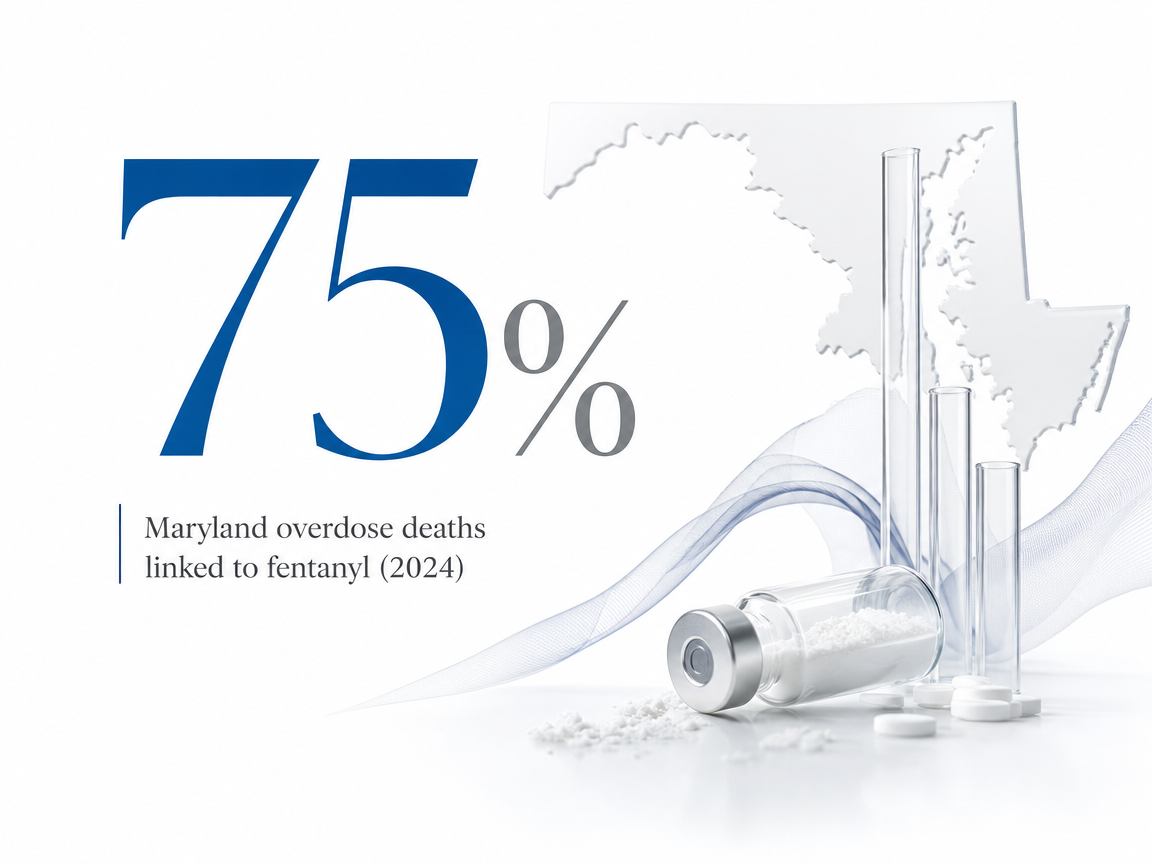
Here is the state context, used once and in scope. Maryland reported a 38% decrease in fatal overdoses in 2024 compared with 2023, a shift the state attributes to expanded naloxone access, broader availability of medications for opioid use disorder, and better data tracking 9. Montgomery County accounted for 83 of Maryland's 1,768 overdose deaths in 2024, with 75% of statewide deaths linked to fentanyl 10. Those are county and statewide figures, not Rockville-specific, and the trend is improving — but fentanyl's presence in the local supply means any single use carries risk your family may not have planned for a decade ago.
What changes operationally: you keep naloxone in the house during the planning week, you have the Rockville Crisis Center at 1301 Piccard Drive on the fridge 22, and you line up a medically supervised detox bed before the conversation rather than after. An opioid intervention is still consent-based. It just has a shorter runway.
What a Realistic Outcome Looks Like Six Months Later
Six months after the sit-down, the picture is rarely a tidy before-and-after. It looks more like a family that has rearranged itself around a healthier center of gravity.
In the version that goes well, your loved one has completed a level of care that matched the clinical picture, stepped down into outpatient or an intensive outpatient program, and is working with a therapist you did not have to find at midnight. The case manager still checks in. The family coach has helped you stop playing roles — the fixer, the enforcer, the one who stays quiet — that kept the old pattern alive. A 2023 caregiver meta-analysis points out that supporting the people around the person in treatment measurably improves caregiver well-being 17.
In the harder version, your loved one left treatment early, or said no on the day of the conversation and said yes two months later. That is also a realistic outcome. Addiction is a chronic condition, and continuing care — not a single event — is what the research supports 24. Six months in, success often looks like a family that is still in the conversation.
Frequently Asked Questions
How quickly can a Rockville family meet with an intervention team in person?
For most Rockville families, a first in-person planning meeting can happen within a few days of the initial call. A local team working from a Bethesda or Rockville Pike office can usually schedule a 90-minute private consult that week — not a video call with someone in another time zone. If opioids or a safety concern are in the picture, the conversation moves faster.
What's the difference between a private concierge intervention team and Montgomery County's ACCESS or Crisis Center?
ACCESS at 240-777-1770 provides free county-based screening, information, and referral 6. The Rockville Crisis Center at 1301 Piccard Drive handles 24/7 crisis response 22. Neither is a dedicated case manager. A private concierge team adds planning sessions on your schedule, structured family preparation, transport, and continuity across the months after admission. Many families use both — a county call first, then a private sit-down.
Can you guarantee my loved one will say yes and go to treatment?
No credible provider can. A professional intervention is consent-based, not coercive. A 2023 review of family therapy for adolescent and adult substance use reached similar conclusions regarding the benefits of structured, multi-session models 16. If your loved one says no that day, the family still leaves with clearer lines and a better starting point for the next conversation.
What can my family actually be told about my loved one's treatment under HIPAA and 42 CFR Part 2?
Consent is the hinge. Substance-use treatment records carry extra protection under 42 CFR Part 2; the 2024 final rule now permits a single consent for future disclosures tied to treatment, payment, and operations 18. HIPAA may permit providers to share mental-health information with family when the patient agrees or in situations involving a serious and imminent threat you can help lessen 19. Without a signed release naming you, information generally cannot flow.
How do I know if a Rockville provider is actually licensed to deliver clinical treatment in Maryland?
Maryland's Behavioral Health Administration licenses community behavioral-health programs under COMAR 10.63, and those licenses are site-specific and service-specific 11, 26. A new online application process took effect February 10, 2025, so current status is checkable 12. Ask the provider which parts of their work are licensed clinical treatment and which are nonclinical support such as companionship, transport, or case coordination 25. Both can be valuable — they are not the same.
What should we do right now if our loved one is in immediate danger before the intervention happens?
Call 911 or go to the nearest emergency department if there's a medical emergency, overdose, suicide plan with means, or violence. For acute mental-health or substance-use crisis that isn't medical, call the Rockville Crisis Center at 240-777-4000 — 24/7, with mobile crisis available 21, 22. The county also operates a Behavioral Health Crisis Stabilization Center 8. Keep naloxone on hand if opioids are involved.
References
- Neighborhood Plans | Rockville, MD - Official Website. https://www.rockvillemd.gov/201/Neighborhood-Plans
- Rockville 2040 Comprehensive Plan - RockvilleMD.gov. https://www.rockvillemd.gov/projects/rockville-2040-comprehensive-plan/
- Community Data and Trends | City of Rockville. https://www.rockvillemd.gov/services/community-data-and-trends/
- Rockville Campus | Montgomery College, Maryland. https://www.montgomerycollege.edu/about-mc/campuses-and-locations/rockville-campus/index.html
- Mental Wellness | Montgomery College, Maryland. https://www.montgomerycollege.edu/life-at-mc/student-wellness-center/mental-wellness/index.html
- ACCESS to Behavioral Health and Substance Use Disorders (ACCESS). https://www.montgomerycountymd.gov/hhs-program/bhcs/bhcsaccbehavhealthsvcs-p239.html
- Child and Adolescent Behavioral Health Services. https://www.montgomerycountymd.gov/HHS-Program/BHCS/BHCSChildAdolMentalHealth-p471.html
- Behavioral Health Crisis Stabilization Center - Montgomery County. https://www.montgomerycountymd.gov/HHS-Program/BHCS/BHCStabilizationCenter.html
- The Behavioral Health Administration End of Year Report for FY25. https://health.maryland.gov/bha/Documents/BHA%20EOY%20Report%20for%20FY25.pdf
- Press Releases - Montgomery County. https://www2.montgomerycountymd.gov/mcgportalapps/Press_Detail.aspx?Item_ID=47470
- COMAR 10.63 Programs - Maryland Department of Health. https://health.maryland.gov/bha/Pages/COMAR-10-63-Programs-.aspx
- MDH implements new behavioral health licensing process. https://health.maryland.gov/newsroom/Pages/MDH-implements-new-behavioral-health-licensing-process.aspx
- MASTER - COMAR 10.63 - Maryland Department of Health. https://health.maryland.gov/regs/SiteAssets/Pages/BHA10.63Revisions/MASTER%20-%20COMAR%2010.63%20-%20Redline%20-%2007.30.2025%20-%20Ch.%201.pdf
- Treatment and Recovery. https://nida.nih.gov/publications/drugs-brains-behavior-science-addiction/treatment-recovery
- Family Intervention Models for Young Adults with Substance Abuse: A Systematic Review. https://pubmed.ncbi.nlm.nih.gov/39564277/
- Effects of family therapy for substance abuse: A systematic review of recent research. https://pubmed.ncbi.nlm.nih.gov/36564902/
- Psychosocial interventions for carers of people with severe mental and substance use disorders: a systematic review and meta-analysis. https://pubmed.ncbi.nlm.nih.gov/37997647/
- Fact Sheet 42 CFR Part 2 Final Rule. https://www.hhs.gov/hipaa/for-professionals/regulatory-initiatives/fact-sheet-42-cfr-part-2-final-rule/index.html
- HIPAA Privacy Rule and Sharing Information Related to Mental Health. https://www.hhs.gov/sites/default/files/hipaa-privacy-rule-and-sharing-info-related-to-mental-health.pdf
- 2024 City of Rockville Needs Assessment and Gap Analysis Report. https://www.rockvillemd.gov/wp-content/uploads/2025/07/2024-City-of-Rockville-Needs-Assessment-and-Gap-Analysis-Report.pdf
- Get Help. https://www.montgomerycountymd.gov/opioids/get-help.html
- Behavioral Health and Crisis Services. https://apps.montgomerycountymd.gov/BASISOPERATING/Common/Department.aspx?ID=BHCS
- Helping a Loved One Dealing with Mental and/or Substance Use Problems. https://samhsa.gov/sites/default/files/samhsa_families_family_support_guide_final508.pdf
- Principles of Drug Addiction Treatment: A Research-Based Guide. https://nida.nih.gov/sites/default/files/podat-3rdEd-508.pdf
- MDH Care Provider Licensing - Maryland Department of Health. https://health.maryland.gov/bha/Documents/OGA_MDHLicensingOverview.pdf
- Maryland Department of Health 10.63.01-10.63.06 Behavioral Health Regulations. https://health.maryland.gov/regs/Pages/10-63-01-10-63-06-Behavioral-Health-Regulations-(.aspx
- Overdose Data & Reports - Opioids - Montgomery County. https://www.montgomerycountymd.gov/opioids/data.html
A Voice Shaping the Conversation
The topics explored here—change, self-awareness, recovery, and growth—are the same themes Amanda Marino brings to audiences nationwide through speaking engagements and live events.
Known for her appearances on A&E’s Intervention and Digital Addiction, Amanda speaks to organizations, communities, and leadership teams about navigating adversity, embracing vulnerability, and building lives rooted in purpose. Her message resonates far beyond treatment, offering insight that applies to families, professionals, and anyone standing at a crossroads.



Heal on your terms—any time, anywhere.